

 My Starred Hymns
 My FlexScores
 My Hymnals
 My Purchased Files

Believers Hymn Book #10
Display Title: Awake my soul, in joyful lays First Line: Awake my soul, in joyful lays Meter: L.M. Date: 2008
Believers Hymn Book #10
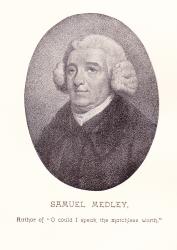 Medley, Samuel, born June 23, 1738, at Cheshunt, Herts, where his father kept a school. He received a good education; but not liking the business to which he was apprenticed, he entered the Royal Navy. Having been severely wounded in a battle with the French fleet off Port Lagos, in 1759, he was obliged to retire from active service. A sermon by Dr. Watts, read to him about this time, led to his conversion. He joined the Baptist Church in Eagle Street, London, then under the care of Dr. Gifford, and shortly afterwards opened a school, which for several years he conducted with great success. Having begun to preach, he received, in 1767, a call to become pastor of the Baptist church at Watford. Thence, in 1772, he removed to Byrom Street, Liv… Go to person page >






