Go, labor on: spend and be spent

Full Text

1 Go, labor on! spend and be spent!
Thy joy to do the Father's will;
It is the way the Master went;
Should not the servant tread it still?

2 Go, labor on! 'tis not for naught;
Thine earthly loss is heavenly gain;
Men heed thee, love thee, praise thee not;
The Master praises: what are men?

3 Go, labor on! enough, while here,
If He shall praise thee, if He deign
Thy willing heart to mark and cheer;
No toil for Him shall be in vain.

4 Go, labor on, while it is day!
The world's dark night is hastening on:
Speed, speed thy work! cast sloth away!
It is not thus that souls are won.

5 Toil on! faint not! keep watch, and pray!
Be wise the erring soul to win!
Go forth into the world's highway!
Compel the wanderer to come in!

6 Toil on, and in thy toil rejoice!
For toil comes rest, for exile home;
Soon shalt thou hear the Bridegroom's voice,
The midnight peal, "Behold, I come!"

The Hymnal: revised and enlarged as adopted by the General Convention of the Protestant Episcopal Church in the United States of America in the year of our Lord 1892

Author: Horatius Bonar

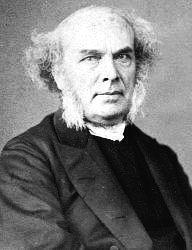
Horatius Bonar was born at Edinburgh, in 1808. His education was obtained at the High School, and the University of his native city. He was ordained to the ministry, in 1837, and since then has been pastor at Kelso. In 1843, he joined the Free Church of Scotland. His reputation as a religious writer was first gained on the publication of the "Kelso Tracts," of which he was the author. He has also written many other prose works, some of which have had a very large circulation. Nor is he less favorably known as a religious poet and hymn-writer. The three series of "Hymns of Faith and Hope," have passed through several editions. --Annotations of the Hymnal, Charles Hutchins, M.A. 1872… Go to person page >

Notes

Go, labour on, spend and be spent. H. Bonar. [Missions.] "Written in 1843, and printed at Kelso in a small booklet of three or four hymns." In 1843 it was included in Dr. Bonar's Songs for the Wilderness, in 8 stanzas of 4 lines, and entitled "Labour for Christ." In 1857 it was repeated in his Hymns of Faith & Hope, 1st series, in 8 stanzas of 4 lines, and entitled "The Useful Life," from Daniel, iii. p. 128. Previous to this, however, it had been brought into common use through the Leeds Hymn Book1853, No. 604. In the Supplement to the New Congregational Hymn Book, 1869, No. 1157, it is divided into two parts, Pt. ii. being stanzas v.-viii., "Go, labour on while it is day." This arrangement is also found in other collections, sometimes as, "Go, labour on while yet His day." This second part is in somewhat extensive use in America as a separate hymn. In the American Sahbath Hymn Book, 1858, No. 879, stanzas iv., vi.-viii. are given as, "Go, labour on; your hands are weak”; and, in Holy Song, 1869, No. 535, stanzas i., ii., vii., and viii., very much altered, as, "Go forth to toil; to spend, be spent." This last arrangement is too wretched to be associated with Dr. Bonar's name.

--John Julian, Dictionary of Hymnology (1907)

Tune

PENTECOST (Boyd)

William Boyd (b. Montego Bay, Jamaica, 1847; d. Paddington, England, 1928) composed PENTECOST in 1864 for the hymn text "Come, Holy Ghost, Our Souls Inspire"; it was published in 1868 in Thirty-Two Hymn Tunes Composed by Members of the University of Oxford. The name PENTECOST derives from the subjec…

Go to tune page >


ERNAN (Mason)


Timeline

Instances

Instances (3)TextImageAudioScore
Christian Worship: a Lutheran hymnal #563Text
Revival Hymns and Choruses #466
Trinity Hymnal #584Text