Scripture References:
st.1 = Gen. 28:16-17, Ps. 95:6, Hab. 2:20
st.2 = Isa. 6:3, Rev. 4:8-11
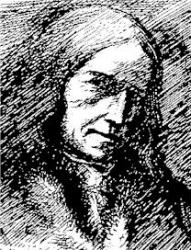
Gerhardt Tersteegen (b. Mörs, Prussia, Germany, 1697; d. Mühlheim, Germany, 1769) wrote this hymn (“Gott ist gegenwärtig”) in eight stanzas after his conversion experience in 1724. designing it to fit this tune by Neander. The hymn was first published in Tersteegen’s Geistliches Blumengärtlein (1729) with the heading “Remembrance of the glorious and delightful presence pf God.”
Stanzas 1 and 2 summon worshipers to praise and adore God, and stanza 2 (with an allusion to Isa. 6) begins a prayer for sanctification that continues through stanza 3. Though judged inadequate when compared with Tersteegen’s mystical original, the translation (with the current selection of stanzas) is a favorite in many hymnals. While many of Tersteegen’s hymns may be more suitable for private meditation, this one is a fine vehicle for public praise of God.
Tersteegen was a renowned representative of the Christian tradition of mysticism in German Reformed hymnody. He received a gymnasium (high school) education, but after his father’s death, family poverty kept him from university training. He became a merchant and then a weaver, producing silk ribbons. Reared in the Reformed Church, Tersteegen was influenced by a Pietist group but experienced a spiritual depression until 1724, when he dedicated his life to God in a confession written in his own blood.
After this he began to conduct prayer meetings. Attracted to mysticism, Tersteegen became an important spiritual leader to many, and from 1727 until late in his life, he ran a retreat center in Otterbeck, near Mühlheim. He preached in Prussia and the Netherlands and kept up an extensive correspondence. When it was necessary, Tersteegen was supported by his followers, and in turn he shared his goods and simple medicines with the poor, becoming known as the “physician of the poor and the forsaken.” Because his ministry was outside the established church, he often experienced the displeasure of church and civic authorities. His writings include translations into German from Latin and French mystics, sermons and meditiations, and over one hundred hymns published in Geistliche Blumen-Gärtlein (1729 and later editions).
The composite translation in the Psalter Hymnal is mostly the work of Frederick W. Foster (1760-1835), John Miller (1756-1810), and William Mercer (1811-1873); see PHH 357 for more information on Mercer.
Liturgical Use:
Beginning of worship (useful as a choral introit); stanza 3 fits well after the service of confession and assurance.
--Psalter Hymnal Handbook, 1988
Hymnary Pro Subscribers
Access
an additional article
on the Canterbury Dictionary of Hymnology:
Hymnary Pro subscribers have full access to the Canterbury Dictionary of Hymnology.
Subscribe now


 My Starred Hymns
 My FlexScores
 My Hymnals
 My Purchased Files