Scripture References:
st. 1 = Ps. 48:14, Ps. 73:23-24, John 6:31-35, Ex. 16:4
st. 2 = Ex. 13:21-22, Ps. 28:7
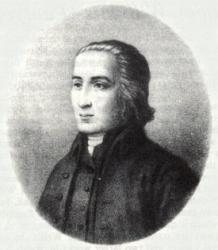
The great circuit-riding preacher/poet William Williams (b. Cefn-y-Coed, Carmarthenshire, Wales, 1717; d. Pantycelyn, Carmarthenshire, 1791) wrote the original Welsh text "Arglwydd, arwain trwy'r anialwch"–"Lord, Lead Me Through the Wilderness." It was published in his Alleluia (1745) and in his Caniadau (1762) with the title, "A prayer for strength to go through the wilderness of the world." Translated into some seventy-five languages, Williams's text has become universally popular in Christendom (and with the tune CWM RHONDDA, a favorite at Welsh rugby matches).
The English translation by Peter Williams (b. Llansadurnin, Carmarthanshire, Wales, 1722; d. Llandyfeilog, Wales, 1796), which began "Guide me, O thou great Jehovah," was published in his Hymns on Various Subjects (1771). That first stanza is still in use, but the remaining stanzas come from William Williams's own translation, which he prepared for The Collection of Hymns Sung in the Countess of Huntingdon’s Chapels (1771).
Pilgrimage is a much-used metaphor in Williams's texts. "Guide Me, O My Great Redeemer" draws on images from the Exodus story in the Old Testament: "bread of heaven" (Ex. 16), "crystal fountain" (Ex. 17), "fire and cloudy pillar" (Ex. 13:21-22). But the New Testament, Christocentric focus of the text is equally clear in the repeated final line of each stanza: Jesus is the "bread of heaven" (or "bread of life," (John 6), the "rock" who is our "strength and shield" (1 Cor. 10:4), and the victor over "death … and hell's destruction" (Rev. 1:18). Thus the change from the original “Jehovah” of the first line to "Redeemer" makes eminent sense.
William Williams and Peter Williams were contemporaries with a similar background. William Williams is usually considered to be the greatest Welsh hymn writer of the eighteenth century. He had begun to prepare himself for a medical profession, but the course of his life was altered when he was influenced by the ministry of Howell Harris, an evangelist associated with George Whitefield. Williams began to study for the ministry and in 1740 was ordained a deacon in the Church of England. After being refused ordination as a priest because of his evangelical beliefs, he joined the Calvinist Methodists in 1744. He became an itinerant evangelist and for the next forty-five years served as a leading figure in the revival movement in Wales. Williams's evangelistic preaching was greatly aided by his hymns, which were sung with great enthusiasm at revival and "society" meetings. Known as the "sweet singer of Wales," he wrote about eight hundred hymn texts in Welsh and over one hundred in English. They were published in Alleluia (1744), Hosanna I Fab Dafydd (1754), Hosanna to the Son of David (1759), Y Moro Wydr (1762), and Gloria in Excelsis (1771).
Peter Williams was converted to Christianity by the preaching of George Whitefield and was ordained in the Church of England in 1744. His evangelical convictions soon made him suspect, however, and he left the state church to join the Calvinist Methodists in 1746. He served as an itinerant preacher for many years and was a primary figure in the Welsh revival of the eighteenth century. After being expelled by the Methodists in 1791 on a charge of heresy, he ministered in his own chapel during the last years of his life. He published the first Welsh Bible commentary (1767-1770) and a Bible concordance (1773); he was also one of the annotators for John Canne's Welsh Bible (1790). In addition Williams published a Welsh hymnal, Rhai Hymnau ac Odlau Ysbrydol (1759), as well as Hymns on Various Subjects (1771).
Liturgical Use:
As a hymn of pilgrimage and prayer for divine providence; for various services and occasions on the Christian journey, including Old/New Year and the Easter season (given its Exodus theme).
--Psalter Hymnal Handbook, 1998
=============================
Arglwydd arwain trwy'r anialwch. W. Williams. [Strength to pass through the Wilderness.] This was published in the firstedition of the author's Alleluia , Bristol, 1745, in 5 stanzas of 6 lines.
The first translation of a part of this hymn into English was by Peter Williams, in his Hymns on Various Subjects (vii.), Together with The Novice Instructed: Being an abstract of a letter written to a Friend. By the Rev. P. Williams, Carmarthen, 1771, Printed for the author.
W. Williams himself adopted the translation of stanzas i., ii., iii. and iv. into English, added a fourth stanza, and printed them as a leaflet as follows:—
"A Favourite Hymn,
sung by
Lady Huntingdon's Young Collegians.
Printed by the desire of many Christian friends.
Lord, give it Thy blessing!
i.
“Guide me, 0 Thou great Jehovah,
Pilgrim through this barren land;
I am weak, but Thou art mighty,
Hold me with Thy pow'rful hand:
Bread of heaven, bread of heaven,
Feed me till I want no more.
ii.
"Open now the chrystal fountain,
Whence the healing stream doth flow;
Let the fire and cloudy pillar
Lead me all my journey thro*:
Strong Deliv'rer, strong Deliv'rer,
Be Thou still my strength and shield.
iii.
"When I tread the verge of Jordan,
Bid my anxious fears subside;
Death of deaths, and hell's destruction,
Land me safe on Canaan's side:
I will ever give to Thee.
iv.
"Musing on my habitation,
Musing on my heav'nly home,
Fills my soul with holy longings:
Come, my Jesus, quickly come;
Vanity is all I see;
Lord, I long to be with Thee!"
This leaflet was undated, but was c. 1772. During the same or the following year, it was included in the Lady H. Collection, 5th edition, Bath, W. Gye, No. 94. Stanzas i.-iii. had previously appeared in The Collection of Hymns. sung in the Countess of Huntingdon's Chapels in Sussex. Edinburgh: Printed by A. Donaldson, for William Balcombe, Angmoring, Sussex, No. 202. This is undated; but Mr. Brooke's copy contains the autograph, "Elizabt. Featherstonehaugh, 1772," the writing and ink of which show it to be genuine. We can safely date it 1771. It was repeated in G. Whitefield's Psalms & Hymns, 1773; in Conyers, 1774, and others, until it has become one of the most extensively used hymns in the English language.
There are diversities of text in use the origin of which in every case it is difficult to determine. The most widely known are:—
1. Where the 6th line in each stanza reads respectively, "Bread of heaven," "Strong deliverer," and "Songs of praises," the arrangement is from the Lady H. Collection, 1771. This form is given in nineteen out of every twenty hymnals which adopt the hymn, including Hymns Ancient & Modern &c.
2. Where the 5th line reads respectively, "Lord of Glory," "Strong deliverer," "Lord and Saviour," the text is from Cotterill's Selection, 1810 to 1819, where it is changed to the plural throughout.
3. Where the 5th line reads respectively, "Of Thy goodness," "Strong Deliverer," and "Grateful praises," the changes were made in Hall's Mitre, 1836.
4. The original, with the omission of lines 5 and 6 in each stanza, thereby reducing it to 8 7's, given in many American hymnals, appeared in the Prayer Book Collection, 1826.
In addition to these there are altered texts, as follows:
5. Guide us, 0 Thou great Redeemer, in Morrell & How, 1854; Scottish Episcopal Hymn Book, 1858, and others.
6. Guide us, Thou whose Name is Saviour. By J. Keble, re-written for the Salisbury Hymn Book, 1857, and repeated in the People's Hymnal, 1867, Sarum, 1868, the Hymnary, 1872, &c.
7. Guide us, Jesu, Holy Saviour. In the Parish Hymn Book 1863-75. This is Keble's alteration of Williams, again altered.
8. Guide us, 0 Thou great Deliverer. In the English Hymnal, by J. A. Johnston, 2nd ed., 1856, No. 167.
9. 0 Thou Great Jehovah, lead us. This form of the text is in Kennedy, 1863, No. 639.
10. Guide us, O eternal Saviour. In the Calcutta Hymn Book, 1862, No. 102.
This hymn in one form or another has been rendered into many languages, but invariably from the English. These translations included the Rev. B. Bingham's rendering into Latin, "Magne tu, Jehova," of the 3 stanza arrangement, given with the English text, in his Hymnologia Christiana Latina, 1871.
--Excerpts from John Julian, Dictionary of Hymnology (1907)


 My Starred Hymns
 My FlexScores
 My Hymnals
 My Purchased Files