Scripture References:
st. 2 = Isa. 6:3, Rev. 4:8
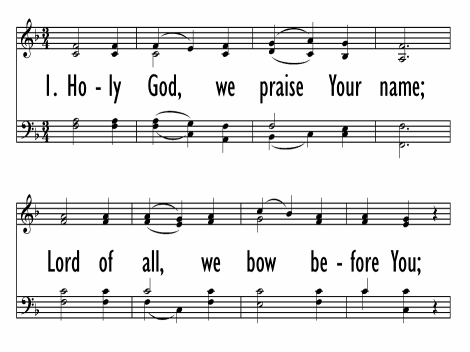
This text is based on the anonymous fourth-century Latin hymn “Te Deum Laudamus," which in one modern English prose translation reads:
We praise you, O God,
we acclaim you as Lord;
all creation worships you,
the Father everlasting.
To you all angels, all the powers of heaven,
the cherubim and seraphim, sing in endless praise:
Holy, holy, holy Lord, God of power and might,
heaven and earth are full of your glory.
The glorious company of apostles praise you.
The noble fellowship of prophets praise you.
The white-robed army of martyrs praise you.
Throughout the world the holy Church acclaims you:
Father, of majesty unbounded,
your true and only Son, worthy of all praise,
the Holy Spirit, advocate and guide.
You, Christ, are the king of glory,
the eternal Son of the Father.
When you took our flesh to set us free
you humbly chose the virgin's womb.
You overcame the sting of death,
and opened the kingdom of heaven to all believers.
You are seated at God's right hand in glory.
We believe that you will come to be our judge.
Come then, Lord, and help your people,
bought with the price of your own blood,
and bring us with your saints
to glory everlasting.
-English Language Liturgical Commission, from Praying Together, 1988
A classic text of the church, "Te Deum Laudamus" has been a staple item in many liturgies and is sometimes extended with versicles and responses. It is loved by all traditions of Christendom: Eastern, Roman Catholic, and Protestant. Much of the text consists of liturgical phrases and acclamations, including some from the "Gloria in excelsis Deo" (see 247). Over the centuries many composers have set this text in large choral works; it has been translated and versified into many languages and expressed in numerous hymns.
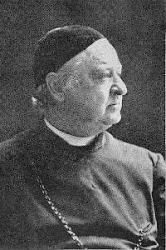
A German versification of the "Te Deum" ("Grosser Gott, wir loben dich") appeared anonymously in the Katholisches Gesangbuch (Vienna, around 1774) at the request of Empress Maria Theresa of Austria. Four years later that versification was also published by Ignaz Franz (b. Protzau, Silesia, 1719; d. Breslau [Poland], 1790) with small alterations; thus it is attributed to Franz in some modern sources. Franz was a Roman Catholic priest who studied at Glas and Breslau. He held a number of church positions, the longest (1766 until his death) as an assistant in the ecclesiastical court in Breslau. Franz published ten books, the most important a Roman Catholic hymnal, Katholisches Gesangbuch (c. 1774), which contained forty-seven of his hymns.
A rather free English translation of the German and Latin by Clarence A. Walworth b. Plattsburg, NY, 1820; d. Albany, NY, 1900) was published in a Redemptorist Father's hymnal in 1853 and was reprinted in Dublin's Catholic Psalmist in 1858.
Walworth was born into a Presbyterian home. After studying at Union College in Schenectady, New York, he was admitted to the bar in 1841. His interest in theology led to studies for the Episcopalian ministry at General Theological Seminary in New York City, but under the influence of the Oxford Movement he became a Roman Catholic in 1845 and joined the Redemptorist Order. In 1848 he was ordained as "Clarence Alphonsus" at the Redemptorist college in Wittem, the Netherlands. Walworth served as a priest in Troy, New York and in Albany, New York. One of the founders of the Paulist Order, he fought industrial abuses, took up the cause of Native Americans on the St. Regis reservation, and wrote poetry and hymns. He was stricken with blindness during the last ten years of his life. His best-known publication is The Oxford Movement in America (1895).
The Psalter Hymnal includes Walworth's stanzas 1-4, which cover only the first half of the "Te Deum." We and all creation praise our God and Lord (st. 1); all the angels sing their praise to God (st. 2); saints in heaven and the church on earth praise God (st. 3); we praise the triune God (st. 4). The two halves of this part of the "Te Deum" are carefully balanced: stanza 2 ends with the angels' threefold Sanctus; stanza 4 concludes with a Gloria Patri.
Liturgical Use:
An opening hymn at Sunday morning worship services (as is traditional for the 'Te Deum"); an extended doxology for festive occasions.
--Psalter Hymnal Handbook


 My Starred Hymns
 My FlexScores
 My Hymnals
 My Purchased Files