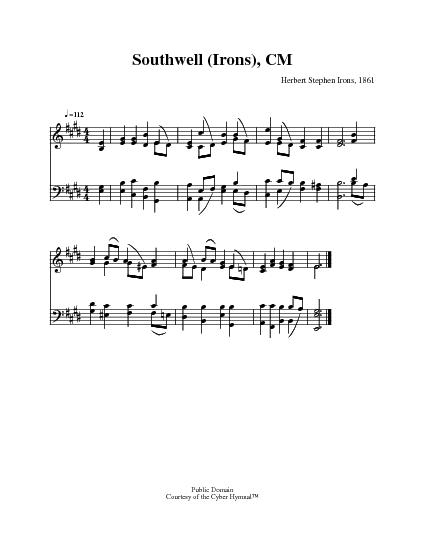
1. How sad our state by nature is!
Our sin, how deep the stain!
And Satan binds our captive minds
Fast in his slavish Chains.
2. But here a Voice of sov'reign grace
Sounds from the sacred Word:
Come, ye despairing sinners, come,
And trust upon the Lord.
3. My soul obeys th’ almighty call
And runs to this relief;
I would believe your promise, Lord;
Oh! help my unbelief.
4. To the dear fountain of your blood,
Incarnate God, I fly;
Here let me wash my spotted soul
From crimes of deepest dye.
5. Stretch out your arm, victorious King,
My reigning sins subdue;
Drive the old dragon from his seat,
With all his hellish crew.
6. A guilty, weak, and helpless worm,
On your kind arms I fall;
Be now my strength and righteousness,
My Jesus, and my all.
Source: Hymns and Devotions for Daily Worship #195
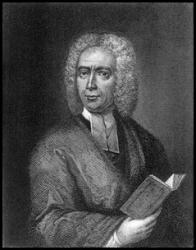
Isaac Watts was the son of a schoolmaster, and was born in Southampton, July 17, 1674. He is said to have shown remarkable precocity in childhood, beginning the study of Latin, in his fourth year, and writing respectable verses at the age of seven. At the age of sixteen, he went to London to study in the Academy of the Rev. Thomas Rowe, an Independent minister. In 1698, he became assistant minister of the Independent Church, Berry St., London. In 1702, he became pastor. In 1712, he accepted an invitation to visit Sir Thomas Abney, at his residence of Abney Park, and at Sir Thomas' pressing request, made it his home for the remainder of his life. It was a residence most favourable for his health, and for the prosecution of his literary… Go to person page >| First Line: | How sad our state by nature is! |
| Title: | Faith in Christ For Pardon and Sanctification |
| Author: | Isaac Watts (1707) |
| Meter: | 8.6.8.6 |
| Language: | English |
| Copyright: | Public Domain |
How sad our state by nature i. J. Watts. [Salvation through Christ.] First published in his Hymns & Sacred Songs, 1707 (edition 1709, Book ii., No. 90), in 6 stanzas of 4 lines, and headed "Faith in Christ for Pardon and Sanctification." In 1736-7 it was included by J. Wesley in his Charlestown Psalms &Hymns, p. 52, with the change of stanza v., line 4, "With all his hellish crew,” to "With his infernal crew." Wesley's alteration was repeated by G. Whitefield in his Collection, 1753; by M. Madan, in his Psalms & Hymns 1760, and others. In Conyers's Collection, edition 1774, the line reads, “And form our souls anew.” In modern hymn-books the difficulty is over-come by the omission of the stanza. Several interesting "Associations " in connection with this hymn are given in G. J. Stevenson's Methodist Hymn Book Notes, 1883.
--John Julian, Dictionary of Hymnology (1907)

My Starred Hymns