Coeli Deus sanctissime. [Wednesday.] This hymn is sometimes ascribed to St. Ambrose, but on insufficient authority. It is found in two forms, the first what is usually received as the original, and the second the revised text in the Roman Breviary, 1632. Both texts are given in Daniel, i., No. 52; and the first in Mone, No. 277, who notes the oldest form of the hymn from a manuscript of the 8th century, in the Town Library at Trier. The first form is in the Mozarabic, York, Sarum, and many other Breviaries, both English and continental, but the Roman form is only in that Breviary. It is found in three manuscripts of the 11th century, in the British Museum (Vesp. D. xii. f. 19; Jul. A. vi. f. 27; Harl. 2961, f. 223); in a manuscript of the 9th century, at St, Gall, No. 20; and also printed from an 11th century manuscript at Durham in the Latin Hymns of the Anglo-Saxon Church, 1851. [Rev. W. A. Shoults, B.D.]
In annotating the translations it will be necessary to take the two forms of the hymn:—
i. The Textus Receptus.
Translation in common use:—
0 God, Whose hand doth spread the sky, by J. M. Neale, in the enlarged ed. of the Hymnal Noted, 1854, in 5 stanzas of 4 lines, and the Hymner, 1882.
ii. The Roman Breviary Text.
Translations in common use:—
1. All Holy God on high, by W. J. Copeland, in his Hymns for the Week, &c, 1848, p. 33, in 5 stanzas of 4 lines. This text is repeated in St. John's Hymnal (Aberdeen), 1870, No. 99.
2. Lord of eternal purity, by E. Caswall, in his Lyra Catholica, 1849, p. 24, and again in his Hymns, &c, 1873, p. 15, in 5 stanzas of 4 lines. This translation is in several hymnals, including the People's, Martineau, and others. In the Hymnary, 1872, it is altered to, "Most Holy God, enthroned on high," and in the Roman Catholic Hymns for the Year, to "0 Lord of perfect purity."
--Excerpts from John Julian, Dictionary of Hymnology (1907)


 My Starred Hymns
 My FlexScores
 My Hymnals
 My Purchased Files
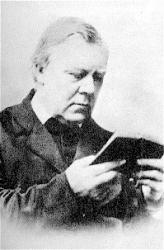 Edward Caswall was born in 1814, at Yately, in Hampshire, where his father was a clergyman. In 1832, he went to Brasenose College, Oxford, and in 1836, took a second-class in classics. His humorous work, "The Art of Pluck," was published in 1835; it is still selling at Oxford, having passed through many editions. In 1838, he was ordained Deacon, and in 1839, Priest. He became perpetural Curate of Stratford-sub-Castle in 1840. In 1841, he resigned his incumbency and visited Ireland. In 1847, he joined the Church of Rome. In 1850, he was admitted into the Congregation of the Oratory at Birmingham, where he has since remained. He has published several works in prose and poetry.
--Annotations of the Hymnal, Charles Hutchins, M.A. 1872… Go to person page >
Edward Caswall was born in 1814, at Yately, in Hampshire, where his father was a clergyman. In 1832, he went to Brasenose College, Oxford, and in 1836, took a second-class in classics. His humorous work, "The Art of Pluck," was published in 1835; it is still selling at Oxford, having passed through many editions. In 1838, he was ordained Deacon, and in 1839, Priest. He became perpetural Curate of Stratford-sub-Castle in 1840. In 1841, he resigned his incumbency and visited Ireland. In 1847, he joined the Church of Rome. In 1850, he was admitted into the Congregation of the Oratory at Birmingham, where he has since remained. He has published several works in prose and poetry.
--Annotations of the Hymnal, Charles Hutchins, M.A. 1872… Go to person page >