TEXTS TUNES PEOPLE HYMNALS

Hymn Text
TextsMy God, how wonderful Thou art

Title:My God, how wonderful Thou art
Author:Frederick William Faber (1848)
Meter:8.6.8.6
ABOUTRELATED TUNESMEDIAINSTANCES

Full hymn text Information about this text

1 My God, how wonderful Thou art,
Thy majesty how bright!
How beautiful Thy mercy-seat,
In depths of burning light!

2 How dread are Thine eternal years,
O Everlasting Lord;
By prostrate spirits, day and night
Incessantly adored!

3 O how I fear Thee, living God,
With deepest, tenderest fears;
And worship Thee with trembling hope,
And penitential tears.

4 Yet I may love Thee too, O Lord,
Almighty as Thou art,
For Thou hast stooped to ask of me
The love of my poor heart.

5 No earthly father loves like Thee,
No mother half so mild
Bears and forbears, as Thou hast done
With me, Thy sinful child.

6 Father of Jesus, love's Reward!
What rapture will it be.
Prostrate before Thy throne to lie,
And gaze and gaze on Thee.

Amen.

The Hymnal: Published by the authority of the General Assembly of the Presbyterian Church in the U.S.A., 1895

Scripture References:
st. 1 = Ps. 113:5
st. 5 = Ps. 103:13

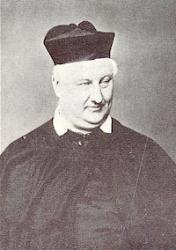
Frederick W. Faber (b. Calverly, Yorkshire, England, 1814; d. Kensington, London, England, 1863) wrote "My God, how wonderful thou art," a hymn published in his Jesus and Mary; or Catholic Hymns (1849). Of the original nine stanzas, 1, 3-5, 7, and 9 are included in modernized form.

Presenting a magnificent view of God, this text is particularly appropriate for the late twentieth century, a time in which humankind has lost its sense of wonder. As we sing, we contemplate the glory and majesty of God (st. 1-2), which in turn inspires our holy fear, penitence, and love (st. 3-4). The text alludes to Psalm 103:13 (st. 5) and gives us an apocalyptic vision of worshiping God face to face (st. 6).

Raised in the Church of England, Faber came from a Huguenot and strict Calvinistic family background. He was educated at Balliol College, Oxford, and ordained in the Church of England in 1839. Influenced by the teaching of John Henry Newman, Faber followed Newman into the Roman Catholic Church in 1845 and served under Newman's supervision in the Oratory of St. Philip Neri. Because he believed that Roman Catholics should sing hymns like those written by John Newton (PHH 462), Charles Wesley (PHH 267), and William Cowper (PHH 434), Faber wrote 150 hymns himself. One of his best known, "Faith of Our Fathers," originally had these words in its third stanza: "Faith of Our Fathers! Mary's prayers/Shall win our country back to thee." He published his hymns in various volumes and finally collected all of them in Hymns (1862).

Liturgical Use:
As a hymn of adoration at the beginning of worship, or as a response after preaching.

--Psalter Hymnal Handbook