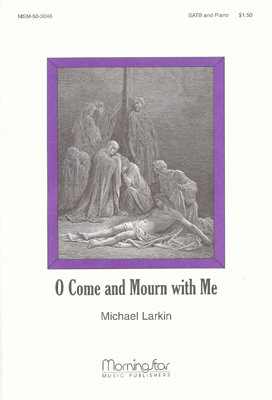
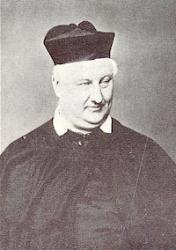
O come and mourn with me awhile. F. W. Faber. [Good Friday.] Published in his Jesus and Mary, 1849, in 12 stanzas of 4 lines, and headed "Jesus Crucified; " and again, after revision, in his Hymns, 1862. It was brought into special notice by being included in an abbreviated and altered form in Hymns Ancient & Modern 1861. The original refrain reads, "Jesus, our Love, is crucified." This was changed in Hymns Ancient & Modern to "Jesus, our Lord, is crucified," and has been almost universally adopted. The history of this refrain, which is somewhat interesting, is given under "My Lord, my Love was crucified". In addition to the Hymns Ancient & Modern arrangement there are others, including, "Ye faithful, come and mourn awhile" in Skinner's Daily Service Hymnal, 1864, "O come, and look awhile on Him," in the 1874 Supplement to the New Congregational Hymn Book; "O come, and mourn beside the Cross" in the Society for Promoting Christian Knowledge Church Hymns, 1871; "Have we no tears to shed for Him," in Beecher's Plymouth Collection, 1855; and others. The Hymns Ancient & Modern version of the text is translated into Latin in Biggs's annotated Hymns Ancient & Modern, 1867, by the Rev. C. B. Pearson, as "Adeste fideles, mecum complorantes."
--John Julian, Dictionary of Hymnology (1907)
======================
O come and mourn with me awhile , p. 852, ii. In recent hymn-hooks other arrangements of this hymn than those noted on p. 852, ii., have come into common use. Following the order of publication, they include:—
1. The Church Hymnary (Scottish), 1898. Sts. i., ii., v., ix., xi., xii.
2. Sursum Corda, 1898 (American). The same as No. l.
3. Church Hymns, 1903. Sts. i., ii., v., xi., xii.
4. Hymns Ancient & Modern, new ed., 1904. Sts. i., ii., iii., v., xii., ix., xi., in the order named.
5. The Methodist Hymn Book, 1904. Sts. i., ii., v., x., xi., xii.
6. The Pilgrim Hymnal, 1904. Opening with st. x., "Come, take thy stand beneath the cross." Stanzas x., v., vi., vii., ix., xii., in the order named.
7. The English Hymnal, 1906, has the original text with the omission of stanzas v., vii., viii., and x.
In all these arrangements (and in others also) slight alterations are introduced. These can be determined by reference to Faber's Hymns, 1862, pp. 81-83.
--John Julian, Dictionary of Hymnology, New Supplement (1907)


 My Starred Hymns
 My FlexScores
 My Hymnals
 My Purchased Files