Scripture References:
all st. = Isa. 6:8, Phil. 1:20-21, Rom. 12:1
st. 4 = Luke 21:2-3 (KJV)
Frances R. Havergal (b. Astley, Worcestershire, England, 1836; d. Oystermouth, Glamorganshire, Wales, 1879) originally composed her text in eleven couplets as a hymn of "self-consecration to Christ" on February 4, 1874. She told the following story about writing this hymn:
I went for a little visit of five days [to Areley House, Worcestershire, in December 1873]. There were ten persons in the house, some unconverted and long prayed for, some converted but not rejoicing Christians. [God] gave me the prayer, "Lord, give me all this house." And He just did! Before I left the house, everyone had got a blessing. The last night of my visit. . . I was too happy to sleep and passed most of the night in praise and renewal of my own consecration, and these little couplets formed themselves and chimed in my heart, one after another, till they finished with "Ever, only, all, for Thee."
The text is a "catalog" hymn that lists aspects of our lives and offers them in Christ's service.
"Take My Life and Let It Be" was first published in the 1874 appendix to Charles B. Snepp's Songs of Grace and Glory (1872). A twelfth couplet was added at some later point, producing the six stanzas published in the Psalter Hymnal.
Although her formal education was sporadic because of poor health, Havergal learned six foreign languages, including Greek and Hebrew, and was well read in many subjects. She began writing poetry at an early age and was also an accomplished singer and pianist. The daughter of a clergyman, she had a conversion experience at the age of fourteen and was confirmed in the Church of England in 1853. Taking seriously her own words "take my silver and my gold," she sent all her jewelry to the Church Mission Society to be sold. She also supported other charitable organizations. Her more than one hundred hymns were originally published in leaflets and later gathered into seven collections: Ministry of Song (1869), Twelve Sacred Songs for Little Singers (1870), Under the Surface (1874), Loyal Responses (1878), Life Mosaic (1879), Life Chords (1880), and Life Echoes (1883), as well as in one large volume, Poetical Works (1884).
Liturgical Use:
Christian worship that emphasizes dedication, offering, or commitment-for example, after the sermon, as an offertory hymn, for ordination or commissioning, for profession of faith, for the dedication or anniversary of a church or congregation; fits well with many stewardship themes.
--Psalter Hymnal Handbook
============================
Take my life, and let it be. Frances R. Havergal. [Self-Consecration to Christ.] This hymn was written at Areley House, Feb. 4, 1874, in 11 stanzas of 2 lines, and published in her Loyal Responses, 1878; the musical edition of the same, 1881; and in Life Chords, 1880. It has also been printed as a leaflet, in various forms for Confirmation, Self-Consecration, and for enclosing in letters, some being accompanied by her father's tune Patmos. It has been translated into French, German, Swedish, Russian, and other European languages, and into several of those of Africa and Asia. The history of its origin is thus given in the HAV. Manuscript:—
Perhaps you will be interested to know the origin of the consecration hymn 'Take my life.' I went for a little visit of five days [to Areley House]. There were ten persons in the house, some unconverted and long prayed for, some converted, but not rejoicing Christians. He gave me the prayer 'Lord, give me all in this house!' And He just did! Before I left the house every one had got a blessing. The last night of my visit after I had retired, the governess asked me to go to the two daughters. They were crying, &c.; then and there both of them trusted and rejoiced; it was nearly midnight. I was too happy to sleep, and passed most of the night in praise and renewal of my own consecration; and these little couplets formed themselves, and chimed in my heart one after another till they finished with 'Ever, Only, ALL for Thee!'"
The music to which Miss Havergal invariably sang this hymn, and with which it was always associated in the publications over which she had any influence, was her father's tune Patmos, and the family's desire is that this course may be followed by others.
--John Julian, Dictionary of Hymnology (1907)


 My Starred Hymns
 My Hymnals
 My Purchased Files



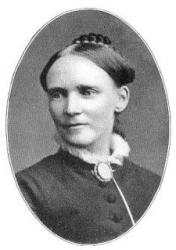 Havergal, Frances Ridley, daughter of the Rev. W. H. Havergal, was born at Astley, Worcestershire, Dec. 14, 1836. Five years later her father removed to the Rectory of St. Nicholas, Worcester. In August, 1850, she entered Mrs. Teed's school, whose influence over her was most beneficial. In the following year she says, "I committed my soul to the Saviour, and earth and heaven seemed brighter from that moment." A short sojourn in Germany followed, and on her return she was confirmed in Worcester Cathedral, July 17, 1853. In 1860 she left Worcester on her father resigning the Rectory of St. Nicholas, and resided at different periods in Leamington, and at Caswall Bay, Swansea, broken by visits to Switzerland, Scotland, and North Wales. She died… Go to person page >