One Sunday afternoon the young Isaac Watts (1674-1748) was complaining about the deplorable hymns that were sung at church. At that time, metered renditions of the Psalms were intoned by a cantor and then repeated (none too fervently, Watts would add) by the congregation. His father, the pastor of the church, rebuked him with "I'd like to see you write something better!" As legend has it, Isaac retired to his room and appeared several hours later with his first hymn, and it was enthusiastically received at the Sunday evening service the same night.
Although the tale probably is more legend than fact, it does illustrate the point that the songs of the church need constant infusion of new life, of new generation's praises. With over 600 hymns to his credit--many of them classics like "When I Survey the Wondrous Cross"--Isaac Watts has rightfully earned the title, "the father of English hymnody." This hymn, which is known as Watts' crowning achievement, was first published in this "Hymns and Spiritual Songs, 1707" and was matched with such tunes as "Tombstone" and an altered version of Tallis' canon called "St. Lukes." For many years it was sung to "Rockingham" by Edward Miller, the son of a stone mason who ran away from home to become a musician, later becoming a flutist in Handel's orchestra. In recent history the hymn text has settled in with Lowell Mason's "Hamburg," an adaptation of a five note (count them!) plainchant melody. Besides writing thousands of hymn tunes he was a church choir director, the president of Boston's Handel and Haydn Society, and a leading figure in music education.
Though "When I Survey the Wondrous Cross" was intended originally as a communion hymn, it gives us plenty to contemplate during Lent as our focus is on the cross Christ. The hymn is said to be based on Galatians 6:14 (May I never boast except in the cross of our Lord Jesus Christ, through which the world has been crucified to me, and I to the world.) which is evident in a verse that Watts' eliminated from later editions of the hymn:
His dying crimson, like a robe,
Spreads o'er his body on the tree;
Then am I dead to all the globe,
And all the globe is dead to me.
Perhaps Watts eliminated this verse in order to focus more attention on our response to Christ's crucifixion than the crucifixion itself. Notice how he starts with contemplation of the cross and the fact that all our worldly achievements and possessions pale in comparison. Next he shows that Christ went to the cross out of love for us. In the most powerful image of the hymn, he affirms the deity of the suffering Christ with the brilliant juxtaposition: "Did e'er such love and sorrow meet, Or thorns compose so rich a crown?" And the last verse shows that the only proper response to this amazing love is complete devotion. --Greg Scheer, 1997
----------------------
When I survey the wondrous Cross. I. Watts. [Good Friday.] This, the most popular and widely used of Watts's hymns, appeared in his Hymns and Spiritual Songs, 1707, and in the enlarged edition 1709, as:—
"Crucifixion to the World, by the Cross of Christ. Gal. vi. 14.
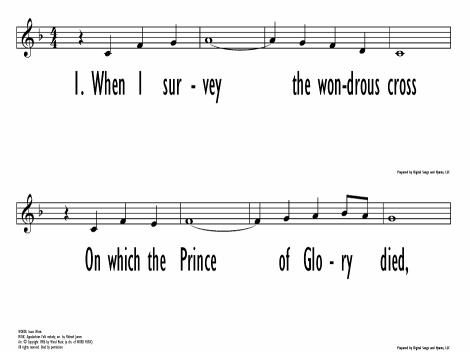
1. “When I survey the wond'rous Croƒs
On which the Prince of Glory dy'd,
My richest gain I count but Loƒs,
And pour Contempt on all my Pride.
2. ”Forbid it, Lord, that I ƒhould boaƒt
Save in the Death of Christ my God;
All the vain Things that charm me moƒt,
I ƒacrifice them to his Blood,
3. "See from his Head, his Hands, his Feet,
Sorrow and Love flow mingled down!
Did e'er ƒuch Love and Sorrow meet,
Or Thorns compose ƒo rich a Crown!
4. "[His dying Crimƒon, like a Robe,
Spreads o'er his Body on the Tree;
Then am I dead to all the Globe,
And all the Globe is dead to me.]
5. "Were the whole Realm of Nature mine,
That were a Preƒent far too ƒmall;
Love ƒo amazing, ƒo divine,
Demands my Soul, my Life, my All."
The first to popularize the four-stanza form of the hymn (stanza iv. being omitted) was G. Whitefield in the 1757 Supplement to his Collection of Hymns. It came rapidly into general use. In common with most of the older hymns a few alterations have crept into the text, and in some instances have been received with favour by modern compilers. These include:
Stanza ii. 1. 2. "Save in the Cross," Madan, 1760.
Stanza iii. 1. 2. "Love flow mingling," Salisbury, 1857.
Stanza iv. 1. 2. “That were a tribute," Cotterill, 1819,
Stanza iv. 1. 2. "That were an offering," Stowell, 1831.
The most extensive mutilations of the text were made by T. Cotterill in his Selection 1819; E. Bickersteth in his Christian Psalmod, 1833; W. J. Hall in his Mitre Hymn Book 1836 ; J. Keble in the Salisbury Hymn Book 1857; and T. Darling in his Hymns for the Church of England, 1857. Although Mr. Darling's text was the only one condemned by Lord Selborne in his English Church Hymnody at the York Church Congress in 1866, the mutilations by others were equally bad, and would have justified him in saying of them all, as he did of Mr. Darling's text in particular:—
“There is just enough of Watts left here to remind one of Horace's saying, that you may know the remains of a poet even, when he is torn to pieces."
In the 1857 Appendix to Murray’s Hymnal; in the Salisbury Hymn Book 1857; in Hymns Ancient & Modern, 1861 and 1875; in the Hymnary, 1872; and in one or two others a doxology has been added, but this practice has not been received with general favour. One of the most curious examples of a hymn turned upside down, and mutilated in addition, is Basil Woodd's version of this hymn beginning "Arise, my soul, with wonder see," in his undated Psalms of David, &c. (circa 1810), No. 198.
The four-stanza form of this hymn has been translated into numerous languages and dialects. The renderings into Latin include: “Quando admirandam Crucem," by R. Bingham in his Hymno. Christiana Latina, 1871; and "Mirabilem videns Crucem," by H. M. Macgill in his Songs of the Christian Creed and Life, 1876. The five-stanza form of the text as in Hymns Ancient & Modern (stanza v. being by the compilers) is translated in Bishop Wordsworth's (St. Andrews) Series Collectarum, 1890, as "Cum miram intueor, de qua Praestantior omni." In popularity and use in all English speaking countries, in its original or in a slightly altered form, this hymn is one of the four which stand at the head of all hymns in the English language. The remaining three are, "Awake, my soul, and with the sun;" "Hark! the herald angels sing;" and "Rock of Ages, cleft for me."
--John Julian, Dictionary of Hymnology (1907)


 My Starred Hymns
 My Hymnals
 My Purchased Files





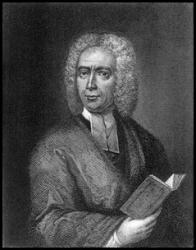 Isaac Watts was the son of a schoolmaster, and was born in Southampton, July 17, 1674. He is said to have shown remarkable precocity in childhood, beginning the study of Latin, in his fourth year, and writing respectable verses at the age of seven. At the age of sixteen, he went to London to study in the Academy of the Rev. Thomas Rowe, an Independent minister. In 1698, he became assistant minister of the Independent Church, Berry St., London. In 1702, he became pastor. In 1712, he accepted an invitation to visit Sir Thomas Abney, at his residence of Abney Park, and at Sir Thomas' pressing request, made it his home for the remainder of his life. It was a residence most favourable for his health, and for the prosecution of his literary… Go to person page >






