You help make Hymnary.org possible. More than 10 million people from 200+ countries found hymns, liturgical resources and encouragement on Hymnary.org in 2025, including you. Every visit affirms the global impact of this ministry.

If Hymnary has been meaningful to you this year, would you take a moment today to help sustain it? A gift of any size—paired with a note of encouragement if you wish—directly supports the server costs, research work and curation that keep this resource freely available to the world.

Give securely online today, or mail a check to:
Hymnary.org
Calvin University
3201 Burton Street SE
Grand Rapids, MI 49546

Thank you for your partnership, and may the hope of Advent fill your heart.

Person Results

Topics:tuesday+before+easter
In:people

Planning worship? Check out our sister site, ZeteoSearch.org, for 20+ additional resources related to your search.
Showing 1 - 10 of 45Results Per Page: 102050

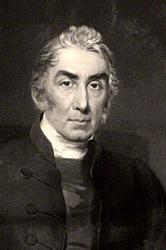
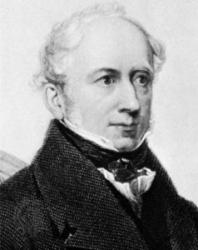
Henry Hart Milman

1791 - 1868 Topics: Tuesday before Easter Gospel Author of "Ride on! Ride on in majesty!" in Magnify the Lord Milman, Henry Hart, D.D., the youngest son of Sir Francis Milman (who received his Baronetage as an eminent Court physician), was born Feb. 10th, 1791, and educated at Dr. Burney's at Greenwich, and subsequently at Eton. His career at B. N. C. Oxford, was brilliant. He took a first class in classics, and carried off the Newdigate, Latin Verse, Latin Essay, and English Essay. His Newdigate on the Apollo Belvedere, 1812, is styled by Dean Stanley "the most perfect of Oxford prize poems." His literary career for several years promised to be poetical. His tragedy Fazio was played at Covent Garden, Miss O'Neill acting Bianca. Samor was written in the year of his appointment to St. Mary's, Reading (1817); The Fall of Jerusalem (1820); Belshazzar and The Martyr of Antioch (1822), and Anne Boleyn, gained a brilliant reception from the reviewers and the public. He was appointed Poetry Professor at Oxford in 1821, and was succeeded ten years after by Keble. It must have been before 1823, the date of Heber's consecration to Calcutta, that the 13 hymns he contributed to Heber's Hymns were composed. But his poetry was only the prelude to his larger work. The Bampton Lectures (1827) mark his transition to theological study, and the future direction of it was permanently fixed by his History of the Jews (1829). This book raised a storm of obloquy. It was denounced from the University pulpit, and in the British Critic. "It was the first decisive inroad of German theology into England, the first palpable indication that the Bible could be studied like another book, that the characters and events of the sacred history could be treated at once critically and reverently" (Dean Stanley). In 1835 he was presented by Sir Robert Peel to a Canonry at Westminster and the Rectory of St. Margaret's. In 1839 appeared his valuable edition of Gibbon's Decline and Fall; and in 1840 his History of Christianity to the Abolition of Paganism in the Roman Empire. Among his minor works in a different field were his Life of Keats and his edition and Life of Horace. It was not till 1854 that his greatest work—-for "vast and varied learning, indefatigable industry, calm impartiality, and subtle and acute criticism, among the most memorable in our language" (Quart Rev.)—-Latin Christianity—-appeared. He had been appointed Dean of St. Paul's in 1849. The great services under the dome originated in his tenure of the Deanery. His latest work, published after his death, Sept. 24, 1868, was The Annals of St. Paul’s. Though one of the most illustrious in the school of English liberal theology, he had no sympathy with the extreme speculations of Germany. The "criticism" of Tübingen "will rarely bear criticism." He "should like an Ewald to criticise Ewald." "Christianity will survive the criticism of Dr. Strauss," and the "bright flashing artillery" of Rénan. His historical style has been compared to Gibbon in its use of epigram and antithesis. His narrative is full of rapidity of movement. His long complex paragraphs have often a splendour of imagination as well as wealth of thought. All the varied powers of his mind found vent in his conversation; he was called, after his death, "the last of the great converters." The catalogue of his friends from the days of Heber, "his early friend," to those of Hallam, Macaulay, and Dean Stanley, was long and distinguished. Milman's 13 hymns were published in Heber's posthumous Hymns in 1827, and subsequently in his own Selection of Psalms & Hymns, 1837. The fine hymn for The Burial of the Dead, in Thring's Collection, "Brother, thou art gone before us," is from The Martyr of Antioch (1822). Like Heber's, they aim at higher literary expression and lyric grace. He makes free use of refrains. The structure is often excellent. His style is less florid and fuller of burning, sometimes lurid force than Heber's. His hymn for the 16th Sunday after Trinity, "When our heads are bowed with woe," has no peer in its presentation of Christ's human sympathy; the hymn for the 2nd Sunday in Lent, “Oh! help us, Lord! each hour of need," is a piece of pure deep devotion. "Ride on, ride on in majesty," the hymn for Palm Sunday, is one of our best hymns. And the stanzas for Good Friday, "Bound upon the accursed tree," form one of the finest meditations on the Passion. All his hymns are still in common use. [Rev.H.Leigh Bennett, M.A.] --John Julian, Dictionary of Hymnology (1907)

Theodulf, Bishop of Orléans

750 - 821 Person Name: Theodulph Topics: Tuesday before Easter Gospel Author of "All glory, laud, and honor" in Magnify the Lord Theodulph of Orleans appears to have been a native of Italy. He was brought to France by Charles the Great, perhaps when Charles returned from Italy in 781. He became Bishop of Orleans about 785, and soon afterwards also Abbot of Fleury. After the death of Charles he continued for some time on friendly terms with the Emperor Louis, but, falling under suspicion of being concerned in the plot in favour of Bernard of Italy, was imprisoned in 818, at Angers, where he seems to have died in 821, apparently on Sep. 18. There is a full and interesting sketch of his life and works in the Dictionary of Chr. Biog., iii., pp. 983-989. See also Potthast's Biblical History, Medii Aevi, 1896, vol. ii., p. 1058. The best and most recent edition of his Carmina is in vol. i., Berlin, 1881, of the Poetae Latini Aevi Carolini, which includes his famous "Gloria, laus et honor," p. 426, i. [Rev. James Mearns, M.A.] --John Julian, Dictionary of Hymnology, New Supplement (1907)

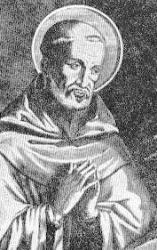
St. Bernard of Clairvaux

1090 - 1153 Person Name: Bernard of Clairvaux Topics: Tuesday before Easter Gospel Author of "O sacred head, sore wounded" in Magnify the Lord Bernard of Clairvaux, saint, abbot, and doctor, fills one of the most conspicuous positions in the history of the middle ages. His father, Tecelin, or Tesselin, a knight of great bravery, was the friend and vassal of the Duke of Burgundy. Bernard was born at his father's castle on the eminence of Les Fontaines, near Dijon, in Burgundy, in 1091. He was educated at Chatillon, where he was distinguished for his studious and meditative habits. The world, it would be thought, would have had overpowering attractions for a youth who, like Bernard, had all the advantages that high birth, great personal beauty, graceful manners, and irresistible influence could give, but, strengthened in the resolve by night visions of his mother (who had died in 1105), he chose a life of asceticism, and became a monk. In company with an uncle and two of his brothers, who had been won over by his entreaties, he entered the monastery of Citeaux, the first Cistercian foundation, in 1113. Two years later he was sent forth, at the head of twelve monks, from the rapidly increasing and overcrowded abbey, to found a daughter institution, which in spite of difficulties and privations which would have daunted less determined men, they succeeded in doing, in the Valley of Wormwood, about four miles from the Abbey of La Ferté—itself an earlier swarm from the same parent hive—on the Aube. On the death of Pope Honorius II., in 1130, the Sacred College was rent by factions, one of which elected Gregory of St. Angelo, who took the title of Innocent II., while another elected Peter Leonis, under that of Anacletua II. Innocent fled to France, and the question as to whom the allegiance of the King, Louie VI., and the French bishops was due was left by them for Bernard to decide. At a council held at Etampes, Bernard gave judgment in favour of Innocent. Throwing himself into the question with all the ardour of a vehement partisan, he won over both Henry I., the English king, and Lothair, the German emperor, to support the same cause, and then, in 1133, accompanied Innocent II., who was supported by Lothair and his army, to Italy and to Rome. When Lothair withdrew, Innocent retired to Pisa, and Bernard for awhile to his abbey of Clairvaux. It was not until after the death of Anacletus, the antipope, in January, 1138, and the resignation of his successor, the cardinal-priest Gregory, Victor II., that Innocent II., who had returned to Rome with Bernard, was universally acknowledged Pope, a result to which no one had so greatly contributed as the Abbot of Clairvaux. The influence of the latter now became paramount in the Church, as was proved at the Lateran Council of 1139, the largest council ever collected together, where the decrees in every line displayed the work of his master-hand. After having devoted four years to the service of the Pope, Bernard, early in 1135, returned to Clairvaux. In 1137 he was again at Rome, impetuous and determined as ever, denouncing the election of a Cluniac instead of a Clairvaux monk to the see of Langres in France, and in high controversy in consequence with Peter, the gentle Abbot of Cluny, and the Archbishop of Lyons. The question was settled by the deposition by the Pope of the Cluniac and the elevation of a Clairvaux monk (Godfrey, a kinsman of St. Bernard) into his place. In 1143, Bernard raised an almost similar question as to the election of St. William to the see of York, which was settled much after the same fashion, the deposition, after a time, if only for a time, of William, and the intrusion of another Clairvaux monk, Henry Murdac, or Murduch, into the archiepiccopal see. Meantime between these two dates—in 1140—the condemnation of Peter Abilaid and his tenets, in which matter Bernard appeared personally as prosecutor, took place at a council held at Sens. Abelard, condemned at Sens, appealed to Rome, and, resting awhile on his way thither, at Cluny, where Peter still presided as Abbot, died there in 1142. St. Bernard was next called upon to exercise his unrivalled powers of persuasion in a very different cause. Controversy over, he preached a crusade. The summer of 1146 was spent by him in traversing France to rouse the people to engage in the second crusade; the autumn with a like object in Germany. In both countries the effect of his appearance and eloquence was marvellous, almost miraculous. The population seemed to rise en masse, and take up the cross. In 1147 the expedition started, a vast horde, of which probably not a tenth ever reached Palestine. It proved a complete failure, and a miserable remnant shared the flight of their leaders, the Emperor Conrad, and Louis, King of France, and returned home, defeated and disgraced. The blame was thrown upon Bernard, and his apology for his part in the matter is extant. He was not, however, for long to bear up against reproach; he died in the 63rd year of his age, in 1153, weary of the world and glad to be at rest. With the works of St. Bernard, the best ed. of which was pub. by Mabillon at Paris in the early part of the 18th cent. (1719), we are not concerned here, except as regards his contributions, few and far between as they are, to the stores of Latin hymnology. There has been so much doubt thrown upon the authorship of the hymns which usually go by his name,—notably by his editor, Mabillon himself,—that it is impossible to claim any of them as having been certainly written by him; but Archbishop Trench, than whom we have no greater modern authority on such a point, is satisfied that the attribution of them all, except the "Cur mundus militat," to St. Bernard is correct. "If he did not write," the Archbishop says, "it is not easy to guess who could have written them; and indeed they bear profoundly the stamp of his mind, being only inferior in beauty to his prose." The hymns by which St. Bernard is best known as a writer of sacred poetry are: (1.) "Jesu duicis memoria," a long poem on the " Name of Jesus"—known as the "Jubilus of St. Bernard," and among mediaeval writers as the " Rosy Hymn." It is, perhaps, the best specimen of what Neale describes as the "subjective loveliness " of its author's compositions. (2.) "Salve mundi Salutore," an address to the various limbs of Christ on the cross. It consists of 350 lines, 50 lines being addressed to each. (3.) "Laetabundus, exultet fidelis chorus: Alleluia." This sequence was in use all over Europe. (4.) "Cum sit omnis homo foenum." (5.) " Ut jucundas cervus undas." A poem of 68 lines, and well known, is claimed for St. Bernard by Hommey in his Supplementum Patrum, Paris, 1686, p. 165, but on what Archbishop Trench, who quotes it at length, (Sac. Lat. Poetry, p. 242,) deems " grounds entirely insufficient." (6.) " Eheu, Eheu, mundi vita," or " Heu, Heu, mala mundi vita." A poem of nearly 400 lines, is sometimes claimed for St. Bernard, but according to Trench, “on no authority whatever." (7.) “O miranda vanitas." This is included in Mabillon's ed. of St. Bernard's Works. It is also attributed to him by Rambach, vol. i. p. 279. Many other hymns and sequences are attributed to St. Bernard. Trench speaks of a " general ascription to him of any poems of merit belonging to that period whereof the authorship was uncertain." Hymns, translated from, or founded on, St. Bernard's, will be found in almost every hymnal of the day, details of which, together with many others not in common use, will be found under the foregoing Latin first lines. -John Julian, Dictionary of Hymnology (1907) See also in: Hymn Writers of the Church

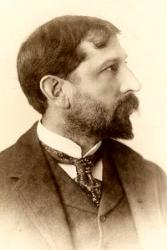
Robert Bridges

1844 - 1930 Topics: Tuesday before Easter Gospel Translator of "O sacred head, sore wounded" in Magnify the Lord Robert S. Bridges (b. Walmer, Kent, England, 1844; d. Boar's Hill, Abingdon, Berkshire, England, 1930) In a modern listing of important poets Bridges' name is often omitted, but in his generation he was consid­ered a great poet and fine scholar. He studied medicine and practiced as a physician until 1881, when he moved to the village of Yattendon. He had already written some poetry, but after 1881 his literary career became a full-time occupation, and in 1913 he was awarded the position of poet laureate in England. Bridges published The Yattendon Hymnal (1899), a collection of one hundred hymns (forty-four written or translated by him with settings mainly from the Genevan psalter, arranged for unaccompanied singing. In addition to volumes of poetry, Bridges also published A Practical Discourse on Some Principles of Hymn-Singing (1899) and About Hymns (1911). Bert Polman =================== Bridges, Robert Seymour, M.A., son of J. J. Bridges, of Walmer, Kent, was b. Oct. 23, 1844, and educated at Eton and at Corpus Christi College, Oxford (B.A. 1867, M.A. 1874). He took his M.A. in 1874, but retired from practice in 1882, and now (1906) resides at Yattendon, Berks. He is the author of many poems and plays. He edition and contributed to the Yattendon Hymnal, 1899 (originally printed at the Oxford Univ. Press in parts—Nos. 1-25, 1895; 26-50, 1897; 51-75, 1898; 76-100, 1899). [Rev. James Mearns, M.A.] --John Julian, Dictionary of Hymnology, New Supplement (1907)

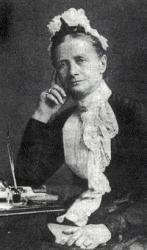
Cecil Frances Alexander

1818 - 1895 Topics: Tuesday before Easter Gospel Author of "There is a green hill far away" in Magnify the Lord As a small girl, Cecil Frances Humphries (b. Redcross, County Wicklow, Ireland, 1818; Londonderry, Ireland, 1895) wrote poetry in her school's journal. In 1850 she married Rev. William Alexander, who later became the Anglican primate (chief bishop) of Ireland. She showed her concern for disadvantaged people by traveling many miles each day to visit the sick and the poor, providing food, warm clothes, and medical supplies. She and her sister also founded a school for the deaf. Alexander was strongly influenced by the Oxford Movement and by John Keble's Christian Year. Her first book of poetry, Verses for Seasons, was a "Christian Year" for children. She wrote hymns based on the Apostles' Creed, baptism, the Lord's Supper, the Ten Commandments, and prayer, writing in simple language for children. Her more than four hundred hymn texts were published in Verses from the Holy Scripture (1846), Hymns for Little Children (1848), and Hymns Descriptive and Devotional ( 1858). Bert Polman ================== Alexander, Cecil Frances, née Humphreys, second daughter of the late Major John Humphreys, Miltown House, co. Tyrone, Ireland, b. 1823, and married in 1850 to the Rt. Rev. W. Alexander, D.D., Bishop of Derry and Raphoe. Mrs. Alexander's hymns and poems number nearly 400. They are mostly for children, and were published in her Verses for Holy Seasons, with Preface by Dr. Hook, 1846; Poems on Subjects in the Old Testament, pt. i. 1854, pt. ii. 1857; Narrative Hymns for Village Schools, 1853; Hymns for Little Children, 1848; Hymns Descriptive and Devotional, 1858; The Legend of the Golden Prayers 1859; Moral Songs, N.B.; The Lord of the Forest and his Vassals, an Allegory, &c.; or contributed to the Lyra Anglicana, the S.P.C.K. Psalms and Hymns, Hymns Ancient & Modern, and other collections. Some of the narrative hymns are rather heavy, and not a few of the descriptive are dull, but a large number remain which have won their way to the hearts of the young, and found a home there. Such hymns as "In Nazareth in olden time," "All things bright and beautiful," "Once in Royal David's city," "There is a green hill far away," "Jesus calls us o'er the tumult," "The roseate hues of early dawn," and others that might be named, are deservedly popular and are in most extensive use. Mrs. Alexander has also written hymns of a more elaborate character; but it is as a writer for children that she has excelled. - John Julian, Dictionary of Hymnology (1907) =============== Alexander, Cecil F., née Humphreys, p. 38, ii. Additional hymns to those already noted in this Dictionary are in common use:— 1. Christ has ascended up again. (1853.) Ascension. 2. His are the thousand sparkling rills. (1875.) Seven Words on the Cross (Fifth Word). 3. How good is the Almighty God. (1S48.) God, the Father. 4. In [a] the rich man's garden. (1853.) Easter Eve. 5. It was early in the morning. (1853.) Easter Day. 6. So be it, Lord; the prayers are prayed. (1848.) Trust in God. 7. Saw you never in the twilight? (1853.) Epiphany. 8. Still bright and blue doth Jordan flow. (1853.) Baptism of Our Lord. 9. The angels stand around Thy throne. (1848.) Submission to the Will of God. 10. The saints of God are holy men. (1848.) Communion of Saints. 11. There is one Way and only one. (1875.) SS. Philip and James. 12. Up in heaven, up in heaven. (1848.) Ascension. 13. We are little Christian children. (1848.) Holy Trinity. 14. We were washed in holy water. (1848.) Holy Baptism. 15. When of old the Jewish mothers. (1853.) Christ's Invitation to Children. 16. Within the Churchyard side by side. (1848.) Burial. Of the above hymns those dated 1848 are from Mrs. Alexander's Hymns for Little Children; those dated 1853, from Narrative Hymns, and those dated 1875 from the 1875 edition of Hymns Ancient & Modern. Several new hymns by Mrs. Alexander are included in the 1891 Draft Appendix to the Irish Church Hymnal. --John Julian, Dictionary of Hymnology, Appendix, Part II (1907) ============= Alexander, Cecil F. , p. 38, ii. Mrs. Alexander died at Londonderry, Oct. 12, 1895. A number of her later hymns are in her Poems, 1896, which were edited by Archbishop Alexander. --John Julian, Dictionary of Hymnology, New Supplement (1907) See also in:Hymn Writers of the Church

Jennie Evelyn Hussey

1874 - 1958 Person Name: Jennie Hussey Topics: Tuesday before Easter Gospel Author of "Lest I forget Gethsemane" in Magnify the Lord Jane Evelyn Hussy was born 8 February 1874 in Henniker, N.H. She was an invalid from rheumatism. She began writing verse as a child. The first were published when she was thirteen. At sixteen she began to write stories, articles and designs for crochet needlework for magazines. In 1898 her first hymns were published. She was a member of the Society of Friends. Dianne Shapiro, from "The Singers and Their Songs: sketches of living gospel hymn writers" by Charles Hutchinson Gabriel (Chicago: The Rodeheaver Company, 1916)

James Montgomery

1771 - 1854 Topics: Tuesday before Easter Gospel Author of "Go to dark Gethsemane" in Magnify the Lord James Montgomery (b. Irvine, Ayrshire, Scotland, 1771; d. Sheffield, Yorkshire, England, 1854), the son of Moravian parents who died on a West Indies mission field while he was in boarding school, Montgomery inherited a strong religious bent, a passion for missions, and an independent mind. He was editor of the Sheffield Iris (1796-1827), a newspaper that sometimes espoused radical causes. Montgomery was imprisoned briefly when he printed a song that celebrated the fall of the Bastille and again when he described a riot in Sheffield that reflected unfavorably on a military commander. He also protested against slavery, the lot of boy chimney sweeps, and lotteries. Associated with Christians of various persuasions, Montgomery supported missions and the British Bible Society. He published eleven volumes of poetry, mainly his own, and at least four hundred hymns. Some critics judge his hymn texts to be equal in quality to those of Isaac Watts and Charles Wesley . Many were published in Thomas Cotterill's Selection of Psalms and Hymns (1819 edition) and in Montgomery's own Songs of Zion (1822), Christian Psalmist (1825), and Original Hymns (1853). Bert Polman ======================== Montgomery, James, son of John Montgomery, a Moravian minister, was born at Irvine, Ayrshire, Nov. 4, 1771. In 1776 he removed with his parents to the Moravian Settlement at Gracehill, near Ballymena, county of Antrim. Two years after he was sent to the Fulneck Seminary, Yorkshire. He left Fulneck in 1787, and entered a retail shop at Mirfield, near Wakefield. Soon tiring of that he entered upon a similar situation at Wath, near Rotherham, only to find it quite as unsuitable to his taste as the former. A journey to London, with the hope of finding a publisher for his youthful poems ended in failure; and in 1792 he was glad to leave Wath for Shefield to join Mr. Gales, an auctioneer, bookseller, and printer of the Sheffield Register newspaper, as his assistant. In 1794 Mr. Gales left England to avoid a political prosecution. Montgomery took the Sheffield Register in hand, changed its name to The Sheffield Iris, and continued to edit it for thirty-one years. During the next two years he was imprisoned twice, first for reprinting therein a song in commemoration of "The Fall of the Bastille," and the second for giving an account of a riot in Sheffield. The editing of his paper, the composition and publication of his poems and hynms, the delivery of lectures on poetry in Sheffield and at the Royal Institution, London, and the earnest advocacy of Foreign Missions and the Bible Society in many parts of the country, gave great variety but very little of stirring incident to his life. In 1833 he received a Royal pension of £200 a year. He died in his sleep, at the Mount, Sheffield, April 30, 1854, and was honoured with a public funeral. A statue was erected to his memory in the Sheffield General Cemetery, and a stained glass window in the Parish Church. A Wesleyan chapel and a public hall are also named in his honour. Montgomery's principal poetical works, including those which he edited, were:— (1) Prison Amusements, 1797; (2) The Wanderer of Switzerland, 1806; (3) The West Indies, 1807; (4) The World before the Flood, 1813; (5) Greenland and Other Poems, 1819; (6) Songs of Zion, 1822; (7) The Christian Psalmist, 1825; (8) The Christian Poet, 1825; (9) The Pelican Island, 1828; (10) The Poet’s Portfolio, 1835; (11) Original Hymns for Public, Private, and Social Devotion, 1853. He also published minor pieces at various times, and four editions of his Poetical Works, the first in 1828, the second in 1836, the third in 1841, and the fourth in 1854. Most of these works contained original hymns. He also contributed largely to Collyer's Collection, 1812, and other hymnbooks published during the next 40 years, amongst which the most noticeable was Cotterill's Selections of 1819, in which more than 50 of his compositions appeared. In his Christian Psalmist, 1825, there are 100 of his hymns, and in his Original Hymns, 1853, 355 and 5 doxologies. His Songs of Zion, 1822, number 56. Deducting those which are repeated in the Original Hymns, there remain about 400 original compositions. Of Montgomery's 400 hymns (including his versions of the Psalms) more than 100 are still in common use. With the aid of Montgomery's MSS. we have given a detailed account of a large number. The rest are as follows:— i. Appeared in Collyer's Collection, 1812. 1. Jesus, our best beloved Friend. Personal Dedication to Christ. 2. When on Sinai's top I see. Sinai, Tabor, and Calvary. ii. Appeared in Cotterill's Selection, 1819. 3. Come to Calvary's holy mountain. The Open Fountain. 4. God in the high and holy place. God in Nature. The cento in Com. Praise, 1879, and others, "If God hath made this world so fair," is from this hymn. 5. Hear me, O Lord, in my distress. Ps. cxliii. 6. Heaven is a place of rest from sin. Preparation for Heaven. 7. I cried unto the Lord most just. Ps. cxlii. 8. Lord, let my prayer like incense rise. Ps. cxxxix. 9. O bless the Lord, my soul! His grace to thee proclaim. Ps. ciii. 10. Out of the depths of woe. Ps. cxxx. Sometimes "When from the depths of woe." 11. The world in condemnation lay. Redemption. 12. Where are the dead? In heaven or hell? The Living and the Dead. iii. Appeared in his Songs of Zion, 1822. 13. Give glory to God in the highest. Ps. xxix. 14. Glad was my heart to hear. Ps. cxxii. 15. God be merciful to me. Ps. lxix. 16. God is my strong salvation. Ps. xxvii. 17. Hasten, Lord, to my release. Ps. lxx. 18. Have mercy on me, O my God. Ps. li. 19. Hearken, Lord, to my complaints. Ps. xlii. 20. Heralds of creation cry. Ps. cxlviii. 21. How beautiful the sight. Ps. cxxxiii. 22. How precious are Thy thoughts of peace. Ps. cxxxix. 23. I love the Lord, He lent an ear. Ps. cxvi. 24. In time of tribulation. Ps. lxxvii. 25. Jehovah is great, and great be His praise. Ps. xlviii. Sometimes, "0 great is Jehovah, and great is His Name." 26. Judge me, O Lord, in righteousness. Ps. xliii. 27. Lift up your heads, ye gates, and wide. Ps.xxiv. 28. Lord, let me know mine [my] end. Ps. xxxi. 29. Of old, 0 God, Thine own right hand. Ps. lxxx. 30. O God, Thou art [my] the God alone. Ps. lxiii. 31. 0 Lord, our King, how excellent. Ps. viii. Sometimes, "0 Lord, how excellent is Thy name." 32. O my soul, with all thy powers. Ps. ciii. 33. One thing with all my soul's desire. Ps. xxvii. From this, "Grant me within Thy courts a place." 34. Searcher of hearts, to Thee are known. Ps. cxxxix. 35. Thank and praise Jehovah's name. Ps. cvii. 36. Thee will I praise, O Lord in light. Ps. cxxxviii. 37. The Lord is King; upon His throne. Ps. xciii. 38. The Lord is my Shepherd, no want shall I know. Ps. xxiii. 39. The tempter to my soul hath said. Ps. iii. 40. Thrice happy he who shuns the way. Ps. i. 41. Thy glory, Lord, the heavens declare. Ps. xix. 42. Thy law is perfect, Lord of light. Ps. xix. 43. Who make the Lord of hosts their tower. Ps. cxxv. 44. Yea, I will extol Thee. Ps. xxx. iv. Appeared in his Christian Psalmist. 1825. 45. Fall down, ye nations, and adore. Universal adoration of God desired. 46. Food, raiment, dwelling, health, and friends. The Family Altar. 47. Go where a foot hath never trod. Moses in the desert. Previously in the Leeds Congregational Collection, 1822. 48. Green pastures and clear streams. The Good Shepherd and His Flock. 49. Less than the least of all. Mercies acknowledged. 50. Not to the mount that burned with fire [flame]. Communion of Saints. 51. On the first Christian Sabbath eve. Easter Sunday Evening. 52. One prayer I have: all prayers in one. Resignation. 53. Our heavenly Father hear. The Lord's Prayer. 54. Return, my soul, unto thy rest. Rest in God. 55. Spirit of power and might, behold. The Spirit's renewing desired. 56. The Christian warrior, see him stand. The Christian Soldier. Sometimes, "Behold the Christian warrior stand." 57. The days and years of time are fled. Day of Judgment. 58. The glorious universe around. Unity. 59. The pure and peaceful mind. A Children's Prayer. 60. This is the day the Lord hath made (q. v.). Sunday. 61. Thy word, Almighty Lord. Close of Service. 62. What secret hand at morning light ? Morning. 63. While through this changing world we roam. Heaven. 64. Within these walls be peace. For Sunday Schools. v. Appeared in his Original Hymns, 1853. 65. Behold yon bright array. Opening a Place of Worship. 66. Behold the book whose leaves display. Holy Scriptures. 67. Come ye that fear the Lord. Confirmation. 68. Home, kindred, friends, and country, these. Farewell to a Missionary. 69. Let me go, the day is breaking. Jacob wrestling. 70. Not in Jerusalem alone. Consecration of a Church. 71. Praise the high and holy One. God the Creator. In common with most poets and hymnwriters, Montgomery strongly objected to any correction or rearrangement of his compositions. At the same time he did not hesitate to alter, rearrange, and amend the productions of others. The altered texts which appeared in Cotterill's Selections, 1819, and which in numerous instances are still retained in some of the best hymnbooks, as the "Rock of Ages," in its well-known form of three stanzas, and others of equal importance, were made principally by him for Cotterill's use. We have this confession under his own hand. As a poet, Montgomery stands well to the front; and as a writer of hymns he ranks in popularity with Wesley, Watts, Doddridge, Newton, and Cowper. His best hymns were written in his earlier years. In his old age he wrote much that was unworthy of his reputation. His finest lyrics are "Angels from the realms of glory," "Go to dark Gethsemane," "Hail to the Lord's Anointed," and "Songs of praise the angels sang." His "Prayer is the soul's sincere desire," is an expanded definition of prayer of great beauty; and his "Forever with the Lord" is full of lyric fire and deep feeling. The secrets of his power as a writer of hymns were manifold. His poetic genius was of a high order, higher than most who stand with him in the front rank of Christian poets. His ear for rhythm was exceedingly accurate and refined. His knowledge of Holy Scripture was most extensive. His religious views were broad and charitable. His devotional spirit was of the holiest type. With the faith of a strong man he united the beauty and simplicity of a child. Richly poetic without exuberance, dogmatic without uncharitableness, tender without sentimentality, elaborate without diffusiveness, richly musical without apparent effort, he has bequeathed to the Church of Christ wealth which could onlv have come from a true genius and a sanctified! heart. --John Julian, Dictionary of Hymnology (1907)

Edward Caswall

1814 - 1878 Topics: Tuesday before Easter Gospel Translator of "At the cross her station keeping" in Magnify the Lord Edward Caswall was born in 1814, at Yately, in Hampshire, where his father was a clergyman. In 1832, he went to Brasenose College, Oxford, and in 1836, took a second-class in classics. His humorous work, "The Art of Pluck," was published in 1835; it is still selling at Oxford, having passed through many editions. In 1838, he was ordained Deacon, and in 1839, Priest. He became perpetural Curate of Stratford-sub-Castle in 1840. In 1841, he resigned his incumbency and visited Ireland. In 1847, he joined the Church of Rome. In 1850, he was admitted into the Congregation of the Oratory at Birmingham, where he has since remained. He has published several works in prose and poetry. --Annotations of the Hymnal, Charles Hutchins, M.A. 1872 ===================== Caswall, Edward, M.A., son of the Rev. R. C. Caswall, sometime Vicar of Yately, Hampshire, born at Yately, July 15, 1814, and educated at Brasenose College, Oxford, graduating in honours in 1836. Taking Holy Orders in 1838, he became in 1840 Incumbent of Stratford-sub-Castle, near Salisbury, and resigned the same in 1847. In 1850 (Mrs. Caswall having died in 1849) he was received into the Roman Catholic communion, and joined Dr. Newman at the Oratory, Edgbaston. His life thenceforth, although void of stirring incidents, was marked by earnest devotion to his clerical duties and a loving interest in the poor, the sick, and in little children. His original poems and hymns were mostly written at the Oratory. He died at Edgbaston, Jan. 2, 1878, and was buried on Jan. 7 at Redwall, near Bromsgrove, by his leader and friend Cardinal Newman. Caswall's translations of Latin hymns from the Roman Breviary and other sources have a wider circulation in modern hymnals than those of any other translator, Dr. Neale alone excepted. This is owing to his general faithfulness to the originals, and the purity of his rhythm, the latter feature specially adapting his hymns to music, and for congregational purposes. His original compositions, although marked by considerable poetical ability, are not extensive in their use, their doctrinal teaching being against their general adoption outside the Roman communion. His hymns appeared in:— (1) Lyra Catholica, which contained 197 translations from the Roman Breviary, Missal, and other sources. First ed. London, James Burns, 1849. This was reprinted in New York in 1851, with several hymns from other sources added thereto. This edition is quoted in the indices to some American hymn-books as Lyra Cath., as in Beecher's Plymouth Collection, 1855, and others. (2) Masque of Mary, and Other Poems, having in addition to the opening poem and a few miscellaneous pieces, 53 translations, and 51 hymns. 1st ed. Lon., Burns and Lambert, 1858. (3) A May Pageant and Other Poems, including 10 original hymns. Lon., Burns and Lambert, 1865. (4) Hymns and Poems, being the three preceding volumes embodied in one, with many of the hymns rewritten or revised, together with elaborate indices. 1st ed. Lon., Burns, Oates & Co., 1873. Of his original hymns about 20 are given in the Roman Catholic Crown of Jesus Hymn Book, N.D; there are also several in the Hymns for the Year, N.D., and other Roman Catholic collections. --John Julian, Dictionary of Hymnology (1907) ====================== Caswall, E. , p. 214, ii. Additional original hymns by Caswall are in the Arundel Hymns, 1902, and other collections. The following are from the Masque of Mary, &c, 1858:— 1. Christian soul, dost thou desire. After Holy Communion. 2. Come, let me for a moment cast. Holy Communion. 3. O Jesu Christ [Lord], remember. Holy Communion. 4. Oft, my soul, thyself remind. Man's Chief End. 5. Sleep, Holy Babe. Christmas. Appeared in the Rambler, June 1850, p. 528. Sometimes given as "Sleep, Jesus, sleep." 6. The glory of summer. Autumn. 7. This is the image of the queen. B. V. M. His "See! amid the winter's snow,” p. 1037, i., was published in Easy Hymn Tunes, 1851, p. 36. In addition the following, mainly altered texts or centos of his translations are also in common use:— 1. A regal throne, for Christ's dear sake. From "Riches and regal throne," p. 870, ii. 2. Come, Holy Ghost, Thy grace inspire. From "Spirit of grace and union," p. 945, i. 3. Hail! ocean star, p. 99, ii,, as 1873. In the Birmingham Oratory Hymn Book, 1850, p. 158. 4. Lovely flow'rs of martyrs, hail. This is the 1849 text. His 1873 text is "Flowers of martyrdom," p. 947, i. 5. None of all the noble cities. From "Bethlehem! of noblest cities," p. 946, ii. 6. O Jesu, Saviour of the World. From “Jesu, Redeemer of the world," p. 228, ii. 7. 0 Lady, high in glory raised. From "O Lady, high in glory, Whose," p. 945, i. The Parochial Hymn Book, 1880, has also the following original hymns by Caswall. As their use is confined to this collection, we give the numbers only:— IS os. 1, 2, 3, 159 (Poems, 1873, p. 453), 209 (1873, p. 288), 299, 324 (1873, p. 323), 357, 402, 554, 555, 558, 569 (1873, p. 334). These are from his Masque of Mary 1858. Nos. 156, 207 (1873, p. 296), 208 (1873, p. 297), 518. These are from his May Pageant, 1865. As several of these hymns do not begin with the original first lines, the original texts are indicated as found in his Poems, 1873. [Rev. James Mearns, M.A.] --John Julian, Dictionary of Hymnology, New Supplement (1907)

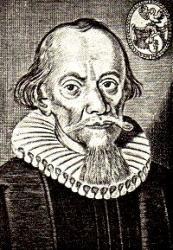
Johann Heermann

1585 - 1647 Topics: Tuesday before Easter Gospel Author of "Ah, holy Jesus, how hast thou offended" in Magnify the Lord Johann Heermann's (b. Raudten, Silesia, Austria, 1585; d. Lissa, Posen [now Poland], 1647) own suffering and family tragedy led him to meditate on Christ's undeserved suffering. The only surviving child of a poor furrier and his wife, Heermann fulfilled his mother's vow at his birth that, if he lived, he would become a pastor. Initially a teacher, Heermann became a minister in the Lutheran Church in Koben in 1611 but had to stop preaching in 1634 due to a severe throat infection. He retired in 1638. Much of his ministry took place during the Thirty Years' War. At times he had to flee for his life and on several occasions lost all his possessions. Although Heermann wrote many of his hymns and poems during these devastating times, his personal faith and trust in God continued to be reflected in his lyrics. He is judged to be the finest hymn writer in the era between Martin Luther and Paul Gerhardt, one whose work marks a transition from the objective hymns of the Reformation to the more subjective hymns of the seventeenth century. His hymn texts were published in collections such as Devoti Musica Cordis, Hauss- und Hertz-Musica (1630, expanded in 1636, 1644), and Sontags- und Fest-evangelia (1636). Bert Polman =================== Heermann, Johann, son of Johannes Heermann, furrier at Baudten, near Wohlau, Silesia, was born at Baudten, Oct. 11, 1585. He was the fifth but only surviving child of his parents, and during a severe illness in his childhood his mother vowed that if he recovered she would educate him for the ministry, even though she had to beg the necessary money. He passed through the schools at Wohlau; at Fraustadt (where he lived in the house of Valerius Herberger, q. v., who took a great interest in him); the St. Elizabeth gymnasium at Breslau; and the gymnasium at Brieg. At Easter, 1609, he accompanied two young noblemen (sons of Baron Wenzel von Rothkirch), to whom he had been tutor at Brieg, to the University of Strassburg; but an affection of the eyes caused him to return to Baudten in 1610. At the recommendation of Baron Wenzel he was appointed diaconus of Koben, a small town on the Oder, not far from Baudten, and entered on his duties on Ascension Day, 1611, and on St. Martin's Day, 1611, was promoted to the pastorate there. After 1623 he suffered much from an affection of the throat, which compelled him to cease preaching in 1634, his place being supplied by assistants. In October, 1638, he retired to Lissa in Posen, and died there on Septuagesima Sunday (Feb. 17), 1647. (Koch, iii. 16-36; Allgemeine Deutsche Biographie, xi. 247-249, &c.) Much of Heermann's manhood was spent amid the distressing scenes of the Thirty Years' War; and by his own ill health and his domestic trials he was trained to write his beautiful hymns of “Cross and Consolation." Between 1629 and 1634, Koben was plundered four times by the Lichtenstein dragoons and the rough hordes under Wallenstein sent into Silesia by the King of Austria in order to bring about the Counter-Reformation and restore the Roman Catholic faith and practice; while in 1616 the town was devastated by fire, and in 1631 by pestilence. In these troublous years Heermann several times lost all his moveables; once he had to keep away from Koben for seventeen weeks; twice he was nearly sabred; and once, while crossing the Oder in a frail boat loaded almost to sinking, he heard the bullets of the pursuing soldiers whistle just over his head. He bore all with courage and patience, and he and his were wonderfully preserved from death and dishonour. He was thus well grounded in the school of affliction, and in his House and Heart Music some of his finest hymns are in the section entitled "Songs of Tears. In the time of the persecution and distress of pious Christians." As a hymnwriter Heermann ranks with the beat of his century, some indeed regarding him as second only to Gerhardt. He had begun writing Latin poems about 1605, and was crowned as a poet at Brieg on Oct. 8, 1608. He marks the transition from the objective standpoint of the hymnwriters of the Reformation period to the more subjective and experimental school that followed him. His hymns are distinguished by depth and tenderness of feeling; by firm faith and confidence in face of trial; by deep love to Christ, and humble submission to the will of God. Many of them became at once popular, passed into the hymnbooks, and still hold their place among the classics of German hymnody. They appeared principally in— (1) Devoti Musica Cordis. Hauss-und Hertz-Musica &c. Leipzig and Breslau, 1630, with 49 hymns (2nd edition 1636, with 64; 3rd edition 1644, with 69). The first section is entitled "Hymns of Penitence and Consolation from the words of the Ancient Fathers of the Church." Seven of these, however, have no mention in their individual titles of the sources from which they are derived; and the remainder are mostly based not on Latin hymns, but on the prose meditations in Martin Moller's Meditationes sanctorum patrum, or on the mediaeval compilations known as the Meditationes and the Manuale of St. Augustine. (2) Sontags-und Fest-Evangelia. Leipzig and Breslau, 1636, being hymns on the Gospels for Sundays and festivals. (3) Poetische Erquickstunden, Nürnberg, 1656; and its Fernere Fortsetzung, also Nürnberg, 1656 [both in Wernigerode], are poems rather than hymns. The hymns of the Hauss-und Hertz-Musica, with a representative selection from Heermann's other poetical works, were edited by C. E. P. Wackernagel, prefaced by a long biographical and critical introduction, and published at Stuttgart, 1855. Six of the most important of Heermann's hymns are annotated under their respective first lines. The other hymns by Heermann which have passed into English are :— I. Hymns in English common use:-- i. 0 Jesu, du mein Bräutigam. Holy Communion. In his Devoti Musica Cordis, Breslau, 1630, p. 78, in 12 stanzas of 4 lines. Thence in Mützell, 1858, No. 34, in Wackernagel's ed. of his Geistliche Lieder, No. 22, and the Unverfälschter Liedersegen, 1851, No. 283. Seems to be founded on Meditation xi. in the mediaeval compilation known as St. Augustine's Manuale. Translated as:— 0 Jesu, Lord, who once for me, a good translation of stanzas i., ii., iv., v., viii., by A. T. Russell, as No. 158 in his Psalms & Hymns, 1851. Other translations are: (l) 0 Jesu! Bridegroom of my Soul," by J. C. Jacobi, 1722, p. 44 (1732, p. 73). (2) "Dear Saviour, who for me hast borne," by Miss Dunn, 1857. ii. Rett, 0 Herr Jesu, rett dein Ehr. In Time of Trouble. A prayer for deliverance and peace for the Church. In his Devoti Musica Cordis, 1630, p. 119, in 5 stanzas of 4 lines, among the "Songs of Tears." Thence in Mützell, 1858, No. 48, in Wackernagel’s ed., No. 36, and the Unverfälschter Liedersegen, 1851, No. 245. Translated as:— Thine honour rescue, righteous Lord, in full, by Dr. M. Loy, in the Ohio Lutheran Hymnal, 1880. iii. Treuer Wächter Israel. In Time of War. 1630, p. 115, in 13 stanzas of 7 lines, among the "Songs of Tears." In Mützell, 1858, No. 47; in Wackernagel's edition, No. 35, and the Unverfälschter Liedersegen, 1851, No. 594. Lauxmann, in Koch, viii. 549, says of it:— "It is a powerful hymn filled with that prevailing prayer that takes heaven by force," and relates of st. vii.,11. v-7, "Eine Mauer um uns bau," that on Jan. 6, 1814, the Allied Forces were about to enter Schleswig. A poor widow with her daughter and grandson lived in a little house near the entrance of the town. The grandson was reading in his hymnbook those in time of war, and when he came to this said, “It would be a good thing, grandmother, if our Lord God would build a wall around us." Next day all through the town cries of distress were heard, but all was still before their door. On the following morning they had courage to open the door, and lo a snowdrift concealed them from the view of the enemy. On this incident Clemens Brentano composed a beautiful poem "Draus vor Schleswig." It is translated as:— Jesu! as a Saviour, aid. A good tr. of st; vii., viii., xiii., by A. T. Russell, as No. 138 in his Psalms & Hymns, 1851. iv. Zionklagt mit Angst und Schmerzen. Church of Christ. First published in his Devoti Musica Cordis, 2nd ed., 1636 (1644, p. 196), in 6 stanzas of 8 lines, entitled, "From the beautiful golden saying of Isaiah, Chapter xlix." In Mützell, 1858, No. 101, in Wackernagel’s ed., No. 53, and the Unverfälschter Liedersegen, 1851, No. 256. Translated as:— Sion bow'd with anguish weepeth A good translation of stanzas i., iii., v., by A. T. Russell, as No. 141 in his Psalms & Hymns, 1851. Another translation is: "Zion mourns in fear and anguish," by Miss Winkworth, 1869, p. 198. II. Hymns not in English common use:-- v. Ach Jesu! dessen Treu. Love to Christ. 1630, p. 144, in 33 stanzas. One of his finest hymns, full of deep love to Christ, but from its great length very little used in Germany. Translated as, "Ah! Jesus! Lord! whose faithfulness," by Miss Burlingham, in the British Herald, May, 1867, p. 72. vi. Der Tod klopft bei mir an. For the Dying. 1656, p. 22, in 121. Translated as, "That Death is at my door," by Miss Winkworth, 1869, p. 201. vii. Du weinest für Jerusalem. Christ weeping over Jerusalem. 1630, p. 81, in 6 stanzas, entitled, "On the Tears of Christ." Founded on St. Luke xix. 41-44, part of the Gospel for the 10 Sundays after Trinity. The translations are: (1) "With tears o'er lost Jerusalem," by Miss Cox, 1841, p. 159. (2) "Our Lord wept o'er Jerusalem," by Dr. H. Mills, 1845 (1856, p. 295). (3) "Thou weepest o'er Jerusalem," by Miss Winkworth, 1855,p. 70. viii. Herr Jesu Christe mein getreuer Hirte. Holy Communion. 1630, p. 74, in 9 stanzas, founded on M. Moller's Meditationes sanctorum patrum, pt. i. c. 11, and pt. v. c. 2. The translations are: (1) "Dear Saviour, Thou my faithful Shepherd, come” by Miss Dunn, 1857, p. 111. (2) "Lord Jesus Christ, my faithful Shepherd, hear," by Miss Winkworth, 1858, p. 93, repeated in Lyra Eucharistica, 1863-64. ix. Herr unser Gott, lass nicht zu Schanden werden. Christ's Church. 1630, p. 114, as one of the "Songs of Tears," in 5 stanzas. Translated as, "Ah! Lord our God, let them not be confounded," by Miss Winkworth, 1869, p. 197. x. Hilf mir, mein Oott, hilf dass nach dir. Christian Conduct. 1630, p. 32, in 7 stanzas, entitled, "For a better life. From the words of Augustine." Founded on No. i. of the Meditationes current under the name of St. Augustine. This meditation is apparently by St. Anselm of Canterbury. Translated as, "Lord, raise in me a constant Flame," by J. C. Jacobi, 1725, p. 27 (1732, p. 105). xi. Jesu, der du tausend Schmerzen. In Sickness. 1656, in the Fernere Fortsetzung, p. 79, in 12 lines, entitled, "In great bodily pain." Translated as, “Jesu, who didst stoop to prove," by Miss Winkworth, 1869, p. 200. xii. Jesu Tilger meiner Sünden. Lent. 1656, in the Fernere Fortsetzung, p. 1, in 10 lines, entitled, "For Victory in Temptation." Translated as, "Jesu, Victor over sin," by Miss Winkworth, 1869, p. 201. xiii. 0 Jesu, Jesu, Gottes Sohn. Love to Christ, 1630, p. 83, in 7 stanzas, entitled, “Of the Love, which a Christian heart bears to Christ, and will still bear." A beautiful expansion of his motto "Mihi omnia Jesus." The translations are: (1) "What causes me to mourn is this," a translation of stanza ii. by P. H. Molther, as No. 371, in the Moravian Hymn Book, 1789 (1886, No. 461). (2) "O Jesus, Jesus, Son of God," by Miss Burlingham, in the British Herald, Oct. 1865, p. 153, and in Reid's Praise Book, 1872. xiv. Treuer Gott ich muss dir klagen. In Trouble. 1630, p. 103, in 12 stanzas, entitled, "Hymn of a sorrowful heart for increase of faith." Translated as, "Faithful God! I lay before Thee," by J. C. Jacobi, 1720, p. 9(1722, p. 70; 1732, p. 117), and as No. 538 in pt. i. of the Moravian Hymn Book, 1754. xv. Wollt ihr euch nicht, o ihr frommen Christen. Second Advent. 1636, p. 210, in 9 stanzas, entitled, "On the day of the Holy Bishop Nicolaus. Gospel of Luke, 12 Chapter." Translated as: (l) "0 dear Christians, as 'tis needful, wou'd ye," as No. 153 in pt. i. of the Moravian Hymn Book, 1754. (2) “Help us, 0 Christ, to watch and pray," a tr. of st. ix. as st. iii. of No. 868 in the Moravian Hymn Book, 1789 (1849, No. 1221). xvi. Wo soll ich fliehen hin. Lent. 1630, p. 20, in 11 stanzas, entitled, "A hymn of consolation in which a troubled heart lays all its sins in true faith upon Christ. From Tauler." Based on M. Moller's Meditationes, vol. i. pt. i., No. 10. Translated as, "0 whither shall I fly," as No. 447 in pt. i. of the Moravian Hymn Book, 1754. In 1886, No. 279, it begins with "0 Jesus, source of Grace" (stanza ii.). [Rev. James Mearns, M.A.] --John Julian, Dictionary of Hymnology (1907)

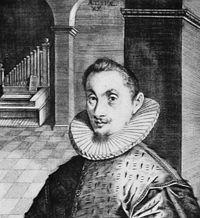
Hans Leo Hassler

1564 - 1612 Topics: Tuesday before Easter Gospel Composer of "PASSION CHORALE (HERZLICH TUT MICH VERLANGEN)" in Magnify the Lord Hans Leo Hassler Germany 1564-1612. Born at Nuremberg, Germany, he came from a family of famous musicians and received early education from his father. He then studied in Venice, Italy, with Andrea Gabrieli, uncle of Giovanni Gabrieli, his friend, with whom he composed a wedding motet. The uncle taught him to play the organ. He learned the polychoral style and took it back to Germany after Andrea Gabrieli's death. He served as organist and composer for Octavian Fugger, the princely art patron of Augsburg (1585-1601). He was a prolific composer but found his influence limited, as he was Protestant in a still heavily Catholic region. In 1602 he became director of town music and organist in the Frauenkirche in Nuremberg until 1608. He married Cordula Claus in 1604. He was finally court musician for the Elector of Saxony in Dresden, Germany, evenually becoming Kapellmeister (1608-1612). A Lutheran, he composed both for Roman Catholic liturgy and for Lutheran churches. He produced two volumns of motets, a famous collection of court songs, and a volume of simpler hymn settings. He published both secular and religious music, managing to compose much for the Catholic church that was also usable in Lutheran settings. He was also a consultant to organ builders. In 1596 he, with 53 other organists, had the opportunity to examine a new instrument with 59 stops at the Schlosskirche, Groningen. He was recognized for his expertise in organ design and often was called on to examine new instruments. He entered the world of mechanical instrument construction, developing a clockwork organ that was later sold to Emperor Rudolf II. He died of tuberculosis in Frankfurt, Germany. John Perry

Pages


Export as CSV
It looks like you are using an ad-blocker. Ad revenue helps keep us running. Please consider white-listing Hymnary.org or getting Hymnary Pro to eliminate ads entirely and help support Hymnary.org.