You help make Hymnary.org possible. More than 10 million people from 200+ countries found hymns, liturgical resources and encouragement on Hymnary.org in 2025, including you. Every visit affirms the global impact of this ministry.

If Hymnary has been meaningful to you this year, would you take a moment today to help sustain it? A gift of any size—paired with a note of encouragement if you wish—directly supports the server costs, research work and curation that keep this resource freely available to the world.

Give securely online today, or mail a check to:
Hymnary.org
Calvin University
3201 Burton Street SE
Grand Rapids, MI 49546

Thank you for your partnership, and may the hope of Advent fill your heart.

Person Results

Text Identifier:"^come_holy_ghost_creator_blest$"
In:people

Planning worship? Check out our sister site, ZeteoSearch.org, for 20+ additional resources related to your search.
Showing 11 - 20 of 43Results Per Page: 102050

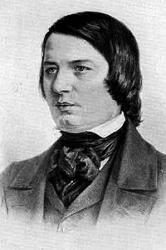
Robert Schumann

1810 - 1856 Person Name: R. Schumann Composer of "[Come, Holy Ghost, Creator blest]" in The Hymnal, Revised and Enlarged, as adopted by the General Convention of the Protestant Episcopal Church in the United States of America in the year of our Lord 1892 Robert Alexander Schumann DM Germany 1810-1856. Born at Swickau, Saxony, Germany, the last child of a novelist, bookseller, and publisher, he began composing music at age seven. He received general music instruction at the local high school and worked to create his own compositions. Some of his works were considered admirable for his age. He even composed music congruent to the personalities of friends, who took note of the anomaly. He studied famous poets and philosophers and was impressed with the works of other famous composers of the time. After his father’s death in 1826, he went to Leipzig to study law (to meet the terms of his inheritance). In 1829 he continued law studies in Heidelberg, where he became a lifelong member of Corps Saxo-Borussia Heidelberg. In 1830 he left the study of law to return to music, intending to pursue a career as a virtuoso pianist. His teacher, Friedrich Wieck, assured him he could become the finest pianist in Europe, but an injury to his right hand (from a practicing method) ended that dream. He then focused his energies on composition, and studied under Heinrich Dorn, a German composer and conductor of the Leipzig opera. Schumann visited relatives in Zwickau and Schneeberg and performed at a concert given by Clara Wieck, age 13 at the time. In 1834 he published ‘A new journal for music’, praising some past composers and deriding others. He met Felix Mendelssohn at Wieck’s house in Leigzig and lauded the greatness of his compositions, along with those of Johannes Brahms. He also wrote a work, hoping to use proceeds from its sale towards a monument for Beethoven, whom he highly admired. He composed symphonies, operas, orchestral and chamber works, and also wrote biographies. Until 1840 he wrote strictly for piano, but then began composing for orchestra and voice. That year he composed 168 songs. He also receive a Doctorate degree from the University of Jena that year. An aesthete and influential music critic, he was one of the most regarded composers of the Romantic era. He published his works in the ‘New journal for music’, which he co-founded. In 1840, against the wishes of his father, he married Clara Wieck, daughter of his former teacher, and they had four children: Marie, Julie, Eugenie, and Felix. Clara also composed music and had a considerable concert career, the earnings from which formed a substantial part of her father’s fortune. In 1841 he wrote 2 of his 4 symphonies. In 1843 he was awarded a professorship in the Conservatory of Music, which Mendelssohn had founded in Leipzig that same year, When he and Clara went to Russia for her performances, he was questioned as to whether he also was a musician. He harbored resentment for her success as a pianist, which exceeded his ability as a pianist and reputation as a composer. From 1844-1853 he was engaged in setting Goethe’s Faust to music, but he began having persistent nervous prostration and developed neurasthenia (nervous fears of things, like metal objects and drugs). In 1846 he felt he had recovered and began traveling to Vienna, Prague, and Berlin, where he was received with enthusiasm. His only opera was written in 1848, and an orchestral work in 1849. In 1850 he succeeded Ferdinand Hiller as musical director at Dusseldorf, but was a poor conductor and soon aroused the opposition of the musicians, claiming he was impossible on the platform. From 1850-1854 he composed a wide variety of genres, but critics have considered his works during this period inferior to earlier works. In 1851 he visited Switzerland, Belgium, and returned to Leipzig. That year he finished his fourth symphony. He then went to Dusseldorf and began editing his complete works and making an anthology on the subject of music. He again was plagued with imaginary voices (angels, ghosts or demons) and in 1854 jumped off a bridge into the Rhine River, but was rescued by boatmen and taken home. For the last two years of his life, after the attempted suicide, Schumann was confined to a sanitarium in Endenich near Bonn, at his own request, and his wife was not allowed to see him. She finally saw him two days before he died, but he was unable to speak. He was diagnosed with psychotic melancholia, but died of pneumonia without recovering from the mental illness. Speculations as to the cause of his late term maladies was that he may have suffered from syphilis, contracted early in life, and treated with mercury, unknown as a neurological poison at the time. A report on his autopsy said he had a tumor at the base of the brain. It is also surmised he may have had bipolar disorder, accounting for mood swings and changes in his productivity. From the time of his death Clara devoted herself to the performance and interpretation of her husband’s works. John Perry

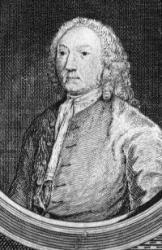
William Knapp

1698 - 1768 Person Name: W. Knapp Composer of "WAREHAM" in The Students' Hymnal Born: 1698, Ware­ham, Dor­set­shire, Eng­land. Died: Sep­tem­ber 26, 1768, Poole, Dor­set­shire, Eng­land. Buried: Poole, Dor­set­shire, Eng­land.

Melchior Vulpius

1570 - 1615 Composer of "DER TAG BRICHT AN" in The Harvard University Hymn Book Born into a poor family named Fuchs, Melchior Vulpius (b. Wasungen, Henneberg, Germany, c. 1570; d. Weimar, Germany, 1615) had only limited educational oppor­tunities and did not attend the university. He taught Latin in the school in Schleusingen, where he Latinized his surname, and from 1596 until his death served as a Lutheran cantor and teacher in Weimar. A distinguished composer, Vulpius wrote a St. Matthew Passion (1613), nearly two hundred motets in German and Latin, and over four hundred hymn tunes, many of which became popular in Lutheran churches, and some of which introduced the lively Italian balletto rhythms into the German hymn tunes. His music was published in Cantiones Sacrae (1602, 1604), Kirchengesangund Geistliche Lieder (1604, enlarged as Ein schon geistlich Gesanglmch, 1609), and posthumous­ly in Cantionale Sacrum (1646). Bert Polman

Randall Keith DeBruyn

b. 1947 Person Name: Randall DeBruyn, b. 1947 Arranger of "LAMBILLOTTE" in Journeysongs (3rd ed.)

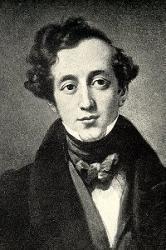
Felix Mendelssohn-Bartholdy

1809 - 1847 Person Name: F. Mendelssohn (1809-1847) Composer of "SPENCER" in The Woman's Hymnal Felix Mendelssohn-Bartholdy (b. Hamburg, Germany, 1809; d. Leipzig, Germany, 1847) was the son of banker Abraham Mendelssohn and the grandson of philosopher Moses Mendelssohn. His Jewish family became Christian and took the Bartholdy name (name of the estate of Mendelssohn's uncle) when baptized into the Lutheran church. The children all received an excellent musical education. Mendelssohn had his first public performance at the age of nine and by the age of sixteen had written several symphonies. Profoundly influenced by J. S. Bach's music, he conducted a performance of the St. Matthew Passion in 1829 (at age 20!) – the first performance since Bach's death, thus reintroducing Bach to the world. Mendelssohn organized the Domchor in Berlin and founded the Leipzig Conservatory of Music in 1843. Traveling widely, he not only became familiar with various styles of music but also became well known himself in countries other than Germany, especially in England. He left a rich treasury of music: organ and piano works, overtures and incidental music, oratorios (including St. Paul or Elijah and choral works, and symphonies. He harmonized a number of hymn tunes himself, but hymnbook editors also arranged some of his other tunes into hymn tunes. Bert Polman

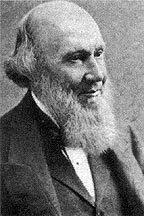
E. J. Hopkins

1818 - 1901 Composer of "ABBEY" in The Church Hymnal Dr Edward John Hopkins MusDoc United Kingdom 1818-1901. Born at Westminster, England, the son of a clarinetist with the Royal Opera House orchestra, he became an organist (as did two of his brothers) and a composer. In 1826 he became a chorister of the Chapel Royal and sang at the coronation of King William IV in Westminster Abbey. He also sang in the choir of St. Paul’s Cathedral, a double schedule requiring skill and dexterity. On Sunday evenings he would play the outgoing voluntary at St. Martin’s in-the-field. He left Chapel Royal in 1834 and started studying organ construction at two organ factories. He took an appointment at Mitcham Church as organist at age 16, winning an audition against other organists. Four years later he became organist at the Church of St. Peter, Islington. In 1841 he became organist at St. Luke’s, Berwick St., Soho. Two Years later he was organist at Temple Church, which had a historic organ (built in 1683). He held this position for 55 years. In 1845 he married Sarah Lovett, and they had four sons and five daughters. He was closely associated with the Bach Society and was organist for the first English performances of Bach’s St. Matthew Passion. In 1855 he collaborated with Edward Rimbault publishing “The organ, its history and construction” (3 editions 1855-70-77). In 1864 he was one of the founders of the “College of organists”. In 1882 he received an honorary Doctorate of Music from the Archbishop of Canterbury. He composed 30+ hymn tunes and some psalm chants, used by the Church of England. He died in London, England. John Perry

Pope Gregory I

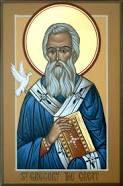
540 - 604 Person Name: Gregory the Great, 559-604 Author of "O come, Creator Spirit blest!" in The Woman's Hymnal Gregory I., St., Pope. Surnamed The Great. Was born at Rome about A.D. 540. His family was distinguished not only for its rank and social consideration, but for its piety and good works. His father, Gordianus, said to have been the grandson of Pope Felix II. or III., was a man of senatorial rank and great wealth; whilst his mother, Silvia, and her sisters-in-law, Tarsilla and Aemiliana, attained the distinction of canonization. Gregory made the best use of his advantages in circumstances and surroundings, so far as his education went. "A saint among saints," he was considered second to none in Rome in grammar, rhetoric, and logic. In early life, before his father's death, he became a member of the Senate; and soon after he was thirty and accordingly, when his father died, he devoted the whole of the large fortune that he inherited to religious uses. He founded no less than six monasteries in Sicily, as well as one on the site of his own house at Rome, to which latter he retired himself in the capacity of a Benedictine monk, in 575. In 577 the then Pope, Benedict I, made him one of the seven Cardinal Deacons who presided over the seven principal divisions of Rome. The following year Benedict's successor, Pelagius II, sent him on an embassy of congratulation to the new emperor Tiberius, at Constantinople. After six years' residence at Constantinople he returned to Rome. It was during this residence at Rome, before he was called upon to succeed Pelagius in the Papal chair, that his interest was excited in the evangelization of Britain by seeing some beautiful children, natives of that country, exposed for sale in the slave-market there ("non Angli, sed Angeli"). He volunteered to head a mission to convert the British, and, having obtained the Pope's sanction for the enterprise, had got three days' journey on his way to Britain when he was peremptorily recalled by Pelagius, at the earnest demand of the Roman people. In 590 he became Pope himself, and, as is well known, carried out his benevolent purpose towards Britain by the mission of St. Augustine, 596. His Papacy, upon which he entered with genuine reluctance, and only after he had taken every step in his power to be relieved from the office, lasted until 604, when he died at the early age of fifty-five. His Pontificate was distinguished by his zeal, ability, and address in the administration of his temporal and spiritual kingdom alike, and his missionaries found their way into all parts of the known world. In Lombardy he destroyed Arianism; in Africa he greatly weakened the Donatists; in Spain he converted the monarch, Reccared: while he made his influence felt even in the remote region of Ireland, where, till his day, the native Church had not acknowledged any allegiance to the See of Rome. He advised rather than dictated to other bishops, and strongly opposed the assumption of the title of "Universal Patriarch" by John the Faster of Constantinople, on the ground that the title had been declined by the Pope himself at the Council of Chalcedon, and declared his pride in being called the “Servant of God's Servants." He exhibited entire toleration for Jews and heretics, and his disapproval of slavery by manumitting all his own slaves. The one grave blot upon his otherwise upright and virtuous character was his gross flattery in congratulating Phocas on his accession to the throne as emperor in 601, a position the latter had secured with the assistance of the imperial army in which he was a centurion, by the murder of his predecessor Mauricius (whose six sons had been slaughtered before their father's eyes), and that of the empress Constantina and her three daughters. Gregory's great learning won for him the distinction of being ranked as one of the four Latin doctors, and exhibited itself in many works of value, the most important of which are his Moralium Libri xxxv., and his two books of homilies on Ezekiel and the Gospels. His influence was also great as a preacher and many of his sermons are still extant, and form indeed no inconsiderable portion of his works that have come down to us. But he is most famous, perhaps, for the services he rendered to the liturgy and music of the Church, whereby he gained for himself the title of Magister Caeremoniarum. His Sacramentary, in which he gave its definite form to the Sacrifice of the Mass, and his Antiphonary, a collection which he made of chants old and new, as well as a school called Orplianotrophium, which he established at Rome for the cultivation of church singing, prove his interest in such subjects, and his success in his efforts to render the public worship of his day worthy of Him to Whom it was addressed. The Gregorian Tones, or chants, with which we are still familiar after a lapse of twelve centuries, we owe to his anxiety to supersede the more melodious and flowing style of church music which is popularly attributed to St. Ambrose, by the severer and more solemn monotone which is their characteristic. The contributions of St. Gregory to our stores of Latin hymns are not numerous, nor are the few generally attributed to him quite certainly proved to be his. But few as they are, and by whomsoever written, they are most of them still used in the services of the Church. In character they are well wedded to the grave and solemn music which St. Gregory himself is supposed to have written for them. The Benedictine editors credit St. Gregory with 8 hymns, viz. (1) “Primo dierum omnium;" (2) "Nocte surgentes vigilemus;" (3) "Ecce jam noctis tenuatur tunbra;" (4) “Clarum decus jejunii;" (5) "Audi benigne conditor;" (6) "Magno salutis gaudio;" (7) “Rex Christe factor omnium;" (8) "Lucis Creator Optime." Daniel in his vol. i. assigns him three others. (9) “Ecce tempus idoneum;" (10) "Summi largitor praemii;" (11) "Noctis tempus jam praeterit." For translations of these hymns see under their respective first lines. (For an elaborate account of St. Gregory, see Smith and Wace's Dictionary of Christian Biography.) [Rev. Digby S. Wrangham, M.A.] -- John Julian, Dictionary of Hymnology (1907) =================== Gregory I., St., Pope, p. 469, i. We have been unable to discover any grounds which justified the Benedictine editors and Daniel in printing certain hymns (see p. 470, i.) as by St. Gregory. Modern scholars agree in denying him a place among hymnwriters; e.g., Mr. F. H. Dudden, in his Gregory the Great (London, 1905, vol. i.,p. 276), says "The Gregorian authorship of these compositions [the hymns printed by the Benedictine editors] however cannot be maintained... Gregory contributed ... nothing at all to the sacred music and poetry of the Roman Church." [Rev. James Mearns, M.A.] --John Julian, Dictionary of Hymnology, New Supplement (1907)

Joseph Barnby

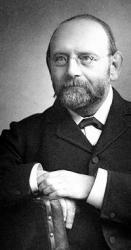
1838 - 1896 Person Name: J. Barnby Composer of "[Come, O Creator Spirit blest]" in Christian Life Songs Joseph Barnby (b. York, England, 1838; d. London, England, 1896) An accomplished and popular choral director in England, Barnby showed his musical genius early: he was an organist and choirmaster at the age of twelve. He became organist at St. Andrews, Wells Street, London, where he developed an outstanding choral program (at times nicknamed "the Sunday Opera"). Barnby introduced annual performances of J. S. Bach's St. John Passion in St. Anne's, Soho, and directed the first performance in an English church of the St. Matthew Passion. He was also active in regional music festivals, conducted the Royal Choral Society, and composed and edited music (mainly for Novello and Company). In 1892 he was knighted by Queen Victoria. His compositions include many anthems and service music for the Anglican liturgy, as well as 246 hymn tunes (published posthumously in 1897). He edited four hymnals, including The Hymnary (1872) and The Congregational Sunday School Hymnal (1891), and coedited The Cathedral Psalter (1873). Bert Polman

Richard Mant

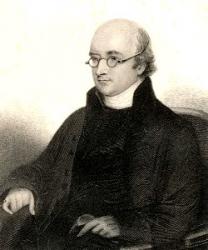
1776 - 1848 Translator (from Latin) of "Come Holy Ghost, Creator Blest" in The Cyber Hymnal Mant, Richard D.D., son of the Rev. Richard Mant, Master of the Grammar School, Southampton, was born at Southampton, Feb. 12, 1776. He was educated at Winchester and Trinity, Oxford (B.A. 1797, M.A., 1799). At Oxford he won the Chancellor's prize for an English essay: was a Fellow of Oriel, and for some time College Tutor. On taking Holy Orders he was successively curate to his father, then of one or two other places, Vicar of Coggeshall, Essex, 1810; Domestic Chaplain to the Archbishop of Canterbury, 1813, Rector of St. Botolph, Bishopsgate, London. 1816, and East Horsley, 1818, Bishop of Killaloe, 1820, of Down and Connor, 1823, and of Dromore, 1842. He was also Bampton Lecturer in 1811. He died Nov. 2, 1848. His prose works were numerous, and although now somewhat obsolete, they were useful and popular in their day. His poetical works, and other works which contain poetical pieces, are:— (1) The Country Curate, 1804; (2) Poems in three Parts, 1806; (3) The Slave, 1807; (4) The Book of Psalms in an English Metrical Version, &c, 1824; (5) The Holydays of the Church; or Scripture Narratives of Our Blessed Lord's Life and Ministry, and Biographical Notices of the Apostles, Evangelists, and Other Saints, with Reflections, Collects, and Metrical Sketches, vol. i., 1828; vol. ii., 1831; (6) The Gospel Miracles in a series of Poetical Sketches, &c., 1832; (7) The British Months, 2 vols., 1836; (8) Ancient Hymns from the Roman Breviary, for Domestick Use. . . .To which are added Original Hymns, principally of Commemoration and Thanksgiving for Christ's Holy Ordinances, 1837: new ed., 1871. (9) The Happiness of the Blessed Dead, 1847. Bishop Mant is known chiefly through his translations from the Latin. He was one of the earliest of the later translators, I. Williams and J. Chandler being his contemporaries. Concerning his translations, Mr. Ellerton, in his Notes on Church Hymns, 1881, p. xlviii. (folio ed.), says justly that:— "Mant had little knowledge of hymns, and merely took those of the existing Roman Breviary as he found them: consequently he had to omit many, and so to alter others that they have in fact become different hymns: nor was he always happy in his manipulation of them. But his book has much good taste and devout feeling, and has fallen into undeserved neglect." His metrical version of the Psalms has yielded very few pieces to the hymnals, the larger portion of his original compositions being from his work of 1837. The most popular of these is "Come Holy Ghost, my soul inspire, Spirit of," &c, and its altered forms; "Bright the vision that delighted," and its altered form of "Round the Lord in glory seated;" and "For all Thy saints, O Lord." His hymns in common use which are not annotated under their respective first lines are:— i. From his Metrical Version of the Psalms, 1824. 1. God, my King, Thy might confessing. Ps. cxlv. 2. Lord, to Thee I make my vows. Ps. xxvii. 3. Blessed be the Lord most High. Ps. xxviii. Pt. ii. 4. My trust is in the highest Name. Ps. xi. 5. Reign, Jehovah, King supreme. Ps. xcix. 6. Thy listening ear, O Lord, incline. Ps. Ixxxvi. 7. To God my earnest voice I raise. Ps. cxlii. 8. To Jehovah hymn the lay. Ps. cxviii. Two centos in Spurgeon's Our Own Hymn Book, 1866. (1) st. i., ii., v.; and (2) "Thee, Jehovah, will I bless" from st. vii.-x. ii. From his Holydays of the Church, &c, 1828-31. 9. Lo, the day the Lord hath made. Easter. 10. There is a dwelling place above. All Saints. iii. From his Ancient Hymns, &c, 1837. 11. Before Thy mercy's throne. Lent. 12. Father of all, from Whom we trace. Unity. 13. For these who first proclaimed Thy word. Apostles. 14. No! when He bids me seek His face. Holy Communion. 15. Oft as in God's own house we sit. Divine Worship. 16. Put off thy shoes, 'tis holy ground. The House of God . 17. Saviour of men, our Hope [Life] and Rest. The Greater Festivals. 18. Thy House each day of hallowed rest. Holy Communion. 19. We bless Thee for Thy Church, 0 Lord. Thanksgiving for the Church. 26. We deem and own it, Lord, a proof. Divine Grace. When all Bishop Mant's translations of original hymns, and versions of the Psalms in common use are taken into account, it is found that he is somewhat strongly represented in modern hymnody. -- John Julian, Dictionary of Hymnology (1907) ==================== http://en.wikipedia.org/wiki/Richard_Mant

Samuel Dyer

1785 - 1835 Person Name: Samuel Dyer, 1785-1835 Arranger of "MENDON" in Worship and Service Hymnal Rv Samuel Dyer United Kingdom 1785-1835. Born in White Chapel, Hampshire, the family moved to Wellshire, England, where he was ordained and served as a Baptist minister. In 1806 the family moved to Coventry, and Samuel emigrated to the U.S. in 1811. He married Renee Novak. He taught music and directed choirs in New York City and Philadelphia, PA. He later moved to Baltimore, MD, and wrote, conducted singing schools in the south and east, and conducted the New York Sacred Music Society. He published “New selection of sacred music” (1817), “Anthems” (1822 & 1834), and “The Philadelphia collection of sacred music” (1828). He died in Hoboken, NJ. John Perry

Pages


Export as CSV
It looks like you are using an ad-blocker. Ad revenue helps keep us running. Please consider white-listing Hymnary.org or getting Hymnary Pro to eliminate ads entirely and help support Hymnary.org.