You help make Hymnary.org possible. More than 10 million people from 200+ countries found hymns, liturgical resources and encouragement on Hymnary.org in 2025, including you. Every visit affirms the global impact of this ministry.

If Hymnary has been meaningful to you this year, would you take a moment today to help sustain it? A gift of any size—paired with a note of encouragement if you wish—directly supports the server costs, research work and curation that keep this resource freely available to the world.

Give securely online today, or mail a check to:
Hymnary.org
Calvin University
3201 Burton Street SE
Grand Rapids, MI 49546

Thank you for your partnership, and may the hope of Advent fill your heart.

Person Results

Text Identifier:"^now_may_he_who_from_the_dead$"
In:people

Planning worship? Check out our sister site, ZeteoSearch.org, for 20+ additional resources related to your search.
Showing 11 - 20 of 22Results Per Page: 102050

George Hews

1806 - 1873 Composer of "HOLLEY" in Common Praise Born: January 6, 1806, Weston, Massachusetts. Died: July 6, 1873, Boston, Massachusetts.

Samuel Dyer

1785 - 1835 Person Name: Samuel Dyer, 1785 - 1835 Arranger of "ASPIRATION" in The Book of Praise Rv Samuel Dyer United Kingdom 1785-1835. Born in White Chapel, Hampshire, the family moved to Wellshire, England, where he was ordained and served as a Baptist minister. In 1806 the family moved to Coventry, and Samuel emigrated to the U.S. in 1811. He married Renee Novak. He taught music and directed choirs in New York City and Philadelphia, PA. He later moved to Baltimore, MD, and wrote, conducted singing schools in the south and east, and conducted the New York Sacred Music Society. He published “New selection of sacred music” (1817), “Anthems” (1822 & 1834), and “The Philadelphia collection of sacred music” (1828). He died in Hoboken, NJ. John Perry

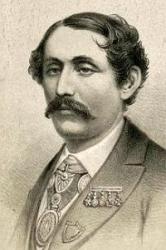
Louis M. Gottschalk

1829 - 1869 Composer of "MERCY" in Trinity Hymnal (Rev. ed.) Louis Moreau Gottschalk USA 1829-1869. Born in New Orleans, LA, to a Jewish father and Creole mother, he had six siblings and half-siblings. They lived in a small cottage in New Orleans. He later moved in with relatives (his grandmother and a nurse). He played the piano from an early age and was soon recognized as a prodigy by new Orleans bourgeois establishments. He made a performance debut at the new St. Charles Hotel in 1840. At 13 he left the U.S. And went to Europe with his father, as they realized he needed classical training to fulfill his musical ambitions. The Paris Conservatory rejected him without hearing him play on the grounds of his nationality. Chopin heard him play a concert there and remarked, “Give me your hand, my child, I predict that you will become the king of pianists. Franz Liszt and Charles Valentin Alkan also recognized his extreme talent. He became a composer and piano virtuoso, traveling far and wide performing, first back to the U.S., then Cuba, Puerto Rico, Central and South America. He was taken with music he heard in those places and composed his own. He returned to the States, resting in NJ, then went to New York City. There he mentored a young Venezuelan student, Carreno, and became concerned that she succeed. He was only able to give her a few lessons, yet she would remember him fondly and play his music the rest of her days. A year after meeting Gottschalk, she performed for President Lincoln and went on to become a renowned concern pianist, earning the nickname “Valkyrie of the Piano”. Gottschalk was also interested in art and made connections with notable figures of the New York art world. He traded one of his compositions to his art friend, Frederic Church, for one of Church's landscape paintings. By 1860 Gootschalk had established himself as the best known pianist in the New World. He supported the Union cause during the Civil War and returned to New Orleans only occasionally for concerts. He traveled some 95,000 miles and gave 1000 concerts by 1865. He was forced to leave the U.S. later that year as a result of a scandelous affair with a student at Oakland Female Seminary in Oakland, CA. He never came back to the U.S. He went to South America giving frequent concerts. At one, in Rio de Janeiro, Brazil, he collapsed from yellow fever as he played a concert. He died three weeks later, never recovering from the collapse, possibly from an overdose of quinine or an abdominal infection. He was buried in Brooklyn, NY. Though some of his works were destroyed or disappeared after his death, a number of them remain and have been recorded by various artists. John Perry

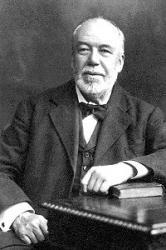
A. H. Mann

1850 - 1929 Person Name: Arthur H. Mann Composer of "CANTONE" in The Sanctuary Hymnal, published by Order of the General Conference of the United Brethren in Christ Arthur Henry ‘Daddy’ Mann MusB MusD United Kingdom 1850-1929. Born at Norwich, Norfolk, England, he graduated from New College, Oxford. He married Sarah Ransford, and they had five children: Sarah, Francis, Arthur, John, and Mary. Arthur died in infancy. Mann was a chorister and assistant organist at Norwich Cathedral, then, after short stints playing the organ at St Peter’s, Wolverhampton (1870-71); St. Michael’s Tettenhall Parish Church (1871-75); and Beverley Minster (1875-76); he became organist at King’s College Chapel, Cambridge (1876-1929), Cambridge University organist (1897-1929), and music master and organist at the Leys School, Cambridge (1894-1922). In addition to composing an oratorio and some hymn tunes, he was music editor of the Church of England Hymnal (1894). In 1918 he directed the music and first service of “Nine lessons & carols” at King’s College Chapel. He was an arranger, author, composer, and editor. His wife, Sarah, died in 1918. He died at Cambridge, England. John Perry

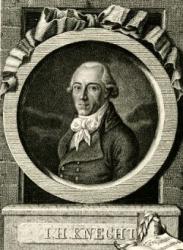
Justin Heinrich Knecht

1752 - 1817 Person Name: Justin H. Knecht Composer of "VIENNA" in Common Service Book of the Lutheran Church Justin Heinrich Knecht Germany 1752-1817. Born at Biberach Baden-Wurttemberg, Germany, he attended a Lutheran college in Esslingen am Neckar from 1768-1771. Having learned the organ, keyboard, violin and oratory, he became a Lutheran preceptor (professor of literature) and music director in Biberach. It was a free imperial city until 1803 and had a rich cultural life. He became organist of St. Martin’s Church in 1792, used by both Lutherans and Catholics, and was there for many years. He led an energetic, busy musical life, composing for both the theatre and church, organizing subscription concerts, teaching music theory, acoustics, aesthetics, composition, and instruments at the Gymnasium, affiliated to the Musikschule in 1806. He went to Stuttgart in 1806 in hopes of a post there as Kapellmeister, serving two years as Konzertmeister, but he was appointed Direktor Beim Orchester by the King of Wurttemberg in 1807. However, he returned to his former life in 1808 and remained there the rest of his life. He died at Biberach. He wrote 10 vocals, 11 opera and stage works, one symphony, 3 chamber music instrumentals, 7 organ works, 4 piano works, and 6 music theories. He was an author composer, editor, contributor, musician, compiler, and lyricist. John Perry

Georg Joseph

1630 - 1668 Person Name: G. Josephi Composer of "DEUS PACIS" in The Riverdale Hymn Book Born: Probably circa 1630, Breslau, Silesia (now Wrocław, Poland). Died: Circa 1668. A musician in the service of the Prince-Bishop of Breslau in last half of the 17th Century, Joseph collaborated published five hymn volumes with Johann Scheffler. Sources Erickson, p. 325 Stulken, p. 218 Music: ANGELUS --www.hymntime.com/tch

Michael Costa

1808 - 1884 Composer of "INVOCATION" in The Praise Hymnary [Michaele Andrea Agniello Costa] Born: Feb­ru­a­ry 14, 1808, Na­ples, It­a­ly. Died: 1884, Hove, East Sus­sex, Eng­land. Buried: Ken­sal Green Cem­e­te­ry, Lon­don, Eng­land. Costa learned the ru­di­ments of mu­sic from his ma­ter­nal grand­fa­ther, Gi­a­co­mo Trit­to; he was placed at the Real Col­le­gio di Mu­si­ca in Na­ples, and af­ter a publ­ic ex­am re­ceived a schol­ar­ship from Fer­di­nand I, King of the Two Si­ci­lies. He com­posed his first can­ta­ta at age 15, and went on to write sym­pho­nies, or­a­tor­ios, op­er­as, and quar­tets. He event­u­al­ly moved to Lon­don, where he was knight­ed in 1869. In 1871, he be­came "di­rect­or of the mu­sic, com­pos­er, and con­duct­or" at Her Ma­jes­ty’s op­e­ra. --www.hymntime.com/tch/

L. G. Hayne

1836 - 1883 Person Name: Leighton G. Hayne Composer of "BUCKLAND" in The Lutheran Hymnal Born: February 28, 1836, St. David’s Hall, Exeter, England. Died: March 3, 1883, Bradfield, Essex, England. Son of Richard Hayne, Rector of Mistley, Leighton graduated from Eton and Queen’s College, Oxford (BMus 1856, DMus 1860); at school, he was Eton College’s organist and conducted the Oxford University chorus. He also served as chaplain of Queen’s College; Vicar of Helston, Cornwall (1866-67); Succentor of Eton (1867-71); and Rector of Mistley, Essex (1871-83), and was well known as an organ builder. Music: BUCKLAND CHALVEY ST. CECILIA ST. LAWRENCE --www.hymntime.com/tch/

J. W. A. Cluett

1834 - 1899 Person Name: John W. A. Cluett Composer of "WENTWORTH" in Book of Worship with Hymns and Tunes

Lewis Thomas Downes

1827 - 1907 Person Name: Lewis T. Downes Composer of "SOLITUDE" in The Hymnal

Pages


Export as CSV
It looks like you are using an ad-blocker. Ad revenue helps keep us running. Please consider white-listing Hymnary.org or getting Hymnary Pro to eliminate ads entirely and help support Hymnary.org.