You help make Hymnary.org possible. More than 10 million people from 200+ countries found hymns, liturgical resources and encouragement on Hymnary.org in 2025, including you. Every visit affirms the global impact of this ministry.

If Hymnary has been meaningful to you this year, would you take a moment today to help sustain it? A gift of any size—paired with a note of encouragement if you wish—directly supports the server costs, research work and curation that keep this resource freely available to the world.

Give securely online today, or mail a check to:
Hymnary.org
Calvin University
3201 Burton Street SE
Grand Rapids, MI 49546

Thank you for your partnership, and may the hope of Advent fill your heart.

Person Results

Text Identifier:"^while_thee_i_seek_protecting_power$"
In:people

Planning worship? Check out our sister site, ZeteoSearch.org, for 20+ additional resources related to your search.
Showing 11 - 20 of 24Results Per Page: 102050

Ignaz Pleyel

1757 - 1831 Person Name: Ignaz J. Pleyel Composer of "BRATTLE STREET" in The Hymnal Ignaz Joseph Pleyel; b. Ruppertstahl, near Vienna, 1757; d. Parice France, 1831 Evangelical Lutheran Hymnal, 1908

Louis Spohr

1784 - 1859 Person Name: Ludwig Spohr, 1784-1859 Composer of "SIMPSON" in The Cyber Hymnal Also: Spohr, Ludwig, 1784-1859 Shpor, Lui, 1784-1859 Spohr, L. (Louis), 1784-1859 Shpor, Ludvig, 1784-1859 Spohr, Ludewig, 1784-1859

Helen Maria Williams

1762 - 1827 Person Name: Helen M. Williams Author of "While Thee I seek, protecting Power" in The Hymnal Miss Helen Maria Williams was born in the north of England, in 1762. At the age of eighteen, she went to London, and soon after took position in the literary world, publishing several poems. Subsequently she resided in Paris, where she published works in prose and poetry. She died in 1827. The eminent French preacher, Athanase Coquerel was her nephew, and received from her his early training. --Annotations of the Hymnal, Charles Hutchins, M.A., 1872. ================== Williams, Helen Maria, daughter of Charles Williams, an officer in the Army, was born in the North of England in 1762. Through the influence of Dr. A. Kippis whose help she sought in London, her first poem, Edwin and Eltruda, a legendary tale, was published in 1782. This was followed by An Ode on the Peace, 1783, and Pern, a Poem. These were all included in her Poems, 2 vols., 1786, 2nd edition 1791. Being connected by her sister's marriage with a French Protestant family, she resided in Paris during the period of the Revolution and the reign of Terror. There she became well known as a political writer of strong republican sympa-thies, but her too independent expressions of opinion led to her temporary imprisonment by Robespierre. Her Letters from France, 1790, were published in England and America, and in a French translation, in France. She also published Letters containing a Sketch of the Politics of France from the 31st May, 1793, till the 28th of July, 1794, 2 vols., 1795, and other works of a like kind; some additional Poems, and a translation of Humboldt's Personal Narratives of his Travels, 1815. The closing years of her life were spent at Amsterdam, in the house of her nephew, Athanase Coquerel, a pastor of the Reformed Church there. Miss Williams died in 1827. From her Poems, 1786, the following hymns have come into common use:— 1, My God, all nature owns Thy sway. Nature speaks of God. In Martineau's Hymns, 1840. 2. While Thee I seek, protecting Power. Safety in God. This hymn was in Dr. Priestley's Birmingham Collection, 1790; in Kippis's Collection, 1795; the Exeter Collection, 1801; and almost every other Unitarian collection to the present time. In the New Congregational Hymn Book , 1859, it begins "While Thee I seek, Almighty Power;" and in several collections a cento beginning "Father, in all our [my] comforts here," is given as in Stowell's Psalms & Hymns, 1831 and 1877, and several others. [Rev. Valentine D. Davis, B.A.] -- John Julian, Dictionary of Hymnology (1907) ================== Williams, Helen Maria, was born in the North of England in 1762. She published a volume of poems when only twenty-one years old, and in 1786 her Poems appeared in two small volumes. She visited Paris in 1788, and lived there for some years with a sister who had married a French Protestant. This was during the period of the Revolution and the Reign of Terror. She was an outspoken republican in her sympathies, 448 and was imprisoned by Robespierre because of some of her utterances in advocacy of the Girondist cause, being released from prison only after his death, in 1794. Her Letters from France (1790 and 1795) were published in England, America, and France. They dealt with political, religious, and literary questions, and showed her to be a woman of more than ordinary intellectual strength. She published many volumes between 1786 and 1823, when her last volume appeared, titled Poems on Various Occasions, being a collection of all her previously published poems. She lived partly in England, but mostly in France, though the closing years of her life were spent in Holland in the home of a nephew who lived at Amsterdam and was pastor of the reformed Church there. Her death occurred at Paris December 14, 1827. Hymn Writers of the Church Wilbur F. Tillett and Charles S. Nutter, 1915

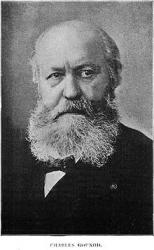
Charles F. Gounod

1818 - 1893 Person Name: Charles Gounod Composer of "RESIGNATION" in The School Hymnary Charles F. Gounod (b. Paris, France, 1818; d. St. Cloud, France, 1893) was taught initially by his pianist mother. Later he studied at the Paris Conservatory, won the "Grand Prix de Rome" in 1839, and continued his musical training in Vienna, Berlin, and Leipzig. Though probably most famous for his opera Faust (1859) and other instrumental music (including his Meditation sur le Prelude de Bach, to which someone added the Ave Maria text for soprano solo), Gounod also composed church music-four Masses, three Requiems, and a Magnificat. His smaller works for church use were published as Chants Sacres. When he lived in England (1870-1875), Gounod became familiar with British cathedral music and served as conductor of what later became the Royal Choral Society. Bert Polman

Gioacchino A. Rossini

1792 - 1868 Person Name: Rossini, 1792-1868 Composer of "MANOAH" in African Methodist Episcopal hymn and tune book Gioacchino A. Rossini; b. 1792, Pesaro; d. 1868, Ruelle near Parise Evangelical Lutheran Hymnal, 1908

Charles E. Kettle

1833 - 1895 Composer of "BLENDEN" in The Pilgrim Hymnal Charles Edward Kettle, 1833-1895 Born: 1833, Bury St. Edmunds, Suffolk, England. Died: Circa February 1895, Steyning district, Sussex, England. As of 1881, Kettle lived in Hove, Sussex, where he was an organist. --www.hymntime.com/tch

Franz Abt

1819 - 1885 Person Name: Abt Composer of "AMPHION" in School and College Hymnal Franz Abt, born Dec. 21, 1819 at Eilenburg in the Prussian provinces of Saxony. His father was a musician and clergyman of the Lutheran Church. Franz studied music at Leipsic, and became known as a song-writer in 1838. In September, 1841, he married, and was leader of the orchesta at the Zuric theatre; became a teacher in 1842, but was litle known until his song "When the Swallows Homeward fly" carried his name to all parts of the civilized world. In 1865 was concert-master at Brunswick, and conducted the great festival at Dresden. He came to the United States in 1872, and was present at teh Peace Jubilee, Boston, where he directed the performance of some of his own music, arriving in New York May w, wher a testimonial concert was given for his benefit at Steinway Hall, May 18. He was received at Philadelphia by the German societies, with torch-light processions and cannonade, May 15, 1872. A Dictionary of Musical Information by John W. Moore, Boston: Oliver, Ditson & Company, 1876

Deodotus Dutton

1808 - 1832 Person Name: D. Dutton Composer of "WOODSTOCK" in The National Baptist Hymnal Dutton, Deodatus, jun., b. cir. 1810, was a native of Monson, Massachusetts, U.S. He was a Licentiate of the third Presbytery, New York, but died before ordination, about 1832. His hymns in common use are:— 1. On Thibet's snow-capt mountain. Missions. This appeared in pt. ii. of the Christian Lyrics, 1831, in 3 stanzas of 8 lines. It is an imitation of Bp. Heber's “From Greenland's icy mountains." 2. O where can the soul find relief from its foes. Heaven. The date and first published of this hymn is uncertain. It is given, together with the above, in the Plymouth Collection, 1855. [Rev. F. M. Bird, M.A.] -- John Julian, Dictionary of Hymnology (1907) ================= Born: De­cem­ber 22, 1808, Mon­son, Mass­a­chu­setts. Died: De­cem­ber 16, 1832, New York Ci­ty. Buried: Ma­rble Cem­e­te­ry, Man­hat­tan, New York. By age 14, Dut­ton was play­ing the or­gan at Cen­ter Church in Hart­ford, Con­nec­ti­cut. He at­tend­ed Brown Un­i­ver­si­ty and Wash­ing­ton (now Trin­i­ty) Coll­ege (grad­u­at­ed 1828), and was li­censed to preach by the Third Pres­by­tery of New York. How­ev­er, he ne­ver re­ceived a pas­tor­ate, and was still pur­su­ing his stu­dies at the time of his death. His works in­clude: The Amer­i­can Psalm­o­dy, 1829, with El­am Ives, Jr. --www.hymntime.com/tch/

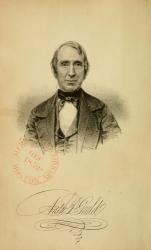
Nathaniel D. Gould

1781 - 1864 Composer of "WOODLAND" in The Seventh-Day Adventist Hymn and Tune Book Nathaniel Duren Gould 1781-1864. Born in Bedford, MA, into the Duren family, He was musically inclined and attended a singing school when young. He was also a master and teacher of penmanship and engraving. As a conservative music reformer he opened a singing school in 1799. He taught mostly Psalmody singing. He married Sally Andrews Prichard in 1801, and they had eight children: Nathaniel, Augustus, Charles, Mary Ann, (2 unnamed infants that died), Elizabeth and Sarah. He also formed the New Ipswitch military band in 1804 He was conductor of the Middlesex MA Musical Society in 1805. He took the name Gould in 1806 to qualify for an inheritance from an uncle. He taught music in NH and MA in some 115 singing schools over 50+ years and had more than 50,000 students. He also compiled and published music. He authored a number of books, one being “History of church music in America” (1853) about early singing schools. He noted traits and temperaments of many singers, some not really performing for the glory of God. He died in Boston, MA. John Perry

Nicholas Heins

1839 - 1910 Composer of "BRECON" in Hymns of the Christian Life Born: 1839, London, England. Died: 1910, Hereford, England.

Pages


Export as CSV
It looks like you are using an ad-blocker. Ad revenue helps keep us running. Please consider white-listing Hymnary.org or getting Hymnary Pro to eliminate ads entirely and help support Hymnary.org.