

 My Starred Hymns
 My FlexScores
 My Hymnals
 My Purchased Files
Planning worship?
Check out our sister site, ZeteoSearch.org,
for 20+ additional resources related to your search.
- |
User Links
Person Results
Fanny Crosby
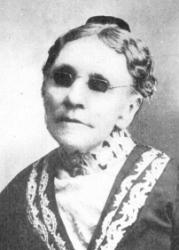
1820 - 1915 Person Name: Fanny J. Crosby Author of "Jesus, Keep Me Near the Cross" in Voices United Pseudonymns: A.V., Mrs. A. E. Andrews, Mrs. E. A. Andrews, Mrs. E. L. Andrews, James L. Black, Henrietta E. Blair, Charles Bruce, Robert Bruce, Leah Carlton, Eleanor Craddock, Lyman G. Cuyler, D.H.W., Ella Dare, Ellen Dare, Mrs. Ellen Douglass, Lizzie Edwards. Miss Grace Elliot, Grace J. Frances, Victoria Frances, Jennie Garnett, Frank Gould, H. D. K., Frances Hope, Annie L. James, Martha J. Lankton [Langton], Grace Lindsey, Maud Marion, Sallie Martin, Wilson Meade, Alice Monteith, Martha C. Oliver, Mrs. N. D. Plume, Kate Smiley, Sallie Smith, J. L. Sterling, John Sterling, Julia Sterling, Anna C. Storey, Victoria Stuart, Ida Scott Taylor, Mary R. Tilden, Mrs. J. B. Thresher, Hope Tryaway, Grace Tureman, Carrie M. Wilson, W.H.D.
Frances Jane Crosby, the daughter of John and Mercy Crosby, was born in Southeast, Putnam County, N. Y., March 24, 1820. She became blind at the age of six weeks from maltreatment of her eyes during a spell of sickness. When she was eight years old she moved with her parents to Ridgefield, Conn., the family remaining there four years. At the age of fifteen she entered the New York Institution for the Blind, where she received a good education. She became a teacher in the institution in 1847, and continued her work until March 1, 1858. She taught English grammar, rhetoric and American history.
This was the great developing period in her life. During the vacations of 1852 and 1853, spent at North Reading, Mass., she wrote the words to many songs for Dr. Geo. F. Root, then the teacher of music at the blind institution. Among them were, "Hazel Dell,", "The Honeysuckle Glen," "Rosalie, the Prairie Flower," "Music in the Air," "Proud World, Good-bye, I'm Going Home," "All Together", "Never Forget the Dear Ones," and others. Subsequently she wrote the words for the cantatas of The Flower Queen and The Pilgrim Fathers, all of which were very popular in their day, though it was not generally known at the time that she was the author.
While teaching at the institution she met Presidents Van Buren and Tyler, Hon. Henry Clay, Governor Wm. H. Seward, General Winfield Scott, and other distinguished characters of American history. Concerning Mr. Clay, she gives the following: "When Mr. Clay came to the institution during his last visit to New York, I was selected to welcome him with a poem. Six months before he had lost a son at the battle of Monterey, and I had sent him some verses. In my address I carefully avoided any allusion to them, in order not to wound him. When I had finished he drew my arm in his, and, addressing the audience, said through his tears: 'This is not the first poem for which I am indebted to this lady. Six months ago she sent me some lines on the death of my dear son.' Both of us were overcome for a few moments. Soon, by a splendid effort, Mr. Clay recovered himself, but I could not control my tears." In connection with her meeting these notable men, we might add that Miss Fanny Crosby had the honor of being the first woman whose voice was heard publicly in the Senate Chamber at Washington. She read a poem there on one occasion. In addition to the thousands of hymns that she has written (about eight thousand poems in all), many of which have not been set to music, she has published four volumes of verses. The first was issued in 1844 and was entitled The Blind Girl, and Other Poems, a second volume, Monterey, and Other Poems, followed in 1849, and the third, A Wreath of Columbia's Flowers, in 1858. The fourth, Bells at Evening and Other Verses, with a biographical sketch by Rev. Robert Lowry, and a fine half-tone portrait, in 1897, the sales of which have reached a fourth edition. The book is published by The Biglow & Main Co., New York.
Though these show the poetical bent of her mind, they have little to do with her world-wide fame. It is as a writer of Sunday-school songs and gospel hymns that she is known wherever the English language is spoken, and, in fact, wherever any other language is heard.
Fanny was married March 5, 1858, to Alex. Van Alstyne, who was also a scholar in the same institution in which she was educated.
She began to write Sunday-school hymns for Wm. B. Bradbury in 1864. Her first hymn,
"We are going, we are going
To a home beyond the skies",
was written at the Ponton Hotel on Franklin Street, New York City, on February 5th of that year. This hymn was sung at Mr. Bradbury's funeral in January, 1868. Since 1864 she supported herself by writing hymns. She resided in New York City nearly all her life, where, she says, she is "a member of the Old John Street M. E. Church in good standing." She spent regular hours on certain days at the office of The Biglow & Main Co., the firm for which she did most of her writing, and for whom she has composed over four thousand hymns. Her hymns have been in great demand and have been used by many of our most popular composers, among whom may be mentioned Wm. B. Bradbury, Geo. F. Root, W. H. Doane, Rev. Robert Lowry, Ira D. Sankey, J. R. Sweney, W. J. Kirkpatrick, H. P. Main, H. P. Danks, Philip Phillips, B. G. Unseld, and others. She could compose at any time and did not need to wait for any special inspiration, and her best hymns have come on the spur of the moment. She always composed with an open book in her hand, generally a copy of Golden Hymns, held closely over her eyes, bottom side up. She learned to play on the guitar and piano while at the institution, and has a clear soprano voice. She also received a technical training in music, and for this reason she could, and did, compose airs for some of her hymns. One of these is,
"Jesus, dear, I come to Thee,
Thou hast said I may,"
both words and music of which are wonderfully sweet. "Safe in the arms of Jesus", probably one of her best known hymns, was her own favorite. Fanny loved her work, and was happy in it. She was always ready either to sympathize or join in a mirthful conversation, as the case may be. The secret of this contentment dates from her first composition at the age of eight years. "It has been the motto of my life," she says. It is:
"O what a happy soul am I!
Although I cannot see,
I am resolved that in this world
Contented I will be;"
This has continued to be her philosophy. She says that had it not been for her affliction she might not have so good an education, nor so great an influence, and certainly not so fine a memory. She knows a great many portions of the Bible by heart, and had committed to memory the first four books of the Old Testament, and also the four Gospels before she was ten years of age.
Her scope of subjects is wide, embracing everything from a contemplation of heaven, as in "The Bright Forever" and "The Blessed Homeland", to an appeal to the work of this world, as in "To the Work" and "Rescue the Perishing." The most of Fanny's published hymns have appeared under the name of Fanny J. Crosby or Mrs. Yan Alstyne, but quite a large number have appeared under the nom de plumes of Grace J. Frances, Mrs. C. M. Wilson, Lizzie Edwards, Ella Dale, Henrietta E. Blair, Rose Atherton, Maud Marion, Leah Carlton, nearly two hundred different names.
-Biographies of Gospel Song and Hymn Writers (excerpts)
=======================
Van Alstyne, Frances Jane, née Crosby, a member of the Methodist Episcopal Church, was born at South East, Putnam County, New York, March 24, 1823. When six weeks old she lost her sight. About 1835 she entered the New York City Institution for the Blind. On completing her training she became a teacher therein from 1847 to 1858. In 1858 she was married to Alexander Van Alstyne, a musician, who was also blind. Her first poem was published in 1831; and her first volumes of verse as A Blind Girl, and Other Poems, 1844; Monteresy, and Other Poems, 1849; and A Wreath of Columbia's Flowers, 1858. Her first hymn was "We are going, we are going" (Death and Burial), which was written for Mr. Bradbury and published in the Golden Censer, 1864. From 1853 to 1858 she wrote 20 songs, which were set to music by G. F. Root. Her songs and hymns number some 2,000 or more, and have been published mainly in several of the popular American Sunday school collections, and often under a nom de plume. About 60 have come into common use in Great Britain. The majority of these are taken from the following American collections:—
i. From The Shining Star, 1864.
1. Softly on the breath of evening. Evening.
ii. From Fresh Laurels, 1867.
2. Beautiful Mansions, home of the blest. Heaven.
3. Jesus the Water of Life has given. The Water of Life.
4. Light and Comfort of my soul. In Affliction.
5. There's a cry from Macedonia. Missions.
6. We are marching on with shield and banner bright. Sunday School Anniversary.
iii. From Musical Leaves, 1868.
7. 0 what are you going to do, brother? Youth for God.
iv. From Sabbath Carols, 1868.
8. Dark is the night, and cold the wind is blowing. Affliction anticipated.
9. Lord, at Thy mercy seat, Humbly I fall. Lent.
v. From Silver Spray, 1868.
10. If I come to Jesus, He will make me glad. Peace in Jesus.
11. 'Twill not be long—our journey here. Heaven anticipated.
vi. From Notes of Joy, 1869.
12. Little beams of rosy light. The Divine Father.
13. Press on! press on! a glorious throng. Pressing towards the Prize.
vii. From Bright Jewels, 1869.
14. Christ the Lord is risen today, He is risen indeed. Easter.
15. Holy, holy, holy is the Lord! Sing 0 ye people, &c. Holiness of God.
16. Jesus, keep me near the Cross. Near the Cross of Christ.
17. Saviour, bless a little child. A Child's Prayer. Written Feb. 6, 1869.
viii. From Songs of Devotion, 1870.
18. Pass me not, 0 gentle Saviour. Lent. Written in 1868.
19. Rescue the perishing, care for the dying. Home Missions.
ix. From Pure Gold, 1871.
20. Great is Jehovah. King of kings. Greatness of God.
21. I would be Thy little lamb. The Good Shepherd.
22. Lead me to Jesus, lead me to Jesus. Desiring Jesus.
23. To the work, to the work, we are servants of God. Home Missions.
24. Why labour for treasures that rust and decay? The Fadeless Crown.
x. From the Royal Diadem, 1873.
25. I am Jesus' little friend. For Infant Schools.
26. Jesus I love Thee. Loving Jesus.
27. Mourner, wheresoe'er thou art. To the Sorrowing and Penitent. Written Oct. 3, 1871.
28. Never be faint or weary. Joy in Jesus.
29. Only a step to Jesus. Invitation.
xi. From Winnowed Hymns, 1873-4.
30. Loving Saviour, hear my cry. Lent.
xii. From Echoes of Zion, 1874.
31. Say, where is thy refuge, my brother? Home Missions.
xiii. From Songs of Grace and Glory, 1874.
32. Thou my everlasting Portion. Christ the Portion of His People.
xiv. From Brightest and Best, 1875.
33. All the way my Saviour leads me. Jesus the Guide.
34. I am Thine, O Lord: I have heard Thy voice. Holiness desired.
35. O come to the Saviour, believe in His name. Invitation. Written, Sep. 7, 1874.
36. O how sweet when we mingle. Communion of Saints. Written in 1866.
37. O my Saviour, hear me. Prayer to Jesus for blessing and love.
38. Only Jesus feels and knows. Jesus the Divine Friend.
39. Revive Thy work, O Lord. Home Missions.
40. Saviour, more than life to me. Jesus All and in All.
41. To God be the glory, great things He hath done. Praise for Redemption.
xv. From Calvary Songs, 1875.
42. Come, O come with thy broken heart. Invitation.
xvi. From Gospel Music, 1876.
43. Here from the world we turn. Divine Worship.
44. When Jesus comes to reward His servants. Watching,
xvii. From Welcome Tidings, 1877.
45. O hear my cry, be gracious now to me. For Pardon and Peace.
xviii. From The Fountain of Song, 1877.
46. Lord, my trust I repose on Thee. Trusting in Jesus.
xix. From Good as Gold, 1880.
47. In Thy cleft, O Rock of Ages. Safety in Jesus.
48. Sound the alarm ! let the watchman cry. Home Missions.
49. Tenderly He leads us. Christ the Leader.
50. 'Tis the blessed hour of prayer. The Hour of Prayer.
In addition to these hymns, all of which are in common use in Great Britain (mainly through I. D. Sankey's Sacred Songs and Solos, the Methodist Sunday School Hymn Book, the Silver Street Sunday Scholars Companion, and other collections for Sunday schools), there are also "A blessing for you, will you take it?" (Pardon through Jesus); "My song shall be of Jesus" (Praise of Jesus); “Now, just a word for Jesus"(Home Missions); "Onward, upward, Christian soldier" (Pressing Heavenward); 44 Sinner, how thy heart is troubled" (Invitation); "'Tis a goodly, pleasant land" (Heaven anticipated); and "When the dewy light was fading" (Death anticipated). All of these are in I. D. Sankey's Sacred Songs & Solos. Mrs. Van Alstyne's most popular composition is "Safe in the arms of Jesus" (Safety in Jesus). This was written in 1868, at the request of Mr. W. H. Doane, to his well-known melody with which it is inseparably associated, and published in Bright Jewels, 1869. Mrs. Van Alstyne's hymns have sometimes been published anonymously; but the greater part are signed by a bewildering number of initials.
The combined sales of the volumes of songs and hymns named above have amounted in English-speaking countries to millions of copies. Notwithstanding the immense circulation thus given to Mrs. Van Alstyne's hymns, they are, with few exceptions, very weak and poor, their simplicity and earnestness being their redeeming features. Their popularity is largely due to the melodies to which they are wedded.
Since the above was in type we have found that the following are also in common use in Great Britain:—
51. Suppose the little cowslip. Value of Little Things.
52. Sweet hour of prayer. The Hour of Prayer. These are in Bradbury's Golden Chain, 1861.
53. Never lose the golden rule. Love to our Neighbours. In Bradbury's Golden Censer, 1864.
54. I will not be afraid at night. Trust in God. In Bradbury's Fresh Laurels, 1867.
55. Praise Him, praise Him, Jesus our, &c. Praise of Jesus. In Biglow & Main's Bright Jewels, 1869.
56. More like Jesus would I be. More like Jesus. In Perkins & Taylor's Songs of Salvation, 1870.
57. Behold me standing at the door. Christ at the Door. In Biglow & Main's Christian Songs, 1872.
58. If I come to Jesus. Jesus the Children's Guide.
59. Jesus, Lord, I come to Thee. Trust in Jesus.
60. Let me learn of Jesus. Jesus the Children's Friend.
61. Singing for Jesus, O singing for Jesus. Singing for Jesus.
62. There is a Name divinely sweet Holy Name of Jesus.
Of these hymns Nos. 58-62 we have not been able to trace.
--Excerpts from John Julian, Dictionary of Hymnology (1907
================
Van Alstyne, Frances J., p. 1203, ii. From the American collections of recent date we find that Mrs. Van Alstyne is still actively engaged in hymn-writing. In the Funk and Wagnalls Company Gloria Deo, 1903, there are about 30 of her hymns, most of which are new. They are all signed, and some are dated, but we have not space to quote the first lines and subjects, as this hymnal is not an official collection of any denomination. Another name, "Mrs. S. K. Bourne" is credited in the same hymnal with about 40 new hymns. If this signature is not another pen-name of Mrs. Van Alstyne's (and these pen-names and initials of hers are very numerous), we can only say that she has a very successful understudy in "Mrs. S. K. Bourne."
--John Julian, Dictionary of Hymnology, New Supplement (1907)
Fanny Crosby
Frederick C. Maker
1844 - 1927 Person Name: Frederick Charles Maker Composer of "REST" in Voices United Frederick C. Maker (b. Bristol, England, August 6, 1844; d. January 1, 1927) received his early musical training as a chorister at Bristol Cathedral, England. He pursued a career as organist and choirmaster—most of it spent in Methodist and Congregational churches in Bristol. His longest tenure was at Redland Park Congregational Church, where he was organist from 1882-1910. Maker also conducted the Bristol Free Church Choir Association and was a long-time visiting professor of music at Clifton College. He wrote hymn tunes, anthems, and a cantata, Moses in the Bulrushes.
Bert Polman
Frederick C. Maker
Philipp Friedrich Hiller
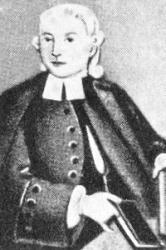
1699 - 1769 Author of "Jesus Christus herrscht als König" in Evangelisches Gesangbuch (Bayern, Mitteldeutschland, Thüringen) Hiller, Philipp Friedrich, son of Johann Jakob Hiller, pastor at Mühlhausen on the the Enz, Württemberg, was born at Mühlhausen, Jan. 6, 1699. He was educated at the clergy training schools at Denkendorf (under J. A. Bengel) and Maulbronn, and the University of Tübingen (M.A. 1720). His first clerical appointment was as assistant at Brettach, near Neckarsulm, 1724-27. He afterwards held similar posts at Hessigheim and elsewhere, and was also, from 1729-31, a private tutor at Nürnberg. He was then, on St. Bartholomew's Day, 1732, instituted as pastor of Neckargröningen, on the Neckar, near Marbach. In 1736 he became pastor of his native place, and in 1748 pastor at Steinheim, near Heidenheim. In his third year of residence at Steinheim he lost his voice, and had to employ an assistant to preach. He died at Steinheim, April 24, 1769. (Koch, v. 107-126; Allgemeine Deutsche Biographie, xii. 425-426, &c.) Of Hiller’s hymns the best appeared in:—
(1) Arndt's Paradiss-Gartlein…..in teutsche Lieder, Nürnberg, N.D. [the copy in Berlin has a frontispiece dated 1730]. This was written during the time he was tutor at Nürnberg. P. Gerhardt had founded the fine hymn "O Jesu Christ, mein schönstes Licht,"
(q.v.) on one of the prayers in the volume of devotions which Johann Arndt had published, 1612, under the title of Paradies-Gärtlein; and Gerhardt's example led Hiller to think of turning the whole of these prayers into hymns. The book is in four parts, and contains 301 hymns, 297 being founded on Arndt and four original. (2) Geistliches Liederkästlein, Stuttgart, 1762, and a second series, Stuttgart, 1767. Each series contains 366 short hymns, one for each day of the year. A complete reprint of these and the other hymns of Hiller (1075 in all) wased. by C. C. E. Ehmann in 1844 (2nd ed. 1858).
Hiller is the most productive and most important of the earlier hymnwriters of Württemberg; and is the poetical exponent of the practical theology of his friend J. A. Bengel. The hymns of his Paradiss-Gärtlein, while clear and Scriptural, are decidedly spun out (see No. xii. below). His Liederkästlein, contains the hymns of his riper years, and reveals a depth of spiritual wisdom, an almost proverbial conciseness, an adaptation to console and direct in the most diverse events of life, and the most varied experiences of the soul, a suitability as a manual for daily devotion, and a simple popularity of style that speedily endeared it to the pious in Southern Germany. It has passed through many editions in Germany, while colonists (especially from Württemberg) have carried it from thence wherever they went. It is said, e.g., that when a German colony in the Caucasus was attacked by a hostile Circassian tribe some fifty years ago the parents cut up their copies of the Liederkästlein and divided the leaves among their children as they were being torn from them into slavery.
The use of Hiller's hymns in Germany has principally been in the hymnbooks of Württemberg, and, through J. J. Bambach's Haus Gesang-Buch, 1735, in Hannover.
The following have passed into English:—
I. Hymns in English common use:
i. Herr über Leben und der Tod. Cross and Consolation. 1730, pt. iii. p. 332, founded on Arndt's Prayer, 26 (28) of Class iii. The part translated is stanzas viii.-xiv., "Herr, meine Burg, Herr Zebaoth," which is founded on the fourth part of the third section of Arndt's Prayer. The text is in Ehmann's Hiller, Nos. 885, 886. Translated as:—
0 God of Hosts! 0 mighty Lord, a translation of stanzas viii., xiii., xiv., signed "F. C. C.," as No. 162 in Dr. Pagenstecher's Collection, 1864.
ii. Mein Gott in deine Hände. For the Dying. Liederkästlein, pt. ii., 1767, for August 3, in 9 stanzas of 4 lines, founded on Ps. xxxi. 6. In Ehmann, No. 986, and in Knapp's Evangelischer Lieder-Schatz, 1837 and 1865. Translated as:—
My God, to Thee I now commend, a good translation of stanzas i., iii., iv., vi., viii., ix., by Miss Winkworth, in her Lyra Germanica, 1st Ser., 1855, p. 245. In her 2nd ed., 1856, she substituted a translation of st. vii. for that of stanza vi. The text of 1856 is in her Chorale Book for England, 1863, No. 194, and in the Ohio Evangelical Lutheran Hymnal, 1880; and the text of 1855 in the Pennsylvania Lutheran Church Book, 1868.
Another translation is: "My God, within Thy hand," by Miss Warner, 1858, p. 480.
iii. Mein Hers, du mustt im Himmel sein. Eternal Life. Liederkästlein, p. ii., 1767, for Jan. 26, in 4 stanzas of 7 lines, founded on St. Matt. vi. 21. In Ehmann, No. 639, and Knapp's Evangelischer Lieder-Schatz, 1837. Translated as :—
Aspire, my heart, on high to live, in full, by Dr. H. Mills, in his Horae Germanicae, 1845 (1856, p. 86), repeated, omitting stanzas iv., as No. 220 in the American Lutheran General Synod's Collection, 1850-52.
iv. Wir warten dein, o Gottes Sehn. Second Advent. Liederkästlein, pt. ii., 1767, for Jan. 24, in 4 stanzas of 8 lines, founded on 1 Thess. i. 9, 10. In Ehmann, No. 1041, and the Württemberg Gesang-Buch, 1842, No. 640. Translated as:-—
We wait for Thee, all glorious One, a good and full translation by J. D. Burns, in the Family Treasury, 1859, pt. ii. p. 111, and his Remains, 1869, p. 264. Included in the Christian Hymn Book, Cincinnati, 1865, and in H. L. Hastings's Songs of Pilgrimage, 1886.
Another translation is: "We wait for Thee, O Son of God," in the British Herald, April, 1866, p. 252, and Reid's Praise Book, 1872. This follows the altered form in C. B. Garve's Christliche Gesänge, 1825.
II. Hymns not in English common use:
v. Abgrund wesentlicher Liebe. Love of God. 1730, pt. ii. p. 25, founded on Prayer 4 in Class II. of Arndt, which is "Thanksgiving for the Love of God, and prayer for it." Translated as, "Thou fathomless Abyss of Love," by Miss Winkworth, 1869, p. 281.
vi. Angenehmes Krankenbette. For the Sick. Liederkästlein, 1762, p. 338, for Dec. 3, in 3 stanzas, founded on St. Luke v. 18. Translated as, "Bed of Sickness! thou art sweet," by Miss Winkworth, 1869, p. 283.
vii. Betet an, verlorne Sünder. Lent. Liederkästlein, 1762, p. 43, for Feb. 18, in 3 stanzas, founded on St. Matt, xviii. 14. Translated as, "Sinners, pray! for mercy pleading," by Dr. H. Mills, 1856, p. 50.
viii. Das Lamm, am Kreuzesstamme. For the Dying. Liederkästlein, pt. ii., 1767, for Feb. 12, in 8 stanzas, founded on Acts vii. 59. In the Württemberg Gesang-Buch, 1842, No. 609, altered to “Der Hirt, am Kreuz gestorben." This form is translated as, "The Shepherd by His passion," by J. D. Burns, in the Family Treasury, 1859, pt. ii. p. 61, and his Remains, 1869, p. 266.
ix. Die Liebe darf wohl weinen. Burial of the Dead. Liederkästlein, 1762, p. 286, for Oct. 12, in 7 stanzas, founded on l Thess. iv. 13. Translated as, "Love over the departed," by J. D. Burns in his Remains, 1869, p. 253.
x. Die Welt kommt einst zusammen. Second Advent. Liederkästlein, pt. ii., 1767, for Jan. 2, in 5 stanzas, founded on 2 Cor. v. 10. Translated as, "The world shall yet be cited," by J. D. Burns in the Family Treasury, 1859, pt. ii. P. 111, and his Remains, 1869, p. 263.
xi. Herr, meine Leibeshütte. For the Dying. Liederkästlein, pt. ii., 1767, for Feb. 18, in 8 stanzas, founded on 2 Peter, i. 14. The translations are: (l) "Lord, my house of clay," by Miss Warner, 1858, p. 605. (2) "My fleshly house is sinking now," by Dr. G. Walker, 1860, p. 102.
xii. Mein Jesus sitzt zur rechten Hand. Ascensiontide. 1730, pt iii. p. 408, as stanzas 118-125 of the hymn on Arndt's prayer 27 (29) in Class III. This prayer is a long paraphrase of the Apostles' Creed. Translated as, "Our Jesus now at God's right hand," by Dr. H. Mills, 1845 (1856, p. 330).
xiii. Singet Gott, denn Gott ist liebe. The Love of God. Liederkästlein, 1762, p. 51, for Feb. 20, in 3 stanzas, founded on 1 John iv. 16. The translations are: (1) "God is love—-then sing His praises," by Dr. H. Mills, 1845 (1856, p. 16). (2) "God is love, sing loud before Him," by J. D. Burns in his Remains, 1869, p. 231.
xiv. Singt doch unserm König. Ascensiontide. Liederkästlein, 1762, p. 328, for Nov. 23, in 3 stanzas, founded on Ps. xcvi. 10. Translated as, “Laud your King and Saviour," by J. Sheppard in bis Foreign Sacred Lyre. 1857, p. 94.
xv. Untheilbare Dreifaltigkeit. Trinity Sunday. 1730, pt. ii. p. 226, founded on Arndt’s prayer 25 in Class II., entitled “Thanksgiving for the revelation of the Holy Trinity." The translation is from the recast of st. vi.-xii. made by J. S. Diterich for the Berlin Gesang-Buch, 1765, No. 51, and beginning "Lob, Ehre, Preis und Dank sel dir." Translated as, "Love, honour, thanks, to Thee we raise," by Dr. H. Mills, 1845 (1856, p. 110).
xvi. Was freut mich noch wenn du's nicht bist. Joy in God. Liederkästlein, 1762, for June 20, in 2 stanzas, founded on Ps. xliii. 4. Translated as, "What earthly joy can fill my heart," by R. Massie in the British Herald, Nov. 1865, p. 175.
xvii. Wer ausharrt bis ans Ende. Cross and Consolation. Liederkästlein, pt. ii., 1767, for May 19, in 4 stanzas, founded on St. Matt. xxiv. 13. Translated as,"He who to death maintaineth," by J. D. Burns in his Remains, 1869, p. 261.
xviii. Wer kann dein Thun begreifen. God's Power. Liederkästlein, 1762, p. 18, for Jan. 18, in 3 stanzas, founded on Is. xlv. 7. Translated as, "Who, Lord, Thy deeds can measure," by Dr. H. Mills, 1845 (1856, p. 15). [Rev. James Mearns, M.A.]
--John Julian, Dictionary of Hymnology (1907)
===============================
Hiller, Philipp F., p. 524, ii. His hymn "Gottes Sohn, in Fleisch gekleidet" (Christmas), from his Liederkastlein, 1762, is translation by Dr. Loy, in the Ohio Lutheran Hymnal, 1880, as "God in human flesh appearing."
--John Julian, Dictionary of Hymnology, Appendix, Part II (1907)
Philipp Friedrich Hiller
John T. Grape
1835 - 1915 Composer of "ALL TO CHRIST" in Christian Classics Ethereal Hymnary John Thomas Grape USA 1835-1915. Born at Baltimore, MD, he became a successful coal merchant. He married Sophia F MacCubbin, and they had one daughter, Agnes. He was a member of Monument St. Methodist Church in Baltimore, where he played the organ, directed the choir, and was active in the Sunday school. Later, he directed the choir at the Hartford Avenue Methodist Church. The hymn noted below was composed by Grape in 1868, with lyrics composed by Envina Mable Hall of the same church in 1865 while sitting in the choir loft during a sermon. Both words and music had been given to the pastor, Rev George W Schreck, at different times, and one day he remembered he had been given both. Grape's tune had a refrain, so Ms Hall, hearing it, then added words to her poem for that, and the hymn was complete. At Schreck's urging they sent the hymn to Professor Theodore Perkins, publisher of “Sabbath Carols” periodical, and it became popular. Grape died in Baltimore.
John Perry
John T. Grape
Johann Crüger
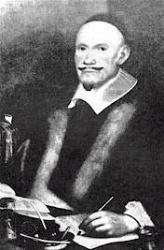
1598 - 1662 Person Name: Johannn Crüger Composer of "NUN DANKET" in The Cyber Hymnal Johann Crüger (b. Grossbriesen, near Guben, Prussia, Germany, 1598; d. Berlin, Germany, 1662) Crüger attended the Jesuit College at Olmutz and the Poets' School in Regensburg, and later studied theology at the University of Wittenberg. He moved to Berlin in 1615, where he published music for the rest of his life. In 1622 he became the Lutheran cantor at the St. Nicholas Church and a teacher for the Gray Cloister. He wrote music instruction manuals, the best known of which is Synopsis musica (1630), and tirelessly promoted congregational singing. With his tunes he often included elaborate accompaniment for various instruments. Crüger's hymn collection, Neues vollkomliches Gesangbuch (1640), was one of the first hymnals to include figured bass accompaniment (musical shorthand) with the chorale melody rather than full harmonization written out. It included eighteen of Crüger's tunes. His next publication, Praxis Pietatis Melica (1644), is considered one of the most important collections of German hymnody in the seventeenth century. It was reprinted forty-four times in the following hundred years. Another of his publications, Geistliche Kirchen Melodien (1649), is a collection arranged for four voices, two descanting instruments, and keyboard and bass accompaniment. Crüger also published a complete psalter, Psalmodia sacra (1657), which included the Lobwasser translation set to all the Genevan tunes.
Bert Polman
===============================
Crüger, Johann, was born April 9, 1598, at Gross-Breese, near Guben, Brandenburg. After passing through the schools at Guben, Sorau and Breslau, the Jesuit College at Olmütz, and the Poets' school at Regensburg, he made a tour in Austria, and, in 1615, settled at Berlin. There, save for a short residence at the University of Wittenberg, in 1620, he employed himself as a private tutor till 1622. In 1622 he was appointed Cantor of St. Nicholas's Church at Berlin, and also one of the masters of the Greyfriars Gymnasium. He died at Berlin Feb. 23, 1662. Crüger wrote no hymns, although in some American hymnals he appears as "Johann Krüger, 1610,” as the author of the supposed original of C. Wesley's "Hearts of stone relent, relent" (q.v.). He was one of the most distinguished musicians of his time. Of his hymn tunes, which are generally noble and simple in style, some 20 are still in use, the best known probably being that to "Nun danket alle Gott" (q.v.), which is set to No. 379 in Hymns Ancient & Modern, ed. 1875. His claim to notice in this work is as editor and contributor to several of the most important German hymnological works of the 16th century, and these are most conveniently treated of under his name. (The principal authorities on his works are Dr. J. F. Bachmann's Zur Geschichte der Berliner Gesangbücher 1857; his Vortrag on P. Gerhard, 1863; and his edition of Gerhardt's Geistliche Lieder, 1866. Besides these there are the notices in Bode, and in R. Eitner's Monatshefte für Musik-Geschichte, 1873 and 1880). These works are:—
1. Newes vollkömmliches Gesangbuch, Augspur-gischer Confession, &c, Berlin, 1640 [Library of St. Nicholas's Church, Berlin], with 248 hymns, very few being published for the first time.
2. Praxis pietatis melica. Das ist: Ubung der Gottseligkeit in Christlichen und trostreichen Gesängen. The history of this, the most important work of the century, is still obscure. The 1st edition has been variously dated 1640 and 1644, while Crüger, in the preface to No. 3, says that the 3rd edition appeared in 1648. A considerable correspondence with German collectors and librarians has failed to bring to light any of the editions which Koch, iv. 102, 103, quotes as 1644, 1647, 1649, 1650, 1651, 1652, 1653. The imperfect edition noted below as probably that of 1648 is the earliest Berlin edition we have been able to find. The imperfect edition, probably ix. of 1659, formerly in the hands of Dr. Schneider of Schleswig [see Mützell, 1858, No. 264] was inaccessible. The earliest perfect Berlin edition we have found is 1653.
The edition printed at Frankfurt in 1656 by Caspar Röteln was probably a reprint of a Berlin edition, c. 1656. The editions printed at Frankfurt-am-Main by B. C. Wust (of which the 1666 is in the preface described as the 3rd) are in considerable measure independent works.
In the forty-five Berlin and over a dozen Frankfurt editions of this work many of the hymns of P. Gerhardt, J. Franck, P. J. Spener, and others, appear for the first time, and therein also appear many of the best melodies of the period.
3. Geistliche Kirchen-Melodien, &c, Leipzig, 1649 [Library of St. Katherine's Church, Brandenburg]. This contains the first stanzas only of 161 hymns, with music in four vocal and two instrumental parts. It is the earliest source of the first stanzas of various hymns by Gerhardt, Franck, &c.
4. D. M. Luther's und anderer vornehmen geisU reichen und gelehrten Manner Geistliche Lieder und Psalmen, &c, Berlin, 1653 [Hamburg Town Library], with 375 hymns. This was edited by C. Runge, the publisher, and to it Crüger contributed some 37 melodies. It was prepared at the request of Luise Henriette (q.v.), as a book for the joint use of the Lutherans and the Re¬formed, and is the earliest source of the hymns ascribed to her, and of the complete versions of many hymns by Gerhardt and Franck.
5. Psalmodia Sacra, &c, Berlin, 1658 [Royal Library, Berlin]. The first section of this work is in an ed. of A. Lobwasser's German Psalter; the second, with a similar title to No. 4, and the date 1657, is practically a recast of No. 4,146 of those in 1653 being omitted, and the rest of the 319 hymns principally taken from the Praxis of 1656 and the hymn-books of the Bohemian Brethren. New eds. appeared in 1676, 1700, 1704, 1711, and 1736.
[Rev. James Mearns, M.A.]
-- Excerpt from John Julian, Dictionary of Hymnology (1907)
=======================
Crüger, Johann, p. 271, ii. Dr. J. Zahn, now of Neuendettelsau, in Bavaria, has recently acquired a copy of the 5th ed., Berlin, 1653, of the Praxis.
--John Julian, Dictionary of Hymnology, Appendix, Part II (1907)
Johann Crüger
Frederick Oakeley
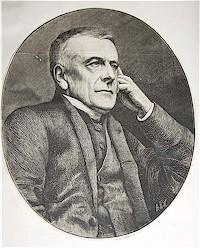
1802 - 1880 Person Name: F. Oakeley (1802-1880) Adapter of "O come, let us adore him" in Hymns for Today's Church (2nd ed.) Frederic Oakeley graduated M.A. at Oxford, and took Orders in the Church of England. He became Prebendary of Lichfield Cathedral, preacher at Whitehall, and incumbent of Margaret Chapel, London. He was active in the "Oxford Movement," and in 1845, called attention to his views for the purpose of seeing if he could continue to hold an Oxford degree, with so great a change in his opinions. The question was tried, and he was perpetually suspended unless he retracted. He then resigned his positions in the Church of England, and entered the Church of Rome, in which he became a Priest, and Canon of the diocese of Westminster. His publications are numerous, and some of them have considerable value.
--Annotations of the Hymnal, Charles Hutchins, M.A., 1872
=================
Oakeley, Frederick, D.D., youngest son of Sir Charles Oakeley, Bart., sometime Governor of Madras, was born at Shrewsbury, Sept. 5, 1802, and educated at Christ Church, Oxford (B.A. 1824). In 1825 he gained a University prize for a Latin Essay; and in 1827 he was elected a Fellow of Balliol. Taking Holy Orders, he was a Prebendary of Lichfield Cathedral, 1832; Preacher at Whitehall, 1837; and Minister of Margaret Chapel, Margaret Street, London, 1839. In 1845 he resigned all his appointments in the Church of England, and was received into the Roman Communion. Subsequently he became a Canon of the Pro-Cathedral in the Roman Catholic ecclesiastical district of Westminster. He died January 29, 1880. Miller (Singers and Songs of the Church, 1869, p. 497), writing from information supplied to him by Canon Oakeley, says:—
”He traces the beginning of his change of view to the lectures of Dr. Charles Lloyd, Regius Professor, delivered at Oxford about the year 1827, on the 'History and Structure of the Anglican Prayer Book.' About that time a great demand arose at Oxford for Missals and Breviaries, and Canon Oakeley, sympathising with the movement, co-operated with the London booksellers in meeting that demand.....He promoted the [Oxford] movement, and continued to move with it till, in 1845, he thought it right to draw attention to his views, to gee if he could continue to hold an Oxford degree in conjunction with so great a change in opinion. The question having been raised, proceedings were taken against him in the Court of Arches, and a sentence given that he was perpetually suspended unless he retracted. He then resigned his Prebendal stall at Lichfield, and went over to the Church of Rome."
Canon Oakeley's poetical works included:—
(1) Devotions Commemorative of the Most Adorable Passion of Our Lord and Saviour Jesus Christ, 1842; (2) The Catholic Florist; (3) The Youthful Martyrs of Rome, a Christian Drama, 1856; (4) Lyra Liturgica; Reflections in Verse for Holy Days and Seasons, 1865.
Canon Oakeley also published several prose works, including a translation of J. M. Horst's Paradise of the Christian Soul, London, Burns, 1850. He is widely known through his translation of the “Adeste fideles.” Several of his original hymns are also in Roman Catholic collections.
--John Julian, Dictionary of Hymnology (1907)
Frederick Oakeley
C. Austin Miles
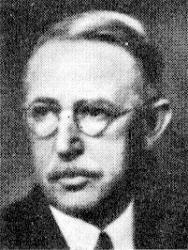
1868 - 1946 Person Name: C. Austin Miles, 1868-1946 Author of "If Jesus Goes With Me" in African American Heritage Hymnal Charles Austin Miles USA 1868-1946. Born at Lakehurst, NJ, he attended the Philadelphia College of Pharmacy and the University of PA. He became a pharmacist. He married Bertha H Haagen, and they had two sons: Charles and Russell. In 1892 he abandoned his pharmacy career and began writing gospel songs. At first he furnished compositions to the Hall-Mack Publishing Company, but soon became editor and manager, where he worked for 37 years. He felt he was serving God better in the gospel song writing business, than as a pharmacist. He published the following song books: “New songs of the gospel” (1900), “The service of praise” (1900), “The voice of praise” (1904), “The tribute of song” (1904), “New songs of the gospel #2” (1905), “Songs of service” (1910), “Ideal Sunday school hymns” (1912). He wrote and/or composed 400+ hymns. He died in Philadelphia, PA.
John Perry
C. Austin Miles
Sigmund von Birken
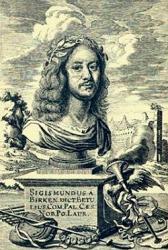
1626 - 1681 Person Name: S. von Birken, c. 1611-1675 Author of "Jesus, I Will Ponder Now" in Evangelical Lutheran Hymnary Birken, Sigismund von, son of Daniel Betulius or Birken, pastor at Wildstein, near Eger, in Bohemia, was born at Wildstein, May 5, 1626. In 1629 his father, along with other Evangelical pastors, was forced to flee from Bohemia, and went to Nürnberg. After passing through the Egidien-Gymnasium at Nürnberg Sigismund entered the University of Jena, in 1643, and there studied both Law and Theology, the latter at his father's dying request. Before completing his course in either he returned to Nürnberg, in 1645, and on account of his poetical gifts was there admitted a member of the Pegnitz Shepherd and Flower Order. At the close of 1645 he was appointed tutor at Wolfenbiittel to the Princes of Brunswick-Luneburg, but after a year (during which he was crowned as a poet), he resigned this post. After a tour, during which he was admitted by Philipp v. Zesen as a member of the German Society (or Patriotic Union), he returned to Nürnberg in 1648, and employed himself as a private tutor. In 1654 he was ennobled on account of his poetic gifts by the Emperor Ferdinand III., was admitted in 1658 as a member of the Fruitbearing Society, and on the death of Harsdörffer, in 1662; became Chief Shepherd of the Pegnitz Order, to which from that time he imparted a distinctly religious cast. He died at Nürnberg, June 12, 1681. (Koch, iii. 478-485; Allgemeine Deutsche Biog., ii. 660; Bode, pp. 44-46; the first dating his death, July, and the last dating his birth, April 25). In his 52 hymns he was not able to shake off the artificial influences of the time, and not many of them have retained a place in German common use. Three have been translated into English:—
i. Auf, auf, mein Herz und du mein ganzer Sinn, Wirf alles heut. [Sunday.] First published (not in 1661, but) in Saubert's Gesang-Buch, Nürnberg, 1076, No. 329, in 10 stanzas. Translated as:—
(1) "Arouse thee up! my Heart, my Thought, my Mind," by H. J. Buckoll, 1842, p. 10. (2) "Awake! awake!—to holy thought aspire," by Dr. H. Mills, 1856.
ii. Jesu, deine Passion. [ Passiontide.] His finest hymn, first published in Saubert's Gesang-Buch, Nürnberg, 1676, No. 83, in 6 stanzas of 8 lines, and included as No. 240 in the Berlin Geistliche Lieder ed., 1863. It did not appear in 1653. Translated as:—
Jesu! be Thy suffering love. A good translation of stanzas i.-iv., by A. T. Russell, as No. 87 in his Psalms and Hymns, 1851. Another translation is:—
"Jesus, on Thy dying love," by W. Reid, in the British Herald, March, 1865, p. 46, repeated in his Praise Book, 1872, No. 435.
iii. Lasset uns mit Jesu ziehen. [Passiontide .] First published in J. M. Dilherr's Heilige Karwochen, Nürnberg, 1653, p. 412, in 4 stanzas of 8 lines. Included as No. 250 in the Berlin Geistliche Lieder, ed. 1863. The only translation in common use is:—
Let us hence, on high ascending . Good and full, by A. T. Russell, as No. 184 in his Psalms & Hymns, 1851. His translations of stanzas iii., iv., were adopted and altered to "Let us now with Christ be dying," as No. 635 in Kennedy, 1863. [Rev. James Mearns, M.A.]
-- John Julian, Dictionary of Hymnology (1907)
Sigmund von Birken
C. W. Naylor
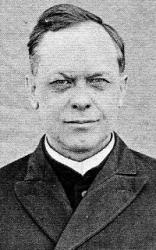
1874 - 1950 Person Name: Charles W. Naylor Author (st. 3-5) of "The Church Has One Foundation" in Timeless Truths Naylor, Charles Wesley. (1874--1950). C. W. Naylor was born in southern Ohio and reared in Ohio and West Virginia by grandparents. At the age of nineteen he left the Methodist church for the Church of God. He worked for a while at the Gospel Trumpet Company in Grand Junction, Michigan and on some evangelistic tours. He was ordained in 1899 in Springfield, Ohio. He was first injured in 1908 in Florida while moving timbers from under a meeting tent. He suffered a dislocated kidney and other internal injuries. A year later he was in a bus accident that left him an invalid for the rest of his life.
Naylor wrote eight books, many articles and pamphlets, many hymns and gospel songs, besides being a columnist in the Gospel Trumpet.
--John W.V. Smith, DNAH Archives
See also: Neidert, David L. (1985). Reformation's Song: A History of Church of God Music. Anderson, Ind.: the author.
C. W. Naylor
Ellen M. H. Gates
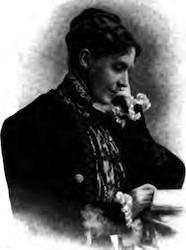
1835 - 1920 Author of "Your Mission" in The Cyber Hymnal Gates, Ellen, née Huntingdon, of Elizabeth, New Jersey, is the author of several popular pieces in the American Mission and Sunday School hymn-books. Of these the following have passed from the American books into Sankey's Sacred Songs and Solos:—
1. Come home, come home, you are weary at heart. Invitation.
2. I am now a child of God. Saved through Jesus.
3. I will sing you a song of that beautiful land. Concerning Heaven.
4. O the clanging bells of time. Yearning for Heaven.
5. Say, is your lamp burning, my brother. Watching and Waiting.
Concerning her poem which is used as a hymn in America, "If you cannot on the ocean" (Duty), Duffield says her account of its origin is as follows:—"The lines were written upon my slate one snowy afternoon in the winter of 1860. I knew, as I know now, that the poem was only a simple little thing, but somehow 1 had a presentiment that it had wings, and would fly into sorrowful hearts, uplifting and strengthening them." (English Hymns, 1886, p. 257.)
--John Julian, Dictionary of Hymnology, Appendix, Part II (1907)
======================
Gates, Ellen, p. 1565, i., now (1906) of New York city, was born at Torrington, Conn., and married to Isaac E. Gates. Her poems, &c, were published as Treasures of Kurium, 1895. Concerning Dr. March's hymn, "Hark! the voice of Jesus crying" (q.v.), and Mrs. Gates's "If you cannot on the ocean," some confusion has arisen, mainly, we think, from the fact that the opening line of Mrs. Gates's hymn, written in 1860, and the first line of Dr. March's second stanza are nearly the same, i.e., "If you cannot on the ocean," and "If you cannot cross the ocean." The incident which associates the late President Lincoln's name with this hymn is thus set forth by Mr. Philip Phillips in his Singing Pilgrim, 1866, p. 97:—
"The words of this truly beautiful song ['If you cannot on the ocean'] were written by Mrs. Ellen H. Gates . . . When our lamented President Lincoln heard Mr. Phillips sing it at the Hall of Representatives in Washington, Feb. 29, 1865, he was overcome with emotion, and sent up the following written request [given in facsimile on p. 97] to Hon. Wm. H. Seward, Chairman, for its repetition:—' Near the end let us have "Your Mission" [the title of the hymn] repeated by Mr. Phillips. Don't say I called for it. A. Lincoln.' "
It was through this incident that the hymn became known through America as " President Lincoln's favourite hymn." [Rev. James Mearns, M.A.]
--John Julian, Dictionary of Hymnology, New Supplement (1907)
Ellen M. H. Gates
Pages




