

 My Starred Hymns
 My FlexScores
 My Hymnals
 My Purchased Files
Planning worship?
Check out our sister site, ZeteoSearch.org,
for 20+ additional resources related to your search.
- |
User Links
Person Results
Charles V. Stanford
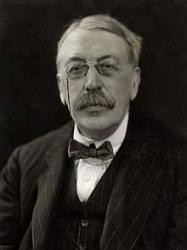
1852 - 1924 Person Name: Charles Villiers Stanford Topics: Circumcision of Christ Collect; Circumcision of Christ Epistle Composer of "ENGELBERG" in Magnify the Lord Sir Charles Villiers Stanford (30 September 1852 – 29 March 1924) was an Irish composer, teacher and conductor. Born to a well-off and highly musical family in Dublin, Stanford was educated at the University of Cambridge before studying music in Leipzig and Berlin. He was instrumental in raising the status of the Cambridge University Musical Society, attracting international stars to perform with it.
While still an undergraduate, Stanford was appointed organist of Trinity College, Cambridge. In 1882, aged 29, he was one of the founding professors of the Royal College of Music, where he taught composition for the rest of his life. From 1887 he was also the professor of music at Cambridge. As a teacher, Stanford was sceptical about modernism, and based his instruction chiefly on classical principles as exemplified in the music of Brahms. Among his pupils were rising composers whose fame went on to surpass his own, such as Gustav Holst and Ralph Vaughan Williams. As a conductor, Stanford held posts with the Bach Choir and the Leeds triennial music festival.
Stanford composed a substantial number of concert works, including seven symphonies, but his best-remembered pieces are his choral works for church performance, chiefly composed in the Anglican tradition. He was a dedicated composer of opera, but none of his nine completed operas has endured in the general repertory. Some critics regarded Stanford, together with Hubert Parry and Alexander Mackenzie, as responsible for a renaissance in English music. However, after his conspicuous success as a composer in the last two decades of the 19th century, his music was eclipsed in the 20th century by that of Edward Elgar as well as former pupils.
Stanford was born in Dublin, the only son of John James Stanford and his second wife, Mary, née Henn. John Stanford was a prominent Dublin lawyer, Examiner to the Court of Chancery in Ireland and Clerk of the Crown for County Meath. His wife was the third daughter of William Henn, Master of the High Court of Chancery in Ireland. Both parents were accomplished amateur musicians; John Stanford was a cellist and a noted bass singer who was chosen to perform the title role in Mendelssohn's Elijah at the Irish premiere in 1847. Mary Stanford was an amateur pianist, capable of playing the solo parts in concertos at Dublin concerts.
The young Stanford was given a conventional education at a private day school in Dublin run by Henry Tilney Bassett, who concentrated on the classics to the exclusion of other subjects. Stanford's parents encouraged the boy's precocious musical talent, employing a succession of teachers in violin, piano, organ and composition. Three of his teachers were former pupils of Ignaz Moscheles, including his godmother Elizabeth Meeke, of whom Stanford recalled, "She taught me, before I was twelve years old, to read at sight. … She made me play every day at the end of my lesson a Mazurka of Chopin: never letting me stop for a mistake. … By the time I had played through the whole fifty-two Mazurkas, I could read most music of the calibre my fingers could tackle with comparative ease." One of the young Stanford's earliest compositions, a march in D♭ major, written when he was eight years old, was performed in the pantomime at the Theatre Royal, Dublin three years later. At the age of nine, Stanford gave a piano recital for an invited audience, playing works by Beethoven, Handel, Mendelssohn, Moscheles, Mozart and Bach. One of his songs was taken up by the University of Dublin Choral Society and was well received.
In the 1860s Dublin received occasional visits from international stars, and Stanford was able to hear famous performers such as Joseph Joachim, Henri Vieuxtemps and Adelina Patti. The annual visit of the Italian Opera Company from London, led by Giulia Grisi, Giovanni Matteo Mario and later Thérèse Tietjens, gave Stanford a taste for opera that remained with him all his life. When he was ten, his parents took him to London for the summer, where he stayed with his mother's uncle in Mayfair. While there he took composition lessons from the composer and teacher Arthur O'Leary, and piano lessons from Ernst Pauer, professor of piano at the Royal Academy of Music (RAM). On his return to Dublin, his godmother having left Ireland, he took lessons from Henrietta Flynn, another former Leipzig Conservatory pupil of Moscheles, and later from Robert Stewart, organist of St Patrick's Cathedral, as well as from a third Moscheles pupil, Michael Quarry. During his second spell in London two years later, he met the composer Arthur Sullivan and the musical administrator and writer George Grove, who later played important parts in his career.
John Stanford hoped that his son would follow him into the legal profession but accepted his decision to pursue music as a career. However, he stipulated that Stanford should have a conventional university education before going on to musical studies abroad. Stanford tried unsuccessfully for a classics scholarship at Trinity Hall, Cambridge, but gained an organ scholarship, and later a classics scholarship, at Queens' College. By the time he went up to Cambridge he had written a substantial number of compositions, including vocal music, both sacred and secular, and orchestral works (a rondo for cello and orchestra and a concert overture).
Stanford immersed himself in the musical life of the university to the detriment of his Latin and Greek studies. He composed religious and secular vocal works, a piano concerto, and incidental music for Longfellow's play A Spanish Student. In November 1870 he appeared as piano soloist with the Cambridge University Musical Society (CUMS), and quickly became its assistant conductor and a committee member. The society had declined in excellence since its foundation in 1843. Its choir consisted solely of men and boys; the lack of women singers severely limited the works that the society could present. Stanford was unable to persuade the members to admit women, and so he staged what The Musical Times called "a bloodless revolution." In February 1872 he co-founded a mixed choir, the Amateur Vocal Guild, whose performances immediately put those of the CUMS singers in the shade. The members of CUMS rapidly changed their minds, and agreed to a merger of the two choirs, with women given associate membership of the society.
The conductor of the combined choir was John Larkin Hopkins, who was also organist of Trinity College. He became ill, and handed over the conductorship to Stanford in 1873. Stanford was also appointed Hopkins's deputy organist at Trinity, and moved from Queens' to Trinity in April 1873. In the summer of that year Stanford made his first trip to continental Europe. He went to Bonn for the Schumann Festival held there, where he met Joachim and Brahms. His growing love of the music of Schumann and Brahms marked him as a classicist at a time when many music-lovers were divided into the classical or the modernist camps, the latter represented by the music of Liszt and Wagner. Stanford was not constrained by the fashion for belonging to one camp or the other; he immensely admired Die Meistersinger though he was unenthusiastic about some of Wagner's other works. After leaving Bonn he returned home by way of Switzerland and then Paris, where he saw Meyerbeer's Le prophète.
Hopkins's illness proved fatal, and after his death the Trinity authorities invited Stanford to take over as organist of the college. He accepted with the proviso that he was to be released each year for a spell of musical study in Germany. The fellows of the college resolved on 21 February 1874:
Two days after his appointment, Stanford took the final examinations for his classics degree. He ranked 65th of 66, and was awarded a third-class degree.
On the recommendation of Sir William Sterndale Bennett, former professor of music at Cambridge and now director of the Royal Academy of Music, Stanford went to Leipzig in the summer of 1874 for lessons with Carl Reinecke, professor of composition and piano at the Leipzig Conservatory. The composer Thomas Dunhill commented that by 1874 it was "the tail-end of the Leipzig ascendancy, when the great traditions of Mendelssohn had already begun to fade." Nevertheless, Stanford did not seriously consider studying anywhere else. Neither Dublin nor London offered any comparable musical training; the most prestigious British music school, the RAM, was at that time hidebound and reactionary. He was dismayed to find in Leipzig that Bennett had recommended him to a German pedant no more progressive than the teachers at the RAM. Stanford said of Reinecke, "Of all the dry musicians I have ever known he was the most desiccated. He had not a good word for any contemporary composer… He loathed Wagner … sneered at Brahms and had no enthusiasm of any sort." Stanford's biographer Paul Rodmell suggests that Reinecke's ultra-conservatism may have been unexpectedly good for his pupil "as it may have encouraged Stanford to kick against the traces." During his time in Leipzig Stanford took piano lessons from Robert Papperitz (1826–1903), organist of the city's Nikolaikirche, whom he found more helpful.
Among Stanford's compositions in 1874 was a setting of part one of Longfellow's poem "The Golden Legend." He intended to set the entire poem, but gave up, defeated by Longfellow's "numerous but unconnected characters." Stanford ignored this and other early works when assigning opus numbers in his mature years. The earliest compositions in his official list of works are a four-movement Suite for piano and a Toccata for piano, which both date from 1875.
After a second spell in Leipzig with Reinecke in 1875, which was no more productive than the first, Stanford was recommended by Joachim to study in Berlin the following year with Friedrich Kiel, whom Stanford found "a master at once sympathetic and able … I learnt more from him in three months, than from all the others in three years."
Returning to Cambridge in the intervals of his studies in Germany, Stanford had resumed his work as conductor of CUMS. He found the society in good shape under his deputy, Eaton Faning, and able to tackle demanding new works. In 1876 the society presented one of the first performances in Britain of the Brahms Requiem. In 1877 CUMS came to national attention when it presented the first British performance of Brahms's First Symphony.
During the same period, Stanford was becoming known as a composer. He was composing prolifically, though he later withdrew some of his works from these years, including a violin concerto which, according to Rodmell, suffered from "undistinguished thematic material." In 1875 his First Symphony won the second prize in a competition held at the Alexandra Palace for symphonies by British composers, although he had to wait a further two years to hear the work performed. In the same year Stanford directed the first performance of his oratorio "The Resurrection," given by CUMS. At the request of Alfred Tennyson, he wrote incidental music for Tennyson's drama Queen Mary, performed at the Lyceum Theatre, London in April 1876.
In April 1878, despite the disapproval of his father, Stanford married Jane Anna Maria Wetton, known as Jennie, a singer whom he had met when she was studying in Leipzig. They had a daughter, Geraldine Mary, born in 1883 and a son, Guy Desmond, born in 1885.
In 1878 and 1879 Stanford worked on his first opera, The Veiled Prophet, to a libretto by his friend William Barclay Squire. It was based on a poem by Thomas Moore with characters including a virgin priestess and a mystic prophet, and a plot that culminates in poisoning and stabbing. Stanford offered the work to the opera impresario Carl Rosa, who refused it and suggested that the composer should try to have it staged in Germany: "Its success will (unfortunately) have much greater chances here if accepted abroad." Referring to the enormous popularity of Sullivan's comic operas, Rosa added, "If the work was of the Pinafore style it would be quite another matter." Stanford had greatly enjoyed Sullivan's Cox and Box, but The Veiled Prophet was intended to be a serious work of high drama and romance. Stanford had made many useful contacts during his months in Germany, and his friend the conductor Ernst Frank got the piece staged at the Königliches Schauspiel in Hanover in 1881. Reviewing the premiere for The Musical Times, Stanford's friend J A Fuller Maitland wrote, "Mr. Stanford's style of instrumentation … is built more or less on that of Schumann; while his style of dramatic treatment bears more resemblance to Meyerbeer than to that of any other master." Other reviews were mixed, and the opera had to wait until 1893 for its English premiere. Stanford nevertheless continued to seek operatic success throughout his career. In his lifelong enthusiasm for opera he differed strikingly from his contemporary Hubert Parry, who made one attempt at composing opera and then renounced the genre.
By the early 1880s, Stanford was becoming a major figure in the British musical scene. His only major rivals were seen as Sullivan, Frederic Hymen Cowen, Parry, Alexander Mackenzie and Arthur Goring Thomas. Sullivan was by this time viewed with suspicion in high-minded musical circles for composing comic rather than grand operas; Cowen was regarded more as a conductor than as a composer; and the other three, though seen as promising, had not so far made a clear mark as Stanford had done. Stanford helped Parry in particular to gain recognition, commissioning incidental music from him for a Cambridge production of Aristophanes' The Birds and a symphony (the "Cambridge") for the musical society. At Cambridge Stanford continued to raise the profile of CUMS, as well as his own, by securing appearances by leading international musicians including Joachim, Hans Richter, Alfredo Piatti and Edward Dannreuther. The society attracted further attention by premiering works by Cowen, Parry, Mackenzie, Goring Thomas and others. Stanford was also making an impression in his capacity as organist of Trinity, raising musical standards and composing what his biographer Jeremy Dibble calls "some highly distinctive church music" including a Service in B♭ (1879), the anthem "The Lord is my shepherd" (1886) and the motet Justorum animae (1888).
In the first half of the 1880s, Stanford collaborated with the author Gilbert à Beckett on two operas, Savonarola, and The Canterbury Pilgrims. The former was well received at its premiere in Hamburg in April 1884, but received a critical savaging when staged at Covent Garden in July of the same year. Parry commented privately, "It seems very badly constructed for the stage, poorly conceived and the music, though clean and well-managed, is not striking or dramatic." The most severe public criticism was in The Theatre, whose reviewer wrote, "The book of Savonarola is dull, stilted, and, from a dramatic point of view, weak. It is not, however, so crushingly tiresome as the music fitted to it. Savonarola has gone far to convince me that opera is quite out of [Stanford's] line and that the sooner he abandons the stage for the cathedral, the better for his musical reputation." The Canterbury Pilgrims had been premiered in London in April 1884, three months before Savonarola was presented at Covent Garden. It had a better reception than the latter, though reviews pointed out Stanford's debt to Die Meistersinger, and complained of a lack of emotion in the love music. George Grove agreed with the critics, writing to Parry, "Charlie's music contains everything but sentiment. Love not at all – that I heard not a grain of. … And I do think that there might be more tune. Melody is not a thing to be avoided surely." In 1896 a critic wrote that the opera had "just such a 'book' as would have suited the late Alfred Cellier. He would probably have made of it a charming light English opera. But Dr. Stanford has chosen to use it for the exemplification of those advanced theories which we know him to hold, and he has given us music which would incline us to think that Die Meistersinger had been his model. The effect of the combination is not happy."
In 1883, the Royal College of Music was set up to replace the short-lived and unsuccessful National Training School for Music (NTSM). Neither the NTSM nor the longer-established Royal Academy of Music had provided adequate musical training for professional orchestral players, and the founder-director of the college, George Grove, was determined that the new institution should succeed in doing so. His two principal allies in this undertaking were the violinist Henry Holmes and Stanford. In a study of the founding of the college, David Wright notes that Stanford had two main reasons for supporting Grove's aim. The first was his belief that a capable college orchestra was essential to give students of composition the chance to experience the sound of their music. His second reason was the severe contrast between the competence of German orchestras and the performance of their British counterparts. He accepted Grove's offer of the posts of professor of composition and (with Holmes) conductor of the college orchestra. He held the professorship for the rest of his life; among the best known of his many pupils were Samuel Coleridge-Taylor, Gustav Holst, Ralph Vaughan Williams, John Ireland, Frank Bridge and Arthur Bliss.
Stanford was never an easy-going teacher. He insisted on one-to-one tutorials, and worked his pupils hard. One of them, Herbert Howells, recalled, "Corner any Stanford pupil you like, and ask him to confess the sins he most hated being discovered in by his master. He will tell you 'slovenliness' and 'vulgarity.' When these went into the teacher's room they came out, badly damaged. Against compromise with dubious material or workmanship Stanford stubbornly set his face." Another pupil, Edgar Bainton, recalled:
Stanford's teaching seemed to be without method or plan. His criticism consisted for the most part of "I like it, my boy," or "It's damned ugly, my boy" (the latter in most cases). In this, perhaps, lay its value. For in spite of his conservatism, and he was intensely and passionately conservative in music as in politics, his amazingly comprehensive knowledge of musical literature of all nations and ages made one feel that his opinions, however irritating, had weight.
To Stanford's regret, many of his pupils who achieved eminence as composers broke away from his classical, Brahmsian precepts, as he had himself rebelled against Reinecke's conservatism. The composer George Dyson wrote, "In a certain sense the very rebellion he fought was the most obvious fruit of his methods. And in view of what some of these rebels have since achieved, one is tempted to wonder whether there is really anything better a teacher can do for his pupils than drive them into various forms of revolution." The works of some of Stanford's pupils, including Holst and Vaughan Williams, entered the general repertory in Britain, and to some extent elsewhere, as Stanford's never did. For many years after his death it seemed that Stanford's greatest fame would be as a teacher. Among his achievements at the RCM was the establishment of an opera class, with at least one operatic production every year. From 1885 to 1915 there were 32 productions, all of them conducted by Stanford.
In 1887 Stanford was appointed professor of music at Cambridge in succession to Sir George Macfarren who died in October of that year. Up to this time, the university had awarded music degrees to candidates who had not been undergraduates at Cambridge; all that was required was to pass the university's music examinations. Stanford was determined to end the practice, and after six years he persuaded the university authorities to agree. Three years' study at the university became a prerequisite for sitting the bachelor of music examinations.
During the last decades of the 19th century, Stanford's academic duties did not prevent him from composing or performing. He was appointed conductor of the Bach Choir, London, in 1885, succeeding its founding conductor Otto Goldschmidt. He held the post until 1902. Hans von Bülow conducted the German premiere of Stanford's Irish Symphony in Hamburg in January 1888, and was sufficiently impressed by the work to programme it in Berlin shortly afterwards. Richter conducted it in Vienna, and Mahler later conducted it in New York. For the Theatre Royal, Cambridge, Stanford composed incidental music for productions of Aeschylus's The Eumenides (1885), and Sophocles' Oedipus Tyrannos (1887). The Times said of the former, "Mr. Stanford's music is dramatically significant, as well as beautiful in itself. It has, moreover, that quality so rare among modern composers – style." In both sets of music Stanford made extensive use of leitmotifs, in the manner of Wagner; the critic of The Times noted the Wagnerian character of the prelude to Oedipus.
In the 1890s, Bernard Shaw writing as "Corno di Bassetto", music critic of The World, voiced mixed feelings about Stanford. In Shaw's view, the best of Stanford's works displayed an uninhibited, Irish, character. The critic was dismissive of the composer's solemn Victorian choral music. In July 1891, Shaw's column was full of praise for Stanford's capacity for spirited tunes, declaring that Richard D'Oyly Carte should engage him to succeed Sullivan as the composer of Savoy operas. In October of the same year, Shaw attacked Stanford's oratorio Eden, bracketing the composer with Parry and Mackenzie as a mutual admiration society, purveying "sham classics":
[W]ho am I that I should be believed, to the disparagement of eminent musicians? If you doubt that Eden is a masterpiece, ask Dr Parry and Dr Mackenzie, and they will applaud it to the skies. Surely Dr Mackenzie’s opinion is conclusive; for is he not the composer of Veni Creator, guaranteed as excellent music by Professor Stanford and Dr Parry? You want to know who Parry is? Why, the composer of "Blest Pair of Sirens," as to the merits of which you only have to consult Dr Mackenzie and Professor Stanford.
To Fuller Maitland, the trio of composers lampooned by Shaw were the leaders of an English musical renaissance (although neither Stanford nor Mackenzie was English). This view persisted in some academic circles for many years.
Stanford returned to opera in 1893, with an extensively revised and shortened version of The Veiled Prophet. It had its British premiere at Covent Garden in July. His friend Fuller Maitland was by this time the chief music critic of The Times, and the paper's review of the opera was laudatory. According to Fuller Maitland The Veiled Prophet was the best novelty of an opera season that had also included Leoncavallo's Pagliacci, Bizet's Djamileh and Mascagni's I Rantzau. Stanford's next opera was Shamus O'Brien (1896), a comic opera to a libretto by George H. Jessop. The conductor was the young Henry Wood, who recalled in his memoirs that the producer, Sir Augustus Harris, managed to quell the dictatorial composer and prevent him from interfering with the staging. Stanford attempted to give Wood lessons in conducting, but the young man was unimpressed. The opera was successful, running for 82 consecutive performances. The work was given in German translation in Breslau in 1907; Thomas Beecham thought it "a colourful, racy work", and revived it in his 1910 opéra comique season at His Majesty's Theatre, London.
At the end of 1894, Grove retired from the Royal College of Music. Parry was chosen to succeed him, and although Stanford wholeheartedly congratulated his friend on his appointment, their relations soon deteriorated. Stanford was known as a hot-tempered and quarrelsome man. Grove had written of a board meeting at the Royal College "where somehow the spirit of the d----l himself had been working in Stanford all the time – as it sometimes does, making him so nasty and quarrelsome and contradictious as no one but he can be! He is a most remarkably clever and able fellow, full of resource and power – no doubt of that – but one has to purchase it often at a very dear price." Parry suffered worse at Stanford's hands with frequent rows, deeply upsetting to the highly-strung Parry. Some of their rows were caused by Stanford's reluctance to accept the authority of his old friend and protégé, but on other occasions Parry seriously provoked Stanford, notably in 1895 when he reduced the funding for Stanford's orchestral classes.
In 1898, Sullivan, ageing and unwell, resigned as conductor of the Leeds triennial music festival, a post which he had held since 1880. He believed that Stanford's motive for accepting the conductorship of the Leeds Philharmonic Society the previous year was to position himself to take over the festival. Stanford later felt obliged to write to The Times, denying that he had been party to a conspiracy to oust Sullivan. Sullivan was by then thought to be a dull conductor of other composers' music, and although Stanford's work as a conductor was not without its critics, he was appointed in Sullivan's place. He remained in charge until 1910. His compositions for the festival included "Songs of the Sea" (1904), "Stabat Mater" (1907) and "Songs of the Fleet (1910)." New works by other composers presented at Leeds during Stanford's years in charge included pieces by Parry, Mackenzie, and seven of Stanford's former pupils. The best-known new work from Stanford's time is probably Vaughan Williams's A Sea Symphony, premiered in 1910.
In 1901 Stanford returned once again to opera, with a version of Much Ado About Nothing, to a libretto by Julian Sturgis that was exceptionally faithful to Shakespeare's original. The Manchester Guardian commented, "Not even in the Falstaff of Arrigo Boito and Giuseppe Verdi have the characteristic charm, the ripe and pungent individuality of the original comedy been more sedulously preserved."
Despite good notices for the opera, Stanford's star was waning. In the first decade of the century, his music became eclipsed by that of a younger composer, Edward Elgar. In the words of the music scholar Robert Anderson, Stanford "had his innings with continental reputation in the latter decades of the nineteenth century, but then Elgar bowled him out." When Elgar was struggling for recognition in the 1890s, Stanford had been supportive of his younger colleague, conducting his music, putting him forward for a Cambridge doctorate, and proposing him for membership of the exclusive London club, the Athenaeum. He was, however, put out when Elgar's success at home and abroad eclipsed his own, with Richard Strauss (whom Stanford detested) praising Elgar as the first progressive English composer. When Elgar was appointed professor of music at Birmingham University in 1904, Stanford wrote him a letter that the recipient found "odious". Elgar retaliated in his inaugural lecture with remarks about composers of rhapsodies, widely seen as denigrating Stanford. Stanford later counter-attacked in his book A History of Music, writing of Elgar, "Cut off from his contemporaries by his religion and his want of regular academic training, he was lucky enough to enter the field and find the preliminary ploughing done."
Though bitter about being sidelined, Stanford continued to compose. Between the turn of the century and the outbreak of the First World War in 1914 his new works included a violin concerto (1901), a clarinet concerto (1902), a sixth and a seventh (and last) symphony (1906 and 1911), and his second piano concerto (1911). In 1916 he wrote his penultimate opera, The Critic. It was a setting of Sheridan's comedy of the same name, with the original text left mostly intact by the librettist, Lewis Cairns James. The work was well received at the premiere at the Shaftesbury Theatre, London, and was taken up later in the year by Beecham, who staged it in Manchester and London.
The First World War had a severe effect on Stanford. He was frightened by air-raids, and had to move from London to Windsor to avoid them. Many of his former pupils were casualties of the fighting, including Arthur Bliss, injured, Ivor Gurney, gassed, and George Butterworth, killed. The annual RCM operatic production, which Stanford had supervised and conducted every year since 1885, had to be cancelled. His income declined, as the fall in student numbers at the college reduced the demand for his services. After a serious disagreement at the end of 1916, his relationship with Parry deteriorated to the point of hostility. Stanford's magnanimity, however, came to the fore when Parry died two years later and Stanford successfully lobbied for him to be buried in St Paul's Cathedral.
After the war, Stanford handed over much of the direction of the RCM's orchestra to Adrian Boult, but continued to teach at the college. He gave occasional public lectures, including one on "Some Recent Tendencies in Composition", in January 1921 which was belligerently hostile to most of the music of the generation after his own. His last public appearance was on 5 March 1921 conducting the Royal Choral Society in his new cantata, At the Abbey Gate. Reviews were polite but unenthusiastic. The Times said, "we could not feel that the music had enough emotion behind it", The Observer thought it "quite appealing even though one feels it to be more facile than powerful."
In September 1922, Stanford completed the sixth Irish Rhapsody, his final work. Two weeks later he celebrated his 70th birthday; thereafter his health declined. On 17 March 1924 he suffered a stroke and on 29 March he died at his home in London, survived by his wife and children. He was cremated at Golders Green Crematorium on 2 April and his ashes were buried in Westminster Abbey the following day. The orchestra of the Royal College of Music, conducted by Boult, played music by Stanford, ending the service with a funeral march that he had written for Tennyson's Becket in 1893. The grave is in the north choir aisle of the Abbey, near the graves of Henry Purcell, John Blow and William Sterndale Bennett. The Times said, "the conjunction of the music of Stanford with that of his great predecessors showed how thoroughly as composer he belonged to their line."
Stanford's last opera, The Travelling Companion, composed during the war, was premiered by amateur performers at the David Lewis Theatre, Liverpool in 1925 with a reduced orchestra. The work was given complete at Bristol in 1928 and at Sadler's Wells Theatre, London, in 1935.
Stanford received many honours, including honorary doctorates from Oxford (1883), Cambridge (1888), Durham (1894), Leeds (1904), and Trinity College, Dublin (1921). He was knighted in 1902 and in 1904 was elected a member of the Royal Academy of Arts, Berlin.
In Stanford's music the sense of style, the sense of beauty, the feeling of a great tradition is never absent. His music is in the best sense of the word Victorian, that is to say it is the musical counterpart of the art of Tennyson, Watts and Matthew Arnold.
Stanford composed about 200 works, including seven symphonies, about 40 choral works, nine operas, 11 concertos and 28 chamber works, as well as songs, piano pieces, incidental music, and organ works. He suppressed most of his earliest compositions; the earliest of works that he chose to include in his catalogue date from 1875.
Throughout his career as a composer, Stanford's technical mastery was rarely in doubt. The composer Edgar Bainton said of him, "Whatever opinions may be held upon Stanford's music, and they are many and various, it is, I think, always recognised that he was a master of means. Everything he turned his hand to always 'comes off.'" On the day of Stanford's death, one former pupil, Gustav Holst, said to another, Herbert Howells, "The one man who could get any one of us out of a technical mess is now gone from us."
After Stanford's death most of his music was quickly forgotten, with the exception of his works for church performance. His Stabat Mater and Requiem held their place in the choral repertoire, the latter championed by Sir Thomas Beecham. Stanford's two sets of sea songs and the song "The Blue Bird" were still performed from time to time, but even his most popular opera, Shamus O'Brien came to seem old fashioned with its "stage-Irish" vocabulary. However, in his 2002 study of Stanford Dibble writes that the music, increasingly available on disc if not in live performance, still has the power to surprise. In Dibble's view, the frequent charge that Stanford is "Brahms and water" was disproved once the symphonies and concertos, much of the chamber music and many of the songs became available for reappraisal when recorded for compact disc. In 2002, Rodmell's study of Stanford included a discography running to 16 pages.
The criticism most often made of Stanford's music by writers from Shaw onwards is that his music lacks passion. Shaw praised "Stanford the Celt" and abominated "Stanford the Professor", who reined in the emotions of the Celt. In Stanford's church music, the critic Nicholas Temperley finds "a thoroughly satisfying artistic experience, but one that is perhaps lacking in deeply felt religious impulse." In his operas and elsewhere, Grove, Parry and later commentators found music that ought to convey love and romance failing to do so. Like Parry, Stanford strove for seriousness, and his competitive streak led him to emulate Sullivan not in comic opera, for which Stanford had a real gift, but in oratorio in what Rodmell calls grand statements that "only occasionally matched worthiness with power or profundity."
--excerpts from en.wikipedia.org
Charles V. Stanford
Caroline M. Noel
1817 - 1877 Person Name: Caroline Maria Noel Topics: Circumcision of Christ Collect; Circumcision of Christ Epistle Author of "At the name of Jesus Ev'ry knee shall bow" in Magnify the Lord Caroline Marie Noel (b. Teston, Kent, England, 1817; d. St. Marylebone, London, England, 1877) The daughter of an Anglican clergyman and hymn writer, she began to write poetry in her late teens but then abandoned it until she was in her forties. During those years she suffered frequent bouts of illness and eventually became an invalid. To encourage both herself and others who were ill or incapacitated, Noel began to write devotional verse again. Her poems were collected in The Name of Jesus and Other Verses for the Sick and Lonely (1861, enlarged in 1870).
Bert Polman
================
Noel, Caroline Maria, daughter of the Hon. Gerard T. Noel (p. 809, ii.), and niece of the Hon. Baptist W. Noel, was born in London, April 10, 1817, and died at 39 Great Cumberland Place, Hyde Park, Dec. 7, 1877. Her first hymn, "Draw nigh unto my soul" (Indwelling), was written when she was 17. During the next three years she wrote about a dozen pieces: from 20 years of age to 40 she wrote nothing; and during the next 20 years the rest of her pieces were written. The first edition of her compositions was published as The Name of Jesus and Other Verses for the Sick and Lonely, in 1861. This was enlarged from time to time, and its title subsequently changed by the publishers to The Name of Jesus and Other Poems. The 1878 ed. contains 78 pieces.
Miss Noel, in common with Miss Charlotte Elliott, was a great sufferer, and many of these verses were the outcome of her days of pain. They are specially adapted "for the Sick and Lonely" and were written rather for private meditation than for public use, although several are suited to the latter purpose. Her best known hymn is the Processional for Ascension Day, "At the Name of Jesus." It is in the enlarged edition of The Name of Jesus, &c, 1870, p. 59, and is dated 1870 by her family.
--John Julian, Dictionary of Hymnology, Appendix, Part II (1907)
Caroline M. Noel
William Walsham How
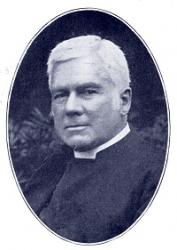
1823 - 1897 Person Name: Bishop W. Walsham How Topics: Circumcision of Christ January 1 Author of "Jesus, Name of wondrous love!" in The Book of Common Praise William W. How (b. Shrewsbury, Shropshire, England, 1823; d. Leenane, County Mayo, Ireland, 1897) studied at Wadham College, Oxford, and Durham University and was ordained in the Church of England in 1847. He served various congregations and became Suffragan Bishop in east London in 1879 and Bishop of Wakefield in 1888. Called both the "poor man's bishop" and "the children's bishop," How was known for his work among the destitute in the London slums and among the factory workers in west Yorkshire. He wrote a number of theological works about controversies surrounding the Oxford Movement and attempted to reconcile biblical creation with the theory of evolution. He was joint editor of Psalms and Hymns (1854) and Church Hymns (1871). While rector in Whittington, How wrote some sixty hymns, including many for children. His collected Poems and Hymns were published in 1886.
Bert Polman
===============
How, William Walsham, D.D., son of William Wybergh How, Solicitor, Shrewsbury, was born Dec. 13, 1823, at Shrewsbury, and educated at Shrewsbury School and Wadham College, Oxford (B.A. 1845). Taking Holy Orders in 1846, he became successively Curate of St. George's, Kidderminster, 1846; and of Holy Cross, Shrewsbury, 1848. In 1851 he was preferred to the Rectory of Whittington, Diocese of St. Asaph, becoming Rural Dean in 1853, and Hon. Canon of the Cathedral in 1860. In 1879 he was appointed Rector of St. Andrew's Undershaft, London, and was consecrated Suffragan Bishop for East London, under the title of the Bishop of Bedford, and in 1888 Bishop of Wakefield. Bishop How is the author of the Society for Promoting Christian Knowledge Commentary on the Four Gospels; Plain Words , Four Series; Plain Words for Children; Pastor in Parochia; Lectures on Pastoral Work; Three All Saints Summers, and Other Poems , and numerous Sermons , &c. In 1854 was published Psalms and Hymns, Compiled by the Rev. Thomas Baker Morrell, M.A., . . . and the Rev. William Walsham How, M.A. This was republished in an enlarged form in 1864, and to it was added a Supplement in 1867. To this collection Bishop How contributed several hymns, and also to the S. P. C. K. Church Hymns , of which he was joint editor, in 1871. The Bishop's hymns in common use amount in all to nearly sixty.
Combining pure rhythm with great directness and simplicity, Bishop How's compositions arrest attention more through a comprehensive grasp of the subject and the unexpected light thrown upon and warmth infused into facia and details usually shunned by the poet, than through glowing imagery and impassioned rhetoric. He has painted lovely images woven with tender thoughts, but these are few, and found in his least appreciated work. Those compositions which have laid the firmest hold upon the Church, are simple, unadorned, but enthusiastically practical hymns, the most popular of which, "O Jesu, Thou art standing"; "For all the Saints who from their labours rest," and "We give Thee but Thine own," have attained to a foremost rank. His adaptations from other writers as in the case from Bishop Ken, "Behold, the Master passeth by," are good, and his Children's hymns are useful and popular. Without any claims to rank as a poet, in the sense in which Cowper and Montgomery were poets, he has sung us songs which will probably outlive all his other literary works.
The more important of Bishop How's hymns, including those already named, and "Lord, Thy children guide and keep"; "O Word of God Incarnate"; "This day at Thy creating word"; "Who is this so weak and helpless"; and others which have some special history or feature of interest, are annotated under their respective first lines. The following are also in common use:—
i. From Psalms & Hymns, 1854.
1. Before Thine awful presence, Lord. Confirmation.
2. Jesus, Name of wondrous love [priceless worth]. Circumcision. The Name Jesus .
3. Lord Jesus, when we stand afar. Passiontide.
4. O blessing rich, for sons of men. Members of Christ.
5. 0 Lord of Hosts, the earth is Thine. In time of War.
6. O Lord, Who in Thy wondrous love. Advent.
ii. From Psalms & Hymns, enlarged, 1864.
7. Lord, this day Thy children meet. Sunday School Anniversary.
iii. From Supplement to the Psalms & Hymns, 1867.
8. Hope of hopes and joy of joys. Resurrection.
9. 0 daughters blest of Galilee. For Associations of Women.
10. O happy feet that tread. Public Worship.
11. With trembling awe the chosen three. Transfiguration.
iv. From Parish Magazine, 1871, and Church Hymns, 1871.
12. O Jesu, crucified for man. Friday.
13. Yesterday, with worship blest. Monday.
v. From the S. P. C. K. Church Hymns. 1871.
14. Bowed low in supplication. For the Parish.
15. Great Gabriel sped on wings of light. Annunciation, of the Blessed Virgin Mary.
16. O blest was he, whose earlier skill. St. Luke.
17. O God, enshrined in dazzling light. Omnipresence. Divine Worship .
18. O heavenly Fount of Light and Love. Witsuntide.
19. O Lord, it is a blessed thing. Weekdays.
20. 0 One with God the Father. Epiphany.
21. O Thou through suffering perfect made. Hospitals.
22. Rejoice, ye sons of men. Purification of the B. V. M.
23. Summer suns are glowing. Summer.
24. The year is swiftly waning. Autumn.
25. Thou art the Christ, O Lord. St. Peter.
26. To Thee our God we fly. National Hymn.
27. Upon the holy Mount they stood. Transfiguration and Church Guilds.
28. We praise Thy grace, 0 Saviour. St. Mark.
vi. From the S. P. C. K. Children's Hymns, 1872.
29. Behold a little child. Jesus the Child's Example.
30. Come, praise your Lord and Saviour. Children's Praises.
31. It is a thing most wonderful. Sunday School Anniversary.
32. On wings of living light. Easter.
Bishop How's hymns and sacred and secular pieces were collected and published as Poems and Hymns, 1886. The Hymns, 54 in all, are also published separately. He d. Aug. 10, 1897.
--John Julian, Dictionary of Hymnology (1907)
===================
How, W. W., p. 540, i. He died Aug. 10, 1897. His Memoir, by F. D. How, was published in 1898.
--John Julian, Dictionary of Hymnology, New Supplement (1907)
William Walsham How
Edward Caswall
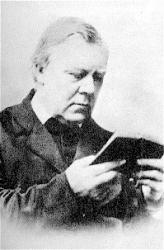
1814 - 1878 Person Name: Rev. E. Caswall Topics: Circumcision of Christ January 1 Translator of "Jesu, the very thought of thee" in The Book of Common Praise Edward Caswall was born in 1814, at Yately, in Hampshire, where his father was a clergyman. In 1832, he went to Brasenose College, Oxford, and in 1836, took a second-class in classics. His humorous work, "The Art of Pluck," was published in 1835; it is still selling at Oxford, having passed through many editions. In 1838, he was ordained Deacon, and in 1839, Priest. He became perpetural Curate of Stratford-sub-Castle in 1840. In 1841, he resigned his incumbency and visited Ireland. In 1847, he joined the Church of Rome. In 1850, he was admitted into the Congregation of the Oratory at Birmingham, where he has since remained. He has published several works in prose and poetry.
--Annotations of the Hymnal, Charles Hutchins, M.A. 1872
=====================
Caswall, Edward, M.A., son of the Rev. R. C. Caswall, sometime Vicar of Yately, Hampshire, born at Yately, July 15, 1814, and educated at Brasenose College, Oxford, graduating in honours in 1836. Taking Holy Orders in 1838, he became in 1840 Incumbent of Stratford-sub-Castle, near Salisbury, and resigned the same in 1847. In 1850 (Mrs. Caswall having died in 1849) he was received into the Roman Catholic communion, and joined Dr. Newman at the Oratory, Edgbaston. His life thenceforth, although void of stirring incidents, was marked by earnest devotion to his clerical duties and a loving interest in the poor, the sick, and in little children. His original poems and hymns were mostly written at the Oratory. He died at Edgbaston, Jan. 2, 1878, and was buried on Jan. 7 at Redwall, near Bromsgrove, by his leader and friend Cardinal Newman. Caswall's translations of Latin hymns from the Roman Breviary and other sources have a wider circulation in modern hymnals than those of any other translator, Dr. Neale alone excepted. This is owing to his general faithfulness to the originals, and the purity of his rhythm, the latter feature specially adapting his hymns to music, and for congregational purposes. His original compositions, although marked by considerable poetical ability, are not extensive in their use, their doctrinal teaching being against their general adoption outside the Roman communion. His hymns appeared in:—
(1) Lyra Catholica, which contained 197 translations from the Roman Breviary, Missal, and other sources. First ed. London, James Burns, 1849. This was reprinted in New York in 1851, with several hymns from other sources added thereto. This edition is quoted in the indices to some American hymn-books as Lyra Cath., as in Beecher's Plymouth Collection, 1855, and others.
(2) Masque of Mary, and Other Poems, having in addition to the opening poem and a few miscellaneous pieces, 53 translations, and 51 hymns. 1st ed. Lon., Burns and Lambert, 1858.
(3) A May Pageant and Other Poems, including 10 original hymns. Lon., Burns and Lambert, 1865.
(4) Hymns and Poems, being the three preceding volumes embodied in one, with many of the hymns rewritten or revised, together with elaborate indices. 1st ed. Lon., Burns, Oates & Co., 1873. Of his original hymns about 20 are given in the Roman Catholic Crown of Jesus Hymn Book, N.D; there are also several in the Hymns for the Year, N.D., and other Roman Catholic collections.
--John Julian, Dictionary of Hymnology (1907)
======================
Caswall, E. , p. 214, ii. Additional original hymns by Caswall are in the Arundel Hymns, 1902, and other collections. The following are from the Masque of Mary, &c, 1858:—
1. Christian soul, dost thou desire. After Holy Communion.
2. Come, let me for a moment cast. Holy Communion.
3. O Jesu Christ [Lord], remember. Holy Communion.
4. Oft, my soul, thyself remind. Man's Chief End.
5. Sleep, Holy Babe. Christmas. Appeared in the Rambler, June 1850, p. 528. Sometimes given as "Sleep, Jesus, sleep."
6. The glory of summer. Autumn.
7. This is the image of the queen. B. V. M.
His "See! amid the winter's snow,” p. 1037, i., was published in Easy Hymn Tunes, 1851, p. 36. In addition the following, mainly altered texts or centos of his translations are also in common use:—
1. A regal throne, for Christ's dear sake. From "Riches and regal throne," p. 870, ii.
2. Come, Holy Ghost, Thy grace inspire. From "Spirit of grace and union," p. 945, i.
3. Hail! ocean star, p. 99, ii,, as 1873. In the Birmingham Oratory Hymn Book, 1850, p. 158.
4. Lovely flow'rs of martyrs, hail. This is the 1849 text. His 1873 text is "Flowers of martyrdom," p. 947, i.
5. None of all the noble cities. From "Bethlehem! of noblest cities," p. 946, ii.
6. O Jesu, Saviour of the World. From “Jesu, Redeemer of the world," p. 228, ii.
7. 0 Lady, high in glory raised. From "O Lady, high in glory, Whose," p. 945, i.
The Parochial Hymn Book, 1880, has also the following original hymns by Caswall. As their use is confined to this collection, we give the numbers only:—
IS os. 1, 2, 3, 159 (Poems, 1873, p. 453), 209 (1873, p. 288), 299, 324 (1873, p. 323), 357, 402, 554, 555, 558, 569 (1873, p. 334). These are from his Masque of Mary 1858. Nos. 156, 207 (1873, p. 296), 208 (1873, p. 297), 518. These are from his May Pageant, 1865.
As several of these hymns do not begin with the original first lines, the original texts are indicated as found in his Poems, 1873. [Rev. James Mearns, M.A.]
--John Julian, Dictionary of Hymnology, New Supplement (1907)
Edward Caswall
St. Bernard of Clairvaux
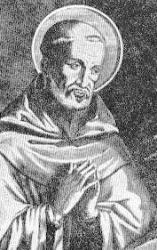
1090 - 1153 Topics: Circumcision of Christ January 1 Author of "O Jesu, King most wonderful" in The Book of Common Praise Bernard of Clairvaux, saint, abbot, and doctor, fills one of the most conspicuous positions in the history of the middle ages. His father, Tecelin, or Tesselin, a knight of great bravery, was the friend and vassal of the Duke of Burgundy. Bernard was born at his father's castle on the eminence of Les Fontaines, near Dijon, in Burgundy, in 1091. He was educated at Chatillon, where he was distinguished for his studious and meditative habits. The world, it would be thought, would have had overpowering attractions for a youth who, like Bernard, had all the advantages that high birth, great personal beauty, graceful manners, and irresistible influence could give, but, strengthened in the resolve by night visions of his mother (who had died in 1105), he chose a life of asceticism, and became a monk. In company with an uncle and two of his brothers, who had been won over by his entreaties, he entered the monastery of Citeaux, the first Cistercian foundation, in 1113. Two years later he was sent forth, at the head of twelve monks, from the rapidly increasing and overcrowded abbey, to found a daughter institution, which in spite of difficulties and privations which would have daunted less determined men, they succeeded in doing, in the Valley of Wormwood, about four miles from the Abbey of La Ferté—itself an earlier swarm from the same parent hive—on the Aube. On the death of Pope Honorius II., in 1130, the Sacred College was rent by factions, one of which elected Gregory of St. Angelo, who took the title of Innocent II., while another elected Peter Leonis, under that of Anacletua II. Innocent fled to France, and the question as to whom the allegiance of the King, Louie VI., and the French bishops was due was left by them for Bernard to decide. At a council held at Etampes, Bernard gave judgment in favour of Innocent. Throwing himself into the question with all the ardour of a vehement partisan, he won over both Henry I., the English king, and Lothair, the German emperor, to support the same cause, and then, in 1133, accompanied Innocent II., who was supported by Lothair and his army, to Italy and to Rome. When Lothair withdrew, Innocent retired to Pisa, and Bernard for awhile to his abbey of Clairvaux. It was not until after the death of Anacletus, the antipope, in January, 1138, and the resignation of his successor, the cardinal-priest Gregory, Victor II., that Innocent II., who had returned to Rome with Bernard, was universally acknowledged Pope, a result to which no one had so greatly contributed as the Abbot of Clairvaux. The influence of the latter now became paramount in the Church, as was proved at the Lateran Council of 1139, the largest council ever collected together, where the decrees in every line displayed the work of his master-hand. After having devoted four years to the service of the Pope, Bernard, early in 1135, returned to Clairvaux. In 1137 he was again at Rome, impetuous and determined as ever, denouncing the election of a Cluniac instead of a Clairvaux monk to the see of Langres in France, and in high controversy in consequence with Peter, the gentle Abbot of Cluny, and the Archbishop of Lyons. The question was settled by the deposition by the Pope of the Cluniac and the elevation of a Clairvaux monk (Godfrey, a kinsman of St. Bernard) into his place. In 1143, Bernard raised an almost similar question as to the election of St. William to the see of York, which was settled much after the same fashion, the deposition, after a time, if only for a time, of William, and the intrusion of another Clairvaux monk, Henry Murdac, or Murduch, into the archiepiccopal see. Meantime between these two dates—in 1140—the condemnation of Peter Abilaid and his tenets, in which matter Bernard appeared personally as prosecutor, took place at a council held at Sens. Abelard, condemned at Sens, appealed to Rome, and, resting awhile on his way thither, at Cluny, where Peter still presided as Abbot, died there in 1142. St. Bernard was next called upon to exercise his unrivalled powers of persuasion in a very different cause. Controversy over, he preached a crusade. The summer of 1146 was spent by him in traversing France to rouse the people to engage in the second crusade; the autumn with a like object in Germany. In both countries the effect of his appearance and eloquence was marvellous, almost miraculous. The population seemed to rise en masse, and take up the cross. In 1147 the expedition started, a vast horde, of which probably not a tenth ever reached Palestine. It proved a complete failure, and a miserable remnant shared the flight of their leaders, the Emperor Conrad, and Louis, King of France, and returned home, defeated and disgraced. The blame was thrown upon Bernard, and his apology for his part in the matter is extant. He was not, however, for long to bear up against reproach; he died in the 63rd year of his age, in 1153, weary of the world and glad to be at rest.
With the works of St. Bernard, the best ed. of which was pub. by Mabillon at Paris in the early part of the 18th cent. (1719), we are not concerned here, except as regards his contributions, few and far between as they are, to the stores of Latin hymnology. There has been so much doubt thrown upon the authorship of the hymns which usually go by his name,—notably by his editor, Mabillon himself,—that it is impossible to claim any of them as having been certainly written by him; but Archbishop Trench, than whom we have no greater modern authority on such a point, is satisfied that the attribution of them all, except the "Cur mundus militat," to St. Bernard is correct. "If he did not write," the Archbishop says, "it is not easy to guess who could have written them; and indeed they bear profoundly the stamp of his mind, being only inferior in beauty to his prose."
The hymns by which St. Bernard is best known as a writer of sacred poetry are: (1.) "Jesu duicis memoria," a long poem on the " Name of Jesus"—known as the "Jubilus of St. Bernard," and among mediaeval writers as the " Rosy Hymn." It is, perhaps, the best specimen of what Neale describes as the "subjective loveliness " of its author's compositions. (2.) "Salve mundi Salutore," an address to the various limbs of Christ on the cross. It consists of 350 lines, 50 lines being addressed to each. (3.) "Laetabundus, exultet fidelis chorus: Alleluia." This sequence was in use all over Europe. (4.) "Cum sit omnis homo foenum." (5.) " Ut jucundas cervus undas." A poem of 68 lines, and well known, is claimed for St. Bernard by Hommey in his Supplementum Patrum, Paris, 1686, p. 165, but on what Archbishop Trench, who quotes it at length, (Sac. Lat. Poetry, p. 242,) deems " grounds entirely insufficient." (6.) " Eheu, Eheu, mundi vita," or " Heu, Heu, mala mundi vita." A poem of nearly 400 lines, is sometimes claimed for St. Bernard, but according to Trench, “on no authority whatever." (7.) “O miranda vanitas." This is included in Mabillon's ed. of St. Bernard's Works. It is also attributed to him by Rambach, vol. i. p. 279. Many other hymns and sequences are attributed to St. Bernard. Trench speaks of a " general ascription to him of any poems of merit belonging to that period whereof the authorship was uncertain." Hymns, translated from, or founded on, St. Bernard's, will be found in almost every hymnal of the day, details of which, together with many others not in common use, will be found under the foregoing Latin first lines.
-John Julian, Dictionary of Hymnology (1907)
See also in:
Hymn Writers of the Church
St. Bernard of Clairvaux
Alexander Robert Reinagle
1799 - 1877 Person Name: A. R. Reinagle Topics: Circumcision of Christ January 1 Composer of "ST. PETER" in The Book of Common Praise Alexander Robert Reinagle United Kingdom 1799-1877. Born at Brighton, Sussex, England, gf Austrian descent, he came from a family of musicians, studying music with his father (a cellist), then with Raynor Taylor in Edinburgh, Scotland. Reinagle became a well-known organ teacher. He became organist at St Peter’s Church, Oxford (1823-1853). He was also a theatre musician. He wrote Teaching manuals for stringed instruments as well. He also compiled books of hymn tunes, one in 1830: “Psalm tunes for the voice and the pianoforte”, the other in 1840: “A collection of Psalm and hymn tunes”. He also composed waltzes. In 1846 he married Caroline Orger, a pianist, composer, and writer in her own right. No information found regarding children. In the 1860s he was active in Oxford music-making and worked with organist, John Stainer, then organist at Magdalen College. Reinagle also composed a piano sonata and some church music. At retirement he moved to Kidlington, Oxfordshire, England. He died at Kidlington.
John Perry
Alexander Robert Reinagle
Edward Perronet
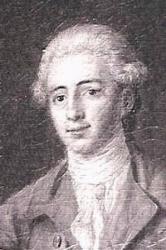
1721 - 1792 Person Name: Edward Perronet, 1726-92 Topics: The Circumcision of Christ January 1st Author of "All hail the power of Jesu's name" in The New English Hymnal Edward Perronet was the son of the Rev. Vincent Perronet, Vicar of Shoreham, Kent. For some time he was an intimate associate of the Wesleys, at Canterbury and Norwich. He afterwards became pastor of a dissenting congregation. He died in 1792. In 1784, he published a small volume, entitled "Occasional Verses, Moral and Social;" a book now extremely rare. At his death he is said to have left a large sum of money to Shrubsole, who was organist at Spafield's Chapel, London, and who had composed the tune "Miles Lane" for "All hail the power of Jesus' Name!"
--Annotations of the Hymnal, Charles Hutchins, M.A. 1872.
------
Perronet, Edward. The Perronets of England, grandfather, father, and son, were French emigres. David Perronet came to England about 1680. He was son of the refugee Pasteur Perronet, who had chosen Switzerland as his adopted country, where he ministered to a Protestant congregation at Chateau D'Oex. His son, Vincent Perronet, M.A., was a graduate of Queen's College, Oxford, though his name is not found in either Anthony Woods's Athenae Oxonienses nor his Fasti, nor in Bliss's apparatus of additional notes. He became, in 1728, Vicar of Shoreham, Kent. He is imperishably associated with the Evangelical Revival under the Wesleys and Whitefield. He cordially cooperated with the movement, and many are the notices of him scattered up and down the biographies and Journals of John Wesley and of Selina, Countess of Huntingdon. He lived to the venerable age of ninety-one; and pathetic and beautiful is the account of John Wesley's later visits to the white-haired saint (b. 1693, d. May 9, 1785).* His son Edward was born in 1726. He was first educated at home under a tutor, but whether he proceeded to the University (Oxford) is uncertain. Born, baptized, and brought up in the Church of England, he had originally no other thought than to be one of her clergy. But, though strongly evangelical, he had a keen and searching eye for defects. A characteristic note to The Mitre, in referring to a book called The Dissenting Gentleman's answer to the Rev. Mr. White, thus runs:—"I was born, and am like to die, in the tottering communion of the Church of England; but I despise her nonsense; and thank God that I have once read a book that no fool can answer, and that no honest man will". The publication of The Mitre is really the first prominent event in his life. A copy is preserved in the British Museum, with title in the author's holograph, and manuscript notes; and on the fly-leaf this:— "Capt. Boisragon, from his oblig'd and most respectful humble servt. The Author. London, March 29th, 1757." The title is as follows:— The Mitre; a Sacred Poem (1 Samuel ii. 30). London: printed in the year 1757. This strangely overlooked satire is priceless as a reflex of contemporary ecclesiastical opinion and sentiment. It is pungent, salted with wit, gleams with humour, hits off vividly the well-known celebrities in Church and State, and is well wrought in picked and packed words. But it is a curious production to have come from a "true son" of the Church of England. It roused John Wesley's hottest anger. He demanded its instant suppression; and it was suppressed (Atmore's Methodist Memorial, p. 300, and Tyerman, ii. 240-44, 264, 265); and yet it was at this period the author threw himself into the Wesleys' great work. But evidences abound in the letters and journals of John Wesley that he was intermittently rebellious and vehement to even his revered leader's authority. Earlier, Edward Perronet dared all obloquy as a Methodist. In 1749 Wesley enters in his diary:
"From Rochdale went to Bolton, and soon found that the Rochdale lions were lambs in comparison with those of Bolton. Edward Perronet was thrown down and rolled in mud and mire. Stones were hurled and windows broken" (Tyerman's Life and Times of the Rev. John Wesley, M.A., 3 vols., 1870 ; vol. ii. 57).
In 1750 John Wesley writes:
”Charles and you [Edward Perronet] behave as I want you to do; but you cannot, or will not, preach where I desire. Others can and will preach where I desire, but they do not behave as I want them to do. I have a fine time between the one and the other. I think Charles and you have in the general a right sense of what it is to serve as sons in the gospel; and if all our helpers had had the same, the work of God would have prospered better both in England and Ireland. I have not one preacher with me, and not six in England, whose wills are broken to serve me" (ibid. ii. 85, and Whitehead's Life of Wesley, ii. 259).
In 1755 arrangements to meet the emergency created by its own success had to be made for Methodism. As one result, both Edward and Charles Perronet broke loose from John Wesley's law that none of his preachers or "helpers" were to dispense the Sacraments, but were still with their flocks to attend the parish churches. Edward Perronet asserted his right to administer the Sacraments as a divinely-called preacher ibid. ii. 200). At that time he was resident at Canterbury, "in a part of the archbishop's old palace" (ibid. ii. 230. In season and out of season he "evangelized." Onward, he became one of the Countess of Huntingdon's "ministers" in a chapel in Watling Street, Canterbury. Throughout he was passionate, impulsive, strong-willed; but always lived near his divine Master. The student-reader of Lives of the Wesleys will be "taken captive" by those passages that ever and anon introduce him. He bursts in full of fire and enthusiasm, yet ebullient and volatile. In the close of his life he is found as an Independent or Congregational pastor of a small church in Canterbury. He must have been in easy worldly circumstances, as his will shows. He died Jan. 2, 1792, and was buried in the cloisters of the great cathedral, Jan. 8. His Hymns were published anonymously in successive small volumes. First of all came Select Passages of the Old and New Testament versified; London: Printed by H. Cock, mdcclvi. … A second similar volume is entitled A Small Collection of Hymns, &c, Canterbury: printed in the year dcclxxxii. His most important volume was the following:— Occasional Verses, moral and sacred. Published for the instruction and amusement of the Candidly Serious and Religious. London, printed for the Editor: And Sold by J. Buckland in Paternoster Row; and T. Scollick, in the City Road, Moorfields, mdcclxxxv. pp. 216 (12°). [The British Museum copy has the two earlier volumes bound up with this.] The third hymn in this scarce book is headed, “On the Resurrection," and is, ”All hail the power of Jesus' name". But there are others of almost equal power and of more thorough workmanship. In my judgment, "The Lord is King" (Psalm xcvi. 16) is a great and noble hymn. It commences:—
“Hail, holy, holy, holy Loud!
Let Pow'rs immortal sing;
Adore the co-eternal Word,
And shout, the Lord is King."
Very fine also is "The Master's Yoke—the Scholar's Lesson," Matthew xi. 29, which thus opens:—
O Grant me, Lord, that sweet content
That sweetens every state;
Which no internal fears can rent,
Nor outward foes abate."
A sacred poem is named "The Wayfaring Man: a Parody"; and another, "The Goldfish: a Parody." The latter has one splendid line on the Cross, "I long to share the glorious shame." "The Tempest" is striking, and ought to be introduced into our hymnals; and also "The Conflict or Conquest over the Conqueror, Genesis xxxii. 24". Still finer is "Thoughts on Hebrews xii.," opening:—
"Awake my soul—arise!
And run the heavenly race;
Look up to Him who holds the prize,
And offers thee His grace."
"A Prayer for Mercy on Psalm cxix. 94," is very striking. On Isaiah lxv. 19, is strong and unmistakable. "The Sinner's Resolution," and "Thoughts on Matthew viii. 2," and on Mark x. 51, more than worthy of being reclaimed for use. Perronet is a poet as well as a pre-eminently successful hymnwriter. He always sings as well as prays. It may be added that the brief paraphrase after Ovid given below, seems to echo the well-known lines in Gray's immortal elegy:—
"How many a gem unseen of human eyes,
Entomb'd in earth, a sparkling embryo lies;
How many a rose, neglected as the gem,
Scatters its sweets and rots upon its stem:
So many a mind, that might a meteor shone,
Had or its genius or its friend been known;
Whose want of aid from some maternal hand,
Still haunts the shade, or quits its native land." [Rev. A. B. Grosart, D.D., LL.D.]
* Agnew's Protestant Exiles from France in the Reign of Louis XIV. confounds Vincent the father with Edward his son.
-- John Julian, Dictionary of Hymnology (1907)
Edward Perronet
John Newton
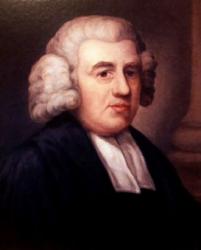
1725 - 1807 Person Name: Rev. John Newton Topics: Circumcision of Christ January 1 Author of "How sweet the Name of Jesus sounds" in The Book of Common Praise John Newton (b. London, England, 1725; d. London, 1807) was born into a Christian home, but his godly mother died when he was seven, and he joined his father at sea when he was eleven. His licentious and tumultuous sailing life included a flogging for attempted desertion from the Royal Navy and captivity by a slave trader in West Africa. After his escape he himself became the captain of a slave ship. Several factors contributed to Newton's conversion: a near-drowning in 1748, the piety of his friend Mary Catlett, (whom he married in 1750), and his reading of Thomas à Kempis' Imitation of Christ. In 1754 he gave up the slave trade and, in association with William Wilberforce, eventually became an ardent abolitionist. After becoming a tide-surveyor in Liverpool, England, Newton came under the influence of George Whitefield and John and Charles Wesley and began to study for the ministry. He was ordained in the Church of England and served in Olney (1764-1780) and St. Mary Woolnoth, London (1780-1807). His legacy to the Christian church includes his hymns as well as his collaboration with William Cowper (PHH 434) in publishing Olney Hymns (1779), to which Newton contributed 280 hymns, including “Amazing Grace.”
Bert Polman
==================
Newton, John, who was born in London, July 24, 1725, and died there Dec. 21, 1807, occupied an unique position among the founders of the Evangelical School, due as much to the romance of his young life and the striking history of his conversion, as to his force of character. His mother, a pious Dissenter, stored his childish mind with Scripture, but died when he was seven years old. At the age of eleven, after two years' schooling, during which he learned the rudiments of Latin, he went to sea with his father. His life at sea teems with wonderful escapes, vivid dreams, and sailor recklessness. He grew into an abandoned and godless sailor. The religious fits of his boyhood changed into settled infidelity, through the study of Shaftesbury and the instruction of one of his comrades. Disappointing repeatedly the plans of his father, he was flogged as a deserter from the navy, and for fifteen months lived, half-starved and ill-treated, in abject degradation under a slave-dealer in Africa. The one restraining influence of his life was his faithful love for his future wife, Mary Catlett, formed when he was seventeen, and she only in her fourteenth year. A chance reading of Thomas à Kempis sowed the seed of his conversion; which quickened under the awful contemplations of a night spent in steering a water-logged vessel in the face of apparent death (1748). He was then twenty-three. The six following years, during which he commanded a slave ship, matured his Christian belief. Nine years more, spent chiefly at Liverpool, in intercourse with Whitefield, Wesley, and Nonconformists, in the study of Hebrew and Greek, in exercises of devotion and occasional preaching among the Dissenters, elapsed before his ordination to the curacy of Olney, Bucks (1764).
The Olney period was the most fruitful of his life. His zeal in pastoral visiting, preaching and prayer-meetings was unwearied. He formed his lifelong friendship with Cowper, and became the spiritual father of Scott the commentator. At Olney his best works—-Omicron's Letters (1774); Olney Hymns (1779); Cardiphonia, written from Olney, though published 1781—were composed. As rector of St. Mary Woolnoth, London, in the centre of the Evangelical movement (1780-1807) his zeal was as ardent as before. In 1805, when no longer able to read his text, his reply when pressed to discontinue preaching, was, "What, shall the old African blasphemer stop while he can speak!" The story of his sins and his conversion, published by himself, and the subject of lifelong allusion, was the base of his influence; but it would have been little but for the vigour of his mind (shown even in Africa by his reading Euclid drawing its figures on the sand), his warm heart, candour, tolerance, and piety. These qualities gained him the friendship of Hannah More, Cecil, Wilberforce, and others; and his renown as a guide in experimental religion made him the centre of a host of inquirers, with whom he maintained patient, loving, and generally judicious correspondence, of which a monument remains in the often beautiful letters of Cardiphonia. As a hymnwriter, Montgomery says that he was distanced by Cowper. But Lord Selborne's contrast of the "manliness" of Newton and the "tenderness" of Cowper is far juster. A comparison of the hymns of both in The Book of Praise will show no great inequality between them. Amid much that is bald, tame, and matter-of-fact, his rich acquaintance with Scripture, knowledge of the heart, directness and force, and a certain sailor imagination, tell strongly. The one splendid hymn of praise, "Glorious things of thee are spoken," in the Olney collection, is his. "One there is above all others" has a depth of realizing love, sustained excellence of expression, and ease of development. "How sweet the name of Jesus sounds" is in Scriptural richness superior, and in structure, cadence, and almost tenderness, equal to Cowper's "Oh! for a closer walk with God." The most characteristic hymns are those which depict in the language of intense humiliation his mourning for the abiding sins of his regenerate life, and the sense of the withdrawal of God's face, coincident with the never-failing conviction of acceptance in The Beloved. The feeling may be seen in the speeches, writings, and diaries of his whole life. [Rev. H. Leigh Bennett, M.A.]
A large number of Newton's hymns have some personal history connected with them, or were associated with circumstances of importance. These are annotated under their respective first lines. Of the rest, the known history of which is confined to the fact that they appeared in the Olney Hymns, 1779, the following are in common use:—
1. Be still, my heart, these anxious cares. Conflict.
2. Begone, unbelief, my Saviour is near. Trust.
3. By the poor widow's oil and meal. Providence.
4. Chief Shepherd of Thy chosen sheep. On behalf of Ministers.
5. Darkness overspreads us here. Hope.
6. Does the Gospel-word proclaim. Rest in Christ.
7. Fix my heart and eyes on Thine. True Happiness.
8. From Egypt lately freed. The Pilgrim's Song.
9. He Who on earth as man was Known. Christ the Rock.
10. How blest are they to whom the Lord. Gospel Privileges.
11. How blest the righteous are. Death of the Righteous.
12. How lost was my [our] condition. Christ the Physician.
13. How tedious and tasteless the hours. Fellowship with Christ.
14. How welcome to the saints [soul] when pressed. Sunday.
15. Hungry, and faint, and poor. Before Sermon.
16. In mercy, not in wrath, rebuke. Pleading for Mercy.
17. In themselves, as weak as worms. Power of Prayer.
18. Incarnate God, the soul that knows. The Believer's Safety.
19. Jesus, Who bought us with His blood. The God of Israel. "Teach us, 0 Lord, aright to plead," is from this hymn.
20. Joy is a [the] fruit that will not grow. Joy.
21. Let hearts and tongues unite. Close of the Year. From this "Now, through another year," is taken.
22. Let us adore the grace that seeks. New Year.
23. Mary to her [the] Saviour's tomb. Easter.
24. Mercy, 0 Thou Son of David. Blind Bartimeus.
25. My harp untun'd and laid aside. Hoping for a Revival. From this "While I to grief my soul gave way" is taken.
26. Nay, I cannot let thee go. Prayer. Sometimes, "Lord, I cannot let Thee go."
27. Now may He Who from the dead. After Sermon.
28. 0 happy they who know the Lord, With whom He deigns to dwell. Gospel Privilege.
29. O Lord, how vile am I. Lent.
30. On man in His own Image made. Adam.
31. 0 speak that gracious word again. Peace through Pardon.
32. Our Lord, Who knows full well. The Importunate Widow. Sometimes altered to "Jesus, Who knows full well," and again, "The Lord, Who truly knows."
33. Physician of my sin-sick soul. Lent.
34. Pleasing spring again is here. Spring.
35. Poor, weak, and worthless, though I am. Jesus the Friend.
36. Prepare a thankful song. Praise to Jesus.
37. Refreshed by the bread and wine. Holy Communion. Sometimes given as "Refreshed by sacred bread and wine."
38. Rejoice, believer, in the Lord. Sometimes “Let us rejoice in Christ the Lord." Perseverance.
39. Salvation, what a glorious plan. Salvation.
40. Saviour, shine and cheer my soul. Trust in Jesus. The cento "Once I thought my mountain strong," is from this hymn.
41. Saviour, visit Thy plantation. Prayer for the Church.
42. See another year [week] is gone. Uncertainty of Life.
43. See the corn again in ear. Harvest.
44. Sinner, art thou still secure? Preparation for the Future.
45. Sinners, hear the [thy] Saviour's call. Invitation.
46. Sovereign grace has power alone. The two Malefactors.
47. Stop, poor sinner, stop and think. Caution and Alarm.
48. Sweeter sounds than music knows. Christmas.
49. Sweet was the time when first I felt. Joy in Believing.
50. Ten thousand talents once I owed. Forgiveness and Peace.
51. The grass and flowers, which clothe the field. Hay-time.
52. The peace which God alone reveals. Close of Service.
53. Thy promise, Lord, and Thy command. Before Sermon.
54. Time, by moments, steals away. The New Year.
55. To Thee our wants are known. Close of Divine Service.
56. We seek a rest beyond the skies. Heaven anticipated.
57. When any turn from Zion's way. Jesus only.
58. When Israel, by divine command. God, the Guide and Sustainer of Life.
59. With Israel's God who can compare? After Sermon.
60. Yes, since God Himself has said it. Confidence.
61. Zion, the city of our God. Journeying Zionward.
-- John Julian, Dictionary of Hymnology (1907)
=================
Newton, J., p. 803, i. Another hymn in common use from the Olney Hymns, 1779, is "Let me dwell on Golgotha" (Holy Communion).
--John Julian, Dictionary of Hymnology, Appendix, Part II (1907)
-----
John Newton was born in London, July 24, 1725. His mother died when he was seven years old. In his eleventh year he accompanied his father, a sea captain, on a voyage. For several years his life was one of dissipation and crime. He was disgraced while in the navy. Afterwards he engaged in the slave trade. Returning to England in 1748, the vessel was nearly wrecked in a storm. This peril forced solemn reflection upon him, and from that time he was a changed man. It was six years, however, before he relinquished the slave trade, which was not then regarded as an unlawful occupation. But in 1754, he gave up sea-faring life, and holding some favourable civil position, began also religious work. In 1764, in his thirty-ninth year, he entered upon a regular ministry as the Curate of Olney. In this position he had intimate intercourse with Cowper, and with him produced the "Olney Hymns." In 1779, Newton became Rector of S. Mary Woolnoth, in London, in which position he became more widely known. It was here he died, Dec. 21, 1807, His published works are quite numerous, consisting of sermons, letters, devotional aids, and hymns. He calls his hymns "The fruit and expression of his own experience."
--Annotations of the Hymnal, Charles Hutchins, M.A. 1872
See also in:
Hymn Writers of the Church
=======================
John Newton
Charles Wesley
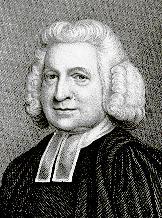
1707 - 1788 Person Name: C. Wesley Topics: Praise to Christ; Circumcision; Name of Christ; New Years Day; Sunday after New Year; Epiphany, Third Sunday; Sundays in Lent; Lent, Third Sunday; Passion Week; Twelfth Sunday after Trinity; Fourteenth Sunday after Trinity; Eighteenth Sunday after Trinity Author of "O for a thousand tongues to sing" in Church Book Charles Wesley, M.A. was the great hymn-writer of the Wesley family, perhaps, taking quantity and quality into consideration, the great hymn-writer of all ages. Charles Wesley was the youngest son and 18th child of Samuel and Susanna Wesley, and was born at Epworth Rectory, Dec. 18, 1707. In 1716 he went to Westminster School, being provided with a home and board by his elder brother Samuel, then usher at the school, until 1721, when he was elected King's Scholar, and as such received his board and education free. In 1726 Charles Wesley was elected to a Westminster studentship at Christ Church, Oxford, where he took his degree in 1729, and became a college tutor. In the early part of the same year his religious impressions were much deepened, and he became one of the first band of "Oxford Methodists."
In 1735 he went with his brother John to Georgia, as secretary to General Oglethorpe, having before he set out received Deacon's and Priest's Orders on two successive Sundays. His stay in Georgia was very short; he returned to England in 1736, and in 1737 came under the influence of Count Zinzendorf and the Moravians, especially of that remarkable man who had so large a share in moulding John Wesley's career, Peter Bonier, and also of a Mr. Bray, a brazier in Little Britain. On Whitsunday, 1737, [sic. 1738] he "found rest to his soul," and in 1738 he became curate to his friend, Mr. Stonehouse, Vicar of Islington, but the opposition of the churchwardens was so great that the Vicar consented that he "should preach in his church no more." Henceforth his work was identified with that of his brother John, and he became an indefatigable itinerant and field preacher. On April 8, 1749, he married Miss Sarah Gwynne. His marriage, unlike that of his brother John, was a most happy one; his wife was accustomed to accompany him on his evangelistic journeys, which were as frequent as ever until the year 1756," when he ceased to itinerate, and mainly devoted himself to the care of the Societies in London and Bristol. Bristol was his headquarters until 1771, when he removed with his family to London, and, besides attending to the Societies, devoted himself much, as he had done in his youth, to the spiritual care of prisoners in Newgate. He had long been troubled about the relations of Methodism to the Church of England, and strongly disapproved of his brother John's "ordinations." Wesley-like, he expressed his disapproval in the most outspoken fashion, but, as in the case of Samuel at an earlier period, the differences between the brothers never led to a breach of friendship. He died in London, March 29, 1788, and was buried in Marylebone churchyard. His brother John was deeply grieved because he would not consent to be interred in the burial-ground of the City Road Chapel, where he had prepared a grave for himself, but Charles said, "I have lived, and I die, in the Communion of the Church of England, and I will be buried in the yard of my parish church." Eight clergymen of the Church of England bore his pall. He had a large family, four of whom survived him; three sons, who all became distinguished in the musical world, and one daughter, who inherited some of her father's poetical genius. The widow and orphans were treated with the greatest kindness and generosity by John Wesley.
As a hymn-writer Charles Wesley was unique. He is said to have written no less than 6500 hymns, and though, of course, in so vast a number some are of unequal merit, it is perfectly marvellous how many there are which rise to the highest degree of excellence. His feelings on every occasion of importance, whether private or public, found their best expression in a hymn. His own conversion, his own marriage, the earthquake panic, the rumours of an invasion from France, the defeat of Prince Charles Edward at Culloden, the Gordon riots, every Festival of the Christian Church, every doctrine of the Christian Faith, striking scenes in Scripture history, striking scenes which came within his own view, the deaths of friends as they passed away, one by one, before him, all furnished occasions for the exercise of his divine gift. Nor must we forget his hymns for little children, a branch of sacred poetry in which the mantle of Dr. Watts seems to have fallen upon him. It would be simply impossible within our space to enumerate even those of the hymns which have become really classical. The saying that a really good hymn is as rare an appearance as that of a comet is falsified by the work of Charles Wesley; for hymns, which are really good in every respect, flowed from his pen in quick succession, and death alone stopped the course of the perennial stream.
It has been the common practice, however for a hundred years or more to ascribe all translations from the German to John Wesley, as he only of the two brothers knew that language; and to assign to Charles Wesley all the original hymns except such as are traceable to John Wesley through his Journals and other works.
The list of 482 original hymns by John and Charles Wesley listed in this Dictionary of Hymnology have formed an important part of Methodist hymnody and show the enormous influence of the Wesleys on the English hymnody of the nineteenth century.
-- Excerpts from John Julian, Dictionary of Hymnology (1907)
==================
Charles Wesley, the son of Samuel Wesley, was born at Epworth, Dec. 18, 1707. He was educated at Westminster School and afterwards at Christ Church, Oxford, where he graduated M.A. In 1735, he took Orders and immediately proceeded with his brother John to Georgia, both being employed as missionaries of the S.P.G. He returned to England in 1736. For many years he engaged with his brother in preaching the Gospel. He died March 29, 1788. To Charles Wesley has been justly assigned the appellation of the "Bard of Methodism." His prominence in hymn writing may be judged from the fact that in the "Wesleyan Hymn Book," 623 of the 770 hymns were written by him; and he published more than thirty poetical works, written either by himself alone, or in conjunction with his brother. The number of his separate hymns is at least five thousand.
--Annotations of the Hymnal, Charles Hutchins, M.A., 1872.
Charles Wesley
Philip Doddridge

1702 - 1751 Person Name: Doddridge Topics: New Year; Circumcision; Name of Christ; New Years Day Author of "Great God! we sing that mighty Hand" in Church Book Philip Doddridge (b. London, England, 1702; d. Lisbon, Portugal, 1751) belonged to the Non-conformist Church (not associated with the Church of England). Its members were frequently the focus of discrimination. Offered an education by a rich patron to prepare him for ordination in the Church of England, Doddridge chose instead to remain in the Non-conformist Church. For twenty years he pastored a poor parish in Northampton, where he opened an academy for training Non-conformist ministers and taught most of the subjects himself. Doddridge suffered from tuberculosis, and when Lady Huntington, one of his patrons, offered to finance a trip to Lisbon for his health, he is reputed to have said, "I can as well go to heaven from Lisbon as from Northampton." He died in Lisbon soon after his arrival. Doddridge wrote some four hundred hymn texts, generally to accompany his sermons. These hymns were published posthumously in Hymns, Founded on Various Texts in the Holy Scriptures (1755); relatively few are still sung today.
Bert Polman
========================
Doddridge, Philip, D.D., was born in London, June 26, 1702. His grandfather was one of the ministers under the Commonwealth, who were ejected in 1662. His father was a London oilman. He was offered by the Duchess of Bedford an University training for ordination in the Church of England, but declined it. He entered Mr. Jennings's non-conformist seminary at Kibworth instead; preached his first sermon at Hinckley, to which Mr. Jennings had removed his academy. In 1723 he was chosen pastor at Kibworth. In 1725 he changed his residence to Market Harborough, still ministering at Kibworth. The settled work of his life as a preceptor and divine began in 1729, with his appointment to the Castle Hill Meeting at Northampton, and continued till in the last stage of consumption. He sailed to Lisbon, in 1751, where he died October 26, the same year. Two hundred pupils in all, gathered from England, Scotland and Holland, were prepared in his seminary, chiefly for the dissenting ministry, but partly for professions. The wide range of subjects, including daily readings in Hebrew and Greek, Algebra, Trigonometry, Watts' Logic, outline of Philosophy, and copious Divinity, is itself a proof of Doddridge's learning. He was presented with his D.D. degree by the University of Aberdeen. His fame as a divine, combined with his wide sympathies and gentle, unaffected goodness, won for him the friendship of Watts, Col. Gardiner and Hervey, and the esteem of Seeker and Warburton. He welcomed the work of Wesley and Whitefield, and entertained the latter on his visit to Northampton. His Rise and Progress of Religion in the Soul and The Family Expositor both did good work in their day. For criticism of his hymns see English Hymnody, Early, § XIV. [Rev. H. Leigh Bennett, M.A.]
After Dr. Doddridge's death his hymns were published by his friend Job Orton, in 1755, as:—
"Hymns founded on Various Texts in the Holy Scriptures. By the late Reverend Philip Doddridge, D.D. Published from the Author's Manuscript by Job Orton . . . Salop. Printed by J. Eddowes and J. Cotton, &c.
MDCCLV."
Concerning the text of the hymns, Orton says in his Preface:—
"There may perhaps be some improprieties, owing to my not being able to read the author's manuscript in particular places, and being obliged, without a poetical genius, to supply those deficiencies, whereby the beauty of the stanza may be greatly defaced, though the sense is preserved."
The 1st edition contained 370 hymns; the 2nd, 1759, 374; and the 3rd, 1766, and later editions, 375. In 1839 Doddridge's great-grandson re-edited the hymns from the original manuscript and published the same as:—
Scriptural Hymns by the Rev. Philip Doddridge, D.D. New and corrected edition containing many hymns never before printed. Edited from the Original Documents by the Author's great-grandson, John Doddridge Humphreys, Esq. Lond. Darton & Clark, 1839.
This work contains 22 additional hymns. The text differs in many instances from Orton's, but these changes have not come into common use. In addition to the manuscript used by Orton and J. D. Humphreys, another containing 100 hymns (five of which are not in any edition of the Hymns), all in the author's handwriting, and most of them dated, is referred to in this Dictionary as the "D. Manuscripts." It is the property of Mr. W. S. Booker and family. A manuscript, not in Doddridge's handwriting, of 77 "Hymns by P. Doddridge, Mar. 16, 1739/1740," is in the possession of Mr. W. T. Brooke. The existence of these manuscripts is accounted for from the fact that Doddridge's hymns were freely circulated in manuscript during his lifetime. It is from his correspondence with R. Blair (q.v.) that the few compositions traceable to him in the Scottish Trans. & Paraphrases were derived.
The hymns by Doddridge which have attained to the greatest popularity are:— “Awake, my soul, stretch every nerve"; " Do not I love Thee, O my Lord? " "Grace 'tis a charming sound”; " Hark, the glad sound, the Saviour comes"; "My God, and is Thy table spread?" "O happy day, that fixed my choice"; "O God of Jacob [Bethel], by Whose hand”; " See Israel's gentle Shepherd stand"; "Ye servants of the Lord." These hymns, with many besides, are annotated under their respective first lines. Of the rest, taken from the Hymns, &c, 1755, the following are also in common use:—
1. Behold the gloomy vale. Death anticipated.
2. Behold the Great Physician stands. Christ the Physician.
3. Captives of Israel, hear. Spiritual Deliverance.
4. Eternal God, our wondering souls. Enoch's Piety and Translation.
5. Eternal Source of life and thought. Subjection to the Father.
G. Exalted Prince of Life, we own. Christ the Prince and Saviour.
7. Father Divine, the Saviour cried. Christ's Submission to the Father.
8. Father Divine, Thy piercing eye. Secret Prayer.
9. Father of mercies, send Thy grace. Sympathy. The Good Samaritan.
10. Go, saith the Lord, proclaim my grace. Forgiveness.
11. God of Eternity, from Thee. Redeeming the Time.
12. God of my life, through all its [my] days. Praising God continually.
13. God. of salvation, we adore. Praise to God for Redemption.
14. Great Father of mankind. Gentiles brought into the Church.
15. Great God, we sing that mighty hand. The New Tear.
16. Great Leader of Thine Israel's host. During Persecution.
17. Great Lord of angels, we adore. Ordination.
18. Great Spirit of immortal love. Purity of Heart desired.
19. Great Teacher of Thy Church, we own. The Divine Precepts.
20. Hail, everlasting Prince of Peace. Sympathy.
21. Hail to the Prince of life and peace. Praise to Christ.
22. Hear, gracious [Saviour] Sovereign, from Thy throne. The Blessings of the Holy Spirit desired.
23. How gentle God's commands. God's Care of His Own.
24. How rich Thy favours, God of grace. God and His Living Temple.
25. How swift the torrent flows [rolls]. Our Fathers, where are they?
26. Jesus the Lord, our souls adore. Christ the Forerunner.
27. Jesus, we own Thy Sovereign hand. Christ to be fully known hereafter.
28. Loud let the tuneful trumpet sound. Gospel Jubilee.
29. My gracious Lord, I own Thy right. Life in Jesus.
30. My [Dear] Saviour, I am [we are] Thine. Joined to Christ through the Spirit.
31. My soul, with all thy waking powers. The Choice of Moses.
32. Now let our voices join. Singing in the ways of God.
33. 0 injured Majesty of heaven. Lent.
34. 0 Zion, tune thy voice. Glory of the Church of Christ.
35. Peace, 'tis the Lord Jehovah's hand. Resignation.
36. Praise the Lord of boundless might. The Father of Lights.
37. Praise to Thy Name, Eternal God. Growth in Grace desired.
38. Remark, my soul, the narrow bounds. The New Year.
39. Repent, the Voice celestial cries. Lent.
40. Return, my roving heart, return. Heart communing.
41. Salvation, O melodious sound. God our Salvation.
42. Saviour of men, and Lord of love. Ministry and Death of Christ.
43. Searcher of hearts, before Thy face. Peter to Simon Magus.
44. Shepherd of Israel, Thou dost keep. Induction or Settlement of a Minister.
45. Shine forth, eternal Source of light. Knowledge of God desired.
46. Shine on our souls, eternal God. Sunday.
47. Sing, ye redeemed of the Lord. Joy on the Homeward Way.
48. Sovereign of life, before Thine eye. Life and Death in God's hands.
49. The darkened sky, how thick it lours. Sorrow followed by Joy.
50. The day approacheth, O my soul. Judgment anticipated.
51. The King of heaven His table spreads. The Gospel Feast.
52. The promises I sing. The unchanging promises of God.
53. The swift-declining day. Walk in the Light.
54. These mortal joys, how soon they fade. Treasures, Perishable and Eternal.
55. Thy judgments cry aloud. Retributive Providence.
56. Thy presence, Everlasting God. Omnipresence of the Father.
57. 'Tis mine, the covenant of His grace. Death anticipated.
58. To Thee, my God; my days are known. Life under the eye of God.
59. Tomorrow, Lord, is Thine. Uncertainty of Life.
60. Triumphant Lord, Thy goodness reigns. The Divine Goodness.
61. Triumphant Zion, lift thy head. The Church Purified and Guarded.
62. Unite my roving thoughts, unite. Peace.
63. What mysteries, Lord, in Thee combine. Christ, the First and Last.
64. While on the verge of life I stand. Death anticipated with Joy.
65. With ecstacy of Joy. Christ the Living Stone.
66. Ye golden lamps of heaven, farewell. Heaven opening.
67. Ye hearts with youthful vigour warm. The Young encouraged.
68. Ye humble souls, that seek the Lord. Easter.
69. Ye sons of men, with joy record. Praise of the Works of God.
70. Yes, the Redeemer rose. Easter
In Dr. Hatfield's Church HymnBook, N. Y., 1872, Nos. 9, 12, 14, 15, 21, 23, 25, 29, 30, 32, 34, 35, 39, 40, 44, 47, 51, 61, 64, 65, 67, 69, 70, as above, are dated 1740. What authority there may be for this date we cannot say, these hymns not being in any “D. MSS." with which we are acquainted, and no dates are given in the Hymns, &c, 1755. Some later American editors have copied this date from Dr. Hatfield.
Doddridge's hymns are largely used by Unitarians both in Great Britain and America. As might be expected, the Congregationalists also draw freely from his stores. The Baptists come next. In the hymnals of the Church of England the choicest, only are in use. Taken together, over one-third of his hymns are in common usage at the present time.
-- John Julian, Dictionary of Hymnology (1907)
================
Doddridge, Philip, D.D. At p. 305 an account is given of a manuscript volume of Doddridge's Hymns, which is the property of the Rooker family. Since that article was written another manuscript vol. has been found. It was the property of Lady Frances Gardiner, née Erskine, an intimate friend of Doddridge, and wife of Col. Gardiner. It is a copy of the Rooker manuscipt, with the revised text, as in the margin of that ms., and is in Doddridge's hand¬writing. It was from this manuscript that the Doddridge hymns were taken for the Scottish Translationsand Paraphrases, 1745. Additional hymns by Dr. Doddridge still in common use include:—
1. My God, how cheerful is the sound. All in Christ.
2. My Saviour, let me hear Thy voice. Pardon desired.
3. My soul, triumphant in the Lord. Divine Guidance assured.
4. No «iore, ye wise, your wisdom boast. Glorying in God alone. From Hymns, No. 128.
5. Now be that Sacrifice survey'd. Christ our Sacrifice.
6. 0 Israel, blest beyond compare. Happiness of God's Israel.
7. Our fathers, where are they? Considering the Past. From Hymns, No. 164.
8. Praise to the Lord on high. Missions.
9. Praise to the radiant Source of bliss. Praise for Divine Guidance.
10. Return, my soul, and seek thy rest. Rest in Jesus.
11. Salvation doth to God belong. National Thanksgiving.
12. Sovereign of Life, I own Thy hand. On Recovery from Sickness.
13. The sepulchres, how thick they stand. Burial.
14. There is a Shepherd kind and strong. The Good Shepherd. From Hymns, No. 216.
15. Wait on the Lord, ye heirs of hope. Waiting on God.
16. We bless the eternal Source of light. Christ's care of the Church.
17. With transport, Lord, our souls proclaim. Immutability of Christ.
18. Ye mourning saints, whose streaming tears. Death and Burial.
These all appeared in Dr. Doddridge's Hymns, 1755.
--John Julian, Dictionary of Hymnology, Appendix, Part II (1907)
Philip Doddridge
Pages




