

 My Starred Hymns
 My FlexScores
 My Hymnals
 My Purchased Files
Planning worship?
Check out our sister site, ZeteoSearch.org,
for 20+ additional resources related to your search.
- |
User Links
Person Results
George Wither
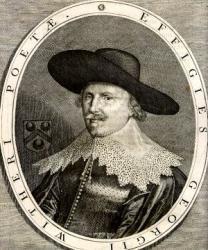
1588 - 1667 Person Name: George Wither, 1588-1667 Author of "Veil, Lord, Mine Eyes till She Be Past" in The Cyber Hymnal Wither, George, or Wyther—spelled in both ways by himself, the first usually, the second occasionally, e.g. in Prince Henrie's Obsequies (1612), and erroneously Withers, was born on June 11th, 1588, at Bentworth, near Alton, Hampshire. He was the only son of George Wither, of Bentworth. His early education was at the Grammar School of Colemore or Colemere, under its celebrated master; John Greaves. After thorough training and discipline here he was entered in 1604 at Magdalen College, Oxford. His tutor was John Warner, subsequently D.D. and Bishop of Rochester. He had only been three years at the University when malicious and ignorant persons persuaded his father that more learning was not required. And so, as he modestly tells us in his Abuses Stript and Whipt (1613), he was withdrawn "without taking any degree," being now destined, as he moderately puts it, "for the plough," that is, for rustic employment on the paternal estate. This proved utterly uncongenial. He is found next at one of the Inns of Chancery, afterwards at Lincoln's Inn, and intimate with William Browne, the poet, of Britannia's Pastorals. His title-pages from 1617 to 1620 self-describe him as "Gentleman,” and as "of the Societie of Lincoln's Inne" (Fidelia (1617), and 1st Psalme (1620), and Workes (1620)). But Anthony a-Wood informs us:—
"still his geng after things more smooth and delightful, he did at length make himself known to the world (after he had taken several rambles therein) by certain speci¬mens of poetry, which being dispersed in several hands, he became shortly after a public author and most admired by some in that age for his quick advancement in that faculty " (Athenae. Oxon. s. n.).
How uncritical was this miserable criticism, will be understood when it is recalled that amongst these "certain specimens" was the Shepherds Hunting under the first form of "A new song of a young man's opinion of the difference between good and bad women" (Pepysian, ad Percy MS.), Prince Henries Obsequies (1612), Epithalamia (1612), and his stinging and patriotically outspoken Abuses Stript and Whipt. The last drew down upon him the wrath of the monarch (James i.) and nobles, and cast him prisoner into the Marshalsea. Four large editions within a year, and numerous others up to 1622 and continuously onward (exclusive of the reproductions in his Workes) was the answer of the People to the Upper Ten.
While in prison he wrote some of the most delicious of his verse. He likewise composed A Satyre to the King (1615). The wisest fool in Christendom was shrewd enough to perceive that it would be safer to make such a subject a friend than an enemy. He had deftly signed the dedication to the king "his Majesty's most loyall Subiect, and yet Prisoner in the Marshalsey." It procured him his release. From this time onward he was perpetually printing something, now in verse and now in prose, until the aggregate exceeded a hundred of books and pamphlets. There are several fairly accurate enumerations of them, e.g. British Bibliographer, i. 174-205, 305-32,417-40; ii. 17-32,378-91; Sir Egerton Brydges' Censuria and Restituta; Hazlitt's Bibliography (1867). The Spenser Society re¬printed a large portion of the Works in prose and verse; but there was really no editing and no annotation. His successive books are the main facts of Wither's life; yet was he an active member of the nation.
Spite of his hard usage and imprisonments, he was loyal as any cavalier. When Charles i. proceeded to declare and carry war into his native Scotland against the Covenanters in 1639, George Wither served his Majesty as a captain of horse and quarter-master of his regiment under the Earl of Arundel. How sorrowful the wrongheadedness of the king who compelled such a true man as Wither to forsake him and prefer the kingdom to the king, as many others who with pathetic reluctance became Roundheads! In 1641-2 he sold his hereditary estates and raised a troop of horse for the Parliament, in whose army he was promoted to be major. On his colours he carried this motto, Pro Rege, Lege, Grege. Having been taken prisoner by the Royalists, a good-humoured jest of Sir John Denham it is alleged saved his life, to wit, that "his Majesty really must not hang George Wither, for so long as he lives no one will account him [Sir John] the worst poet in England." He was set free. Not long after he was constituted by the Long Parliament a Justice of Peace in quorum for Hampshire, Surrey and Essex. This he held for six years, and afterwards was made by Cromwell Major-General of all the horse and foot in the County of Surrey. On the title-page of his Boni Ominis Votu (1656) in the British Museum there is a contemporary manuscript note, "lately made Master of the Statute Office." At the Restoration he was shamefully dealt with, and by a vote of the Convention Parlia¬ment, was committed to Newgate because of his Vox Vulgi —a noble piece of fiery and idiomatic English, and manly pleading for respect to pipular rights and liberties. For his Prisoner's Plea humbly offered (1661) he was again imprisoned, this time in the Tower. He married (Aubrey informs us) Elizabeth, eldest daughter of H. Emerson of South Lanuk, who, he says, was "a great wit and could write in verse too," and was of the same English Emersons from whom the great American Ralph Waldo Emerson descended. He had issue. He was at liberty when he died on 2nd May, 1667. Aubrey states that he was buried within the east doorway of Savoy Church in the Strand, having apparently lived near it, and either died in the church or in his own house (the phrasing being ambiguous).
James Montgomery, in his admirable Lectures on Poets and Poetry, thus sums up his estimate of him and them:—
"There are scattered throughout his multifarious and very unequal productions, many passages of great beauty and excellence. He was avowedly a Christian poet, though he frequently lost his Christian meekness in the heat of polemics; but his zeal carried with it every evidence of honesty; and he was a sufferer almost to martyrdom, both for his loyalty and his orthodoxy, in the troublous times in which he lived. That he was a poet can never be questioned by any reader who has taste and sensibility enough to understand and enjoy the exquisitely affecting confession of his obligations to the Muse. That he was a Christian will be as little questioned by those who are most extensively acquainted with the character of his religious compositions" (s. n.).
Archbishop Trench, in annotating a charming sacred song entitledVanished Blessing ("No voice which I did more esteem, Than music in her sweetest key," &c), thus annotates:—
"I have detached these two stanzas from a longer poem of which they constitute the only valuable portion[?]. George Wither (‘a most profuse pourer forth of English rhyme,' Philips calls him) was indeed so intolerable a power in verse, so overlaid his good with indifferent or bad, that one may easily forget how real a gift he possessed, and sometimes showed that he possessed" (Household Book of English Poetry, 1865).
Mrs. Masson says of him—"he is remembered now-a-days as pre-eminently the Puritan poet, whose irrepressible Muse made herself hsard even amid the din of civil war" (Three Centuries of English Poetr, p. 375). She quotes his delightful "Christmas" ("So now is come our joyfullest part"), and "Of Poesy" (which Milton did not disdain to utilize), and his "Shall I, wasting in despair." With reference to the "irrepressible Muse" of Wither, it is a felicitous characterisation however regarded, inasmuch as so "irrepressible " was he that he actually set up the types and printed off at least one of his bulkier books. Withers contributions to hymnology are to be found chiefly in the following:—
(a) Exercises Upon the First Psalme......(1620). At the close is a metrical paraphrase of Ecclcsiastes xii. 1-8; (b) Paraphrase on the Creed and the Lord's Prayer (in Workes 1620; separately 1688 and misasserted to be now “first printed“); (c) The Songs of the Old Testament, Translated into English Measures: preserving the Naturall Phrase and genuine Sense of the Holy Text ...... To every Song is added a new and easie Tune.....(1621); (d) The Hymnes and Songs of the Church (1623). This was published Cum Privilegio Regis Begalu . It was reprinted like c.; (e) The Psalmes of David translated as Lyrick Verse, according to the scope of the Original......(1632). Gutch had an autograph manuscript of an alleged different text of the versified Psalmes which passed into the Caesar Library; (f) A Collection of Emblemes, Ancient and Modern, quickened with Metrical Illustrations both Morall and Divine......(1635). This was a special favourite of Elia; (g) Haldviah; or Britans Second Remembrancer, bringing to Remembrance (in praisefull and poenitentiall Hymns, Spirituall Songs, and Morall-Odes......(1641). This was reprinted like c and d; (h) Three Graines of Spiritual Frankincense infused into Three Hymnes of Praise (1651).
It is discreditable to the Church of England, of whom he was a devoted son to the close of his life, and to Nonconformity alike, that many, very many more of his Hymnes and Spiritual Songs have not found their way into their hymnals. A critical yet sympathetic reader would easily find a golden sheaf of musical, and well-wrought sacred song. [Rev. A. B. Grosart, D.D., LL.D.]
-- Excerpts from John Julian, Dictionary of Hymnology (1907)
==================
Wither, G., p. 1289, i. Another of his psalm versions, "The Lord is King, and weareth" (Ps. xciii.), from his The Psalmes of David, &c, 1G32, is in the Hymn Book for the Use of Wellington College, 1902.
--John Julian, Dictionary of Hymnology, New Supplement (1907)
George Wither
George Gascoigne
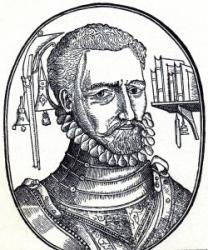
1525 - 1577 Person Name: George Gascoigne, 1525-1777 Author of "You That Have Spent the Silent Night" in The Cyber Hymnal Gascoigne, George, son and heir of Sir John Gascoigne. The date and place of his birth are unknown, but it is probable that he was born about 1525, and from a statement in the Address to Queen Elizabeth prefixed to one of his works, he seems to have spent a part of his early life in Westmoreland. He was educated at Trinity College, Cambridge, from whence he entered the Middle Temple as a student of law before 1548; but neglecting his studies he led a life of reckless extravagance and dissipation, on account of which he was disinherited by his father. In 1555 he migrated to Gray's Inn, but seems to have left it also. In 1557-58 he represented Bedford in Parliament. In 1565 he returned to Gray's Inn, and there, in the following year, two plays by him were represented, The Supposes, translated from the Italian of Ariosto, and Jocasta, adapted from the Phoenissae of Euripides. To the latter Gascoigne contributed three acts. In 1572 he was returned to Parliament as member for the borough of Midhurst: but objections being made to his character he appears not to have taken his seat, and not long afterwards went to the Low Countries and took service with William of Orange, from whom he received a captain's commission. His gallant conduct in the field obtained the favourable notice of that Prince, but after some time he was taken prisoner by the Spaniards and sent back to England.
During Gascoigne's absence his first book, A Hundredth sundrie Floures bound up in one small Poesie, the manuscript of which he had left in the hands of a friend, was printed in 1572 or 1573 without his permission, and after his return from Holland, he published in 1575 a corrected and enlarged edition of his Poesies. Thenceforward he seems to have led a literary life, and is said to have been in some way attached to the court. On the occasion of Elizabeth's celebrated visit to Kenilworth in the summer of 1575, Gascoigne was commissioned by Leicester to devise the masques, &c, performed for the Queen's entertainment. He died at Stamford, Lincolnshire, Oct. 7, 1577, and was probably buried by his friend George Whetstone in the family vault of the Whetstones at Barnack, but this id not certainly known. At some time between 1558 and 1568 Gascoigne married Elizabeth Breton, mother, by her first husband, of the poet Nicholas Breton, and by her had a son. His widow survived until 1585. Gascoigne is noticeable as being one of the earliest English dramatists, the first English satirist, and the first English critic in poetry. In 1869 his poems were collected and edited for the Roxburghe Library by W. C. Hazlitt, and in 1868 his Notes of Instruction in English Verse; The Steele Glas; and The Complaynt of Philomene were included in English reprints edited by Edward Arber, together with Whetstone's metrical life of Gascoigne. To modern hymnody he is known by "We that have passed in slumber sweet," an altered version of his morning hymn, "Ye that have spent the silent night;" and other religious poems. [George Arthur Crawford, M.A.]
-- John Julian, Dictionary of Hymnology (1907)
George Gascoigne
Pages




