You help make Hymnary.org possible. More than 10 million people from 200+ countries found hymns, liturgical resources and encouragement on Hymnary.org in 2025, including you. Every visit affirms the global impact of this ministry.

If Hymnary has been meaningful to you this year, would you take a moment today to help sustain it? A gift of any size—paired with a note of encouragement if you wish—directly supports the server costs, research work and curation that keep this resource freely available to the world.

Give securely online today, or mail a check to:
Hymnary.org
Calvin University
3201 Burton Street SE
Grand Rapids, MI 49546

Thank you for your partnership, and may the hope of Advent fill your heart.

Person Results

Tune Identifier:"^dundee_ravenscroft$"
In:people

Planning worship? Check out our sister site, ZeteoSearch.org, for 20+ additional resources related to your search.
Showing 101 - 110 of 145Results Per Page: 102050

Shududi, As'ad

1826 - 1906 Person Name: اسعد الشدودي Author of "سبحان تلك العزة" in كتاب الترانيم الروحية للكنائس الإنجيلية Asaad Ibrahim alShdudi, 1826-1906 A Lebanese-born Mathematician, who studied and later worked at the American University of Beirut. أسعد إبراهيم الشدودي

Thomas Cotterill

1779 - 1823 Person Name: Thomas Cotterill, 1779-1823 Author of "In memory of the Saviour's love" in The Hymnary of the United Church of Canada Thomas Cotterill (b. Cannock, Staffordshire, England, 1779; d. Sheffield, Yorkshire, England, 1823) studied at St. John's College, Cambridge, England, and became an Anglican clergyman. A central figure in the dispute about the propriety of singing hymns, Cotterill published a popular collection of hymns (including many of his own as well as alterations of other hymns), Selection of Psalms and Hymns in 1810. But when he tried to introduce a later edition of this book in Sheffield in 1819, his congregation protested. Many believed strongly that the Church of England should maintain its tradition of exclusive psalm singing. In a church court the Archbishop of York and Cotterill reached a compromise: the later edition of Selection was withdrawn, and Cotterill was invited to submit a new edition for the archbishop's approval. The new edition was published in 1820 and approved as the first hymnal for the Anglican church of that region. Cotterill's suppressed book, however, set the pattern for Anglican hymnals for the next generation, and many of its hymns are still found in modern hymnals. Bert Polman =============== Thomas Cotterill was born in 1779; studied at S. John's College, Cambridge, graduating M.A.; ordained in 1806, and enterred upon parochial work at Tutbury; afterwards removed to Lane End, where he remained for nine years among the Potteries; in 1817, became perpetual Curate of S. Paul's, Sheffield. He died in 1823. He was the author of several books; among them, "A Selection of Psalms and Hymns for Public and Private Use, adapted to the Services of the Church of England." In the preparation of this collection (the 8th ed., 1819), he had the assistance of Montgomery, who in this work did what he condemned in others, viz., altering and remodeling other authors' hymns. --Annotations of the Hymnal, Charles Hutchins, M.A., 1872. ====================== Cotterill, Thomas, M.A., was the son of a woolstapler at Cannock, Staffordshire, where he was born Dec. 4, 1779. After attending the local boarding-school of the Rev. J. Lomax, he proceeded to the Free School, Birmingham. He graduated at St. John's College, Cambridge (B.A. 1801, M.A. 1805), of which he became a Fellow. Taking Holy Orders, he became Curate of Tutbury in June, 1803 (not 1806, as stated by Miller in Singers & Songs of the Church). His subsequent charges were the Incumbency of Lane End, Staffordshire, 1808-17, and the Perpetual Curacy of St. Paul's Sheffield, 1817-23. He died at Sheffield Dec. 29, 1823 (not Jan. 5, 1824, as in the Gentleman’s Magazine), aged 44. His volume of Family Prayers attained to the sixth edi¬tion in 1824. As a hymn-writer, Cotterill is less known than as the compiler of a Selection of Psalms and Hymns which has had a most marked effect on modern hymnals. The first edition of that Selection was published in 1810, and the 9th in 1820. All subsequent issues were reprints of the last. The most important edition is the 8th, 1819. To that Selection Cotterill contributed at various dates 25 original hymns and versions of individual psalms. These, in common with all the hymns in the Selection, are given without author's name. Through the aid, however, of marked copies [in the collections of Brooke and Julian] and of members of Cotterill's family, we are enabled to identify most, if not all, of his original productions. In addition to those which are annotated under their first lines, we have— i. In his Selection of Psalms & Hymns for Public and Private Use, adapted to the Festivals of the Church of England, &c, 1st ed., 1810:— 1. Awake, O sword, the Father cried. Atonement. 2. Before Thy throne of grace, O Lord. Lent. 3. From Sinai's mount, in might array'd. The Law and the Gospel. 4. From Thine all-seeing Spirit, Lord. Ps. 139. 5. In all the ways and works of God. Ps. 145. 6. Out of the deeps, O Lord, we call. Ps. 130. 7. The Lord, who once on Calvary. The Intercessor. This is based on “Where high the heavenly temple stands," q. v. ii. In the Appendix to the 6th ed. of the same Selection, Staffordshire, 1815:— 8. Blessed are they who mourn for sin. Lent. 9. Father of mercies, let our songs [way, ways]. Thanksgiving. 10. I was alive without the law. Lent. 11. Lord of the Sabbath, 'tis Thy day. Sunday. iii. In the 8th edition of the same, 1819 :— 12. Help us, O Lord, Thy yoke to wear. Charity Sermons. This is sometimes given as "Lord, let us learn Thy yoke to wear," as in Kennedy, 1863, &c. 13. I love the Lord, for He hath heard. Ps. 116. 14. Lo in the East a star appears. Epiphany. This in an altered form begins in Kennedy, 1863, No. 188, with stanza ii., "The ancient sages from afar." 15. Lord, cause Thy face on us to shine. For Unity. 16. When Christ, victorious from the grave. Easter. The 9th ed. of the Selection, 1820, was practically a new work. It was compiled by Cotterill, but revised by Dr. Harcourt, the Archbishop of York, and was dedi¬cated to him. It was the outcome of the compromise in the legal proceedings over the 8th ed., 1819. The 8th ed. contained 367 hymns in addition to 128 versions of the Psalms and 6 Doxologies, the 9th only 152. Its full title was A Selection of Psalms and Hymns for Public Worship, Lond., T. Cadell, 1820. It may be noted that copies of the 8th ed., 1819, are found with two distinct title-pages. One of these, accompanied with the preface, was for the general public, the second, without the preface, for the use of the congregations of St. James's and St. Paul's, Sheffield. Of Cotterill's hymns the most popular are, "O'er the realms of pagan darkness," "Let songs of praises fill the sky," and "Jesus exalted far on high," but these are not distinguished by any striking features of excellence. He was more happy in some of his alterations of older hymns, and in the com¬piling of centos. Many of the readings introduced into the great hymns of the Church first appeared in his Selection. The most notable amongst these are, "Rock of Ages," in 3 stanzas, as in Hymns Ancient & Modern, 1861, the Wesleyan Hymn Book, and other collections; "Lo! He comes with clouds descending;" and “Great God, what do I see and hear." Cotterill's connection with the Uttoxeter Psalms & Hymns, 1805, is given in detail in the article on Staffordshire Hymn-books, and his lawsuit over the 8th ed. of his Selection, 1819, in the article on England Hymnody, Church of. --John Julian, Dictionary of Hymnology (1907)

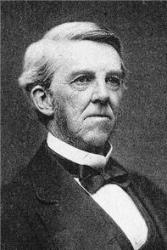
Oliver Wendell Holmes

1809 - 1894 Person Name: Oliver Wendell Holmes, Sr. Author of "Father Of Mercies, Heavenly Friend" in The Cyber Hymnal Holmes, Oliver Wendell, M.D, LL.D., son of the Rev. Abiel Holmes, D.D. of Cambridge, U.S.A., was born at Cambridge, Aug. 29, 1809, and educated at Harvard, where he graduated in 1829. After practising for some time in Boston, he was elected in 1847 to the chair of Anatomy, in Harvard. His writings in prose and verse are well known and widely circulated. They excel in humour and pathos. Although not strictly speaking a hymnwriter, a few of his hymns are in extensive use, and include:— 1. Father of mercies, heavenly Friend. Prayer during war. 2. Lord of all being, throned afar. God's Omnipresence. This is a hymn of great merit. It is dated 1848. 3. 0 Lord of hosts, Almighty King. Soldiers’ Hymn. Dated 1861. 4. 0 Love divine that stoop'st to share. Trust. 1859. Of these Nos. 2 and 4 are in his Professor at the Breakfast Table, and are in common use in Great Britain, in Martineau's Hymns, 1873, and others. In 1886 the D.C.L. degree was conferred upon Professor Holmes by the University of Oxford. He was a member of the Unitarian body. He died Oct 7, 1894. [Rev. F. M. Bird, M.A.] --John Julian, Dictionary of Hymnology (1907) ================== Holmes, O. W. , p. 530, i. His Songs in Many Keys was published in 1861, his Poems, 1869, and the Cambridge edition of his Complete Poetical Works, 1895. Additional hymns of his have come into common use of late, including:— 1. Land where the banners wave last in the sun. [American National Hymn.] Appeared in his Songs in Many Keys, 1861 (7th ed. 1864, p. 289) as "Freedom, our Queen." 2. Lord, Thou hast led us as of old. [Promised Unity.] In his Before the Curfew and other Poems, chiefly occasional, Boston, 1888, as "An hymn set forth to bo sung by the Great Assembly at Newtown [Mass.]." In the Complete Poetical Works it is dated 1886. The hymn "Soon shall the slumbering morn awake," in Hymns for Church and Home, Boston, 1895, is composed of stanzas v.-vii. 3. Our Father, while our hearts unlearn The creeds that wrong Thy name. [Fruits of the Spirit.] Written for the 25th Anniversary Reorganization of the Poston Young Men's Christian Union, May 31, 1893. In his Complete Poetical Works, 1895, p. 298, Horder's Worship Song, 1905, and other collections. 4. Thou gracious [God] Power Whose mercy lends. [Reunion.] "Written for the annual meeting of the famous class '29, Harvard University, in 1869. ln the Methodist Hymn Book, 1904, it begins "Thou gracious God, Whose mercy lends." [Rev. L. F. Benson, D.D.] --John Julian, Dictionary of Hymnology, New Supplement (1907)

William Barton

1598 - 1678 Person Name: W Barton Author of "(Psalm 121) I to the Hills will Lift mine Eyes" in Redemption Hymnal Barton, William, born cir. 1603, and for some time Minister of St. Martin's, Leicester, died May 14, 1678. He was the author of one of the earliest collections of hymns, as distinct from Versions of the Psalms, in the English language. He was a friend of Richard Baxter, and it was at Baxter's request that he made four metrical renderings of the Te Deum (q. v.). His Hymns and Versions of the Psalms were numerous and were published as follows:— (1) The Book of Psalms in Metre, 1644, 2nd ed. 1645, 3rd ed. 1646, 4th ed. 1654. (2) Psalms & Hymns composed for the Public Thanksgiving, Oct. 24, 1651. This consists of versions of Ps. 48, 76, 46 and 135. A copy of this is in the Bodleian. (3) A Century of Select Hymns, known as the Chapter Hymns, 1659, 100 in all. (4) Four Centuries of Select Hymns, an imperfect edition, published, he said, against his will. It contains the 1659 Century, a new Century of Chapter Hymns, and two Centuries of Psalm Hymns, 1668. (5) A new and revised edition of the Chapter Hymns, 1670. (6) A new and revised edition of the Psalm Hymns, 1672. (7) Last revise of the Psalm Hymns, containing the Third Century, 1682. (8) The foregoing Centuries collected, a Third Century of Chapter Hymns added thereto, 20 additional hymns, the Catechism, Book of Canticles, the Catalogue of Virtuous Women (all in metre), were published with an Introduction by his son, Edward Barton, "Minister of Welford, in Northamptonshire," in 1688. This is Barton's work which is known as the Six Centuries of Select Hymns and Spiritual Songs, collected out of the Bible, &c, Lond., 1688. Of these works Nos. 1,2, and 4 differ widely in text from each other; and together with the rest are again altered in the final revision published after his death, 1682, and several times reprinted. The last ed. was published by Robert Robinson of Cambridge in 1768. These versions deserve more attention from compilers than they have hitherto received. It must be noted, however, that the Book of Psalms, and the Psalm Hymns, are distinct works. (9) Barton also printed a 4to volume in 1655, as, A View of Many Errors and some gross Absurdities in the Old Translation of the Psalms in English Metre, as also in some other Translations lately published. This work contains specimens of his own translations and epigrams, and commendatory verses by his friends. -- John Julian, Dictionary of Hymnology (1907)

John Cawood

1775 - 1852 Author of "Almighty God, Thy Word is Cast" in The Lutheran Hymnal John Cawood was born in 1775, at Matlock, Derbyshire, where his father carried on a small farm. He enjoyed very limited educational advantages. At the age of eighteen he occupied a menial position. But seeking every opportunity of self improvement, and aided by those who interested themselves in his behalf, he was enabled in 1797 to enter S. Edmund Hall, Oxford, and obtained his B.A. in 1801, and his M.A. in 1807. He was ordained in 1801, and most of his life in the ministry was spent as perpetual Curate of S. Ann's Chapel of Ease, Bewdley, Worcestershire. He died in 1852. He published several prose works, but no volume of hymns or poems. His son says, "My father composed about thirteen hymns, which have one by one got into print, though never published by himself, or any one representing him." --Annotations of the Hymnal, Charles Hutchins, M.A., 1872 ======================= Cawood, John, M. A., born at Matlock, Derbyshire, March 18, 1775. His parents being in humble circumstances, he received in childhood but a limited education, and at 18 was engaged in the service of the Rev. Mr. Cursham, Sutton-in-Ashfield, Notts. Three years' study, however, under careful direction, enabled him to enter St. Edmund Hall, Oxford, in 1797. Obtaining his degree in 1801, he took Holy Orders, and became successively Curate of Ribsford and Dowles, and Incumbent of St. Ann's Chapel of Ease, Bewdley, Worcestershire. He died Nov. 7, 1852. His hymns, 17 in all, were never published by himself. Of these 9 were included in Cotterill's Selection, 8th ed., 1819, Nos. 268-276. Most of these have passed into other collections. These are :— 1. Almighty God, Thy word is cast. After a Sermon. 2. Hark! what mean those holy voices? (1819.) Christmas. 3. Begin a joyful song. (1819.) Christmas. 4. Behold yon wondrous star. (1819.) Epiphany. 5. Trembling with tenderest alarms. (1816.) Finding of Moses. 6. In Israel's fane, by silent night. (1816.) Samuel. 7. King o'er all worlds the Saviour shone. (1819.) Good Friday. 8. Christians, the glorious hope ye know. (1819.1 Plea for Missions. 9. Hark! what mean those lamentations. (1819.) Missions. In addition, Dr. Rogers pub. in his Lyra Britannica, 1867, from the author's manuscript:— 10. A child of sin and wrath I'm born. (1820.) Infant's Prayer. 11. The Sou of God, in worlds on high. (1822.) Christ's Humility. 12. Blessed Father, Great Creator. (1837.) Holy Trinity. These details are from the S. MSS., amongst which there are 5 hymns yet unpublished. --John Julian, Dictionary of Hymnology (1907)

W. C. John

Author of "Oh Dios eterno" in Himnario Adventista

J. A. B.

Translator of "En grata memoria" in Himnario de la Iglesia Metodista Episcopal

Thomas Sternhold

1449 - 1549 Person Name: Thomas Sternhold, d. 1549 Author of "The Lord descended from above" in The Otterbein Hymnal Thomas Sternhold was Groom of the Robes to Henry VIII and Edward VI. With Hopkins, he produced the first English version of the Psalms before alluded to. He completed fifty-one; Hopkins and others composed the remainder. He died in 1549. Thirty-seven of his psalms were edited and published after his death, by his friend Hopkins. The work is entitled "All such Psalms of David as Thomas Sternhold, late Groome of the King's Majestye's Robes, did in his Lyfetime drawe into Englyshe Metre." Of the version annexed to the Prayer Book, Montgomery says: "The merit of faithful adherence to the original has been claimed for this version, and need not to be denied, but it is the resemblance which the dead bear to the living." Wood, in his "Athenae Oxonlenses" (1691, vol. I, p. 62), has the following account of the origin of Sternhold's psalms: "Being a most zealous reformer, and a very strict liver, he became so scandalized at the amorous and obscene songs used in the Court, that he, forsooth, turned into English metre fifty-one of David's psalms, and caused musical notes to be set to them, thinking thereby that the courtiers would sing them instead of their sonnets; but they did not, some few excepted. However, the poetry and music being admirable, and the best that was made and composed in these times, they were thought fit to be sung in all parochial churches." Of Sternhold and Hopkins, old Fuller says: "They were men whose piety was better than their poetry, and they had drunk more of Jordan than of Helicon." Sternhold and Hopkins may be taken as the representatives of the strong tendency to versify Scripture that came with the Reformation into England--a work men eagerly entered on without the talent requisite for its successful accomplishment. The tendency went so far, that even the "Acts of the Apostles" was put into rhyme, and set to music by Dr. Christopher Tye. --Annotations of the Hymnal, Charles Hutchins, M.A. 1872.

Joseph A. Alexander

1809 - 1860 Person Name: J. A. Alexander Author of "There is a time, we know not when" in Immanuel Hymnal Alexander, Joseph Addison, D.D., brother of Dr. J. W. Alexander, and a minister of the Presbyterian Church, born in Philadelphia, April 24, 1809, graduated at Princeton, 1826, became Adjunct Professor of Latin, 1833, and Associate Professor of Biblical Literature, 1838, died at Princeton, Jan. 28, 1860. Dr. Alexander was a great Hebraist, and published Commentaries on Isaiah, the Psalms, &c. His poem, “The Doomed Man,” was written for, and first published in, the Sunday School Journal, Phila., April 5, 1837. It has striking merit, but moves in one of those doctrinal circles which hymns generally avoid. Parts of it are found as hymns in a few Calvinistic collections, as, "There is a time, we know not when," in the New York Church Praise Book, 1881, No. 288. This is sometimes given with the second stanza, "There is a line, by us unseen," as in Nason's Collection, and Robinson's Songs for the Sanctuary, 1865. Unknown to English collections. [Rev. F. M. Bird, M.A.] --John Julian, Dictionary of Hymnology, p. 39 (1907)

John Logan

1748 - 1788 Author of "O God of Bethel, by Whose Hand" in The Presbyterian Hymnal Logan, John, son of a farmer, born at Fala, Midlothian, 1748, and educated at Edinburgh University, in due course entering the ministry of the Church of Scotland and becoming the minister of South Leith in 1770. During the time he held this charge he delivered a course of lectures on philosophy and history with much success. While he was thus engaged, the chair of Universal History in the University became vacant; but as a candidate he was unsuccessful. A tragedy, entitled Runnamede, followed. He offered it to the manager of Covent Garden Theatre, but it was interdicted by the Lord Chamberlain "upon suspicion of having a seditious tendency." It was subsequently acted in Edinburgh. In 1775 he formed one of the Committee by whom the Translations and Paraphrases of the Church of Scotland was prepared. In 1782 he was compelled to resign his charge at Leith in order to prevent deposition, and finally, having passed on to London, he supported himself partly by his pen, and died there, Dec. 28, 1788. [Also, see Bruce, Michael] The names of Michael Bruce and John Logan are brought together because of the painful controversy which has long prevailed concerning the authorship of certain Hymns and Paraphrases of Holy Scripture which are in extensive use in the Christian Church both at home and abroad. During the latter years of Bruce's short life he wrote various Poems, and also Hymns for a singing class at Kinnesswood, which were well known to his family and neighbours, and were eventually copied out by Bruce himself in a quarto MS. book, with the hope that some day he might see them in print. Immediately upon his death, in 1767, Logan called upon his father and requested the loan of this book that he might publish the contents for the benefit of the family. This was granted. Not till three years afterwards did a certain work, containing seventeen poems, and entitled Poems on Several Occasions, by Michael Bruce, 1770, appear, with a Preface in which it was stated that some of the Poems were by others than Bruce. Bruce's father immediately pointed out the absence from the volume of certain hymns which he called his son's "Gospel Sonnets," and members of the singing class at Kinnesswood also noted the absence of hymns with which they were familiar. Letters of remonstrance and demands for the return of the quarto manuscript book of Bruce by the father remaining unanswered, led him eventually to see Logan in person. No book was forthcoming, a few scraps of manuscript only were returned, and Logan accounted for the absence of the book by saying he feared "that the servants had singed fowls with it." For a time the matter rested here, only to be revived with renewed interest by the publication, in 1781 (14 years after the death of Bruce, and 11 after the Poems, &c, were issued), of Poems. By the Rev. Mr. Logan, One of the Ministers of Leith. In this volume, an "Ode to the Cuckoo," a poem of exquisite beauty, and other poetical pieces which appeared in the Poems on Several Occasions, by Michael Bruce, were repeated, and claimed as his own by Logan. In addition, certain Hymns and Paraphrases were included, most of which were of sterling merit, and poetical excellence. It has been shown, we think, most conclusively by Dr. Mackelvie in his Life of Bruce prefixed to the Poems, 1837 and by Dr. Grosart in his Works of M. Bruce, 1865, that the "Ode to the Cuckoo," "Lochleven," and other poetical pieces were taken from MS. book of M. Bruce. The Hymns and Paraphrases, most of which were included in the Translations and Paraphrases during the same year, were also claimed for Bruce. Until clearer evidence is brought forward on behalf of Bruce, the hymns, or paraphrases, following must be ascribed to John Logan: — "Who can resist th'Almighty arm"; "In streets and op'nings of the gates”; "Thus speaks the heathen: How shall man"; "Take comfort, Christians, when your friends"; "The hour of my departure's come." The following, which are found only in the Translations and Paraphrases of 1781, are claimed by W. Cameron for Logan, and have never been seriously disputed by the friends of Bruce, the second being original, the first a revise from the Translations and Paraphrases of 1745; and the third a revise of Doddridge and Dr. Hugh Blair:— "Let Christian faith and hope dispel"; “Thus speaks the high and lofty One"; "What though no flowers the fig-tree clothe." In addition, we see no cause to deny to Logan the few changes, and new stanza, which are found in Doddridge's "0 God of Bethel, by Whose hand." Of the above hymns 5 are recasts of hymns in the Scottish Translations and Paraphrases of 1745. Those are: "Behold the mountain of the Lord " (see "In latter days the mount of God "); "When Jesus by the Virgin brought" (see "Now let Thy servant die in peace"); "Behold the Ambassador divine" (see "Behold my Servant, see Him rise"); "Let Christian faith and hope dispel" (see “Now let our souls ascend above"); and "What though no flowers the fig-tree clothe" (see "So firm the saints' foundation stands"). …It is curious to note that every hymn which we have ascribed to M. Bruce has come into more or less extensive use outside of the Translations and Paraphrases, and that not one which we have ascribed to Logan, except "Let Christian faith and hope dispel," and “Take comfort, Christians," &c, is found beyond that work, unless we give to Logan the plaintive "The hour of my departure's come" (which Dr. Grosart claims for Bruce), and the recast "O God of Bethel, by Whose hand," whose success is due to Doddridge. This is the verdict of 100 years' use of those hymns, and shows conclusively the poetic strength of Bruce and the weakness of Logan. --John Julian, Dictionary of Hymnology (1907) ================ http://en.wikipedia.org/wiki/John_Logan_%28minister%29

Pages


Export as CSV
It looks like you are using an ad-blocker. Ad revenue helps keep us running. Please consider white-listing Hymnary.org or getting Hymnary Pro to eliminate ads entirely and help support Hymnary.org.