You help make Hymnary.org possible. More than 10 million people from 200+ countries found hymns, liturgical resources and encouragement on Hymnary.org in 2025, including you. Every visit affirms the global impact of this ministry.

If Hymnary has been meaningful to you this year, would you take a moment today to help sustain it? A gift of any size—paired with a note of encouragement if you wish—directly supports the server costs, research work and curation that keep this resource freely available to the world.

Give securely online today, or mail a check to:
Hymnary.org
Calvin University
3201 Burton Street SE
Grand Rapids, MI 49546

Thank you for your partnership, and may the hope of Advent fill your heart.

Person Results

Topics:god+as+creator
In:people

Planning worship? Check out our sister site, ZeteoSearch.org, for 20+ additional resources related to your search.
Showing 101 - 110 of 254Results Per Page: 102050

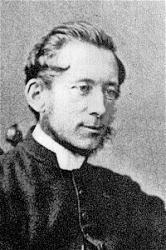
John Bacchus Dykes

1823 - 1876 Person Name: John B. Dykes, 1823-1876 Topics: God as Creator Harmonizer of "O QUANTA QUALIA" in Psalms for All Seasons As a young child John Bacchus Dykes (b. Kingston-upon-Hull' England, 1823; d. Ticehurst, Sussex, England, 1876) took violin and piano lessons. At the age of ten he became the organist of St. John's in Hull, where his grandfather was vicar. After receiving a classics degree from St. Catherine College, Cambridge, England, he was ordained in the Church of England in 1847. In 1849 he became the precentor and choir director at Durham Cathedral, where he introduced reforms in the choir by insisting on consistent attendance, increasing rehearsals, and initiating music festivals. He served the parish of St. Oswald in Durham from 1862 until the year of his death. To the chagrin of his bishop, Dykes favored the high church practices associated with the Oxford Movement (choir robes, incense, and the like). A number of his three hundred hymn tunes are still respected as durable examples of Victorian hymnody. Most of his tunes were first published in Chope's Congregational Hymn and Tune Book (1857) and in early editions of the famous British hymnal, Hymns Ancient and Modern. Bert Polman

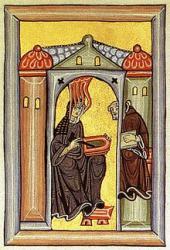
Saint Hildegard

1098 - 1179 Person Name: Hildegard of Bingen Topics: Creation God as Creator Author of "I Am That Great and Fiery Force" in Voices Together Hildegard, St., Virgin and Abbess, was born at Bockelheim, or Bockenheim, Frankfurt, 1098. Her father, Hildebert, was one of the Knights of Meginhard, Count of Spanheim. When eight years old she was committed to tho care of a sister of the Count, Jutta, the Abbess of St. Disibod, a position in which she was succeeded by Hildegard in 1136. Under the rule of Hildegard the convent became so crowded that a new one was built at Rupertsberg, near Bingen, into which, in 1147, Hildegard removed with eighteen Sisters. Hildegard gained great notoriety in very early life on account of visions to which, it is said, she was subject from her 6th to her 15th year. In later life she filled a considerable place in the history of her times, not only as a writer who had the courage of her opinions, and spared neither high nor low in her vigorous denunciations of their shortcomings, political as well as moral, but as a prophetess and preacher. At the instigation of St. Bernard she took a most prominent part in stirring up the unfortunate crusade which he preached, and engaged in many controversies with the hierarchy of her Church. Though she never ceased to be the abbess of the convent she had founded, much of her time was spent in travelling about the Continent, preaching and prophesying. She died in 1179, and was buried at Eupertsberg, but her remains were removed, on the destruction of that convent by the Swedes, to Eilingen, in 1622. Though St. Hildegard was a voluminous writer her contributions to the hymnody of her day were neither numerous nor important. Mone gives three sequences which are attributed to her, viz., one on the Holy Spirit, “0 ignis Spiritus paracliti"; another on the Blessed Virgin Mary, "0 Virga ac diadema purpurae Regis"; and a third on St. Disibod, "0 praesul verae civitatis." [Rev. Digby S. Wrangham, M.A.] -- John Julian, Dictionary of Hymnology

Arlo D. Duba

b. 1929 Person Name: Alro D. Duba Topics: God as Creator Author of "Come, All You Servants of the Lord" in Psalms for All Seasons Arlo Duba (b. 1929) was an administrator at Princeton Seminary and is professor of worship (emeritus) and former dean at the University of Dubuque (Iowa) Theological School. Sing! A New Creation, 2002

Joseph Parry

1841 - 1903 Topics: God as Creator Composer of "ABERSTWYTH" in Psalms for All Seasons Joseph Parry (b. Merthyr Tydfil, Glamorganshire, Wales, 1841; d. Penarth, Glamorganshire, 1903) was born into a poor but musical family. Although he showed musical gifts at an early age, he was sent to work in the puddling furnaces of a steel mill at the age of nine. His family immigrated to a Welsh settlement in Danville, Pennsylvania in 1854, where Parry later started a music school. He traveled in the United States and in Wales, performing, studying, and composing music, and he won several Eisteddfodau (singing competition) prizes. Parry studied at the Royal Academy of Music and at Cambridge, where part of his tuition was paid by interested community people who were eager to encourage his talent. From 1873 to 1879 he was professor of music at the Welsh University College in Aberystwyth. After establishing private schools of music in Aberystwyth and in Swan sea, he was lecturer and professor of music at the University College of South Wales in Cardiff (1888-1903). Parry composed oratorios, cantatas, an opera, orchestral and chamber music, as well as some four hundred hymn tunes. Bert Polman

John Ryland

1753 - 1825 Topics: God as Creator Author of "Sovereign Ruler of the Skies" in The Sing! Hymnal Ryland, John, D.D., son of Rev. John Collett Ryland, was born at Warwick, Jan. 29, 1753. At that time his father was Baptist minister at Warwick, but in 1759 removed to Northampton. "J. Ryland, junior," as for many years he was accustomed to subscribe himself, was in 1781 ordained co-pastor with his father at Northampton. In 1794 he accepted the presidency of the Baptist College and the pastorate of the church in Broadmead, Bristol, and these offices he retained until his death on June 25, 1825. Dr. Ryland was a man of considerable literary culture, and received the degree of D.D. from Brown University, Rhode Island. He was one of the founders of the Baptist Missionary Society, and for the three years following the death of Rev. A. Fuller, in 1815, acted as its secretary. His prose works were Memoirs of Rev. B. Hall, Arnsby (2nd ed., 1852); A candid statement of the reasons which induce Baptists to differ from their Christian brethren; and many Sermons and Charges. After his death appeared 2 vols. of Discourses, selected from his manuscripts, and entitled Pastoral Memorial. To these discourses are appended many of his hymns, with their dates. Dr. Ryland's hymns were composed at different times, from his sixteenth year to the year of his death. The earliest were published when he was 16, in his Serious Essays, 1771. These 36 hymns were never republished. Several appeared in the Gospel Magazine from 1771 to 1782, and the Protestant Magazine, 1782-83; others in Rippon's Baptist Selection, 1787; 2 in the Collection for the Monthly Prayer Meeting at Bristol, 1797 ; 2 in Andrew Fuller's Memoirs, 1831; and 25 in the Pastoral Memorials, 1825. His Hymns and Verses on Sacred Subjects, to the number of 99, were reprinted from his mss. by D. Sedgwick, and were published, with a Memoir, in 1862. The hymns are dated therein from the mss. [Rev. W. R. Stevenson, M.A.] Those of Dr. Ryland's hymns now in common use include:— 1. For Zion's sake I'll not restrain. Missions. Dated 1798, and printed by D. Sedgwick from Ryland's manuscripts, 1862. 2. Had not the Lord, my soul may say [cry] . Ps. cxxiv. From his Serious Essays, 1771. It is No. 124 in Spurgeon's Our Own Hymn Book, 1866. Not in Sedgwick's reprint. 3. Holy, holy, holy Lord, self-existent Deity. Holy Trinity. Dated 1796. It was given in the tenth edition of Rippon's Baptist Selection, 1800, Pt. 2, No. 22; in the Pastoral Memorials, 1825; and Sedgwick's reprint, 1862, in 5 stanzas of 8 lines. It is in common use in Great Britain and America. 4. Look down, my soul, on hell's domain. Gratitude for escape. This is No. 881 in Spurgeon's Our Own Hymn Book. 1866, and dated 1777. We cannot trace it in any of Ryland's works or amongst his hymns. 5. Lord, teach a little child to pray. A Child's Prayer. Dated 1786. The note to this hymn by Dr. Ryland's son, in Sedgwick's reprint, 1862, p. 15, is:— "This and the following hymn ["God is very good to me “was composed at the request of Mrs. Fuller, wife of the Rev. Andrew Fuller, of Kettering, for the use of Miss Sarah Fuller, who died May 30th, 1789, aged six years and six months." It was published in Andrew Fuller's Memoirs, 1831, p. 442, andsin Sedgwick's reprint, 1862. 6. Now let the slumbering church awake. Activity in the Church desired. Dated "Feb. 20, 1798." Published in the Pastoral Memorials, 1825, and in Sedgwick's reprint, 1862. In Spurgeon's Our Own Hymn Book, 1866. 7. O Lord, I would delight in Thee. Delight in Christ. Dated "Dec. 3, 1777." Dr. Ryland added this note to the ms.:—-" I recollect deeper feelings of mind in composing this hymn, than perhaps I ever felt in making any other." It was published in Rippon's Selection 1798, No. 248; in the Pastoral Memorials, 1825; and in Sedgwick's reprint, 1862, in 7 st. of 41. It is in extensive use in its original, or an abbreviated form; or as "O Lord we would delight in Thee." In the American Methodist Episcopal Hymns, 1849; and their Hymn, 1878, st. i., ii., vi., vii. are rewritten in S. M. as "Lord, I delight in Thee." 8. Out of the depths of doubt and fear. Ps. cxxx. From the Serious Essays, 1771 (misdated in Spurgeon's Our Own Hymn Book 1775). It is not in the Pastoral Memorials, 1825, nor in Sedgwick's reprint, 1862. 9. Rejoice, the Saviour reigns. Missions. Dated "Jan. 19, 1792." In the 10th ed. of Rippon's Selection, 1800, 422 (2nd pt.) it is given in 6 st. of 6 1., as in the Ryland ms., and then after the word "Pause" two stanzas are added on, which are not in the ms. The 6 stanzas were repeated in the Pastoral Memorials, 1825; in Sedgwick's reprint, 1862; and in Spurgeon's Our Own Hymn Book, 1866 (abbreviated), and other modern hymnals. 10. Sovereign Ruler of the skies. Guidance, Peace, and Security in God. Dated "Aug. 1,1777." Included in Rippon's Selection, 1787, No. 545 ; the Pastoral Memorials, 1825 ; and Sedgwick's reprint, 1862, in 9 st. of 4 1. 11. Thou Son of God, and Son of Man. Praise to God, the Son. This is undated. It was given in the Pastoral Memorials, 1825; and Sedgwick's reprint, 1862. 12. When Abraham's servant to procure. Onward, Heavenward. Dr. Ryland's son, under the date of Nov. 4, 1861, informed D. Sedgwick that this hymn "was written with a slate pencil on a rusty iron blower by moonlight, past twelve o'clock, Dec. 30, 1773," and he gives these words as a quotation from his father's manuscript. It is almost needless to add that this account does not agree with the generally received history of the hymn, as set forth in Miller's Singers and Songs, 1869, p. 313. In the May number of the Gospel Magazine, 1775, p. 235, the hymn was given in 9 st. of 4 1., with the heading" Hinder me not-—Gen. xxiv. 56," and signed "Elachistoteros." It was repeated in Rippon's Selection, 1787, No. 447; and Sedgwick's reprint, 1862. In Rippon a note is added, "This hymn may begin with 6th verse." This direction has been followed in some modern collections, the result being the hymn commonly known as "In all my Lord's appointed ways." 13. When the Saviour dwelt below. Compassion of Christ. Dated 1806. Included in the Pastoral Memorials, 1825, and Sedgwick's reprint, 1862. Dr. Ryland's hymns are plain and simple, but they lack poetry and passion, and are not likely to be largely drawn upon, for future hymnals. --John Julian, Dictionary of Hymnology (1907)

Henry K. Oliver

1800 - 1885 Topics: God as Creator Composer of "FEDERAL STREET" in Psalms for All Seasons Henry Kemble Oliver (b. Beverly, MA, 1800; d. Salem, MA, 1885) was educated at Harvard and Dartmouth. He taught in the public schools of Salem (1818-1842) and was superintendent of the Atlantic Cotton Mills in Lawrence, Massachusetts (1848-1858). His civic service included being mayor of Lawrence (1859­1861) and Salem (1877-1880), state treasurer (1861-1865), and organizer of the Massachusetts Bureau of Statistics and Labor (1867-1873). Oliver was organist at several churches, including Park Street Congregational Church in Boston, North Church in Salem, and the Unitarian Church in Lawrence. A founder of the Mozart Association and several choral societies in Salem, he published his hymn tunes in Hymn and Psalm Tunes (1860) and Original Hymn Tunes (1875). Bert Polman

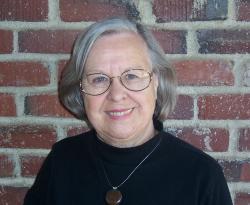
Jean Janzen

b. 1933 Topics: Creation God as Creator Author of "Mothering God, You Gave Me Birth" in Voices Together Jean Janzen was born on December 5, 1933, the seventh of Henry Peter Wiebe and Anna Schultz Wiebe's eventual eight children (Three Mennonite Poets 5). For the first five years of her life, Janzen lived in Dalmeny, Saskatchewan (A Cappella 25). In 1938, she moved to Mountain Lake, Minnesota when her schoolteacher father began his second ministry as a pastor (“Coming into Voice”). A year later, the family moved to Kansas (“Coming into Voice”). Janzen says she cannot remember when she wrote her first poem, but the first evidence of her work is a handwritten book of five poems that she made in third or fourth grade, which was saved by her mother through the family’s many moves (E-mail Interview). She had very little exposure to poetry and literature as a child, except for hymns and Bible stories. She values these elements of her childhood and “treasure[s] the artful rhythms of the King James [Bible]” (E-mail Interview). Janzen attended Meade Bible Academy, Tabor College, and Grace College (A Cappella 25). It was in college that she had her first real exposure to literature. She was “thrilled, and became a literature major.” She remembers being “enamored” with Emily Dickinson and writing papers about her whenever given the chance. However, she never considered writing poetry as a possible career (E-mail Interview). Janzen--then Jean Wiebe--married Louis Janzen, a medical student, and the couple moved to Chicago where she worked as a medical secretary while taking courses at Northwestern University (Hostetler, A Cappella 25). Janzen cites this period of her life as the beginning of her love for visual art, calling the Chicago Art Institute the “open gate” for her and her husband where they “became hooked” (Mennonite Life Interview). In 1961, they moved to Fresno, Cal., where Louis worked as a pediatrician in a private practice. Here they raised their two daughters and two sons. When her youngest child was in school, Janzen “joined a writer’s group at the encouragement of [her] husband and nephew after they read some poems [she] had written as a gift to [her] husband” (E-mail Interview). As her children became older, Janzen went back to college, earning a BA in English from Fresno Pacific College and an MA in Creative Writing and English from California State University at Fresno in 1982. There she studied with poets Peter Everwine, Philip Levine, and C.G. Hanzlicek. Janzen says that after one semester of writing poetry in college, she took the work “seriously” and “imagined the possibility of growing into a poet,” but it took her several years “to be willing to say that out loud” (E-mail Interview). Rudy Wiebe, a Mennonite novelist, served as a mentor who influenced Janzen's writing career. She received a grant from the National Endowment for the Arts in 1995 (“Coming into Voice”). Janzen grew up in the Evangelical Mennonite Brethren Church and many of her relatives, including her father, were pastors (“Coming into Voice”). This strong connection with the church has had a significant influence on her poetry. Music has also played an important role in Janzen’s life. Her mother loved music and music was an important part of worship in her church. She learned to play the piano when she was young, later studying music in college and teaching piano for many years (“Coming into Voice”). Janzen finds harmony between the religious and artistic elements of her life, integrating them in a way that enriches both. She also uses her gifts in the church, serving as a minister of worship at the College Community Mennonite Brethren Church in Clovis, Cal., as well as writing hymn texts, which have been set to music and are included in several hymn books. Other prominent themes in her work include art, history, family, the earth, and her Russian Mennonite ancestors (“Coming into Voice”). Janzen says that “the sensual and spiritual are inevitably intertwined” (Mennonite Life Interview) and it is this element of her work that has attracted the most attention from critics and readers. She emphasizes “the presence of spirit in the flesh,” using rich description of physical objects to reveal deeper emotions and truths. Janzen has taught poetry writing at Fresno Pacific University and Eastern Mennonite University in Virginia. --www.goshen.edu/mennonitepoetry/

David N. Johnson

1922 - 1987 Person Name: David Johnson, 1922-1987 Topics: God as Creator Composer of "EARTH AND ALL STARS " in Lift Up Your Hearts David Johnson (b. San Antonio, TX, 1922; d. Phoenix, AZ, 1987), former music department chairman at St. Olaf College, composed EARTH AND ALL STARS and published it in his Twelve Folksongs and Spirituals (1968). Johnson studied at Trinity, University, San Antonio, Texas, and received his master's and doctoral degrees in music from Syracuse University, New York. In addition to St. Olaf, he taught at Syracuse University; Alfred University, Alfred, New York; and Arizona State University. Johnson was organist at Syracuse University and organist and choir director at Trinity Episcopal Cathedral in Phoenix. His publications include Instruction Book for Beginning Organists and Organ Teacher's Guide; his compositions number over three hundred and include hymn tunes, varied harmonizations, and hymn preludes. Bert Polman

Lowell Mason

1792 - 1872 Person Name: Lowell Mason, 1792-1872 Topics: God as Creator Composer of "RIPLEY" in Psalms for All Seasons Dr. Lowell Mason (the degree was conferred by the University of New York) is justly called the father of American church music; and by his labors were founded the germinating principles of national musical intelligence and knowledge, which afforded a soil upon which all higher musical culture has been founded. To him we owe some of our best ideas in religious church music, elementary musical education, music in the schools, the popularization of classical chorus singing, and the art of teaching music upon the Inductive or Pestalozzian plan. More than that, we owe him no small share of the respect which the profession of music enjoys at the present time as contrasted with the contempt in which it was held a century or more ago. In fact, the entire art of music, as now understood and practiced in America, has derived advantage from the work of this great man. Lowell Mason was born in Medfield, Mass., January 8, 1792. From childhood he had manifested an intense love for music, and had devoted all his spare time and effort to improving himself according to such opportunities as were available to him. At the age of twenty he found himself filling a clerkship in a banking house in Savannah, Ga. Here he lost no opportunity of gratifying his passion for musical advancement, and was fortunate to meet for the first time a thoroughly qualified instructor, in the person of F. L. Abel. Applying his spare hours assiduously to the cultivation of the pursuit to which his passion inclined him, he soon acquired a proficiency that enabled him to enter the field of original composition, and his first work of this kind was embodied in the compilation of a collection of church music, which contained many of his own compositions. The manuscript was offered unavailingly to publishers in Philadelphia and in Boston. Fortunately for our musical advancement it finally secured the attention of the Boston Handel and Haydn Society, and by its committee was submitted to Dr. G. K. Jackson, the severest critic in Boston. Dr. Jackson approved most heartily of the work, and added a few of his own compositions to it. Thus enlarged, it was finally published in 1822 as The Handel and Haydn Society Collection of Church Music. Mason's name was omitted from the publication at his own request, which he thus explains, "I was then a bank officer in Savannah, and did not wish to be known as a musical man, as I had not the least thought of ever making music a profession." President Winchester, of the Handel and Haydn Society, sold the copyright for the young man. Mr. Mason went back to Savannah with probably $500 in his pocket as the preliminary result of his Boston visit. The book soon sprang into universal popularity, being at once adopted by the singing schools of New England, and through this means entering into the church choirs, to whom it opened up a higher field of harmonic beauty. Its career of success ran through some seventeen editions. On realizing this success, Mason determined to accept an invitation to come to Boston and enter upon a musical career. This was in 1826. He was made an honorary member of the Handel and Haydn Society, but declined to accept this, and entered the ranks as an active member. He had been invited to come to Boston by President Winchester and other musical friends and was guaranteed an income of $2,000 a year. He was also appointed, by the influence of these friends, director of music at the Hanover, Green, and Park Street churches, to alternate six months with each congregation. Finally he made a permanent arrangement with the Bowdoin Street Church, and gave up the guarantee, but again friendly influence stepped in and procured for him the position of teller at the American Bank. In 1827 Lowell Mason became president and conductor of the Handel and Haydn Society. It was the beginning of a career that was to win for him as has been already stated the title of "The Father of American Church Music." Although this may seem rather a bold claim it is not too much under the circumstances. Mr. Mason might have been in the average ranks of musicianship had he lived in Europe; in America he was well in advance of his surroundings. It was not too high praise (in spite of Mason's very simple style) when Dr. Jackson wrote of his song collection: "It is much the best book I have seen published in this country, and I do not hesitate to give it my most decided approbation," or that the great contrapuntist, Hauptmann, should say the harmonies of the tunes were dignified and churchlike and that the counterpoint was good, plain, singable and melodious. Charles C. Perkins gives a few of the reasons why Lowell Mason was the very man to lead American music as it then existed. He says, "First and foremost, he was not so very much superior to the members as to be unreasonably impatient at their shortcomings. Second, he was a born teacher, who, by hard work, had fitted himself to give instruction in singing. Third, he was one of themselves, a plain, self-made man, who could understand them and be understood of them." The personality of Dr. Mason was of great use to the art and appreciation of music in this country. He was of strong mind, dignified manners, sensitive, yet sweet and engaging. Prof. Horace Mann, one of the great educators of that day, said he would walk fifty miles to see and hear Mr. Mason teach if he could not otherwise have that advantage. Dr. Mason visited a number of the music schools in Europe, studied their methods, and incorporated the best things in his own work. He founded the Boston Academy of Music. The aim of this institution was to reach the masses and introduce music into the public schools. Dr. Mason resided in Boston from 1826 to 1851, when he removed to New York. Not only Boston benefited directly by this enthusiastic teacher's instruction, but he was constantly traveling to other societies in distant cities and helping their work. He had a notable class at North Reading, Mass., and he went in his later years as far as Rochester, where he trained a chorus of five hundred voices, many of them teachers, and some of them coming long distances to study under him. Before 1810 he had developed his idea of "Teachers' Conventions," and, as in these he had representatives from different states, he made musical missionaries for almost the entire country. He left behind him no less than fifty volumes of musical collections, instruction books, and manuals. As a composer of solid, enduring church music. Dr. Mason was one of the most successful this country has introduced. He was a deeply pious man, and was a communicant of the Presbyterian Church. Dr. Mason in 1817 married Miss Abigail Gregory, of Leesborough, Mass. The family consisted of four sons, Daniel Gregory, Lowell, William and Henry. The two former founded the publishing house of Mason Bros., dissolved by the death of the former in 1869. Lowell and Henry were the founders of the great organ manufacturer of Mason & Hamlin. Dr. William Mason was one of the most eminent musicians that America has yet produced. Dr. Lowell Mason died at "Silverspring," a beautiful residence on the side of Orange Mountain, New Jersey, August 11, 1872, bequeathing his great musical library, much of which had been collected abroad, to Yale College. --Hall, J. H. (c1914). Biography of Gospel Song and Hymn Writers. New York: Fleming H. Revell Company.

John A. Stevenson

1761 - 1833 Topics: Creation God as Creator Composer of "VESPER HYMN" in Voices Together

Pages


Export as CSV
It looks like you are using an ad-blocker. Ad revenue helps keep us running. Please consider white-listing Hymnary.org or getting Hymnary Pro to eliminate ads entirely and help support Hymnary.org.