

 My Starred Hymns
 My FlexScores
 My Hymnals
 My Purchased Files
Planning worship?
Check out our sister site, ZeteoSearch.org,
for 20+ additional resources related to your search.
- |
User Links
Person Results
Gustav Holst
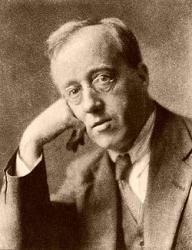
1874 - 1934 Topics: Judgment Composer of "THAXTED" in Glory to God Gustav Holst (b. Chelteham, Gloucestershire, England, September 21, 1874, d. London, England, May 25, 1934) was a renowned British composer and musician. Having studied at Cheltenham Grammar School, he soon obtained a professional position as an organist, and later as choirmaster. In 1892, Holst composed a two-act operetta, which so impressed his father that he borrowed the money to send Holst to the Royal College of Music. Severe neuritis in his right hand later caused him to give up the keyboard, and Holst turned to the trombone and composing. In 1895 Holst met Ralph Vaughan Williams, and the two became lifelong friends. Vaughan Williams helped Holst land his first job as a singing teacher. Holst became very interested in Indian and Hindu culture, and composed a number of operas translated from Sanksrit myths. These were not received well in England, however. Holst is best known for his composition, The Planets, as well as
Gustav Holst
Ludwig van Beethoven
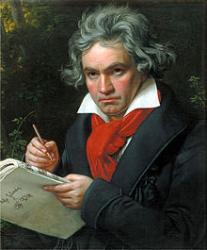
1770 - 1827 Person Name: Beethoven Topics: Royalty of Christ Judgment His Prerogative Composer of "[O Lord, to thee I cry]" in Bible Songs A giant in the history of music, Ludwig van Beethoven (b. Bonn, Germany, 1770; d. Vienna, Austria, 1827) progressed from early musical promise to worldwide, lasting fame. By the age of fourteen he was an accomplished viola and organ player, but he became famous primarily because of his compositions, including nine symphonies, eleven overtures, thirty piano sonatas, sixteen string quartets, the Mass in C, and the Missa Solemnis. He wrote no music for congregational use, but various arrangers adapted some of his musical themes as hymn tunes; the most famous of these is ODE TO JOY from the Ninth Symphony. Although it would appear that the great calamity of Beethoven's life was his loss of hearing, which turned to total deafness during the last decade of his life, he composed his greatest works during this period.
Bert Polman
Ludwig van Beethoven
William H. Walter
1825 - 1893 Person Name: William H. Walter, 1825-1893 Topics: Judgment Composer of "FESTAL SONG" in The Hymnal
William H. Walter
Ignaz Franz
1719 - 1790 Topics: Judgment Author (st. 1-4) of "Holy God, We Praise Thy Name" in The United Methodist Hymnal Ignaz Franz Poland 1719-1790. Born at Protzau, Silesia, he studied in Glaz andf Breslau. In 1742 he became a Roman Catholic priest. He served as chaplain at Gross-Glogau and vicar of Glogau in Silesia. In 1753 he was appointed archpriest at Schlawa, and assessor to the apostolic vicar's office in Breslau in 1766. He also functioned as the Assessor for Theological Affairs at the Apostolic Vicariate. He wrote hymn lyrics and compiled religious music. His works include “Katholisches Gesangbuch” (1744). He died at Breslau.
John Perry
Ignaz Franz
Lewis Edson
1748 - 1820 Person Name: Lewis Edson, 1748-1820 Topics: Judgment Composer of "LENOX" in Hymns of the Saints Lewis EdsonBorn in Massachusetts,he began working as a blacksmith and farmer. After marrying, he became a singing teacher, notable in his day. He taught singing in MA NY and CN, moving to NY in 1817. He was also an author. His 35 works consist of tunebooks, anthems, Psalm music, music scores and chants for choir use.
John Perry
Lewis Edson
James G. Walton
1821 - 1905 Person Name: James G. Walton, 1821-1905 Topics: Judgment Composer of "ST. CATHERINE" in The Hymnal Born: February 19, 1821, Clitheroe, Lancashire, England.
Died: September 1, 1905, Bradford, New York.
Little is known of Walton’s life. His works include:
Plain Song Music for the Holy Communion Office, 1874 (editor)
Music: ST. CATHERINE
--www.hymntime.com/tch
James G. Walton
Henry K. Oliver
1800 - 1885 Person Name: H. K. Oliver Topics: Judgment Composer of "FEDERAL STREET" in The Tribute of Praise Henry Kemble Oliver (b. Beverly, MA, 1800; d. Salem, MA, 1885) was educated at Harvard and Dartmouth. He taught in the public schools of Salem (1818-1842) and was superintendent of the Atlantic Cotton Mills in Lawrence, Massachusetts (1848-1858). His civic service included being mayor of Lawrence (18591861) and Salem (1877-1880), state treasurer (1861-1865), and organizer of the Massachusetts Bureau of Statistics and Labor (1867-1873). Oliver was organist at several churches, including Park Street Congregational Church in Boston, North Church in Salem, and the Unitarian Church in Lawrence. A founder of the Mozart Association and several choral societies in Salem, he published his hymn tunes in Hymn and Psalm Tunes (1860) and Original Hymn Tunes (1875).
Bert Polman
Henry K. Oliver
William Bengo Collyer
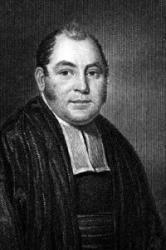
1782 - 1854 Person Name: William B. Collyer Topics: The Last Things Judgment Author (st. 2-4) of "Great God, What do I See and Hear?" in The Lutheran Hymnal William Bengo Collyer was born at Blackheath Hill, in 1782, and studied at Homerton College. Before completing his twentieth year he became pastor of a Congregational society at Peckham, continuing in that position through his life. He died in 1854. He received the degree of D.D. from the University of Edinburgh in 1808. For many years he was one of the most popular Dissenting ministers in London. He published many hymns and some works on theology.
--Annotations of the Hymnal, Charles Hutchins, M.A. 1872.
===================
Collyer, William Bengo, D.D., born at Blackheath, April 14, 1782, educated at Homerton College, where, when 16 years old, he was enrolled as a student for the ministry. At 20 he began his ministry at Peckham on Dec. 17, 1801 ordained pastor of a small church consisting of ten communicants. From 1814 to 1826 he was also pastor of a Church meeting in Salters' Hall. On June 17, 1817, a new chapel was opened for him at Peckham. There, from the time of his settlement in 1801, he laboured with great success and honour until Dec. 11, 1853, on which clay he preached for the last time. He died Jan. 8, 1854.
Dr. Collyer was eminent in his day as an eloquent Evangelical preacher, when formalism in worship, and Arianism in doctrine, prevailed. He was a man of amiable disposition, polished manners, and Christian courtesy; popular with rich and poor alike. He was the author of a series of lectures on Divine Revelation, in seven volumes: Scripture Facts, Prophecies, Miracles, Parables, Doctrines, Duties, Comparisons. Dr. Collyer compiled a hymn-book with the title, Hymns partly collected and partly original, designed as a supplement to Dr. Watts's Psalms and Hymns, 1812. It was intended at first for the use of his own congregation only, and was to include many hymns composed by himself, to be sung after sermons which he had preached to them, but he was led to alter the plan. It comprises 979 hymns, 6 choruses, and 4 doxologics, arranged in groups according to their authors, and not subjects. Of this number 57 were written by Dr. Collyer, and are for the most part short descriptive or didactic poems, religious or moral essays in verse, and not hymns addressed to the Creator and Redeemer. Some of them are devoid of Christian truth, and are poems of nature or of sentiment. Some of them were written during the hard and sorrowful times of the wars of Bonaparte, and relate to famine and national calamity. Several were prepared for the public meetings of missionary and benevolent societies, which had their origin in his time. He also published Services suited to the Solemnization of Matrimony, Baptism, &c, 1837, which contained 89 of his hymns, &c.; Hymns for Israel, a Tribute of Love for God's Ancient People, 1848 (41 hymns). In Dr. Leifchild's Original Hymns, 1843, there are also 39 of his compositions. Many of his pieces appeared in the Evangelical Magazine, and were also appended to his numerous published Sermons. A few of his hymns are still in common use, including. "Another fleeting day is gone"; "Assembled at Thy great command"; "O Jesu, in this solemn hour"; "O Thou, the helpless orphan's hope"; "Return, O wanderer, return," and the fine cento, "Great God, what do I see and hear."
[Rev. F. J. Faulding, D.D.]
--John Julian, Dictionary of Hymnology (1907)
======================
Collyer, William Bengo, p. 243, ii. The following hymns by Dr. Collyer are also in common use:—
1. Another fleeting day is gone. Evening. (1812.)
2. 0 Jesus, in this solemn hour. Reception of Church Officers. (1842.)
3. O Thou, the helpless orphan's hope. On Behalf of Orphans. In the Evangelical Magazine, 1808, p. 48.
4. See the clouds upon the mountain. Sunday Morning. (1842.)
5. Soft be the gently breathing notes. Praise to the Redeemer. (1812.)
6. Softly the shade of evening falls. Evening. (1812.) From this, “Soon shall a darker night descend" is taken.
7. Thou Prince of glory slain for me. Good Friday. (1812.)
The date 1812 is that of his Collection, and 1842 of Leifchild's Original Hymns.
--John Julian, Dictionary of Hymnology, Appendix, Part II (1907)
William Bengo Collyer
James Walch
1837 - 1901 Topics: Christ Second Coming and Judgment of Composer of "EAGLEY" in Trinity Hymnal James Walch was a musician and composer, born near Bolton, Lancashire, England in 1837. He spent his early life in the town and was organist in several churches there, including the parish church of St George’s. From 1870-1877, he was conductor for the Bolton Philharmonic Society. He also composed at least four published hymn tunes, the best known of which is called “Tidings”. Written in 1875, it’s usually used as the tune to a hymn called “O Zion Haste”.
James Walch was a musical instrument dealer by trade, and moved to Barrow-in-Furness in 1877. He later moved to Llandudno Junction in North Wales, where he died in August 1901 and was buried locally. His wife later donated money to pay for the organs in two local churches, St Paul's Llandudno and All Saints Deganwy, in his memory.
Three decades later, an article in the London Gazette reported on a dispute arising from his will, and mentioned that he had a son, Harry West Walch, who was a pianist and lived in Hereford.
St Paul's Church, Llandudno newsletter; used by permission of Christ Dearden (Walch's wife paid for the organ at St. Paul's Church)
James Walch
Pages




