You help make Hymnary.org possible. More than 10 million people from 200+ countries found hymns, liturgical resources and encouragement on Hymnary.org in 2025, including you. Every visit affirms the global impact of this ministry.

If Hymnary has been meaningful to you this year, would you take a moment today to help sustain it? A gift of any size—paired with a note of encouragement if you wish—directly supports the server costs, research work and curation that keep this resource freely available to the world.

Give securely online today, or mail a check to:
Hymnary.org
Calvin University
3201 Burton Street SE
Grand Rapids, MI 49546

Thank you for your partnership, and may the hope of Advent fill your heart.

Person Results

Topics:unity
In:people

Planning worship? Check out our sister site, ZeteoSearch.org, for 20+ additional resources related to your search.
Showing 101 - 110 of 1,353Results Per Page: 102050

Daniel L. Schutte

b. 1947 Person Name: Daniel L. Schutte, b. 1947 Topics: Unity and Fellowship Author of "Here I Am, Lord" in Lift Up Your Hearts

Lloyd Stone

1912 - 1993 Person Name: Lloyd Stone, 1912-1993 Topics: Unity Author (sts. 1-2) of "This Is My Song" in Evangelical Lutheran Worship Lloyd Stone (1912 – 1993) was born in California and attended the University of Southern California as a music major, with the intent of becoming a teacher. Instead, he joined a circus bound for Hawaii and remained there for the rest of his life, writing poems and songs. This is his best known work; stanzas 1 and 2 were written in 1934 when Lloyd was 22 years old. Often combined with several additional verses by Georgia Harkness, the poem is typically sung to the tune Finlandia, composed by Jean Sibelius. Lloyd also wrote a musical based on Joyce Kilmer’s poem, "Trees," and several books of Hawaii-themed poems. Said one reviewer, "[Stone] does not sing of the palms and the surf, but of the earthy human beauty which is the heritage of the islands." --www.yourdailypoem.com/

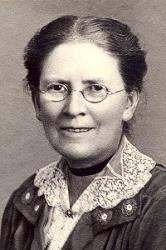
Ada R. Habershon

1861 - 1918 Topics: Unity Author of "Will the Circle Be Unbroken" in Hymns for a Pilgrim People

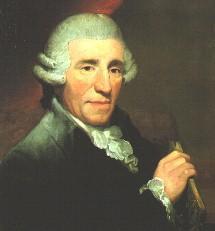
Joseph Haydn

1732 - 1809 Person Name: Franz Joseph Haydn, 1732-1809 Topics: People of God / Church Unity of God's People; Unity of the Church Composer of "AUSTRIAN HYMN" in Psalms for All Seasons Franz Joseph Haydn (b. Rohrau, Austria, 1732; d. Vienna, Austria, 1809) Haydn's life was relatively uneventful, but his artistic legacy was truly astounding. He began his musical career as a choirboy in St. Stephen's Cathedral, Vienna, spent some years in that city making a precarious living as a music teacher and composer, and then served as music director for the Esterhazy family from 1761 to 1790. Haydn became a most productive and widely respected composer of symphonies, chamber music, and piano sonatas. In his retirement years he took two extended tours to England, which resulted in his "London" symphonies and (because of G. F. Handel's influence) in oratorios. Haydn's church music includes six great Masses and a few original hymn tunes. Hymnal editors have also arranged hymn tunes from various themes in Haydn's music. Bert Polman

Michael Forster

b. 1946 Person Name: Michael Forster, b. 1946 Topics: Christian unity Author (v. 4) of "Come, Holy Ghost, our souls inspire" in Complete Anglican Hymns Old and New

John Warrington Hatton

1710 - 1793 Person Name: John Hatton, _____-1793 Topics: The Church's Life and Work Unity and Glory Composer of "DUKE STREET" in Hymnal and Liturgies of the Moravian Church John Warrington Hatton (b. Warrington, England, c. 1710; d, St. Helen's, Lancaster, England, 1793) was christened in Warrington, Lancashire, England. He supposedly lived on Duke Street in Lancashire, from where his famous tune name comes. Very little is known about Hatton, but he was most likely a Presbyterian, and the story goes that he was killed in a stagecoach accident. Bert Polman

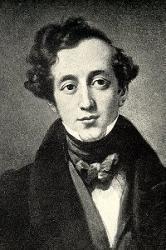
Felix Mendelssohn-Bartholdy

1809 - 1847 Person Name: Felix Mendelssohn Topics: Unity of the Church Adapter and Harmonizer of "MUNICH" in Lift Up Your Hearts Felix Mendelssohn-Bartholdy (b. Hamburg, Germany, 1809; d. Leipzig, Germany, 1847) was the son of banker Abraham Mendelssohn and the grandson of philosopher Moses Mendelssohn. His Jewish family became Christian and took the Bartholdy name (name of the estate of Mendelssohn's uncle) when baptized into the Lutheran church. The children all received an excellent musical education. Mendelssohn had his first public performance at the age of nine and by the age of sixteen had written several symphonies. Profoundly influenced by J. S. Bach's music, he conducted a performance of the St. Matthew Passion in 1829 (at age 20!) – the first performance since Bach's death, thus reintroducing Bach to the world. Mendelssohn organized the Domchor in Berlin and founded the Leipzig Conservatory of Music in 1843. Traveling widely, he not only became familiar with various styles of music but also became well known himself in countries other than Germany, especially in England. He left a rich treasury of music: organ and piano works, overtures and incidental music, oratorios (including St. Paul or Elijah and choral works, and symphonies. He harmonized a number of hymn tunes himself, but hymnbook editors also arranged some of his other tunes into hymn tunes. Bert Polman

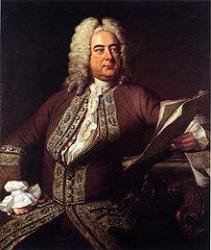
George Frideric Handel

1685 - 1759 Person Name: George Frederick Handel, 1685-1759 Topics: Life and Unity in the Church Composer of "THEODORA (Handel)" in Singing the Faith George Frideric Handel (b. Halle, Germany, 1685; d. London, England, 1759) became a musician and composer despite objections from his father, who wanted him to become a lawyer. Handel studied music with Zachau, organist at the Halle Cathedral, and became an accomplished violinist and keyboard performer. He traveled and studied in Italy for some time and then settled permanently in England in 1713. Although he wrote a large number of instrumental works, he is known mainly for his Italian operas, oratorios (including Messiah, 1741), various anthems for church and royal festivities, and organ concertos, which he interpolated into his oratorio performances. He composed only three hymn tunes, one of which (GOPSAL) still appears in some modern hymnals. A number of hymnal editors, including Lowell Mason, took themes from some of Handel's oratorios and turned them into hymn tunes; ANTIOCH is one example, long associated with “Joy to the World.” Bert Polman

Hugh Wilson

1766 - 1824 Person Name: Hugh Wilson, 1764-1824 Topics: Unity Composer of "MARTYRDOM" in This Far By Faith Hugh Wilson (b. Fenwick, Ayrshire, Scotland, c. 1766; d. Duntocher, Scotland, 1824) learned the shoemaker trade from his father. He also studied music and mathematics and became proficient enough in various subjects to become a part-­time teacher to the villagers. Around 1800, he moved to Pollokshaws to work in the cotton mills and later moved to Duntocher, where he became a draftsman in the local mill. He also made sundials and composed hymn tunes as a hobby. Wilson was a member of the Secession Church, which had separated from the Church of Scotland. He served as a manager and precentor in the church in Duntocher and helped found its first Sunday school. It is thought that he composed and adapted a number of psalm tunes, but only two have survived because he gave instructions shortly before his death that all his music manuscripts were to be destroyed. Bert Polman

A. L. Skoog

1854 - 1934 Person Name: Andrew L. Skoog Topics: Unity and Fellowship Translator of "Day by Day" in Lift Up Your Hearts Skoog, Andrew L. (Gunnarskog, Sweden, December 17, 1856 [sic]--October 30, 1934, Minneapolis, Minnesota). Evangelical Covenant. Son of pietists. Tailor's apprentice at 10. Family emigrated to St. Paul, Minn., when Andrew was 13. Only formal music training was 12 lessons on a melodeon. Organist, choir director, and Sunday School superintendent in Swedish Tabernacle, Minneapolis, 1886-1916. Co-editor of hymnals: Evangelii Basun I & II, 1881-1883; Lilla Basunen, 1890; and Jubelklangen, 1896. Was in editorial committee of Covenant's first three hymnals: Sions Basun, 1908; De Ungas Sångbok, 1914; and Mission Hymns, 1921. Editor and publisher of Gittit 1892-1908, a monthly choir journal with music; a series of ten bound volumes of choir selections; and many hymns. --J. Irving Erickson, DNAH Archives

Pages


Export as CSV
It looks like you are using an ad-blocker. Ad revenue helps keep us running. Please consider white-listing Hymnary.org or getting Hymnary Pro to eliminate ads entirely and help support Hymnary.org.