You help make Hymnary.org possible. More than 10 million people from 200+ countries found hymns, liturgical resources and encouragement on Hymnary.org in 2025, including you. Every visit affirms the global impact of this ministry.

If Hymnary has been meaningful to you this year, would you take a moment today to help sustain it? A gift of any size—paired with a note of encouragement if you wish—directly supports the server costs, research work and curation that keep this resource freely available to the world.

Give securely online today, or mail a check to:
Hymnary.org
Calvin University
3201 Burton Street SE
Grand Rapids, MI 49546

Thank you for your partnership, and may the hope of Advent fill your heart.

Person Results

Topics:scriptures
In:people

Planning worship? Check out our sister site, ZeteoSearch.org, for 20+ additional resources related to your search.
Showing 111 - 120 of 953Results Per Page: 102050

Carl Bernhard Garve

1763 - 1841 Person Name: Carl Bernhard Garve, 1763-1841 Topics: The Holy Scriptures Author of "Thy Word, O Lord, Like Gentle Dews" in Hymnal and Liturgies of the Moravian Church Garve, Carl Bernhard, was born Jan. 24, 1763, at Jeinsen, near Hannover, where his father was a farmer. He was educated at the Moravian schools in Zeist, and Neuwied, at their Pädagogium at Niesky, and their Seminary at Barby. In 1784 he was appointed one of the tutors at Niesky, and in 1789 at Barby; but as his philosophical lectures were thought rather unsettling in their tendency, he was sent, in 1797, to arrange the documents of the archive at Zeist. After his ordination as diaconus of the Moravian church, he was appointed, in 1799, preacher at Amsterdam; in 1801 at Ebersdorf (where he was also inspector of the training school); in 1809 at Berlin; and in 1816 at Neusalza on the Oder. Feeling the burden of years and infirmities he resigned the active duties of the ministry in 1836, and retired to Herrnhut, where he died June 21, 1841. (Koch, vii. 334-342; (Allgemeine Deutsche Biographie, viii. 392-94, &c.) Garve ranks as the most important of recent Moravian hymnwriters, Albertini being perhaps his superior in poetical gifts, but certainly not in adaptability to church use. His better productions are almost entirely free from typically Moravian features; and in them Holy Scripture is used in a sound and healthful spirit. They are distinguished by force and at the same time elegance of style, and are full of deep love and devotion to the Saviour. Many of them have passed into the German Evangelical hymnbooks, no less than 36 being included in the Berlin Gesange-Buch 1829; and of those noted below No. i. is to be found in almost all recent German collections. They appeared mostly in the two following collections, both of which are to be found in the Town Library, Hamburg: (1) Christliche Gesänge, Görlitz, 1825, with 303 hymns, a few being recasts from other authors. (2) Brüdergesange, Gnadau, 1827, with 65 hymns intended principally for use in the Moravian Communion. Garve's hymns in English common use are:— i. Dein Wort, 0 Herr, ist milder Thau. Holy Scripture. Perhaps his finest hymn. 1825, as above, p. 51, in 7 st. of 8 l. Included, as No. 410, in the Berlin Geistliche Lieder S., ed. 1863, and in the German hymnbooks for Hannover, 1883, for the kingdom of Saxony, 1883, for the province of Saxony, 1882, &c." Translated as:— 1. Thy Word, 0 Lord, like gentle dews. A good translation of st. i.-iii, by Miss Winkworth, in the first Ser., 1855, of her Lyra Germanica, p. 36. In the Pennsylvania Lutheran Church Book, 1868, it is No. 314 in full, but rewritten to D.C.M. In 1864 it was included, altered, and with 11. 5-8 of each stanza omitted, as No. 681 in Hymns of the Spirit, Boston, U. S., and this has been repeated in Dr. Martineau's Hymns of Praise & Prayer, 1873, and Dr. Allon's Children's Worship, 1878. 2. Thy Word, 0 Lord, is gentle dew. A good translation of st. i.-iii., based on the Lyra Germanica, by Miss Winkworth, as No. 102 in her Chorale Book for England, 1863, and thence, in the Ohio Lutheran Hymnal, 1880. ii. Hallelujah, Christus lebt. Easter. 1825, as above, p. 105, in 8 st. of 6 1. Included in Knapp's Evangelical Lutheran Songbook, 1850, No. 565. Translated as:— Hallelujah! Jesus lives! A good translation (omitting st. iv., vi.) by Miss Borthwick, in the 4th Ser., 1862, of the Hymns from the Land of Luther, p. 30 (1884, p. 201). In Lyra Messianica, 1864, p. 295, and in G. S. Jellicoe's Collection, 1867, No. 103, it begins, "Alleluia ! Jesus lives." iii. O Vater der Gemeine. Trinity Sunday. 1825, as above, p. 18, in 3 st. of 7 l. Included as No. 107 in Knapp's Evangelischer Lieder-Schatz, 1837. Translated as: -- Father of all created. In full, as No. 159, in Dr. Pagenstecher's Collection, 1864, signed " F. C. C." Another translation is, "0 Father, we adore Thee," in the British Herald, Oct. 1866, p. 324, repeated as No. 416 in Reid's Praise Book, 1872. Hymns not in English common use:— « iv. Der Herr ist treu, Der Herr ist ewig treu. God's Faithfulness. 1825, p. 5, in 6 st., repeated in the Berlin Gesang-Buch, 1829, No. 60, beginning "Gott ist treu." Translated by N. L. Frothingham, 1870, p. 253. v. Geduld! Geduld! ob's stürmisch weht. Trust in God. 1825, p. 180, in 3 st., repeated in the Berlin Gesang-Buch 1829, No. 593, beginning "Geduld! wie sehr der Sturm auch weht." Translated by N. L. Frothingham, 1870, p. 265. vi. Sagt was hat die weite Welt. Holy Scripture. 1825, p 49, in 6 st. Translated as “Tell me, can the world display," in the British Herald, Nov. 1866, p. 360, repeated as No. 420 in Reid's Praise Book, 1872. vii. Wer bin ich, Herr, in deinem Licht. Self-Examination, 1825, p. 216, in 15 st. Translated by N. L. Frothingham, 1870, p. 258. viii. Zur Arbeit winkt mir mein Beruf. Before Work, 1825, p. 233, in 9 st. Translated by E. Massie, l861. A hymn sometimes ascribed to Garve is noted under "Gib deinen Frieden uns." [Rev. James Mearns, M.A.] -- John Julian, Dictionary of Hymnology (1907)

Rowland Hugh Prichard

1811 - 1887 Person Name: Rowland Huw Prichard, 1811-1887 Topics: The Holy Scriptures Composer of "HYFRYDOL" in Singing the Faith Rowland H. Prichard (sometimes spelled Pritchard) (b. Graienyn, near Bala, Merionetshire, Wales, 1811; d. Holywell, Flintshire, Wales, 1887) was a textile worker and an amateur musician. He had a good singing voice and was appointed precentor in Graienyn. Many of his tunes were published in Welsh periodicals. In 1880 Prichard became a loom tender's assistant at the Welsh Flannel Manufacturing Company in Holywell. Bert Polman

L. O. Emerson

1820 - 1915 Topics: Worship Holy Scriptures Composer of "SESSIONS" in The Seventh-Day Adventist Hymn and Tune Book Luther Orlando Emerson was born at Parsonsfield, Maine, August 3, 1820. He descended from distinguished English ancestry. His parents were quite musical, and while the family circle were together, they had a choir and orchestra of their own. The father played the violoncello, the mother was an excellent singer, the flute and violin added their sweet tones, till the quiet homestead rang with melody. Mr. Emerson's education was obtained at the district school, Parsonsfield Seminary and Effingham Academy. He was full of energy, quick and versatile, an apt scholar, and with a view to entering the profession of medicine he entered Dracut Academy, Mass. But his great love for music swerved him from that course, and now, having far better opportunities for cultivating and enjoying this taste and ability, he soon determined upon music as the profession of his choice. He accordingly commenced a course of musical instruction under the late I. B. Woodbury, then a popular teacher of music. After several years of study on the voice, piano, organ and in harmony, Mr. Emerson went to Salem, Mass., began teaching, and took charge of his first choir at a salary of one hundred dollars per year. Here he commenced the composition of music for his own choir, whiich was so popular with its members and the congregation, that Mr. Emerson was encouraged to seek a larger hearing by publishing a collection of church music. Among the tunes was that of Sessions, named after his pastor, which was destined to have a perennial popularity, and is often used in worship in the place of Old Hundred, for the Doxology. At the great Peace Jubilee it was received with applause when sung by a chorus of ten thousand voices, accompanied by an orchestra of two hundred instruments and a great pipe organ. The effect was sublime beyond expression. In 1847 occurred the marriage of Mr. Emerson to Miss Mary Gore, daughter of a prominent Boston merchant. She was a lady of much musical taste and ability. In 1853 he decided to make an effort to put his music before the public, and accordingly went to Boston in search of a publisher. Like most young and unknown authors, he met with but little encouragement, but finally found a publisher in the person of Mr. B. B. Muzzy. Thus was the Romberg Collection published. The book was not pushed — hence it found no market. After a residence of eight years in Salem, Mr. Emerson removed to Boston, accepting the position of organist and musical director at the Bulfinch Street Church, then under the pastoral care of Rev. Wm. R. Alger, which he filled for four years. He eagerly improved the rare means of culture which were once more enjoyed, meanwhile teaching and composing music. In 1857 he formed the connection with Oliver Ditson Company, of Boston, of author and publisher, which has continued to the present time with but one interruption (a single volume brought out by another firm), the Golden Wreath, which at once became popular, and sold forty thousand during the first year, this being the initial volume in the long series since brought out by these publishers. In 1858 came the Golden Harp, which was also a success. These successes gave him not only encouragement, but reputation. Mr. Emerson now entered upon a career of usefulness and popularity for which he had been preparing during the years of self-denying struggle and discipline. He was called to take charge of the music in the Second Congregational Church, Greenfield, Mass., and also of the musical department of Power's Institute, at Bernardston. Amid nature's most beautiful surroundings, he had a quiet retreat for the pursuit of his true vocation, the composition of church music. The first fruit of his genius here was the Sabbath Harmony, in 1860. This book was also a success. In 1863 followed the Harp of Judah, which had the remarkable sale of nearly fifty thousand copies in the first three months. This book probably gave Mr. Emerson his preeminence as a composer of church music, containing as it did his anthem, Guide Me, O Thou Great Jehovah, and many of his finest compositions. Having declined the solicitations of Dr. Lowell Mason to become his associate in music, Mr. Emerson started forth on his own plans, and attained the highest rank among those who loved the pure and beautiful in song. Mr. W. S. B. Mathews, a musical critic, pronounces him the best melodist of all the psalmodic writers. In 1866 the equally successful Jubilate appeared, followed by the Choral Tribute, the Standard and the Leader. In the last two Dr. I. R. Pahner was associated with him. Later on came the Salutation, Voice of Worship, Herald of Praise, etc. The diligence with which Mr. Emerson plied his pen can be estimated when one recalls the fact that he has made seventy-two collections of music, embracing music for churches, singing schools, public schools, choral societies and conventions, instruction books for voice, organ, etc. He has also composed and published scores of songs, quartets and instrumental pieces. The great amount of work this represents can only be appreciated by those who have undertaken similar labors. Some years ago the degree of Doctor of Music was conferred upon Professor Emerson by the Faculty of Findlay College, Findlay, Ohio. For many years past. Dr. Emerson has devoted his energies to the grand purpose of elevating the general character of music in our churches, and thus largely advancing the interests of true worship. He places great stress upon the mission of church music. He regards sacred music as the best expression of devotional feeling that exists. He looks upon sacred song as prayer, and believes that it inspires and intensifies prayer. With this view he has taken an active and prominent part in musical festivals and conventions, of which he has conducted over three hundred throughout the United States and Canada. As a conductor, he stands in the front rank. As a teacher. Dr. Emerson has an exceedingly happy faculty of imparting in a concise manner to his classes. His very pleasing address enables him to command the undivided attention of his pupils. As a singer, he has always held high rank, and has sung much in public. His voice is a baritone of great compass, and quite powerful. As a lecturer upon music, Dr. Emerson has attracted much attention. His most popular lecture is entitled The World of Music, in which he traces its origin and progress, and gives some excellent traits of the lives of the great composers. In this lecture he also shows the design of music, and how it has been prized in every age of the world, among all nations — its power in the Church and State, and the need of its influence in the family — in joy and sorrow — for this life and the life to come. -Biography of Gospel Song and Hymn Writers

Audrey Mieir

1916 - 1996 Topics: Choruses Scripture and Praise Author of "His Name Is Wonderful" in The Hymnal for Worship and Celebration Audrey Mieir's musical gift showed itself an early age, when she began singing and leading choral performances. In the 1950’s she established the Harmony Chorus, and worked with musician-evangelist Phil Kerr. These efforts were followed by concerts throughout America in the 1960’s. Mieir is also remembered as music director for Rex Humbard’s television show Cathedral of Tomorrow, and for helping found orphanages in Korea. © The Cyber Hymnal™ (www.hymntime.com/tch)

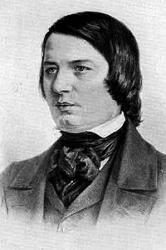
Robert Schumann

1810 - 1856 Person Name: R. Schumann Topics: The Holy Scriptures Composer of "HEATH" in The Church Hymnal Robert Alexander Schumann DM Germany 1810-1856. Born at Swickau, Saxony, Germany, the last child of a novelist, bookseller, and publisher, he began composing music at age seven. He received general music instruction at the local high school and worked to create his own compositions. Some of his works were considered admirable for his age. He even composed music congruent to the personalities of friends, who took note of the anomaly. He studied famous poets and philosophers and was impressed with the works of other famous composers of the time. After his father’s death in 1826, he went to Leipzig to study law (to meet the terms of his inheritance). In 1829 he continued law studies in Heidelberg, where he became a lifelong member of Corps Saxo-Borussia Heidelberg. In 1830 he left the study of law to return to music, intending to pursue a career as a virtuoso pianist. His teacher, Friedrich Wieck, assured him he could become the finest pianist in Europe, but an injury to his right hand (from a practicing method) ended that dream. He then focused his energies on composition, and studied under Heinrich Dorn, a German composer and conductor of the Leipzig opera. Schumann visited relatives in Zwickau and Schneeberg and performed at a concert given by Clara Wieck, age 13 at the time. In 1834 he published ‘A new journal for music’, praising some past composers and deriding others. He met Felix Mendelssohn at Wieck’s house in Leigzig and lauded the greatness of his compositions, along with those of Johannes Brahms. He also wrote a work, hoping to use proceeds from its sale towards a monument for Beethoven, whom he highly admired. He composed symphonies, operas, orchestral and chamber works, and also wrote biographies. Until 1840 he wrote strictly for piano, but then began composing for orchestra and voice. That year he composed 168 songs. He also receive a Doctorate degree from the University of Jena that year. An aesthete and influential music critic, he was one of the most regarded composers of the Romantic era. He published his works in the ‘New journal for music’, which he co-founded. In 1840, against the wishes of his father, he married Clara Wieck, daughter of his former teacher, and they had four children: Marie, Julie, Eugenie, and Felix. Clara also composed music and had a considerable concert career, the earnings from which formed a substantial part of her father’s fortune. In 1841 he wrote 2 of his 4 symphonies. In 1843 he was awarded a professorship in the Conservatory of Music, which Mendelssohn had founded in Leipzig that same year, When he and Clara went to Russia for her performances, he was questioned as to whether he also was a musician. He harbored resentment for her success as a pianist, which exceeded his ability as a pianist and reputation as a composer. From 1844-1853 he was engaged in setting Goethe’s Faust to music, but he began having persistent nervous prostration and developed neurasthenia (nervous fears of things, like metal objects and drugs). In 1846 he felt he had recovered and began traveling to Vienna, Prague, and Berlin, where he was received with enthusiasm. His only opera was written in 1848, and an orchestral work in 1849. In 1850 he succeeded Ferdinand Hiller as musical director at Dusseldorf, but was a poor conductor and soon aroused the opposition of the musicians, claiming he was impossible on the platform. From 1850-1854 he composed a wide variety of genres, but critics have considered his works during this period inferior to earlier works. In 1851 he visited Switzerland, Belgium, and returned to Leipzig. That year he finished his fourth symphony. He then went to Dusseldorf and began editing his complete works and making an anthology on the subject of music. He again was plagued with imaginary voices (angels, ghosts or demons) and in 1854 jumped off a bridge into the Rhine River, but was rescued by boatmen and taken home. For the last two years of his life, after the attempted suicide, Schumann was confined to a sanitarium in Endenich near Bonn, at his own request, and his wife was not allowed to see him. She finally saw him two days before he died, but he was unable to speak. He was diagnosed with psychotic melancholia, but died of pneumonia without recovering from the mental illness. Speculations as to the cause of his late term maladies was that he may have suffered from syphilis, contracted early in life, and treated with mercury, unknown as a neurological poison at the time. A report on his autopsy said he had a tumor at the base of the brain. It is also surmised he may have had bipolar disorder, accounting for mood swings and changes in his productivity. From the time of his death Clara devoted herself to the performance and interpretation of her husband’s works. John Perry

Noel Dexter

1938 - 2019 Topics: Liturgical Psalms and Scriptural Texts Composer of "[O praise ye the Lord, O praise ye the Lord]" in Sing a New Song Noel Dexter was born on December 21, 1938 and grew up in Port Antonio, Portland, Jamaica. He studied ethnomusicology and church music at the University of West Indies, in the United Kingdom and in the United States. He founded and led the Kingston Singers as well as other theatrical productions. For 25 years he was director of music at the University of West Indies, Mona, While there he lead the University Singers, until 2012, when he retired. He composed many hymns, anthems, and arrangements. Dianne Shapiro, from "Music Great, Noel Dexter, Remembered" in "The Gleaner," August 19, 2019 (accessed online 8/6/2020)

Daniel Forget

b. 1956 Person Name: Daniel Forget, 1956- Topics: Canticles and Scripture Paraphrases Translator (French) of "Oh sing to our God" in The Book of Praise

David Evans

1874 - 1948 Topics: Scriptures, The Holy Harmonizer of "SPANISH HYMN" in The Hymnbook David Evans (b. Resolven, Glamorganshire, Wales, 1874; d. Rosllannerchrugog, Denbighshire, Wales, 1948) was an important leader in Welsh church music. Educated at Arnold College, Swansea, and at University College, Cardiff, he received a doctorate in music from Oxford University. His longest professional post was as professor of music at University College in Cardiff (1903-1939), where he organized a large music department. He was also a well-known and respected judge at Welsh hymn-singing festivals and a composer of many orchestral and choral works, anthems, service music, and hymn tunes. Bert Polman

C. H. Woolston

1856 - 1927 Person Name: Reverend C. H. Woolston Topics: Choruses Scripture and Praise Author of "Jesus Loves the Little Children" in The Hymnal for Worship and Celebration A Baptist minister, Woolston lived with his wife Agnes in East Brunswick, New Jersey, in 1880; and in Philadelphia, Pennsylvania, in 1900, 1910 & 1920. Cyber Hymnal

David Rutherford McGuire

1929 - 1971 Person Name: David Rutherford McGuire, 1929-1971 Topics: Holy Scriptures Reviser of "Jesus loves me, this I know" in The Book of Praise McGuire was born in St. Catherines, Ontario, Canada. He attended University and Wycliffe Colleges at the University of Toronto. Ordained as an Anglican priest, he pastored four churches in Ontario. He also served on the committee that produced the 1971 Hymn Book, used by the United Church of Canada and by Canadian Anglicans. © The Cyber Hymnal™. Used by permission. (www.hymntime.com)

Pages


Export as CSV
It looks like you are using an ad-blocker. Ad revenue helps keep us running. Please consider white-listing Hymnary.org or getting Hymnary Pro to eliminate ads entirely and help support Hymnary.org.