You help make Hymnary.org possible. More than 10 million people from 200+ countries found hymns, liturgical resources and encouragement on Hymnary.org in 2025, including you. Every visit affirms the global impact of this ministry.

If Hymnary has been meaningful to you this year, would you take a moment today to help sustain it? A gift of any size—paired with a note of encouragement if you wish—directly supports the server costs, research work and curation that keep this resource freely available to the world.

Give securely online today, or mail a check to:
Hymnary.org
Calvin University
3201 Burton Street SE
Grand Rapids, MI 49546

Thank you for your partnership, and may the hope of Advent fill your heart.

Person Results

Topics:personal+work
In:person

Planning worship? Check out our sister site, ZeteoSearch.org, for 20+ additional resources related to your search.
Showing 111 - 120 of 184Results Per Page: 102050

Reginald Heber

1783 - 1826 Person Name: Bp. Heber Topics: The Lord Jesus Christ: His Person, Offices, and Work The star in the East Author of "Brightest and best of the sons of the morning" in Methodist Hymn-Book Reginald Heber was born in 1783 into a wealthy, educated family. He was a bright youth, translating a Latin classic into English verse by the time he was seven, entering Oxford at 17, and winning two awards for his poetry during his time there. After his graduation he became rector of his father's church in the village of Hodnet near Shrewsbury in the west of England where he remained for 16 years. He was appointed Bishop of Calcutta in 1823 and worked tirelessly for three years until the weather and travel took its toll on his health and he died of a stroke. Most of his 57 hymns, which include "Holy, Holy, Holy," are still in use today. -- Greg Scheer, 1995 ==================== Heber, Reginald, D.D. Born at Malpas, April 21, 1783, educated at Brasenose College, Oxford; Vicar of Hodnet, 1807; Bishop of Calcutta, 1823; died at Trichinopoly, India, April 3, 1826. The gift of versification shewed itself in Heber's childhood; and his Newdigate prize poem Palestine, which was read to Scott at breakfast in his rooms at Brazenose, Oxford, and owed one of its most striking passages to Scott's suggestion, is almost the only prize poem that has won a permanent place in poetical literature. His sixteen years at Hodnet, where he held a halfway position between a parson and a squire, were marked not only by his devoted care of his people, as a parish priest, but by literary work. He was the friend of Milman, Gifford, Southey, and others, in the world of letters, endeared to them by his candour, gentleness, "salient playfulness," as well as learning and culture. He was on the original staff of The Quarterly Review; Bampton Lecturer (1815); and Preacher at Lincoln's Inn (1822). His edition of Jeremy Taylor is still the classic edition. During this portion of his life he had often had a lurking fondness for India, had traced on the map Indian journeys, and had been tempted to wish himself Bishop of Calcutta. When he was forty years old the literary life was closed by his call to the Episcopate. No memory of Indian annals is holier than that of the three years of ceaseless travel, splendid administration, and saintly enthusiasm, of his tenure of the see of Calcutta. He ordained the first Christian native—Christian David. His first visitation ranged through Bengal, Bombay, and Ceylon; and at Delhi and Lucknow he was prostrated with fever. His second visitation took him through the scenes of Schwartz's labours in Madras Presidency to Trichinopoly, where on April 3,1826, he confirmed forty-two persons, and he was deeply moved by the impression of the struggling mission, so much so that “he showed no appearance of bodily exhaus¬tion." On his return from the service ”He retired into his own room, and according to his invariable custom, wrote on the back of the address on Confirmation 'Trichinopoly, April 3, 1826.' This was his last act, for immediately on taking off his clothes, he went into a large cold bath, where he had bathed the two preceding mornings, but which was now the destined agent of his removal to Paradise. Half an hour after, his servant, alarmed at his long absence, entered the room and found him a lifeless corpse." Life, &c, 1830, vol. ii. p. 437. Heber's hymns were all written during the Hodnet period. Even the great missionary hymn, "From Greenland's icy mountains," notwithstanding the Indian allusions ("India's coral strand," "Ceylon's isle"), was written before he received the offer of Calcutta. The touching funeral hymn, "Thou art gone to the grave," was written on the loss of his first babe, which was a deep grief to him. Some of the hymns were published (1811-16) in the Christian Observer, the rest were not published till after his death. They formed part of a ms. collection made for Hodnet (but not published), which contained, besides a few hymns from older and special sources, contributions by Milman. The first idea of the collection appears in a letter in 1809 asking for a copy of the Olney Hymns, which he "admired very much." The plan was to compose hymns connected with the Epistles and Gospels, to be sung after the Nicene Creed. He was the first to publish sermons on the Sunday services (1822), and a writer in The Guardian has pointed out that these efforts of Heber were the germs of the now familiar practice, developed through the Christian Year (perhaps following Ken's Hymns on the Festivals), and by Augustus Hare, of welding together sermon, hymnal, and liturgy. Heber tried to obtain from Archbishop Manners Sutton and the Bishop of London (1820) authorization of his ms. collection of hymns by the Church, enlarging on the "powerful engine" which hymns were among Dissenters, and the irregular use of them in the church, which it was impossible to suppress, and better to regulate. The authorization was not granted. The lyric spirit of Scott and Byron passed into our hymns in Heber's verse; imparting a fuller rhythm to the older measures, as illustrated by "Oh, Saviour, is Thy promise fled," or the martial hymn, "The Son of God goes forth to war;" pressing into sacred service the freer rhythms of contemporary poetry (e.g. "Brightest and best of the sons of the morning"; "God that madest earth and heaven"); and aiming at consistent grace of literary expression.. Their beauties and faults spring from this modern spirit. They have not the scriptural strength of our best early hymns, nor the dogmatic force of the best Latin ones. They are too flowing and florid, and the conditions of hymn composition are not sufficiently understood. But as pure and graceful devotional poetry, always true and reverent, they are an unfailing pleasure. The finest of them is that majestic anthem, founded on the rhythm of the English Bible, "Holy, Holy, Holy, Lord God Almighty." The greatest evidence of Heber's popularity as a hymnwriter, and his refined taste as a compiler, is found in the fact that the total contents of his ms. collection which were given in his posthumous Hymns written and adapted to the Weekly Church Service of the Year. London, J. Murray, 1827; which included 57 hymns by Heber, 12 by Milman, and 29 by other writers, are in common in Great Britain and America at the present time. [Rev. H. Leigh Bennett, M.A.] Of Bishop Heber's hymns, about one half are annotated under their respective first lines. Those given below were published in Heber's posthumous Hymns, &c, 1827. Some of them are in extensive use in Great Britain and America; but as they possess no special histories they are grouped together as from the Hymns, &c, 1827:— 1. Beneath our feet, and o'er our head. Burial. 2. Creator of the rolling flood. St. Peter's Day, or, Gospel for 6th Sunday after Trinity. 3. Lo, the lilies of the field. Teachings of Nature: or, Gospel for 15th Sunday after Trinity. 4. 0 God, by Whom the seed is given. Sexagesima. 6. 0 God, my sins are manifold. Forgiveness, or, Gospel for 22nd S. after Trinity. 6. 0 hand of bounty, largely spread. Water into Wine, or, Gospel for 2nd S. after Epiphany. 7. 0 King of earth, and air, and sea. Feeding the Multitude; or, Gospel for 4th S. in Lent. 8. 0 more than merciful, Whose bounty gave. Good Friday. 9. 0 most merciful! 0 most bountiful. Introit Holy Communion. 10. 0 Thou, Whom neither time nor space. God unsearchable, or, Gospel for 5th Sunday in Lent. 11. 0 weep not o'er thy children's tomb. Innocents Day. 12. Room for the proud! Ye sons of clay. Dives and Lazarus, or, Gospel for 1st Sunday after Trinity. 13. Sit thou on my right hand, my Son, saith the Lord. Ascension. 14. Spirit of truth, on this thy day. Whit-Sunday. 15. The feeble pulse, the gasping breath. Burial, or, Gospel for 1st S. after Trinity. 16. The God of glory walks His round. Septuagesima, or, the Labourers in the Marketplace. 17. The sound of war in earth and air. Wrestling against Principalities and Powers, or, Epistle for 2lst Sunday after Trinity. 18. The world is grown old, her pleasures are past. Advent; or, Epistle for 4th Sunday in Advent. 19. There was joy in heaven. The Lost Sheep; or, Gospel for 3rd S. after Trinity. 20. Though sorrows rise and dangers roll. St. James's Day. 21. To conquer and to save, the Son of God. Christ the Conqueror. 22. Virgin-born, we bow before Thee. The Virgin Mary. Blessed amongst women, or, Gospel for 3rd S. in Lent. 23. Wake not, 0 mother, sounds of lamentation. Raising the Widow's Son, or, Gospel for 16th S. after Trinity. 24. When on her Maker's bosom. Holy Matrimony, or, Gospel for 2nd S. after Epiphany. 25. When through the torn sail the wild tempest is streaming. Stilling the Sea, or, Gospel for 4th Sunday after Epiphany. 26. Who yonder on the desert heath. The Good Samaritan, or, Gospel for 13th Sunday after Trinity. This list is a good index of the subjects treated of in those of Heber's hymns which are given under their first lines, and shows that he used the Gospels far more than the Epistles in his work. --John Julian, Dictionary of Hymnology (1907)

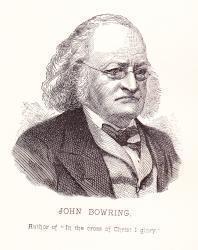
John Bowring

1792 - 1872 Person Name: Sir John Bowring Topics: The Lord Jesus Christ: His Person, Offices, and Work Glorying in the Cross Author of "In the cross of Christ I glory" in Methodist Hymn-Book James Bowring was born at Exeter, in 1792. He possessed at an early age a remarkable power of attaining languages, and acquired some reputation by his metrical translations of foreign poems. He became editor of "The Westminster Review" in 1825, and was elected to Parliament in 1835. In 1849, he was appointed Consul at Canton, and in 1854, was made Governor of Hong Kong, and received the honour of knighthood. He is the author of some important works on politics and travel, and is the recipient of several testimonials from foreign governments and societies. His poems and hymns have also added to his reputation. His "Matins and Vespers" have passed through many editions. In religion he is a Unitarian. --Annotations of the Hymnal, Charles Hutchins, M.A., 1872 ======================================= Bowring, Sir John, LL.D., a distinguished man of letters, was born at Exeter, Oct. 17, 1792. His studies extended to philology, poetry, politics, and other branches of learning, whilst as editor of the Westminster Review for some years (he received the appointment in 1825) he did considerable work as a reviewer. He held several official appointments under the Government as Commissioner to France on commercial matters (1831-5); British Consul at Hong Kong (1849); and Governor of Hong Kong (1854). He was twice Member of Parliament, and was knighted in 1854. He died Nov. 23rd, 1872. His published works are very numerous, and display an astonishing acquaintance with various languages. Those specially bearing on poetry include:— (1) Russian Anthology, with Biographical and Critical notices of the Poets of Russia, 1821; (2) Specimens of the Russian Poets, 1823; (3) Ancient Poetry and Romance of Spain, 1824; (4) Batavian Anthology, or Specimens of Dutch Poets, 1824; (5) Servian Popular Poetry, 1821; (6) Specimens of Polish Poets, 1827; (1) Poetry of the Magyars, 1830; (8) History of the Poetical Literature of Bohemia, 1832, &c. In addition to these works, which are mainly translations, Sir John Bowring wrote original verse. This was published interspersed with a few translations, as follows:— (1) Matins and Vespers with Hymns and Occasional Devotional Pieces, Lond., 1823; 2nd edition, enlarged, 1824; 3rd edition, again enlarged, 1841; and the 4th, still further enlarged, in 1851. (2) Hymns: as a Sequel to the Matins, 1825. In addition he contributed to a few Unitarian hymnals, especially that of the Rev. J. R. Beard of Manchester, 1837. In that Collection many of the hymns added to the 3rd edition of Matins, &c, 1841, were first published A selection from these, together with a biographical sketch, was published by Lady Bowring in 1873, as a Memorial Volume of Sacred Poetry. This work contains hymns from the Matins and Vespers, together with others from Periodicals, and from his manuscripts. Of his hymns a very large percentage have come into common use. A few have been adopted by almost all denominations, as, "God is love, His mercy brightens;" "How sweetly flow'd the gospel sound;" "In the Cross of Christ I glory;" "Watchman, tell us of the night;"; and others, but the greater portion are confined to the Unitarian collections of Great Britain and America, of which denomination he was a member. In addition to the more important, which are annotated under their first lines, there are also the following in common use:—- 1. Clay to clay, and dust to dust. Burial. From his Hymns, 1825, into the Hymn & Tune Book, Boston, U.S., 1868, &c. 2. Come the rich, and come the poor. Divine Worship. Contributed to Beard's Collection, 1837, No. 290, and repeated in Bowring's Matins, &c., 3rd edition, 1841. It is in a few American collections. 3. Drop the limpid waters now. Holy Baptism. From Matins and Vespers, 3rd edition, 1841, into Kennedy, 1863. 4. Earth's transitory things decay. The Memory of the Just. From his Hymns, 1825, into Beard, 1837; the American Plymouth Collection, 1855; and the Songs for the Sanctuary, N.Y., 1865, &c. 5. Father, glorify Thy name. The Father glorified. Also from Hymns, 1825, into Beard, 1837; the Hymns of the Spirit, Boston, U.S., 1864, &c. 6. Father and Friend, Thy light, Thy love. Omnipresence. From Matins and Vespers, 2nd edition, 1824, into several collections, and sometimes in an abbreviated form. 7. Father of Spirits, humbly bent before Thee. Also in Hymns, 1825, and Dr. Martineau's Hymns of Praise & Prayer, 1873. In Longfellow and Johnson's Hymns of the Spirit, Boston, U.S., 1864, it is given as, "Father of Spirits, gathered now before Thee." 8. From all evil, all temptation. Preservation implored. Contributed to Beard's Collection, 1837. 9. From the recesses of a lowly spirit. Prayer of trust. From Matins and Vespers, 1st edition, 1823, into several American collections. 10. Gather up, 0 earth, thy dead. Published in his Matins & Vespers, 3rd ed., 1841, in 3 stanzas of 8 lines and repeated, slightly altered, in Kennedy, 1863, No. 753. 11. Gently the shades of night descends Evening. A cento from his poem on "Sunday Evening," in the Matins, &c, 1st edition, 1823, p. 6. It is given in the Boston Hymns of the Spirit, 1864; the Boston Hymn & Tune Book, 1868, and other collections. 12. How dark, how desolate. Hope. 1st published in his Matins, &c, 1823, p. 246. In Dr. Martineau's Hymns of Praise & Prayer, 1873, it is No. 515. 13. How shall we praise Thee, Lord of Light! Evening. A cento from the same poem as No. 7 above. It is given in the Hymns of the Spirit, 1864, and other American collections. 14. Lead us with Thy gentle sway. Divine Guidance desired. Hymns, 1825, into Hymns of the Spirit, 1864, and others. 15. Lord, in heaven, Thy dwelling-place. Praise. Contributed to Beard's Collection, 1837, No. 70, repeated in the author's Matins, &c, 3rd edition 1841, p. 235, and given in a few American collections. In the Hymns of the Spirit, 1864, it is altered to "Lord of every time and place." 16. 0 let my [thy] trembling soul be still. Resignation. From the 1st edition of the Matins, &c, 1823, p. 251, in 3 stanzas of 6 lines, into Beard's Collection, 1837; the Hymns of the Spirit, 1864, and others. It is sometimes given as, "0 let thy," &c. 17. 0, sweet it is to feel and know. Monday Morning. A poem in 16 stanzas of 4 lines, given in his Matins, &c, 1823, p. 60. In 1837 stanzas i.-iii. were given in Beard's Collection as No. 448, and entitled "God near in sorrow." In the 3rd edition of the Matins, &c, 1841, this cento was repeated (p. 245), with the same title, notwithstanding the full poem was in the same book. 18. On the dust I'm doomed to sleep. Resurrection. Appeared in his Matins, &c, 1st edition, 1823, p. 252, in 2 stanzas of 8 lines. In the 2nd edition, 1824, p. 232, it was altered to "In the dust," &c. This was repeated in 1841. In some hymnals it reads:— 19. The heavenly spheres to Thee, 0 God. Evening. This "Hymn to the Deity" appeared in the 2nd edition of his Matins, &c, 1824, pp. 235-6, in 4 stanzas of 4 double lines. It is also in the 3rd edition, 1841; the Boston Hymns of the Spirit, 1864 and other American collections. 20. When before Thy throne we kneel. Divine Worship. From his Hymns, 1825, into Beard's Collection, 1837, No. 93; the Boston Hymn & Tune Book, 1868, No. 21, and others. 21. Where is thy sting, 0 death! Death. Also from the Hymns, 1825, into the same collections as No. 20 above. It will be noted that Beard's Collection, 1837, is frequently named above. The full title of that hymnal is— A Collection of Hymns for Public and Private Worship. Compiled by John R. Board, Lond., John Green, 1837. The Rev. John Relly Beard was an Unitarian Minister in Manchester, and the collection is dedicated "To the Manchester Meeting of Ministers." It contained a large number of original hymns. Bowring contributed 82, of which 33 were published therein for the first time. Some of his hymns are of great merit, and most of them are characterised by great earnestness and deep devotion. -- John Julian, Dictionary of Hymnology (1907) ================== Bowring, Sir John, p. 166, i. In the article on Bowring the hymns numbered therein as 4 and 20 are stated to have appeared in his Hymns, 1825, but in error. The earliest date to which we can positively trace them is Beard's Collection, 1837. From the Hymns, 1825, we find, however, that the following are in modern hymnals:— 1. Our God is nigh. Divine Presence. 2. 'Tis not the gift; but 'tis the spirit. Outward and Inward Virtue. 3. When the storms of sorrow gather. God our Guide. From the various editions of his Matins and Vespers additional hymns arc also in modern use:— 4. If all our hopes and all our fears. Heaven Anticipated. (1823.) 5. In Thy courts let peace be found. Public Worship. (1841.) 6. The offerings to Thy throne which rise. Heart Worship. (1824.) 7. Who shall roll away the stone? Easter. In Beard's Collection, 1837, and Matins & Vespers, 1841. --John Julian, Dictionary of Hymnology, Appendix, Part II (1907)

Michael Weisse

1480 - 1534 Person Name: M. Weisse Topics: The Lord Jesus Christ: His Person, Offices, and Work Author of "Christ, the Lord, is risen again" in Methodist Hymn-Book Michael Weiss was born at Neisse, in Silesia. He was a pastor among the Bohemian Brethren, and a contemporary with Luther. His hymns have received commendation. He died in 1540. --Annotations of the Hymnal, Charles Hutchins, M.A. 1872. ============ Weisse, Michael (Weiss, Wiss, Wegs, Weys, Weyss), was born circa 1480, in Neisse, Silesia, took priest's orders, and was for some time a monk at Breslau. When the early writings of Luther came into his hands, Weisse, with two other monks, abandoned the convent, and sought refuge in the Bohemian Brethren's House at Leutomischl in Bohemia. He became German preacher (and apparently founder of the German communities) to the Bohemian Brethren at Landskron in Bohemia, and Fulnck in Moravia, and died at Landskron in 1534 (Koch, ii. 115-120; Wackernagel's D. Kirchenlied, i. p. 727; Fontes rerum Austricarum, Scriptores, vol. ii. pt. ii. p. 227, Vienna, 18G3, &c). Weisse was admitted as a priest among the Brethren at the Synod of Brandeis, in 1531, and in 1532 was appointed a member of their Select Council, but he had previously performed important missions for the Brethren. He was, e.g., sent by Bishop Lucas, in 1522, along with J. Roh or Horn, to explain the views of the Bohemian Brethren to Luther; and again, in 1524, when they were appointed more especially to report on the practices and holiness of life of the followers of the German Reformers. He was also entrusted with the editing of the first German hymn-book of the Bohemian Brethren, which appeared as Ein New Gesengbuchlen at Jungen Bunzel (Jung Bunzlau) in Bohemia in 1531. This contained 155 hymns, all apparently either translations or else originals by himself. The proportion of translations is not very clear. In the preface to the 1531, Weisse addressing the German Communities at Fulnek and Landskron says, "I have also, according to my power, put forth all my ability, your old hymn-book as well as the Bohemian hymn-book (Cantional) being before me, and have brought the same sense, in accordance with Holy Scripture, into German rhyme." Luther called Weisse "a good poet, with somewhat erroneous views on the Sacrament" (i.e. Holy Communion); and, after the Sacramental hymns had been revised by Roh (1544), included 12 of his hymns in V. Babst's Gesang-Buch, 1545. Many of his hymns possess considerable merit. The style is flowing and musical, the religious tone is earnest and manly, but yet tender and truly devout, and the best of them are distinguished by a certain charming simplicity of thought and expression. At least 119 passed into the German Lutheran hymnbooks of the 16th and 17th centuries, and many are still in use. The following hymns by Weisse have also passed into English:— i. Christus ist erstanden. Von des Todes Banden. Easter. First published 1531 as above, and thence in Wackernagel, iii. p. 273, in 7 stanzas of 4 lines. It is suggested by the older hymn, "Christ ist erstanden". In the Unverfälschter Liedersegen, 1851, No. 129. The translation in common use is:— Christ the Lord is risen again! This is a full and very good translation by Miss Winkworth, in her Lyra Germanica, 2nd Ser., 1858, p. 37, and her Chorale Book for England, 1863, No. 58. It has been included in many recent English and American hymnals. Other translations are:— (1) "Christ (and 'tis no wonder"). This is No. 260 in pt. i. of the Moravian Hymn Book, 1754. (2) "Christ our Lord is risen," by Dr. H. Mills, 1856, p. 322. ii. Es geht daher des Tages Schein. Morning. 1531 as above, and thence in Wackernagel, iii. p. 318, in 7 stanzas of 4 lines. In the Unverfälschter Liedersegen, 1851, No. 455. The translations in common use are:— 1. The Light of Day again we see. In full, by H. J. Buckoll in his Hymns from German, 1842, p. 14. His translations of stanzas iii., iv., vi., vii., beginning “Great God, eternal Lord of Heaven," were included in the Rugby School Hymn Book, 1843. 2. Once more the daylight shines abroad. This is a full and very good translation by Miss Winkworth, in her Lyra Germanica, 2nd Ser., 1858, p. 69, and her Chorale Book for England, 1863, No. 18. Repeated in Thring's Collection, 1880-82. iii. Gelobt sei Gott im höchsten Thron. Easter. 1531 as above, and thence in Wackernagel, iii. p. 265, in 20 stanzas of 3 lines, with Alleluia. The translations in common use are: — 1. Praise God upon His heavenly throne. This is a free translation of stanzas 1, 4, 10, 19, 20, by A. T. Russell, as No. 112, in his Psalms & Hymns, 1851. 2. Glory to God upon His throne. By Mrs. H. R. Spaeth, in the Southern Lutheran Service and Hymns for Sunday Schools , Philadelphia, 1883. iv. Gott sah zu seiner Zeit. Christmas. 1531 as above, and thence in Wackernagel, iii. p. 244, in 10 stanzas of 9 lines. The translation in common use is:— When the due Time had taken place. By C. Kinchen, omitting stanza v., as No. 169 in the Moravian Hymn Book, 1742 (1849, No. 20). In the ed. of 1886, No. 954 consists of stanza x., beginning “Ah come, Lord Jesus, hear our prayer." v. Lob sei dem allmächtigen Gott. Advent. 1531 as above, and thence in Wackernagel, iii. p. 230, in 14 stanzas of 4 lines. Included in V. Babst's Gesang-Buch, 1545, and recently as No. 12 in the Unverfälschter Liedersegen , 1851. In the larger edition of the Moravian Hymn Book, 1886, it is marked as a translation from a Bohemian hymn, beginning "Cirkev Kristova Boha chval." The translations are:— 1. Praise be to that Almighty God. By J. Gambold, omitting stanza xi.-xiii., as No, 246, in pt. i. of the Moravian Hymn Book, 1754. In the 1789 and later eds. (1886, No. 31), it begins “To God we render thanks and praise." 2. O come, th' Almighty's praise declare. By A. T. Russell, of stanzas i.-iii., v., as No. 26 in his Psalms & Hymns, 1851. vi. O Herre Jesu Christ, der du erschienen bistanza. For Children. On Christ's Example in His early years on earth . 1531 as above, and in Wackernagel, iii. p. 326, in 7 stanzas of 7 lines. The first three stanzas are translated as “Christ Jesus, Lord most dear," in the Moravian Hymn Book, 1754, pt. i., No. 278. The form in common use is that in Knapp's Evangelischer Lieder-Schatz , 1837, No. 2951, which begins "Nun hilf uns, o Herr Jesu Christ," and is in 3 stanzas of 4 lines, entirely recast. This is translated as:— Lord Jesus Christ, we come to Thee . In full from Knapp, by Miss Winkworth, in her Chorale Book for England , 1863, No. 179. Hymns not in English common use:— vii. Den Vater dort oben. Grace after Meat. 1531, and thence in Wackernagel, iii., p. 321, in 5 stanzas of 7 lines. In the Berlin Geistliche Lieder, ed. 1863, No. 1136. Translated as, "Father, Lord of mercy," by J. V. Jacobi, 1122, p. 117. In his edition, 1732, p. 183, slightly altered, and thence in the Moravian Hymn Book, 1754, pt. i., No. 290. viii. Die Sonne wird mit ihrem Schein. Evening. 1531, and thence in Wackernagel, iii., p. 323, in 6 stanzas of 4 lines. In the Unverfälschter Liedersegen, 1851, No. 517. Translated as, "Soon from our wishful eyes awhile," by H. J. Buckoll, 1842. ix. Komm, heiliger Geist, wahrer Gott. Whitsuntide . 1531, and in Wackernagel , iii., p. 282, in 9 stanzas of 5 lines From the Bohemian as noted at p. 157, and partly suggested by the "Veni Sancte Spiritus reple " (q.v.). The translations are: (1) “Come, Holy Ghost, Lord God indeed." This is No. 285 in pt. i. of the Moravian Hymn Book, 1754. (2) "Thou great Teacher, Who instructest." This is a translation of stanza vii., as No. 234 in the Moravian Hymn Book, 1801 (1849, No. 267). x. Lob und Ehr mit stettem Dankopfer. The Creation: Septuagesima . 1531, and in Wackernagel, iii., p. 287, in 5 stanzas of 16 lines. Translated as, “Praise, glory, thanks, be ever paid," by Miss Winkworth, 1869, p. 137. xi. 0 Jesu Christ, der Heiden Licht. Epiphany. 1531, and in Wackernagel , iii. p. 248, in 2 stanzas of 14 lines. Translated as, "0 Jesus Christ, the Gentiles' Light." This is No. 253 in pt. i. of the Moravian Hymn Book, 1754. In the Brüder Gesang-Buch, 1778, No. 1467, stanza ii. was rewritten. This form begins, "Erscheine alien Auserwahlten," and is in 4 stanzas of 4 lines. Translated as, "Lord, to Thy chosen ones appear," by Miss Winkworth, 1869, p. 139. xii. Singet lieben Leut. Redemption by Christ. 1531, and in Wackernagel, iii. p. 243, in 16 stanzas of 4 lines. Translated as, "Sing, be glad, ye happy sheep." This is a translation of stanza xiv., by C. G. Clemens, as No. 299 in the Moravian Hymn Book, 1789. In the 1801 and later editions (1849, No. 403) it begins, "O rejoice, Christ's happy sheep." [Rev. James Mearns, M.A.] -- Excerpts from John Julian, Dictionary of Hymnology (1907)

Graham Kendrick

b. 1950 Topics: Abandonment; Anger; Apathy; Children; Cloud; Desert; Disasters; Eternal Life; Feet; Floods; Greed; Holiness Personal; Hope; Invitation; Love (Human); Mercy; Peacemakers; Poverty; Prayer; Prisoners; Sun; Thunder; War; Water of Life; Work; Abandonment; Anger; Apathy; Children; Cloud; Desert; Disasters; Eternal Life; Feet; Floods; Greed; Holiness Personal; Hope; Invitation; Love (Human); Mercy; Peacemakers; Poverty; Prayer; Prisoners; Sun; Thunder; War; Water of Life; Work; Grace Sanctifying and Perfecting Grace Author of "Come to the Water" in Worship and Song Graham Kendrick (b. England, August 2, 1950), the son of a Baptist minister in Northamptonshire, is one of the most prolific Christian singer-songwriters in the United Kingdom. He’s written music for over thirty years, and to date has released thirty-eight albums. He is best known for his songs “Shine, Jesus, Shine,” “Knowing You,” and “The Servant King.” Kendrick has received honorary doctorates in divinity from Brunel University and Wycliffe College. In 1987 he helped co-found the March for Jesus, which today is a global phenomenon in which Christians take their faith to the streets in a celebration of Christ. In 1995 Kendrick received a Dove Award for his international work, and he remains an active advocate for Compassion International, which is a Christian child sponsorship organization dedicated to the long-term development of children living in poverty around the world, and also is a contributor to CompassionArt, an organization with the aim of generating income from works of art to assist in the relief of suffering around the planet. Laura de Jong

Timothy R. Matthews

1826 - 1910 Person Name: T. R. Matthews, 1826-1910 Topics: The Holy Spirit His Person, Mission and Work Composer of "NORTH COATES" in The Methodist Hymn-Book with Tunes Timothy Richard Matthews MusB United Kingdom 1826-1910. Born at Colmworth, England, son of the Colmworth rector, he attended the Bedford and Gonville Schools and Caius College, Cambridge. In 1853 he became a private tutor to the family of Rev Lord Wriothesley Russell, a canon of St. George’s Chapel, Windsor Castle, where he studied under organist, George Elvey, subsequently a lifelong friend. He married Margaret Mary Thompson, and they had 11 children: Norton, Mary, George, Cecil, Evelyn, Eleanor, Anne, Arthur, Wilfred, Stephen, and John. Matthews served as Curate and Curate-in-Charge of St Mary’s Church, Nottingham (1853-1869). While there, he founded the Nottingham Working Men’s Institute. He became Rector at North Coates, Lincolnshire (1869-1907). He retired in 1907 to live with his eldest son, Norton, at Tetney vicarage. He edited the “North Coates supplemental tune book” and “Village organist”. An author, arranger, and editor, he composed morning and evening services, chants, and responses, earning a reputation for simple but effective hymn tunes, writing 100+. On a request he wrote six tunes for a children’s hymnal in one day. He composed a Christmas carol and a few songs. His sons, Norton, and Arthur, were also known as hymn tune composers. He died at Tetney, Lincolnshire, England. John Perry

Mary B. Wingate

1845 - 1933 Person Name: Mrs. Mary B. Wingate; Topics: Personal Work and Service Author of "Dear to the Heart of the Shepherd." in Victory Songs

George Kirbye

1565 - 1634 Person Name: G. Kirbye, ?-1634 Topics: The Holy Spirit His Person, Mission and Work Composer of "WINCHESTER OLD" in The Methodist Hymn-Book with Tunes George Kirbye (c. 1565 – buried October 6, 1634) was an English composer of the late Tudor period and early Jacobean era. He was one of the members of the English Madrigal School, but also composed sacred music. Little is known of the details of his life, though some of his contacts can be inferred. He worked at Rushbrooke Hall near Bury St Edmunds, evidently as a tutor to the daughters of Sir Robert Jermyn. In 1598 he married Anne Saxye, afterwards moving to Bury St Edmunds. Around this time he probably made the acquaintance of John Wilbye, a much more famous madrigalist, who lived and worked only a few miles away, and whose style he sometimes approaches. In 1626 his wife died, and he is known to have been a churchwarden during the next several years until his death. Kirbye's most significant musical contributions were the psalm settings he wrote for East's psalter in 1592, the madrigals he wrote for the Triumphs of Oriana (1601), the famous collection dedicated to Elizabeth I, and an independent set of madrigals published in 1597. Stylistically his madrigals have more in common with the Italian models provided by Marenzio than do many of the others by his countrymen: they tend to be serious, in a minor mode, and show a careful attention to text setting; unlike Marenzio, however, he is restrained in his specific imagery. Kirbye avoided the light style of Morley, which was hugely popular, and brought into the madrigal serious style of pre-madrigal English music. He is not as often sung as Morley, Weelkes or Wilbye, but neither was he as prolific; still, some of his madrigals appear in modern collections. --en.wikipedia.org/wiki/

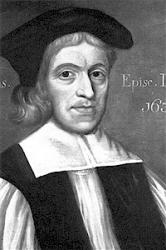
John Cosin

1594 - 1672 Person Name: John Cosin, 1594-1672 Topics: God: His Being, Word and Works God the Holy Spirit: His Person and Work Translator of "Come, Holy Ghost, our souls inspire" in The Book of Praise The following note is from Bird's "Songs of the Spirit," p. 171. "Cosin was a native of Norwich, and scholar of Caius College, Cambridge; Prebend of Durham, 1624; Rector of Branspeth, 1626; in 1660, Dean and then Bishop of Durham. His 'Collection of Private Devotions for the Hours of Prayer,' much offended the Puritans, who styled it 'a book of Cozening Devotions.' This work contains ten short hymns (three of them from the Latin), which are supposed to be his. --Annotations of the Hymnal, Charles Hutchins, M.A., 1872. ======================= Cosin, John, D.D., son of Giles Cosin, of Norwich, born at Norwich Nov. 30, 1594; educated at the Free School of that city and Caius College, Cambridge. Taking Holy Orders he became (besides holding minor appointments) Prebendary of Durham Cathedral; Rector of Brancepeth, 1626; Master of Peterhouse, Cambridge, 1634, and Vice-Chancellor of the University and Dean of Peterborough, 1640. He suffered much at the hands of the Puritans; but after the Restoration in 1660, he became Dean and then Bishop of Durham. Died at Westminster, Jan. 15, 1672. His translation of the Veni Greater Spiritus (q. v.), 44. “Come, Holy Ghost, our souls inspire," was included in his Collection of Private Devotions, 1627. --John Julian, Dictionary of Hymnology (1907)

Chris Tomlin

b. 1972 Topics: Abandonment; Anger; Apathy; Children; Cloud; Desert; Disasters; Eternal Life; Feet; Floods; Greed; Holiness Personal; Hope; Invitation; Love (Human); Mercy; Peacemakers; Poverty; Prayer; Prisoners; Sun; Thunder; War; Water of Life; Work; Abandonment; Anger; Apathy; Children; Cloud; Desert; Disasters; Eternal Life; Feet; Floods; Greed; Holiness Personal; Hope; Invitation; Love (Human); Mercy; Peacemakers; Poverty; Prayer; Prisoners; Sun; Thunder; War; Water of Life; Work; Grace Sanctifying and Perfecting Grace Author of "Come to the Water" in Worship and Song

Michael Saward

1932 - 2015 Topics: Redemption in Christ Christ's Saving Work; Biblical Persons; Jesus Christ Self-humiliation; Biblical Persons Adam; God Truth; Jesus Christ Self-humiliation; Proclamation; Saving Work of Christ Author of "These Are the Facts" in The Worshiping Church Michael John Saward (b. Blackheath, Kent, England, 1932) was residentiary Canon of St. Paul's Cathedral, London, and a church commissioner and member of the general synod of the Church of England. Educated at Eltham College, Bristol University, and Tyndale Hall, he was ordained in the Church of England in 1956. Saward served in several congregations and was radio and television officer for the Church Information Office (1967-1972). His publications include Leisure (1963), Couldn’t Care Less (1966), Don't Miss the Party (1974), and All Change (1983). Associated with the Jubilate Group for a number of years, he has written some sixty hymns and served as text editor for Hymns for Today's Church (1982). Bert Polman

Pages


Export as CSV
It looks like you are using an ad-blocker. Ad revenue helps keep us running. Please consider white-listing Hymnary.org or getting Hymnary Pro to eliminate ads entirely and help support Hymnary.org.