You help make Hymnary.org possible. More than 10 million people from 200+ countries found hymns, liturgical resources and encouragement on Hymnary.org in 2025, including you. Every visit affirms the global impact of this ministry.

If Hymnary has been meaningful to you this year, would you take a moment today to help sustain it? A gift of any size—paired with a note of encouragement if you wish—directly supports the server costs, research work and curation that keep this resource freely available to the world.

Give securely online today, or mail a check to:
Hymnary.org
Calvin University
3201 Burton Street SE
Grand Rapids, MI 49546

Thank you for your partnership, and may the hope of Advent fill your heart.

Person Results

Topics:warning
In:person

Planning worship? Check out our sister site, ZeteoSearch.org, for 20+ additional resources related to your search.
Showing 111 - 120 of 418Results Per Page: 102050

William J. Kirkpatrick

1838 - 1921 Person Name: Wm. J. Kirkpatrick Topics: Warning and Entreaty Composer of "[On the happy golden shore]" in Redemption Songs William J. Kirkpatrick (b. Duncannon, PA, 1838; d. Philadelphia, PA, 1921) received his musical training from his father and several other private teachers. A carpenter by trade, he engaged in the furniture business from 1862 to 1878. He left that profession to dedicate his life to music, serving as music director at Grace Methodist Church in Philadelphia. Kirkpatrick compiled some one hundred gospel song collections; his first, Devotional Melodies (1859), was published when he was only twenty-one years old. Many of these collections were first published by the John Hood Company and later by Kirkpatrick's own Praise Publishing Company, both in Philadelphia. Bert Polman

A. Williams

1731 - 1776 Person Name: Aaron Williams Topics: Salvation Invitation and Warning Composer of "ST. THOMAS" in The Evangelical Hymnal Aaron Williams (b. London, England, 1731; d. London, 1776) was a singing teacher, music engraver, and clerk at the Scottish Church, London Wall. He published various church music collections, some intended for rural church choirs. Representative of his compilations are The Universal Psalmodist (1763)— published in the United States as The American Harmony (1769)—The Royal Harmony (1766), The New Universal Psalmodist (1770), and Psalmody in Miniature (1778). His Harmonia Coelestis (1775) included anthems by noted composers. Bert Polman

Mary Dana Shindler

1810 - 1883 Person Name: Mary S. B. Dana Topics: Christian Commission Warning Men of Judgment Author of "Flee As a Bird to Your Mountain" in The Christian Hymnary Shindler, Mary Stanley Bunce, née Palmer, better known as Mrs. Dana, was born in Beaufort, South Carolina, Feb. 15, 1810. In 1835 she was married to Charles E. Dana, of New York, and removed with him to Bloomington, now Muscatine, Iowa, in 1838. Mr. Dana died in 1839, and Mrs. Dana returned to South Carolina. Subsequently she was married to the Rev. Robert D. Shindler, who was Professor in Shelby College, Kentucky, in 1851, and afterwards in Texas. Mrs. Shindler, originally a Presbyterian, was for some time an Unitarian; but of late years she has been a member of the Protestant Episcopal Church. As Mary S. B. Dana she published the Southern Harp, 1840, and the Northern Harp, 1841. From these works her hymns have been taken, 8 of which are in T. O. Summers's Songs of Zion, 1851. The best known are:— 1. Fiercely came the tempest sweeping. Christ stilling the storm. (1841.) 2. I'm a pilgrim, and I'm a stranger. A Christian Pilgrim. (1841.) 3. O sing to me of heaven. Heaven contemplated. (1840.) Sometimes given as "Come, sing to me of heaven." [Rev. F. M. Bird, M.A.] -- John Julian, Dictionary of Hymnology (1907) =================== Shindler, Mary S. B., p. 1055, i. Other hymns usually attributed to this writer, are "Prince of Peace, control my will" (Perfect Peace), in the Church of England Magazine, March 3, 1858, in 32 lines; and " Once upon the heaving ocean" (Jesus calming the Sea). --John Julian, Dictionary of Hymnology, Appendix, Part II (1907)

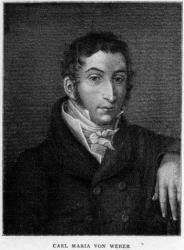
Carl Maria von Weber

1786 - 1826 Person Name: C. M. von Weber, 1786-1826 Topics: Warning and Invitation Composer of "SEYMOUR" in Hymnal and Liturgies of the Moravian Church Carl Maria von Weber; b. 1786, Oldenburg; d. 1826, London Evangelical Lutheran Hymnal, 1908

J. W. Elliott

1833 - 1915 Person Name: J W Elliott 1833-1915 Topics: The Gospel Invitation and Warning Composer of "DAY OF REST" in Praise! psalms hymns and songs for Christian worship J.W. Elliott was a popular composer of the Victorian period, and is best known for his nursery rhyme music and for his work on hymnals in the 1870s. He was born James William Elliott, in Warwick, England, on February 13, 1833. As a child, he sang as a chorister in the Leamington Parish Church. In those days, choristers were given lessons in all facets of church music, including organ lessons, counterpoint studies, and more in exchange for providing an extraordinary level of service to their parish church (services throughout the week, all holidays, extra services, etc.). The result is that most choristers who completed their studies received an excellent music education, and James was no exception. After starting his career as an organist and choirmaster for a countryside church, his talent became obvious. He moved to London, where he assisted Sir Arthur Sullivan (of Gilbert and Sullivan fame) in editing Church Hymns. In addition, James worked for a music publisher. His compositions include two operettas, numerous anthems, service music, works for instruments including the very popular harmonium, and most particularly for Nursery Rhymes and Nursery Songs, his children’s music score that sets many of the Nursery Rhymes to delightful music. Several of his hymn tunes are still in use today in many hymnals, most notably his hymn tune “Day of Rest.” He was heavily involved in the preparation of the musical edition of Church Hymns in 1874, the Choral Service Book of 1892, and transcriptions of hymn tunes using harmonies different than the traditional ones found in hymnals. He died in St. Marylebone, London, on February 5, 1915. --www.nursery-songs.com/

Laurentius Laurenti

1660 - 1722 Person Name: Laurentius Laurenti (1666-1722) Topics: Warning Message Expectation and Hope of Christ's Coming Author of "Rejoice, All Ye Believers" in The Christian Hymnary Laurenti, Laurentius, son of Herr Lorenz, or Laurenti, a burgess of Husum, in Schleswig, was born at Husum, June 8, 1660. He entered the University of Rostock in 1681, and after a year and a half spent there, went to Kiel to study music. In 1684 he was appointed cantor and director of the music at the cathedral church at Bremen. He died at Bremen, May 29, 1722 (Koch, iv. 281; Rotermund's continuation of Jöcher's Gelehrten-Lexicon, iii. 1405, &c). Laurenti was one of the best hymn-writers of the Pietistic school. His hymns are founded on the Gospels for Sundays and Festivals, and they draw out the bearing on the Christian life of the leading thoughts therein contained. They are of noble simplicity; are Scriptural, fervent, and often of genuine poetical worth. In Freylinghausen's Gesang-Buch, 1704 and 1714, no less than 34 are included, and many of these, with others by him, are still in extensive German use. They appeared in his:— Evangelia Melodica, das ist: Geistliche Lieder,und Lobgesange, nach den Sinn der ordentlichen Sonn-und Festages Evangelien, &c. Bremen, 1700 [Royal Library, Berlin], with 148 hymns on the Gospels, and two others. Of his hymns those which have passed into English are:—— i. Du wesentliches Wort. Christmas. Founded on St. John i. 1-12. In his Evangelia Melodica, 1700, p. 30, in 8 stanzas of 8 lines, entitled, "For the Third Day of Christmas." Included in Freylinghausen's Gesang-Buch, 1704, No. 20; and, recently, as No. 83, in the Berlin Geistliche Lieder, 1863. The translations in common use are:— 1. 0 Thou essential Word, Who from. A good translation, omitting st. iii., v., by Miss Winkworth, in her Lyra Germanica, first Ser., 1855, p. 15 (2nd edition, 1856, considerably altered); and repeated, abridged, in Flett's Collection, Paisley, 1871. Varying centos, beginning with st. i., 1. 5, altered to "O Saviour of our race," are found in America, as in Boardman's Selections, Philadelphia, 1861; the Pennsylvania Lutheran Church Book, 1868; and the Dutch Ref. Hymns of the Church, 1869. 2. 0 Thou essential Word, Who wast. By Miss Winkworth, in her Chorale Book for England, 1863, No. 54. This is her 1856 version (as above) rewritten to the original metre. Repeated, in full, in Dr. Thomas's Augustine Hymn Book, 1866, and the Ohio Lutheran Hymnal, 1880; and, abridged, in the English Presbyterian Psalms & Hymns, 1867, and Laudes Domini, N. Y., 1884. ii. Ermuntert euch, ihr Frommen. Second Advent. This is his finest hymn. In his Evangelia Melodica, 1700, p. 353, in 10 stanzas of 8 lines, entitled, "For the 27th Sunday after Trinity." It is founded on St. Matt. xxv. 1-13; and unites the imagery of the parable of the Ten Virgins with that of Rev. xx., xxi. Included, as No. 578, in Freylinghausen's Gesang-Buch, 1704; and, recently, as No. 1519, in the Berlin Geistliche Lieder, ed. 1863. The translation in common use is:— Rejoice, all ye believers. By Mrs. Findlater, in Hymns from the Land of Luther, 1st Ser., 1854, p. 61 (1884, p. 62), a good translation of st. i.-iii., vii., viii., x. In full, but altered to the original metre, in Schaff’s Christ in Song, 1869 and 1870. This version is found in a large number of English and American hymnals, under the following forms:— (1) Rejoice, all ye believers (st. i.). Varying centos are found in Mercer, 1864, Hymnal Companion, 1876, &c.; and in America in Hatfield's Church Hymn Book, 1872, Evangelical Hymnal, N. Y., 1880, and others. (2)

George Washington Doane

1799 - 1859 Person Name: G. W. Doane Topics: Warning Author of "Fling Out the Banner" in Jubilant Voices for Sunday Schools and Devotional Meetings Doane, George Washington, D.D. Bishop Doane was born at Trenton, New Jersey, May 27, 1799, and graduated at Union College, Schenectady, New York. Ordained in 1821, he was Assistant Minister at Trinity Church, New York, till 1824. In 1824 he became a Professor at Trinity College, Hartford, Conn.; in 1828 Rector of Trinity Church, Boston; and, in 1832, Bishop of New Jersey. He founded St. Mary's Hall, Burlington, 1837, and Burlington College, Burlington, 1846. Died April 27, 1859.  Bishop Doane's exceptional talents, learning, and force of character, made him one of the great prelates of his time. His warmth of heart secured devoted friends, who still cherish his memory with revering affection. He passed through many and severe troubles, which left their mark upon his later verse. He was no mean poet, and a few of his lyrics are among our best. His Works, in 4 volumes with Memoir by his son, were published in 1860. He issued in 1824 Songs by the Way, a small volume of great merit and interest. This edition is now rare. A second edition, much enlarged, appeared after his death, in 1859, and a third, in small 4to, in 1875. These include much matter of a private nature, such as he would not himself have given to the world, and by no means equal to his graver and more careful lyrics, on which alone his poetic fame must rest.The edition of 1824 contains several important hymns, some of which have often circulated without his name. Two of these are universally known as his, having been adopted by the American Prayer Book Collection, 1826:-- 1. Softly now the light of day. Evening. This, in addition to its use in American hymnals, is also found in the English Collections, including Snepp's Songs of Grace & Glory.   Written in 1824. 2. Thou art the way, to Thee alone. Christ the Way. This, in the judgment of many, is the first of American hymns, and one of the most admirable and useful in the English language. In the United States its use is most extensive, and since its introduction into the English Collections by Bickersteth in 1833, Hall in his Mitre, in 1836, and others, it has grown in favour until it ranks with the most popular of the great English hymns. Near in merit to the foregoing stands a companion piece in the same work, which deserves to be better known :— 3.  Lord, should we leave Thy hallowed feet. The next three have been overlooked at home, but have obtained considerable circulation in English Collections. 4.  Father of mercies hear,  Thy pardon we implore.    Ash Wednesday or Lent.    A translation of "Audi, benigne Conditor" q.v.), published in his Songs by the Way, 1824, together with several other translations, thus anticipating by twelve years the great English movement in that direction.   Original translation in his Songs by the Way, 1875Miller (S. & S., p. 12) attributes this translation to Dr. Neale in error. 5.  Return and come to God.   Invitation.   In his Songs, &c, 1824.   It is found in  Hall’s Mitre, 1836; the Baptist Hymnal, 1879, and several others. 6.  To thee, 0 Lord, with dawning light.  Morning.    This hymn is attributed to Heber by Miller (S. & S. , p. 381) in error.  It is included in the Society for Promoting Christian Knowledge Hymns, 1852; in Windle and others.    It is from the Songs, &c, 1824. His later hymns, the dates of which are generally preserved in the last edition of his Songs by the Way, include the following, which are more or less in use :— 7.  Beloved, it is well.   All well in Christ.   This is entitled "To my wife"; is dated Mar. 12, 1833, and was written in a copy of Dr. Bedell's "It is well."    It is given in Kennedy, 1863. 8.  Broken-hearted, weep no more.    Assurance of Peace.    The date of this hymn is not preserved. It is found as early as 1829, when it appeared in the 2nd edition of Cleland's (Baptist) Hymns. 9.  Fling out the banner, let it float.    Missions, Home & Foreign.    This hymn, sometimes dated 1824 in error, was written at Riverside, 2nd Sunday in Advent, 1848, and is one of the author's latest effusions.    It is in extensive use both in Great Britain and America. 10.  He came not with His heavenly crown.   The two Advents. In his Songs by the Way, edition 1875, this poem is dated Dec. 1827.    In Dale's English Hymnbook, 1879, it is given with the omission of stanza iii., and in the American Protestant Episcopal  Hymnal,   1871,  it begins  with stanza iv., "Once more, O Lord, Thy sign shall be."    Full text in Lyra Sac. Amer., p. 92. 11.  Lift not thou the wailing voice.   Burial.   A funeral hymn, adopted by the Anglican Hymnbook, but dated 1826 in error, for 1830. 12.  What is that, mother?  The lark, my child. This is not a hymn, but a familiar and long popular song. 13.  "When darkness erst [once] at God's command. Israel in Egypt.    In Kennedy, 1863, No. 722. 14.  Young and happy while thou art.    Youth for Christ.   A favourite piece in many juvenile collections.   It is dated Sept., 1827, and is given in Songs by the Way, 1875. The Lyra Sacra Americana also contains the following:— 15.  Brightness of the Father's glory.    Morning. A tr. of "Consors Paterni luminis " (q.v.).   It is from the Songs, &c, 1824. 16.  Child that kneelest meekly there.     Child at Prayer.    Suggested by a cast from a piece of sculpture by Greenough representing a child at prayer. 17.  Grant me, Lord, Thy graces three.    Faith, Hope, and Charity desired. 18.  Perfect through suffering may it be.     Uses of suffering.    Dated in Songs by the Way, "The Breakers, June 1, 1853." 19.  Yes, it is a faithful saying.   Redemption. In his Songs, &c, 1824.             [Rev. F. M. Bird, M.A.] -- John Julian, Dictionary of Hymnology (1907)

John E. Gould

1821 - 1875 Topics: Warning Composer of "BERA" in Church Hymns and Gospel Songs John Edgar Gould USA 1821-1875. Born in Bangor, ME, he became a musician. He managed music stores in New York City and Philadelphia, PA., the latter with composer partner, William Fischer. He married Josephine Louisa Barrows, and they had seven children: Blanche, Marie, Ida, John, Josephine, Josephine, and Augusta. He compiled eight religious songbooks from 1846 thru 1869. He died while traveling in Algiers, Africa, and was buried in Philadelphia, PA. John Perry

Jeremiah Ingalls

1764 - 1838 Topics: The Gospel Invitation and Warning Composer of "COME, YE SINNERS" in Sacred Hymns and Tunes Jeremiah Ingalls USA 1764-1838. Born at Andover, MA, his father died of hardships from the American Revolutionary War when he was thirteen. In VT, he worked as a farmer, Cooper, Taverner, and choirmaster. He mastered the bass viol (similar to a cello) and became a composer. He moved to Newbury, VT, in 1787, and in 1791 he married Mary (Polly) Bigelow of Westminster, MA, and they had eleven children (nine living to adulthood): Smith, Jeremiah, Joshua, Jeremiah, Mary, Moses, Elizabeth, John, Almyra, Isaac, and Hannah. He taught singing and began leading the singing at the First Congregational Church there. The choir became well-known, and people came from miles around to hear them sing. In 1800 he built and operated a tavern. He also worked as a cooper. In 1803 he became a deacon, and in 1805 he published a song book, “Christian Harmony”, that contained folk and popular songs with tunes used in spiritual songs sung in early religious revivals and campmeetings, some becoming hymns in later song books. It was said that at times he would be so immersed in his music that his livelihood suffered as a result. He was removed and excommunicated from his church in 1810, having a falling out with the church due to marriage infidelity that he refused to repent of. He ran his tavern for a number of years, but finally sold it and moved to Rochester, VT, in 1819, where he became the first choirmaster of the Church of Christ. His tenure there was successful, and he was a signer of the document establishing construction of the first church building in Rochester (1812). Later, his son, John, succeeded him as choirmaster there. the family’s last move was to a farm near Hancock, VT. He was described as short, portly, good-humored, and absentminded, and having a high voice, but singing bass well. His family was musical, some noted for their musical abilities. A singing society in VT was named for him and promoted singing events. Some of his music became well-known around the world. He died at Hancock, VT. Note: It is said that he wrote a letter to the First Congregational Church in Westminster 18 years after departing repenting of his infidelity (allegedly after his illegitimate son, Thomas, was of age, but the letter was lost in church records, although the church said they had received it. John Perry

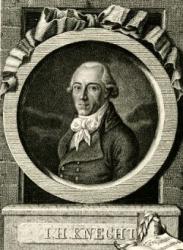
Justin Heinrich Knecht

1752 - 1817 Person Name: Justin H. Knecht, 1752-1817 Topics: Warning and Invitation Composer of "ST. EDITH" in Hymnal and Liturgies of the Moravian Church Justin Heinrich Knecht Germany 1752-1817. Born at Biberach Baden-Wurttemberg, Germany, he attended a Lutheran college in Esslingen am Neckar from 1768-1771. Having learned the organ, keyboard, violin and oratory, he became a Lutheran preceptor (professor of literature) and music director in Biberach. It was a free imperial city until 1803 and had a rich cultural life. He became organist of St. Martin’s Church in 1792, used by both Lutherans and Catholics, and was there for many years. He led an energetic, busy musical life, composing for both the theatre and church, organizing subscription concerts, teaching music theory, acoustics, aesthetics, composition, and instruments at the Gymnasium, affiliated to the Musikschule in 1806. He went to Stuttgart in 1806 in hopes of a post there as Kapellmeister, serving two years as Konzertmeister, but he was appointed Direktor Beim Orchester by the King of Wurttemberg in 1807. However, he returned to his former life in 1808 and remained there the rest of his life. He died at Biberach. He wrote 10 vocals, 11 opera and stage works, one symphony, 3 chamber music instrumentals, 7 organ works, 4 piano works, and 6 music theories. He was an author composer, editor, contributor, musician, compiler, and lyricist. John Perry

Pages


Export as CSV
It looks like you are using an ad-blocker. Ad revenue helps keep us running. Please consider white-listing Hymnary.org or getting Hymnary Pro to eliminate ads entirely and help support Hymnary.org.