You help make Hymnary.org possible. More than 10 million people from 200+ countries found hymns, liturgical resources and encouragement on Hymnary.org in 2025, including you. Every visit affirms the global impact of this ministry.

If Hymnary has been meaningful to you this year, would you take a moment today to help sustain it? A gift of any size—paired with a note of encouragement if you wish—directly supports the server costs, research work and curation that keep this resource freely available to the world.

Give securely online today, or mail a check to:
Hymnary.org
Calvin University
3201 Burton Street SE
Grand Rapids, MI 49546

Thank you for your partnership, and may the hope of Advent fill your heart.

Person Results

Topics:help
In:people

Planning worship? Check out our sister site, ZeteoSearch.org, for 20+ additional resources related to your search.
Showing 121 - 130 of 303Results Per Page: 102050

I. H. Meredith

1872 - 1962 Topics: Helping Others Composer of "[You may help a load to lighten]" in Sunday School Hymns No. 1 Pseudonyms Charles C. Ack­ley (tak­en from his wife’s name, Cla­ris­sa Ack­ley Cow­an) Broughton Ed­wards Floyd En­gle (from his ad­dress on Floyd Street in En­gle­wood Cliffs, New Jer­sey) Arthur Grant­ley Bruce Ken­ne­dy See also Ackley, Chas. C. 1872-1962 See also Edwards, Broughton

Ada Blenkhorn

1858 - 1927 Topics: Helping Others Author of "I'll Be a Happy Christian" in Inspiring Songs No. 1 Ada Jane Blenkhorn Canada 1858-1927 Born in Cobourg, Ontario, the 10th of 11 children, she emigrated with her family to the U.S. In 1884 and settled in Cleveland, OH.. She was raised a Methodist, and began writing hymn lyrics at age 34. A prolific writer of hymn lyrics, she was about to give it up when a friend encouraged her to continue, telling her some soul might be saved by a hymn she would write. She worked for many years as secretary to her brother, Henry's, real estate company. After his death in 1923, she became president of the company. She never married. John Perry

William Vincent Wallace

1812 - 1865 Person Name: Wm. Wallace Topics: Christ Present Help Composer of "SERENITY" in Songs for the King's Business

John Baptiste Calkin

1827 - 1905 Person Name: J. B. Calkin Topics: God our help Composer of "ROSSITER" in Gloria Deo John Baptiste Calkin United Kingdom 1827-1905. Born in London, he was reared in a musical atmosphere. Studying music under his father, and with three brothers, he became a composer, organist, and music teacher. At 19, he was appointed organist, precenter, and choirmaster at St. Columbia's College, Dublin, Ireland, 1846 to 1853. From 1853 to 1863 we was organist and choirmaster at Woburn Chapel, London. From 1863 to 1868, he was organist of Camden Road Chapel. From 1870 to 1884 he was organist at St. Thomas's Church, Camden Town. In 1883 he became professor at Guildhall School of Music and concentrated on teaching and composing. He was also a professor of music and on the council of Trinity College, London, and a member of the Philharmonic Society (1862). In 1893 he was a fellow of the College of Organists. John and wife, Victoire, had four sons, each following a musical carer. He wrote much music for organ and scored string arrangements, sonatas, duos, etc. He died at Hornsey Rise Gardens. John Perry

William Hiley Bathurst

1796 - 1877 Person Name: W. Bathurst Topics: The Christian Life Help, Comfort, Guidance Author of "O for a faith that will not shrink" in Churches of Christ Hymn Book Bathurst, William Hiley , M.A., son of the Rt. Hon. Charles Bragge (afterwards Bathurst) some time M.P. for Bristol, born at Clevedale, near Bristol, Aug. 28, 1796, and educated at Winchester, and Christ Church, Oxford, graduating B.A. in 1818. From 1820 to 1852 he held the Rectory of Barwick-in-Elmet, near Leeds. Resigning the Rectory in the latter year, through his inability to reconcile his doctrinal views with the Book of Common Prayer, he retired into private life, and died at Lydney Park, Gloucestershire, Nov. 25, 1877. His works include, The Georgics of Virgil: Translated by W. H. B., 1849; Metrical Musings; or, Thoughts on Sacred Subjects in Verse, 1849; and Psalms and Hymns for Public and Private Use, 1831 (2nd ed. 1842). This last contains 141 versions of Psalms, and 206 hymns. All the latter, and many of the former are original. Of his hymns, those in most extensive use are, "Hark! the distant isles proclaim," "Holy Spirit from on high,” "Jesus, Thy Church with longing eyes,” "Eternal Spirit, by whose power," "O for a faith that will not shrink” and “O Saviour, may we never rest." In addition to these and a few others (all of which are annotated under their first lines), the following are in common use, but mainly in America:— 1. Before Thy cross, my dying Lord. Faith. 2. Before Thy mercy-seat, O Lord. Holy Scriptures. 3. Behold what unspeakable love. Heaven. 4. Does the Lord of Glory speak? Holy Scripture. 5. Ere the world with light invested. Holy Spirit. 6. Except the Lord our labours bless. Ps. cxxvii. 1. Full of weakness and of sin. The Creator Spirit desired. 8. Glory to the Almighty Father. Praise. 9. Holy Lord, our hearts prepare. Preparation for Prayer. 10. Holy Spirit from on high. Holy Spirit's direction implored. 11. How blest are they who feel the weight. Repentance. 12. How strange that souls whom Jesus feeds. Conflict. 13. How sweet it is in early youth. Youthful Piety. 14. How sweet the hour of closing day. Death. 15. Led by a Father's gentle hand. Communion of Saints 16. Lord, a better heart bestow. Lent. 17. Lord, bid the light arise. To the Holy Spirit. 18. Lord, shed Thy glory as of old. Whitsuntide. 19. Lord, what blessed consolation. Safety of the Church. 20. Lord, when our offerings we present. Offertory. 21. 0 for a beam of heavenly light. Lent. 22. 0 for that flame of living tire. Holy Spirit. 23. 0 give thanks unto the Lord. Ps. cv. 24. Shepherd of Israel, from above. On behalf of Children. 25. This day the Lord hath called His own. Sunday. 26. When the world my heart is rending. Heaven. 27. Why search ye in the narrow tomb? Ascension. 28. Ye servants of the living God. Praise. All these hymns were given in his Psalms & Hymns , &c, 1831 (Preface dated November 15th, 1830), and repeated, without alteration, in the 2nd ed., 1842. They are characterized by simplicity of language, and directness of aim; but do not in any instance rise above the ordinary level of passable hymn-writing. In some American collections Bathurst's name is contracted to "Bath," and this is regarded either as a complete surname or as a Bath Collection. The contraction was given by Bickersteth in his Christian Psalmody, 1833. --John Julian, Dictionary of Hymnology (1907) =================== Bathurst, William H., p. 117, ii. Additional hymns from his Psalms & Hymns, 1831, are in common use as follows:— 1. Great God, when I approach Thy throne. Redemption. 2. How bright a day was that which saw. The First Sabbath. 3. How frail and fallible I am. Jesus Unchangeable. 4. In Jesus' name with one accord. Divine Worship. 5. Lord, I claim Thee for my own. Ps. lxiii. 6. Lord shew Thy glory as of old. This is not "Lord shed Thy glory, &c," as stated at p. 118, i., 18. 7. Lord, when I lift my voice to Thee. Ps. ci. 8. O Lord, defend us as of old. Ps. lxxiv. 9. O Lord, how long shall heathens hold. Ps. lxxix. 10. 0 Lord, look down with pitying eye. Intercession for the Jews. Begins with st. iv. of “0 how is Zion's glory gone." 11. Praise God, O my soul. Ps. cxlvi. 12. Saviour, at Thy feet we bow. United Prayer. 13. 'Tis past, that agonizing hour. Ascension. 14. The Lord look'd all around. Universal Corruption. 15. To the Source of every blessing. Praise to the Father. 16. What can relieve the troubled soul? Christ the Comforter. --John Julian, Dictionary of Hymnology, Appendix, Part II (1907)

Mrs. Barbauld

1743 - 1825 Topics: The constant help of Providence Author of "Praise to God, immortal praise" in A Collection of Psalms and Hymns for Christian Worship (6th ed.) Barbauld, Anna Laetitia, née Aikin, daughter of the Rev. John Ailrin, D.D., a dissenting minister, was b. at Kibworth-Harcourt, Leicestershire, June 20, 1743. In 1753 Dr. Aikin became classical tutor at a dissenting academy at Warrington. During her residence there she contributed five hymns to Dr. W. Enfield's Hymns for Public Worship, &c, Warrington, 1772. In the following year these were included in her Poems, Lond., J. Johnson, 1773. In May, 1774, Miss Aikin was married to the Rev. Rochemont Barbauld, a descendant of a French Protestant family, and a dissenting minister. For some years Mr. Barbauld conducted, in addition to his pastoral work, a boarding school at Palgrave, Suffolk. From this he retired in 1785. In 1786 he undertook the charge of a small congregation at Hampstead, and from thence he passed to the dissenting chapel (formerly Dr. Price's) at Newington Green, in 1802. He d. Nov. 11, 1808. Mrs. Barbauld continued to reside in the neighbourhood until her death, March 9, 1825. In the latter part of the same year her niece published The Works of Anna Laetitia Barbauld, with Memoir, by Lucy Aikin, 2 vols., Lond., Longman, 1825. As a writer of hymns Mrs. Barbauld was eminently successful. Their use, however, with the exception of five contributed to Dr. W. Enfield's collection, is almost exclusively confined to the Unitarian hymnals of Great Britain and America. Including these hymnals, the whole of her hymns are still in common use. These hymns appeared thus:— i. In Dr. W. Enfield's Hymns, &c., 1772. 1. Again the Lord of life and light. Easter. 2. Awake, my soul, lift up thine eyes. Conflict. 3. Behold, where breathing love divine. Christian Charity. 4. Jehovah reigns, let every nation hear. God's Dominion. A part of this was given in Collyer's Sel., 1812, No. 586, as:— 5. This earthly globe, the creature of a day. 6. Praise to God, Immortal praise. Harvest. ii. Poems, 1773 (Preface dated Dec. 1, 1772). The whole of the above, and also:— 7. God of my life and author of my days. To God the Father. This is an “Address to the Deity," in 80 1. It is given in Martineau's Collection, 1840 and 1873. From it the following centos were given in Collyer's Selection> 1812:— 8. God, our kind Master, merciful as just. 9. If friendless in the vale of tears I stray. iii. Poems revised 1792. 10. Come, said [says] Jesus' sacred voice. Invitation. 11. How blest the sacred tie that binds. Christian Fellowship. 12. Lo where a crowd of pilgrims toil. Pilgrimage of Life. From this is taken:— 13. Our country is Immanuel's ground [land]. iv. Leisure Hour Improved (Ironbridge), 1809. 14. Sweet is the scene when virtue dies. Death. v. Supplement to the Unitarian Coll. of Kippis, Bees, and others, 1807. 15. When as returns the solemn day. Sunday. 16. Sleep, sleep to day, tormenting cares. Sunday. 17. How may earth and heaven unite. Worship. vi. Works, with Memoir, 1825. In vol. i. most of the above are reprinted, and the following are added :— 18. Joy to the followers of the Lord. Joy. (c. 1820.) 19. Pure spirit, O where art thou now. Bereavement. This is dated 1808. 20. Salt of the earth, ye virtuous few. Salt of the Earth. 21. When life as opening buds is sweet. Death. This is dated " November, 1814." The more important of these hymns are annotated in this Dictionary under their first lines. Mrs. Barbauld's Hymns in Prose for Children, originally published in 1781, were long popular and have been translated into French, Italian, Spanish, and other languages. -- John Julian, Dictionary of Hymnology (1907) =================== Barbauld, Anna L., p. 113, ii. No. 18 on p. 114, i.,should be dated circa 1820. Another hymn in common use from Mrs. Barbauld's Works, &c, 1825, is, "O Father! though the anxious fear" (E. Taylor, p. 1117, in error). --John Julian, Dictionary of Hymnology, Appendix, Part II (1907) See also in: Hymn Writers of the Church

Elizabeth Rundle Charles

1828 - 1896 Person Name: Elizabeth R. Charles Topics: Helping Others Author of "Cruise of Comfort" in Inspiring Songs No. 1 Charles, Elizabeth, née Rundle, is the author of numerous and very popular works intended to popularize the history of early Christian life in Great Britain; of Luther and his times; of Wesley and his work; the struggles of English civil wars; and kindred subjects as embodied in the Chronicles of the Schönherg-Cotta Family, the Diary of Kitty Trevelyan, &c, was born at Tavistock, Devonshire, Her father was John Rundle, M.P., and her husband, Andrew Paton Charles, Barrister-at-Law. Mrs. Charles has made some valuable contributions to hymnology, including original hymns and translations from the Latin and German. These were given in her:— (1) The Voice of Christian Life in Song; or, Hymns and Hymn-writers of Many Lands and Ages, 1858; (2) The Three Wakings, and other Poems, 1859; and (3) The Chronicles of the Schönberg-Cotta Family; (4) Poems, New York, 1867. This has some additional pieces. Her hymn on the Annunciation, "Age after age shall call thee [her] blessed," appeared in her Three Wakings, &c., 1859. --John Julian, Dictionary of Hymnology (1907) ========================= Charles, Elizabeth, née Rundle. Mrs. Charles has assumed the name of "Rundle-Charles," as given in the 1890 edition of the Hymnal Companion. Other hymns in common use are:— 1. Around a Table, not a tomb. Holy Communion. Dated Oct. 1862. In her Poems, 1868, in 6 stanzas of 4 lines. 2. Come, and rejoice with me. Joy in Christ. Some-times dated 1846. From her Three Wakings, 1859, p. 146, in 7 stanzas of 4 lines, and headed "Eureka." 3. Jesus, what once Thou wast. Jesus the Unchangeable One. In Mrs. Brock's Children's Hymn Book, 1881. 4. Never further than Thy Cross. Passiontide. In The Family Treasury, Feb. 1860. 5. What marks the dawning of the Year? New Year. From her Three Wakings, 1859, p. 155. --John Julian, Dictionary of Hymnology, Appendix, Part II (1907) ====================== Charles, Elizabeth, née Rundle, pp. 218, ii.; 1556, i. Mrs. Rundle-Charles was born Jan. 2, 1828, married in 1851, and died March 28, 1896. Her hymn, "The little birds fill all the air with their glee" (Thankfulness), was published in her Three Waitings, 1859, p. 165, as a "Song for an Infant School." It is found in The Sunday School Hymnary, 1905, and others. [Rev. James Mearns, M.A.] --John Julian, Dictionary of Hymnology, New Supplement (1907)

Matthias Greiter

1495 - 1550 Person Name: Matthäus Greiter Topics: God Help Composer of "OLD 113TH" in The Presbyterian Hymnal Greitter, Matthäus, was a monk and chorister of Strassburg Cathedral, but in 1524 espoused the cause of the Reformation. In 1528 he was appointed assistant pastor of St. Martin's Church, and afterwards at St. Stephen's. When the Interim [Agricola] was forced on Strassburg, he was the only one of the Lutheran pastors that sought to further it, a course which he afterwards deeply regretted. His death is dated by Wetzel, i. 349, as Dec. 20, 1550; by the Allgemeine Deutsche Biographie, ix. 636, as Nov. 20, 1550; while Koch, ii. 104, says he died of the pestilence in 1552. Greitter was a distinguished musician, and with his friend Dachstein (q.v.) edited the Strassburg Kirchen ampt, 1524-5. Four psalm tunes by Greitter, and one by Dachstein were inserted by Calvin in his first Hymnbook published at Strassburg, 1539. All these were transferred to the first edition of the French-Genevan Psalter in 1542, and two of them, both by Greitter (the tunes to psalms 36 and 91), were retained in the final edition of 1562. Of his seven Psalm versions 4 have been translated into English :— i. Ach Gott, wie lang vergissest mein. Ps. xiii. 1524. Wackernagel, iii. p. 89, in 4 st. Translated as, "O Lord, how lang forever wil thow foirget," in the Gude and Godly Ballates, ed. 1568, folio 46 (1868, p. 78). ii. Da Israel aus Egypten zog. Ps. cxiv. In Die Zwen Psalmen: In exitu Israel, &c, Strassburg, 1527, thence in Wackernagel, iii. p. 93, in 2 stanzas. Translated as, "Quhen, fra Egypt departit Israeli," In the Gude & Godly Ballates, ed. 1568, folio 56 (1868, p. 95). iii. Nicht uns, nicht uns, o ewiger Herr. Ps. cxv, 1527, as ii., and Wackernagel, iii. p. 93, in 4 st. Translated as, “Not unto us, not unto us, O Lord," in the G. & G. Ballates, ed. 1568, folio 56 (1868, p. 95). iv. 0 Herre Gott, begnade mich. Ps. li. 1525. Wackernagel, iii. p. 90, in 5 st. Translated as, "O Lorde God, have mercy on me," by Bishop Coverdale, 1539 (Remains, 1846, p. 574). [Rev.James Mearns, M.A.] --John Julian, Dictionary of Hymnology (1907)

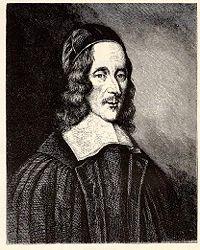
George Herbert

1593 - 1633 Person Name: George Herbert (1593-1633) Topics: God--in Jesus Christ His Love, Help, Healing Author of "Come, my way, my truth, my life" in New Church Praise Herbert, George, M.A., the fifth son of Richard Herbert and Magdalen, the daughter of Sir Richard Newport, was born at his father's seat, Montgomery Castle, April 3, 1593. He was educated at Westminster School, and at Trinity College, Cambridge, graduating B.A. in 1611. On March 15, 1615, he became Major Fellow of the College, M.A. the same year, and in 1619 Orator for the University. Favoured by James I., intimate with Lord Bacon, Bishop Andrewes, and other men of influence, and encouraged in other ways, his hopes of Court preferment were somewhat bright until they were dispelled by the deaths of the Duke of Richmond, the Marquis of Hamilton, and then of King James himself. Retiring into Kent, he formed the resolution of taking Holy Orders. He was appointed by the Bishop of Lincoln to the Prebend of Lcighton Ecclesia and to the living of Leighton Bromswold, Hunts, July 15, 1626. He remained until 1629, when an attack of ague obliged him to remove to his brother's, house at Woodford, Essex. Not improving in health at Woodford, he removed to Dantsey, in Wiltshire, and then as Rector to Bemerton, to which he was inducted, April 26, 1630, where he died Feb. 1632. The entry in the register of Bemerton is "Mr. George Herbert, Esq., Parson of Foughleston and Bemerton, was buried 3 day of March 1632." His life, by Izaak Walton, is well known; another Memoir, by Barnabas Oley, is forgotten. Herbert's prose work, Priest to the Temple, appeared several years after his death: but The Temple, by which he is best known, he delivered to Nicholas Ferrar (q.v.), about three weeks before his death, and authorized him to publish it if he thought fit. This was done iu 1633. The work became popular, and the 13th edition was issued in 1709. It is meditative rather than hymnic in character, and was never intended for use in public worship. In 1697 a selection from The Temple appeared under the title Select Hymns Taken out of Mr. Herbert's Temple & turned into the Common Metre To Be Sung In The Tunes Ordinarily us'd in Churches. London, Parkhurst, 1697. In 1739, J. & C. Wesley made a much more successful attempt to introduce his hymns into public worship by inserting over 40 in a much-altered form in their Hymns & Sacred Poems. As some few of these came into their collection of Psalms & Hymns, 1741, revised 1743, they were long sung by the Methodists, but do not now form part of the Wesleyan Hymn Book. No further attempt seems to have been made to use the Temple poems as hymns until 1853, when some altered and revised by G. Rawson were given in the Leeds Hymn Book of that year. From that time onward more attention was paid to Herbert alike by Churchmen and Nonconformists, and some of his hymns are now widely accepted. Many editions of his works have been published, the most popular being that of the Rev. Robert Aris Wilmott, Lond., Geo. Routledge & Son, 1857; but Dr. Grosart's privately printed edition issued in his Fuller Worthies Library in 1874, in three volumes, is not only the most complete and correct, but included also his psalms not before reprinted, and several poems from a ms. in the Williams Library, and not before published. The Temple has also been pub¬lished in facsimile by Elliott Stock, 1876, with preface by Dr. Grosart; and in ordinary type, 1882, by Wells Gardner, with preface by J. A. Shorthouse. The quaintness of Herbert's lyrics and the peculiarity of several of their metres have been against their adoption for congregational purposes. The best known are: "Let all the world in every corner sing"; "My stock lies dead, and no increase"; "Throw away Thy rod"; "Sweet day, so cool, so calm"; and "Teach me, my God, and King." [William T. Brooke] --John Julian, Dictionary of Hymnology (1907)

John Barnard

b. 1948 Person Name: John Barnard, 1948- Topics: Help Composer of "WITHINGTON" in The Book of Praise

Pages


Export as CSV
It looks like you are using an ad-blocker. Ad revenue helps keep us running. Please consider white-listing Hymnary.org or getting Hymnary Pro to eliminate ads entirely and help support Hymnary.org.