You help make Hymnary.org possible. More than 10 million people from 200+ countries found hymns, liturgical resources and encouragement on Hymnary.org in 2025, including you. Every visit affirms the global impact of this ministry.

If Hymnary has been meaningful to you this year, would you take a moment today to help sustain it? A gift of any size—paired with a note of encouragement if you wish—directly supports the server costs, research work and curation that keep this resource freely available to the world.

Give securely online today, or mail a check to:
Hymnary.org
Calvin University
3201 Burton Street SE
Grand Rapids, MI 49546

Thank you for your partnership, and may the hope of Advent fill your heart.

Person Results

Topics:house+of+god+
In:person

Planning worship? Check out our sister site, ZeteoSearch.org, for 20+ additional resources related to your search.
Showing 121 - 130 of 350Results Per Page: 102050

César Malan

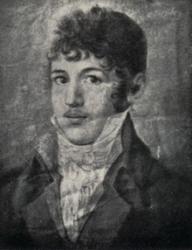
1787 - 1864 Person Name: Rev. H. A. C. Malan, 1787-1864 Topics: God's House; Law, God's Man's; Prayer; Word of God; Worship; Adoration and Praise Opening of Service Composer of "HENDON" in The Hymnal Rv Henri Abraham Cesar Malan, 1787-1864. Born in Geneva, Switzerland, into a bourgeois family that moved to Switzerland to escape religious persecution during the French Revolution, he attended the university in Marseilles, France, intending to become a businessman. Although having some grounding in religious faith by his mother, he decided to attend the Academy at Geneva (founded by Calvin) in preparation for ministry. He was ordained in 1810, after being appointed a college master (teaching Latin) in 1809. Malan was in accord with the National Church of Geneva as a Unitarian, but the Reveil Movement caused him to become a dissident (evangelical) instead of a proponent of the Reformed Church (believing works, not faith, was what mattered). In 1811 he married (wife’s name not found). They had at least two children (one son was Solomon, referenced below). From 1813 on Malan slowly became an evangelical, after being given an understanding of true salvation through grace (not works) in 1816 by two German Lutherans from Geneva. He became saved upon this realization and was so changed that he burned his prized collection of classical authors and manuscripts. In 1817 he preached around Geneva, and one sermon in particular, “Man only justified by faith alone” created a firestorm and brought him into conflict with religious authorities of the region. From then on he wished to help reform the national church from within, but the forces of the Venerable Company were too strong for him and excluded him from the pulpits and caused his dismissal from his regentsship at the college in 1818. Others in agreement with Malan were Charles Spurgeon, Robert Wilcox, Robert Haldane, and Henry Drummond. In 1820 he built a chapel in his garden and obtained the license of the State for it as a separatist place of worship. He preached in that chapel 43 years. In 1823 he was formally deprived of his status as a minister of the national Church. Various events caused his congregation to diminish over the next few years, and he began long tours of evangelization subsidized by religious friends in his land, Belgium, France, England and Scotland. He often preached to large congregations. Malan also authorized a hymn book, “Chants de Sion” (1841). A strong Calvinist, Malan lost no opportunity to evangelize. On one occasion an old man he visited pulled Malan’s hymnal out and told him he had prayed to see the author of it before he died. On a visit to England Malan also inspired author, Charlotte Elliott, to write the hymn lyrics for “Just as I am”, when seeking an answer to her conversion she asked and he advised her to come to Christ ‘just as she was’. Malan published a score of books and also produced many religious tracts and pamphlets largely on questions in dispute between the National and evangelical churches of Rome. He also wrote articles in the “Record” and in American reviews. His hymns were set to his own melodies. He was an artist, a mechanic, a carpenter, a metal forger, and a printer. He had his own workshop, forge and printing press. One of his greatest joys was the meeting of the evangelical alliance at Geneva in 1861 which helped change church views. He retired to his home, Vandoeuvres, in the countryside near Geneva in 1857, dying there seven years later.. He was honored by a visit from the Queen of Holland two years before his death. He is mainly remembered as a hymn writer, having written 1000+ hymn lyrics and tunes. One son, Solomon, a gifted linguist and theologian, became Vicar of Broadwindsor. About a dozen of his hymns appeared translated in the publication “Friendly visitor” (1826). He was an author, creator, composer, editor, correspondent, contributor, translator, owner, and performer. John Perry ================= Malan, Henri Abraham César. The family of Malan traces its origin to the valleys of Piedmont. A branch of it settled at Mérindol, in Dauphiné, but was driven from France by the persecutions that followed the Revocation of the Edict of Nantes. Pierre Malan [Cesar's father], after seeing his sister fall a victim to persecution, left Mérindol (1714), and arrived at Geneva (1722). Henri Abraham César Malan was born at Geneva in 1787. After an education at the College, he went to Marseilles, with the intention of learning business: but, soon after, entered the Academy at Geneva, as a preparation for the ministry, to which he was ordained in 1810. He had been appointed one of the masters at the College in the previous year. The National Church of Geneva was at that time almost Unitarian, and Malan's convictions were in accord with it. But the great movement known as the Réveil, of which the first products were the dissident church of Bourg de Four and at a later date that founded by Malan himself, and which finally imbued the whole Swiss Church with its spirit, was silently preparing itself. The germ of the movement may be traced in the Société des Amis (1810), of which Empeytaz and A. Bost were leaders; and in Malan's independent attainment to the doctrines of the Divinity of the Saviour and the free gifts of salvation through Him (1816). But the human agency, which gave it force, and determined its Calvinistic direction, was the visit of Robert Haldane (in the autumn of 1816), to whom not only these pioneers of the movement, but F. Monod, E. Rieu, Guers, Gonthier, Merle d'Aubigné, and others, always pointed as their spiritual father. Empeytaz and others sought to attain enfranchisement by the establishment of the "petite Eglise of Bourg de Four." Malan wished to reform the national Church from within: and a sermon at Geneva, which brought on him the obloquy of the professors and theologians that composed his audience, and which Haldane characterized as a republication of the Gospel, was his first overt act (Jan. 19, 1817). But the opposing forces were far too strong for him. The Venerable Company excluded him from the pulpits, and achieved his dismissal from his regentship at the College (1818). In 1820 he built a chapel (Chapelle du Temoignage) in his garden, and obtained the licence of the State for it, as a separatist place of worship. In 1823 he was formally deprived of his status as a minister of the national Church. The seven years that succeeded were the palmy days of the little chapel. Strangers, especially from England, mingled with the overflowing Swiss congregation. But (in 1830) a secession to Bourg de Four, and then the foundation of the Oratoire and the Société Evangelique, which in 1849 absorbed the congregation of Bourg de Four under the title of the Église Evangélique, thinned more and more the number of his adherents. His burning zeal for the conversion of souls found a larger outlet in long tours of evangelization, subsidized by religious friends, in his own land and Belgium and France, and also in Scotland and England, where he had friends among many religious bodies, and where he preached to large congregations. The distinguishing characteristic of these tours was his dealing with individuals. On the steamboat or the diligence, in the mountain walk, at the hotel, no opportunity was lost. On one occasion an old,man whom he visited drew from under his pillow a copy of his great hymnbook, Chants de Sion, 1841, and told him how he had prayed to see the author of it before he died. It is as the originator of the modern hymn movement in the French Reformed Church that Malan's fame cannot perish. The spirit of his hymns is perpetuated in the analysis of Christian experience, the never-wearied delineation of the hopes and fears, the joys and sorrows of the believer's soul, which are still the staple of French Protestant hymns. To this was added, in Malan himself, a marked didactic tone, necessitated by the great struggle of the Réveil for Evangelical doctrine; and an emphatic Calvinism, expressing itself with all the despondency of Newton and Cowper, but, in contrast with them, in bright assurance, peace and gladness. French criticism has pronounced his hymns unequal, and full of literary defects; but their unaffected freshness and fervent sincerity are universally allowed. In the Chants de Sion, hymns 20, ”Hosanna! Béni soit"; 165, “Mon coeur joyeux, plein d'espérance"; 199, "Du Rocher de Jacob"; 200, "Agneau de Dieu"; 239, "Trois fois Jehovah," are in every Protestant French hymnbook; and several others are very widely used. Besides his hymns Malan produced numberless tracts and pamphlets on the questions in dispute between the National and Evangelical Churches and the Church of Rome, as well as articles in the Record and in American reviews. He was a man of varied acquirements. His hymns were set to his own melodies. He was an artist, a mechanic: his little workshop had its forge, its carpenter's bench, its printing press. To the end of his life his strong Calvinism, and his dread of mere external union in church government, kept him distinct from all movements of church comprehension, though freely joining in communion with all the sections of Evangelical thought in Geneva and Scotland. At one time there seemed a prospect of his even rejoining the national Church, which had driven him from her. One of his greatest joys was the meeting of the Evangelical Alliance at Geneva (1861). He left no sect; one of his latest orders was the demolition of his decayed chapel, in which he had preached for 43 years. He died at Vandoeuvres, near Geneva, in 1864, leaving a numerous family, one of whom, the Rev. S. C. Malan, D.D., sometime Vicar of Broadwindsor, is well known as a linguist and a theologian of the English Church. To English readers Malan is chiefly known as a hymn-writer through translations of his "Non, ce n'est pas mourir" (q.v.): "It is not death to die", &c. About a dozen of his hymns appear in a translated form in the Friendly Visitor for 1826. [Rev. H. Leigh Bennett, M.A.] -- John Julian, Dictionary of Hymnology (1907) ================= http://en.wikipedia.org/wiki/César_Malan

David Evans

1874 - 1948 Person Name: David Evans (1874-1948) Topics: Our Response to God in the worship of God's house Harmonizer of "MARTYRS" in Church Hymnary (4th ed.) David Evans (b. Resolven, Glamorganshire, Wales, 1874; d. Rosllannerchrugog, Denbighshire, Wales, 1948) was an important leader in Welsh church music. Educated at Arnold College, Swansea, and at University College, Cardiff, he received a doctorate in music from Oxford University. His longest professional post was as professor of music at University College in Cardiff (1903-1939), where he organized a large music department. He was also a well-known and respected judge at Welsh hymn-singing festivals and a composer of many orchestral and choral works, anthems, service music, and hymn tunes. Bert Polman

L. O. Emerson

1820 - 1915 Person Name: Luther O. Emerson Topics: House of God Composer of "MALONE" in Psalter Hymnal (Blue) Luther Orlando Emerson was born at Parsonsfield, Maine, August 3, 1820. He descended from distinguished English ancestry. His parents were quite musical, and while the family circle were together, they had a choir and orchestra of their own. The father played the violoncello, the mother was an excellent singer, the flute and violin added their sweet tones, till the quiet homestead rang with melody. Mr. Emerson's education was obtained at the district school, Parsonsfield Seminary and Effingham Academy. He was full of energy, quick and versatile, an apt scholar, and with a view to entering the profession of medicine he entered Dracut Academy, Mass. But his great love for music swerved him from that course, and now, having far better opportunities for cultivating and enjoying this taste and ability, he soon determined upon music as the profession of his choice. He accordingly commenced a course of musical instruction under the late I. B. Woodbury, then a popular teacher of music. After several years of study on the voice, piano, organ and in harmony, Mr. Emerson went to Salem, Mass., began teaching, and took charge of his first choir at a salary of one hundred dollars per year. Here he commenced the composition of music for his own choir, whiich was so popular with its members and the congregation, that Mr. Emerson was encouraged to seek a larger hearing by publishing a collection of church music. Among the tunes was that of Sessions, named after his pastor, which was destined to have a perennial popularity, and is often used in worship in the place of Old Hundred, for the Doxology. At the great Peace Jubilee it was received with applause when sung by a chorus of ten thousand voices, accompanied by an orchestra of two hundred instruments and a great pipe organ. The effect was sublime beyond expression. In 1847 occurred the marriage of Mr. Emerson to Miss Mary Gore, daughter of a prominent Boston merchant. She was a lady of much musical taste and ability. In 1853 he decided to make an effort to put his music before the public, and accordingly went to Boston in search of a publisher. Like most young and unknown authors, he met with but little encouragement, but finally found a publisher in the person of Mr. B. B. Muzzy. Thus was the Romberg Collection published. The book was not pushed — hence it found no market. After a residence of eight years in Salem, Mr. Emerson removed to Boston, accepting the position of organist and musical director at the Bulfinch Street Church, then under the pastoral care of Rev. Wm. R. Alger, which he filled for four years. He eagerly improved the rare means of culture which were once more enjoyed, meanwhile teaching and composing music. In 1857 he formed the connection with Oliver Ditson Company, of Boston, of author and publisher, which has continued to the present time with but one interruption (a single volume brought out by another firm), the Golden Wreath, which at once became popular, and sold forty thousand during the first year, this being the initial volume in the long series since brought out by these publishers. In 1858 came the Golden Harp, which was also a success. These successes gave him not only encouragement, but reputation. Mr. Emerson now entered upon a career of usefulness and popularity for which he had been preparing during the years of self-denying struggle and discipline. He was called to take charge of the music in the Second Congregational Church, Greenfield, Mass., and also of the musical department of Power's Institute, at Bernardston. Amid nature's most beautiful surroundings, he had a quiet retreat for the pursuit of his true vocation, the composition of church music. The first fruit of his genius here was the Sabbath Harmony, in 1860. This book was also a success. In 1863 followed the Harp of Judah, which had the remarkable sale of nearly fifty thousand copies in the first three months. This book probably gave Mr. Emerson his preeminence as a composer of church music, containing as it did his anthem, Guide Me, O Thou Great Jehovah, and many of his finest compositions. Having declined the solicitations of Dr. Lowell Mason to become his associate in music, Mr. Emerson started forth on his own plans, and attained the highest rank among those who loved the pure and beautiful in song. Mr. W. S. B. Mathews, a musical critic, pronounces him the best melodist of all the psalmodic writers. In 1866 the equally successful Jubilate appeared, followed by the Choral Tribute, the Standard and the Leader. In the last two Dr. I. R. Pahner was associated with him. Later on came the Salutation, Voice of Worship, Herald of Praise, etc. The diligence with which Mr. Emerson plied his pen can be estimated when one recalls the fact that he has made seventy-two collections of music, embracing music for churches, singing schools, public schools, choral societies and conventions, instruction books for voice, organ, etc. He has also composed and published scores of songs, quartets and instrumental pieces. The great amount of work this represents can only be appreciated by those who have undertaken similar labors. Some years ago the degree of Doctor of Music was conferred upon Professor Emerson by the Faculty of Findlay College, Findlay, Ohio. For many years past. Dr. Emerson has devoted his energies to the grand purpose of elevating the general character of music in our churches, and thus largely advancing the interests of true worship. He places great stress upon the mission of church music. He regards sacred music as the best expression of devotional feeling that exists. He looks upon sacred song as prayer, and believes that it inspires and intensifies prayer. With this view he has taken an active and prominent part in musical festivals and conventions, of which he has conducted over three hundred throughout the United States and Canada. As a conductor, he stands in the front rank. As a teacher. Dr. Emerson has an exceedingly happy faculty of imparting in a concise manner to his classes. His very pleasing address enables him to command the undivided attention of his pupils. As a singer, he has always held high rank, and has sung much in public. His voice is a baritone of great compass, and quite powerful. As a lecturer upon music, Dr. Emerson has attracted much attention. His most popular lecture is entitled The World of Music, in which he traces its origin and progress, and gives some excellent traits of the lives of the great composers. In this lecture he also shows the design of music, and how it has been prized in every age of the world, among all nations — its power in the Church and State, and the need of its influence in the family — in joy and sorrow — for this life and the life to come. -Biography of Gospel Song and Hymn Writers

Johann Christoph Bach

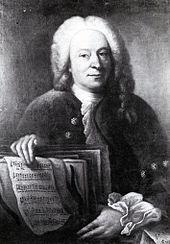
1642 - 1703 Person Name: Johann Christopher Bach, 1642 - 1703 Topics: The Church of God The House of Worship Composer of "ST. LEONARD" in The Hymnary

I. B. Woodbury

1819 - 1858 Person Name: Isaac B. Woodbury Topics: House of God Longed for and Loved Composer of "EDMESTON" in The Psalter Woodbury, Isaac Baker. (Beverly, Massachusetts, October 23, 1819--October 26, 1858, Columbia, South Carolina). Music editor. As a boy, he studied music in nearby Boston, then spent his nineteenth year in further study in London and Paris. He taught for six years in Boston, traveling throughout New England with the Bay State Glee Club. He later lived at Bellow Falls, Vermont, where he organized the New Hampshire and Vermont Musical Association. In 1849 he settled in New York City where he directed the music at the Rutgers Street Church until ill-health caused him to resign in 1851. He became editor of the New York Musical Review and made another trip to Europe in 1852 to collect material for the magazine. in the fall of 1858 his health broke down from overwork and he went south hoping to regain his strength, but died three days after reaching Columbia, South Carolina. He published a number of tune-books, of which the Dulcimer, of New York Collection of Sacred Music, went through a number of editions. His Elements of Musical Composition, 1844, was later issued as the Self-instructor in Musical Composition. He also assisted in the compilation of the Methodist Hymn Book of 1857. --Leonard Ellinwood, DNAH Archives

W. H. Havergal

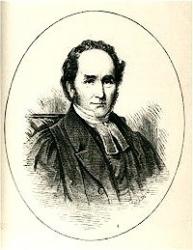
1793 - 1870 Person Name: William Henry Havergal, 1793 - 1870 Topics: The Church of God The House of Worship Composer of "EVAN" in The Hymnary Havergal, William Henry, M.A, son of William Havergal, was born at High Wycombe, Buckinghamshire, 1793, and was educated at St. Edmund's Hall, Oxford (B.A. 1815, M.A. 1819). On taking Holy Orders he became in 1829 Rector of Astley, Worcestershire; in 1842, Rector of St. Nicholas, Worcester; and in 1860, Rector of Shareshill, near Wolverhampton. He was also Hon. Canon in Worcester Cathedral from 1845. He died April 18, 1870. His hymns, about 100 in all, were in many instances written for special services in his own church, and printed as leaflets. Several were included in W. Carus Wilson's Book of General Psalmody, 1840 (2nd ed., 1842); and in Metrical Psalms & Hymns for Singing in Churches, Worcester, Deighton, 1849, commonly known as the Worcester Diocesan Hymn Book, and of which he was the Editor. In Life Echoes, 1883, his hymns are given with those of Miss Havergal. Of those in common use the greater part are in Mercer, and Snepp's Songs of Grace & Glory. Although his hymns are all good, and two or three are excellent, it is not as a hymnwriter but as a musician that Canon Havergal is best known. His musical works and compositions included, in addition to numerous individual hymn tunes and chants, the Gresham Prize Service, 1836; the Gresham Prize Anthem, 1845; Old Church Psalmody, 1849; History of the Old 100th Psalm tune, 1854, &c. He also reprinted Ravenscroft’s Psalter of 1611. His hymns in common use include:— 1. Blessed Jesus, lord and Brother. School Festivals, 1833. Published in Life Echoes, 1883. 2. Brighter than meridian splendour. Christ the glory of His Church. 1830. Published in W. C. Wilson's Book of General Psalms, 1840; the Worcester Psalms & Hymns, 1849, &c. 3. Christians, awake to joy and praise. Christmas Carol, c. 1860. Printed on broadsheet, with music by the author, and sold on behalf of the Lancashire Cotton Distress Fund. 4. Come, Shepherds, come, 'tis just a year. Christmas Carol. 1860. Published in Snepp's Songs of Grace & Glory, 5. For ever and for ever, Lord. Missions, 1866, for the Church Mission Society. Published in Snepp's Songs of Grace & Glory, 1872, and the Life Echoes, 1883. 6. Hallelujah, Lord, our voices. Sunday. 1828. Published in W. C. Wilson's Book of General Psalms, 1840; the Worcester Psalms & Hymns, 1849; Life Echoes, 1883, &c. 7. Heralds of the Lord of glory. Missions. First sung in Astley Church, Sep. 23, 1827. Published in Miss Havergal's Starlight through the Shadows, 1880; Snepp's Songs of Grace & Glory, 1872, &c. 8. Hosanna, raise the pealing hymn. Praise to Christ, 1833, and first sung in Astley Church, June 9, 1833. Published in W. C. Wilson's Book of General Psalmody, 1840; the Worcester Psalms & Hymns, 1849; Life Echoes 1883, &c. 9. How vast the field of souls. Missions. 1858. Printed for Shareshill Church Miss. Anniversary, 1863, and published in Snepp's Songs of Grace & Glory, 1872, and the Life Echoes, 1883. 10. In doubt and dread dismay. Missions. Written in 1837, and published in W. C. Wilson's Book of General Psalmody, 1840; the Worcester Psalms & Hymns, 1849, &c. 11. Jerusalem the golden, The home of saints shall be. Heaven. Published in Life Echoes, 1883. 12. My times are in Thy hand, Their best, &c. 1860. Published in Snepp's Songs of Grace & Glory, 1872, the Records of the author's life and work, and Life Echoes, 1883. The editor of the Records says (p. 159) "this hymn has been much appreciated, and well illustrates the devotional and cheerful spirit of the writer." 13. No dawn of holy light. Sunday. 1825. Printed in 1831 on a leaflet, and published in W. C. Wilson's Book of General Psalmody, 1840; the Worcester Psalms & Hymns, 1849; Life Echoes, 1883, &c. 14. Our faithful God hath sent us. Harvest. Written at Shareshill in 1863, for a Harvest Festival. Published in Snepp's Songs of Grace & Glory 1872, and Life Echoes, 1883. 15. Shout, 0 earth! from silence waking. Praise to Jesus for Redemption. 1841. Published in the Worcester Psalms & Hymns, 1849; Snepp's Songs of Grace & Glory, 1872, &c. 16. So happy all the day. Christmas Carol, c. 1834. Published in Snepp's Songs of Grace & Glory, 1872. 17. Soon the trumpet of salvation. Missions. 1826. Published in Snepp's Songs of Grace & Glory, 1872. 18. To praise our Shepherd's [Saviour's] care. The Good Shepherd. Written after witnessing the death of Elizabeth Edwards, aged 12, of St. Nicholas, Worcester, and printed as a leaflet. Published in W. C. Wilson's Book of General Psalmody, 1840; the Worcester Psalms & Hymns, 1849; Life Echoes, &c, 1883. The author also published a Memoir of the child. 19. Widely 'midst the slumbering nations. Missions. 1828. Published in the Worcester Psalms & Hymns, 1849; Snepp's Songs of Grace & Glory, 1872, &c. In addition to these hymns, his carols, "How grand, and how bright," "Our festal morn is come," and others are annotated under their respective first lines. Most of these carols and hymns were reprinted in Christmas Carols & Sacred Songs, Chiefly by the Rev. W. H. Havergal, London, Nisbet, 1869. --John Julian, Dictionary of Hymnology (1907) ===================== Havergal, W. H., p. 498, i. Other hymns are: — 1. Lord, if judgments now are waking. Second Advent. Published in W. Carus Wilson's Book of General Psalmody, 1840; in Kennedy, 1863, &c. 2. Remember, Lord, Thy word of old displayed. Missions. "Composed for a special prayer-meeting for missionary labourers, held in the author's schoolroom, in the parish of St. Nicholas's, Worcester." (W. F. Stevenson's Hymns for Church and Home, 1873, where the original text is also given.) It must be noted that No. 17, at p. 498, ii., "Soon the trumpet of salvation," was first published in A Collection of Original Airs adapted to Hymns, &c, 1826. --John Julian, Dictionary of Hymnology, Appendix, Part II (1907)

Melchior Vulpius

1570 - 1615 Person Name: Melchior Vulpius, 1560-1616 Topics: The Church of God The House of Worship Composer of "VULPIUS" in The Hymnary Born into a poor family named Fuchs, Melchior Vulpius (b. Wasungen, Henneberg, Germany, c. 1570; d. Weimar, Germany, 1615) had only limited educational oppor­tunities and did not attend the university. He taught Latin in the school in Schleusingen, where he Latinized his surname, and from 1596 until his death served as a Lutheran cantor and teacher in Weimar. A distinguished composer, Vulpius wrote a St. Matthew Passion (1613), nearly two hundred motets in German and Latin, and over four hundred hymn tunes, many of which became popular in Lutheran churches, and some of which introduced the lively Italian balletto rhythms into the German hymn tunes. His music was published in Cantiones Sacrae (1602, 1604), Kirchengesangund Geistliche Lieder (1604, enlarged as Ein schon geistlich Gesanglmch, 1609), and posthumous­ly in Cantionale Sacrum (1646). Bert Polman

St. John of Damascus

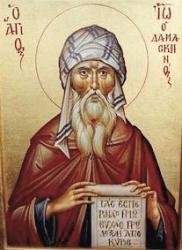
675 - 787 Person Name: John of Damascus Topics: The Church of God The House of Worship Author of "The Day of Resurrection!" in The Hymnary Eighth-century Greek poet John of Damascus (b. Damascus, c. 675; d. St. Sabas, near Jerusalem, c. 754) is especially known for his writing of six canons for the major festivals of the church year. John's father, a Christian, was an important official at the court of the Muslim caliph in Damascus. After his father's death, John assumed that position and lived in wealth and honor. At about the age of forty, however, he became dissatisfied with his life, gave away his possessions, freed his slaves, and entered the monastery of St. Sabas in the desert near Jerusalem. One of the last of the Greek fathers, John became a great theologian in the Eastern church. He defended the church's use of icons, codified the practices of Byzantine chant, and wrote about science, philosophy, and theology. Bert Polman ======================== John of Damascus, St. The last but one of the Fathers of the Greek Church, and the greatest of her poets (Neale). He was of a good family in Damascus, and educated by the elder Cosmas in company with his foster-brother Cosmas the Melodist (q. v.). He held some office under the Caliph. He afterwards retired to the laura of St. Sabas, near Jerusalem, along with his foster-brother. There he composed his theological works and his hymns. He was ordained priest of the church of Jerusalem late in life. He lived to extreme old age, dying on the 4th December, the day on which he is commemorated in the Greek calendar, either in his 84th or 100th year (circa 780). He was called, for some unknown reason, Mansur, by his enemies. His fame as a theologian rests on his work, the first part of which consists of philosophical summaries, the second dealing with heresies, and the third giving an account of the orthodox faith. His three orations in favour of the Icons, from which he obtained the name of Chrysorrhous and The Doctor of Christian Art, are very celebrated. The arrangement of the Octoechusin accordance with the Eight Tones was his work, and it originally contained no other Canons than his. His Canons on the great Festivals are his highest achievements. In addition to his influence on the form and music, Cardinal Pitra attributes to him the doctrinal character of the later Greek hymnody. He calls him the Thomas Aquinas of the East. The great subject round which his hymns are grouped is The Incarnation, developed in the whole earthly career of the Saviour. In the legendary life of the saint the Blessed Virgin Mary is introduced as predicting this work: the hymns of John of Damascus should eclipse the Song of Moses, rival the cherubim, and range all the churches, as maidens beating their tambours, round their mother Jerusalem (Pitra, Hymn. Grecque, p. 33). The legend illustrates not only the dogmatic cast of the hymns, but the introduction of the Theotokion and Staurotheotokion, which becomes the prevalent close of the Odes from the days of St. John of Damascus: the Virgin Mother presides over all. The Canons found under the name of John Arklas (one of which is the Iambic Canon at Pentecost) are usually attributed to St. John of Damascus, and also those under the name of John the Monk. Some doubt, however, attaches to the latter, because they are founded on older rhythmical models which is not the case with those bearing the name of the Damascene, and they are not mentioned in the ancient Greek commentaries on his hymns. One of these is the Iambic Canon for Christmas. His numerous works, both in prose and verse, were published by Le Quien, 1712; and a reprint of the same with additions by Migne, Paris, 1864. Most of his poetical writings are contained in the latter, vol. iii. pp. 817-856, containing those under the title Carmina; and vol. iii. pp. 1364-1408, the Hymni. His Canon of SS. Peter & Paul is in Hymnographie Grecque, by Cardinal Pitra, 1867. They are also found scattered throughout the Service Books of the Greek Church, and include Iambic Canons on the Birth of Christ, the Epiphany, and on Pentecost; Canons on Easter, Ascension, the Transfiguration, the Annunciation, and SS. Peter & Paul: and numerous Idiomela. In addition, Cardinal Mai found a manuscript in the Vatican and published the same in his Spicilegium Romanum, which contained six additional Canons, viz.: In St. Basilium; In St. Chrysostomum; In St. Nicolaum; In St. Petrum; In St. Georgium, and In St. Blasium. But M. Christ has urged grave objections to the ascription of these to St. John of Damascus (Anthologia Graeca Carminum Christorium, p. xlvii.). Daniel's extracts in his Thesaurus Hymnologicus, vol. iii. pp. 80, 97, extend to six pieces. Dr. Neale's translations of portions of these works are well known. [Rev. H. Leigh Bennett, M.A.] -- John Julian, Dictionary of Hymnology (1907)

Henry Carey

1687 - 1743 Person Name: Henry Carey, 1692-1743 Topics: The Church of God The House of Worship Composer of "SURREY" in The Hymnary Henry Carey, b. 1685 (?); d. London, 1743 Evangelical Lutheran Hymnal, 1908

Heinrich Albert

1604 - 1651 Person Name: Heinrich Albert, 1604 - 1651 Topics: The Church of God The House of Worship Composer of "GODESBERG" in The Hymnary Alberti, or Albert, Heinrich, son of Johann Albert, tax collector at Lobenstein, in Voigtland (Reuss), born at Lobenstein, June 28, 1604. After some time spent in the study of law at Leipzig, lie went to Dresden and studied music under his uncle Heinrich Schutz, the Court Capellmeister. He went to Konigsberg in 1626, and was, in 1631, appointed organist of the Cathedral. In 1636 he was enrolled a member of the Poetical Union of Konigsberg, along with Dach, Roberthin, and nine others. He died at Konigsberg, Oct. 6, 1651. His hymns, which exhibit him as of a pious, loving, true, and artistic nature, appeared, with those of the other members of the Union, in his Arien etliche theils geistliche, theils iceltliche zur Andacht, guten Sitten, Keuscher Liebe und Ehrenlust dienende Lieder, pub. separately in 8 pts., 1638-1650, and in a collected form, Konigsberg, 1652, including in all, 118 secular, and 74 sacred pieces. Of the 78 sacred melodies which he composed and published in these 8 pts., 7 came into German common use (Koch, iii. 191-197; Allg. Deutsche Biog., i. 210-212, the latter dating his death, 1655 or 1656). Two of his hymns have been translated into English, viz.: i. Der rauhe Herbst kommt wieder. [Autumn.] 1st pub. as above in pt. viii., 1650, No. 9, in 9 stanzas of 6 lines, entitled "On the happy departure, Sep. 2, 1048, of Anna Katherine, beloved little daughter of Herr Andreas Hollander," of Kneiphof. Included, as No. 731, in the Unverfalschter Leidersegen, 1851, omitting st. iii., viii., ix. The translations are:— (1) "The Autumn is returning," by Miss Manington, 1863, p. 175. (2) "Sad Autumn's moan returneth," in E. Massie's Sacred Odes, vol. ii. 1867, p. 1. ii. Gott des Himmels und der Erden. [Morning.] First pub. as above in pt. v. 1643, No. 4, in 7 stanzas of 6 lines, included as No. 459 in the Unv. L. S., 1851. Of this hymn Dr. Cosack, of Konigsberg (quoted in Koch,viii. 186), says:— "For two hundred years it is hardly likely that a single day has greeted the earth that has not, here and there, in German lands, been met with Alberti's hymn. Hardly another morning hymn can be compared with it, as far as popularity and intrinsic value are concerned, if simplicity and devotion, purity of doctrine and adaptation to all the circumstances of life are to decide." Sts. ii., iii., v. have been special favorites in Germany, st. v. being adopted by children, by brides, by old and young, as a morning prayer. The fine melody (in the Irish Church Hymnal called "Godesberg") is also by Alberti. Translations in common use:— 1. God, the Lord of what's created, in full in J. C. Jacobi's Div. Hymns 1720. p. 35. In his 2nd ed. 1732, p. 169, altered to—" God, the Lord of the Creation " ; and thence slightly altered as No. 478 in part i. of the Moravian Hymn Book, 1754, with a doxology as in the Magdeburg G. B., 1696. In 1789, No. 743, altered to—"God, omnipotent Creator"; with st. ii., iv., vii., omitted; st. iii., viii. being also omitted in the 1801 and later ed. In 1868, st. iii.—v. were included as No. 511 in the Pennsylvania Lutheran Ch. Bk., with st. ii., vi., vii. from A. T. Russell. 2. God, Thou Lord of Earth and Heaven, in full, by H. J. Buckoll in his H. from the German, 1842, p. 22. His translations of st. iv.-vi. beginning—" Now the morn new light is pouring," were included as No. 3 in the Rugby School Hymn Book, 1843 (ed. 1876, No. 4), and of st. v., vi., altered to "Jesus! Lord! our steps be guiding," as No. 130 in Dr. Pagenstecher's Collection, 1864. 3. God, who heaven and earth upholdest. A good tr. omitting st. iv. and based on Jacobi, by A. T. Russell, as No. 64 in the Dalston Hospital Collection, 1848. In his own Psalms & Hymns, 1851, No. 3, the translations of st. vi., vii. were omitted, and this was repeated as No. 218, in the New Zealand Hymnal, 1872. The Pennsylvania Lutheran Church Book takes st. i. partly from Miss Winkworth. 4. God who madest earth and heaven, Father, Son, and Holy Ghost. A good and full tr. by Miss Winkworth in her Lyra Germanica, 1st ser., 1855, p. 213 (later ed., p. 215, slightly altered). In full in R. M. Taylor's Par. Church Hymnal 1872, No. 27. A cento from st. i., 11.1-4; v., 11. 1-4; vi., 11. 1-4; with v., 11. 5, 6; and vii., 11. 5, 6, was included as No. 23 in the Irish Church Hymnal 1873. In 1868, included in L. Rehfuess' Church at Sea, p. 79, altered to—"Creator of earth and heaven." In 1863 it was altered in metre and given as No. 160 in the Chorale Book for England. From this Porter's Church Hymnal 1876, No. 54, omits st. iii. Also in the Ohio Lutheran Hymnal, 1880, No. 293. 5. God who madest earth and heaven. A good translation omitting st. vii., and with st. i., 11. 1-4, from Miss Winkworth, contributed by R. Massie, as No. 501, to the 1857 ed. of Mercer's Church Psalms & Hymns (Ox. ed. 1864, No. 7, omitting st. v.). 6. God of mercy and of might. A good translation (omitting st. v., vi,) by Dr. Kennedy, as No. 811, in his Hymnologia Christiana, 1863, repeated in Dr. Thomas's Aug. Hymn Book 1866, No. 510; and, omitting the translations of st. vii., as No. 31, in Holy Song, 1809. --John Julian, Dictionary of Hymnology (1907)

Pages


Export as CSV
It looks like you are using an ad-blocker. Ad revenue helps keep us running. Please consider white-listing Hymnary.org or getting Hymnary Pro to eliminate ads entirely and help support Hymnary.org.