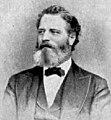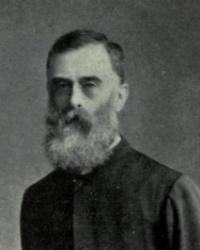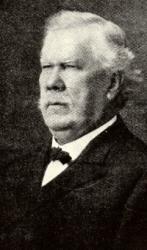
1840 - 1927 Person Name: J. H. K. Topics: Zion, House of God Arranger of "[Glorious things of thee are spoken]" in Fair as the Morning. Hymns and Tunes for Praise in the Sunday-School Kurzenknabe, John Henry. (Muenchhof, Kurhessen, Germany, June 18, 1840--April 13, 1927, Harrisburg, Pennsylvania). German Reformed layman. His parents died of cholera when he was five, and he was placed in a boarding school. When 14, he came to the United States with his violin and his share ($500) of his parents' estate. During the 48-day voyage, he attended an elderly sick woman, a Mrs. Ziegler from Wilkes-Barre, Penn., whose family helped him settled in the States. He attended Wyoming Seminary nearby, where he studied music and perfected his English. Even before graduation, he taught violin and began teaching singing classes in the area. In 1856, William B. Bradbury came to Wilkes-Barre for a six-week musical institute. He was so impressed with Kurzenknabe's talent that he offered him, still only 16 years old, $50 a month and board to accompany him to other institutes as an assistant teacher.
Two years later, Kurzenknabe was teaching a class in Hagerstown, Maryland. At the final concert, one of the soloists became ill and a 14-year-old girl, Susan Shaffer, filled the role so well they eloped to Greencastle, Penn., and were married on November 13, 1859. They had 15 children, moving every few years until 1869 when they settled permanently in Harrisburg. J.H. (as he preferred to be called) tried to enlist in the Union Army during the Civil War, but was rejected because of his flat feet. He became a U.S. citizen on November 2, 1866.
He opened the first piano story in Harrisburg. He continued to teach singing classes, published his many song-books under the imprint J.H. Kurzenknabe & Sons, organized a band and an orchestra, and was an early and active member of the Board of Trade. Long active in the local German Reformed Church, as the city expanded he organized St. John's Sunday School in 1893 which became St. John's Chapel in 1899 at Fourth and Maclay Streets. This has kept growing so that the present church buildings include Kurzenknabe Auditorium.
As president of the Pennsylvania State Music Teachers' Association, he presided over their convention in Harrisburg, December 26-28, 1894. For the occasion, he prepared a concert with 300 voices and orchestra which was conducted by W.W. Gilchrist of Philadelphia. From this grew the Harrisburg Choral Society. That same year, he became the local examiner for the London (England) College of Music.
He wrote the words and/or the music to over 650 hymns. His song-books went through several editions, selling a total of over 300,000 copies.
In 1904, with his daughter Lily he made an extended trip back to his native Germany. On his 50th wedding anniversary, the wedding march was played by six sons and a daughter. His wife died on March 24, 1920, at the age of 75. He followed her at the age of 86.
--Information furnished by great-grandson, John G. Kurzenknabe. Additional essays are available in the DNAH Archives.
===============================
Born: June 18, 1840, Mönchdorf, Kurhessen, Germany.
Buried: East Harrisburg Cemetery, Harrisburg, Pennsylvania.
Kurzenknabe, J. H., music teacher and author, was born in Moenchehof, near Cassel, Curhessen, Germany, Jun 18, 1840. He is a son of John George and Anna Kurzenknabe. He was left an orphan in childhood. He attended the Industrial School at Cassel. When he was fourteen years old he bade farewell to friends and home, September 15, 1854, and set out to seek his fortune in the New World, sailing from Bremerhaven for America on the following day. By mistake he was transferred to a ship on which all were strangers to him, but he was buoyant with hope and free as a bird. During the voyage of forty-nine days, being a very clever violinist, he made friends among the officers and crew and became also a general favorite with the passengers, so that he was the pet of the ship. His especial attention was attracted to an old lady who was sick during the whole voyage. Her children in America had sent money to bring over their old mother. To this helpless woman he ministered in his boyish way as best he could. The forty-nine days' voyage was tempestuous, and minus mast, and storm-beaten, the ship hove in sight of the eagerly looked-for land. On her arrival at New York, the children of the old lady were there to meet her, to whom she told the story of the boy's kindness.
In this family he found a temporary home, and in years to come he was not forgotten by them. Arrangements were made for him to go to a seminary in Pennsylvania, where under Christian training he found a safe shelter and valuable instruction. Having a talent for music he followed this bent, and in that institution of learning he prosecuted his musical studies and made for himself a name as a teacher of the violin and vocal music. He was afterwards placed under the care and instruction of William B. Bradbury, then the most prominent teacher of music in the country. After a thorough course under this master, Mr. Kurzenknabe started on his own responsibility. His first and only attempt to teach singing and a day-school together in a Maryland town was a total failure, but the very next engagement, which was at Sag Harbor, L. I., proved a complete success. After teaching successfully in Baltimore and other Maryland towns, he visited the New England States and taught conventions in a number of important cities. He then returned to Hagerstown, Md., where his lot fell in pleasant places, and here, too, he found the wife to cheer him through his busy life.
He taught successfully in Baltimore, York, Pa., Harrisburg, Philadelphia and New York, and last in Camden, N. J., where the first child, a boy, greeted the parents and cheered their hearts. His next place of residence and teaching was Moorestown, N. J., and the next Philadelphia, where a daughter was born. The war coming on, the New England States seemed safer than Pennsylvania, hence Dedham, Mass., became the next home. Fine classes in Yankee land, war songs and teaching in most of the prominent town brought money to the purse, but sickness claimed the boy for a victim. Repeated and urgent invitations from Maryland friends to make a change, for the boy's sake, induced the Kurzenknabes to disregard the threatening perils of war and journey southward. Antietam and Gettysburg brought the armies of both sides, and the great invasion left the family destitute and helpless, with but five dollars in money and a railroad ticket to Sunbury, Pa., whence the floods drove them back. Mercersburg and study for the ministry were quickly decided upon. But exciting debates of the church involved theological gladiators and their followers, and too free a tongue was not the wisest thing to have in those days of trial. Fairy visions vanished. The advent of twin boys made an increase of income imperative and teaching was the only resource. A house was purchased at McConnelsburg, but sold after an occupancy of two years. Mechanicsburg was home for a short time, and finally Harrisburg became the permanent residence, and a house was purchased which is still home. Teaching for twenty-seven years in many different States, sometimes hundreds of miles from home, always joyous, looking at the bright side of life, active, with plenty of grit, yet with his heart centered where the loved ones stay, earnest, enthusiastic, this is J. H. Kurzenknabe as his friends and scholars know him.
Professor Kurzenknabe is the author and compiler of the following books: "Sweet Silver Echoes," "Music at Sight," "Gospel Trio," "Songs and Glees," "Wreath of Gems," "Song Treasury," "Peerless Praise," "Gates Ajar," "Sowing and Reaping," " Theory of Music," "Fair as the Morning," and "Kindly Light." The sale of "Sowing and Reaping" has rached over 280,000 copies, and over 190,000 copies of "Fair as the Morning" have been sold. "Kindly Light" starts in with 20,000 copies engaged in advance of publication. All of htese books are published by his well-known house of J. H. Kurzenknabe & Sons, Harrisburg, Pa. Mr. Kurzenknabe was married in Greencastle, Pa., November 13, 1859, to Susan Shafer, daughter of George and Frederica Shafer, residents of Hagerstown, Md.
Professor Kurzenknabe is at present a member of Salem Reformed church, which, as elder, he represented for many years at Classis and in the Synod. He belongs to Peace and Plenty Lodge, No. 69, I. O. O. F., Harrisburg Encampment, No. 301, the I. O. of H., and several other organizations. He is often for weeks from home, attending conventions, gospel services and children's gatherings. He eats and sleeps well, is in perfect health, is five feet nine inches in height, turning the scale at two hundred pounds, and knowing nothing by experience of sickness. You will find him a hale-fellow-well-met. May his days of usefulness be many and his talent ever be active in the Master's cause, till the welcome summons, "Well done, thou good and faithful servant," calls him to the rest that awaits the people of God. This sketch is prepared by one of his loyal friends and ardent admirers.
http://maley.net/transcription/sketches/kurzenknabe_j_h
J. H. Kurzenknabe


 My Starred Hymns
 My FlexScores
 My Hymnals
 My Purchased Files