

 My Starred Hymns
 My FlexScores
 My Hymnals
 My Purchased Files
Planning worship?
Check out our sister site, ZeteoSearch.org,
for 20+ additional resources related to your search.
- |
User Links
Person Results
Nicholas Brady
1659 - 1726 Person Name: Nicholas Brady, 1659-1726 Topics: Scriptures Alterer of "As Pants the Hart for Cooling Streams" in Ambassador Hymnal Nicholas Brady, the son of an officer in the Royalist army, was born in Brandon, Ireland, 1659. He studied at Westminster School, and at Christ Church College, oxford, and graduated at Trinity College, Dublin. He held several positions in the ministry, but later in life retired to Richmond Surrey, where he established a school. Here he translated some of the Psalms. Several volumes of his sermons and smaller works were published, but his chief work, like that of his co-colabourer Tate, was the "Metrical Version of Psalms."
This version was authorized by King William in 1696, and has, since that time, taken the place of the earlier translation by Sternhold and Hopkins, which was published in 1562. The whole of the Psalms, with tunes, appeared in 1698, and a Supplement of Church Hymns in 1703. Of this version, which has little poetic merit, Montgomery says "It is nearly as inanimate as the former, though a little more refined." None of the "Metrical Psalms" are to be compared with the Psalms of the Prayer Book Psalter, and very few of them are worthy a place in a collection of hymns.
--Annotations of the Hymnal, Charles Hutchins, 1872.
Nicholas Brady
John Burton
1773 - 1822 Person Name: John Burton, 1773-1822 Topics: The Holy Scriptures; Holy Scripture; Holy Scripture Author of "Holy Bible, Book Divine" in African Methodist Episcopal Church Hymnal Burton, John, born 1773, in Nottingham, where he resided until 1813, when he removed to Leicester, at which town he died in 1822. He was a Baptist, a very earnest Sunday School teacher, and one of the compilers of the Nottingham Sunday School Union Hymn Book, 1812. This book reached the 20th edition in 1861. The 1st edition contains 43 hymns which have his signature. He is known almost exclusively by one hymn, "Holy Bible, book divine" (q.v.). He was also author of The Youth's Monitor, and other similar productions for the young. Robert Hall wrote a recommendatory preface to one of his works. [Rev. W. R. Stevenson, M. A.]
-- John Julian, Dictionary of Hymnology (1907)
John Burton
Julia Ward Howe
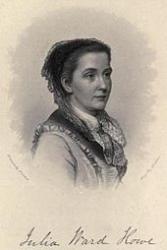
1819 - 1910 Topics: Service Music Scripture Acclamations Author of "The Battle Hymn of the Republic" in The United Methodist Hymnal Born: May 27, 1819, New York City.
Died: October 17, 1910, Middletown, Rhode Island.
Buried: Mount Auburn Cemetery, Cambridge, Massachusetts.
Howe, Julia, née Ward, born in New York City in 1819, and married in 1843 the American philanthropist S. G. Howe. She has taken great interest in political matters, and is well known through her prose and poetical works. Of the latter there are Passion Flower, 1854; Words of the Hour, 1856; Later Lyrics, 1866; and From Sunset Ridge, 1896. Her Battle Hymn of the Republic, "eyes have seen the glory of the coming of the Lord," was written in 1861 at the outbreak of the Civil War, and was called forth by the sight of troops for the seat of war, and published in her Later Lyrics, 1806, p. 41. It is found in several American collections, including The Pilgrim Hymnal, 1904, and others. [M. C. Hazard, Ph.D.]
--John Julian, Dictionary of Hymnology, New Supplement (1907)
============================
Howe, Julia Ward. (New York, New York, May 27, 1819--October 17, 1910). Married Samuel Gridley Howe on April 26, 1843. She was a woman with a distinguished personality and intellect; an abolitionist and active in social reforms; author of several book in prose and verse. The latter include Passion Flower, 1854; Words of the Hours, 1856; Later Lyrics, 1866; and From a Sunset Ridge, 1896.
She became famous as the author of the poem entitled "Battle Hymn of the Republic," which, in spite of its title, was written as a patriotic song and not as a hymn for use in public worship, but which has been included in many American hymn books. It was written on November 19, 1861, while she and her husband, accompanied by their pastor, Rev. James Freeman Clarke, minister of the (Unitarian) Church of the Disciples, Boston, were visiting Washington soon after the outbreak of the Civil War. She had seen the troops gathered there and had heard them singing "John Brown's body lies a-mouldering in the grave" to a popular tune called "Glory, Hallelujah" composed a few years earlier by William Steffe of Charleston, South Carolina, for Sunday School use. Dr. Clarke asked Julie Howe if she could not write more uplifting words for the tune and as she woke early the next morning she found the verses forming in her mind as fast as she could write them down, so completely that later she re-wrote only a line or two in the last stanza and changed only four words in other stanzas. She sent the poem to The Atlantic Monthly, which paid her $4 and published it in its issue for February, 1862. It attracted little attention until it caught the eye of Chaplain C. C. McCable (later a Methodist bishop) who had a fine singing voice and who taught it first to the 122nd Ohio Volunteer Infantry regiment to which he was attached, then to other troops, and to prisoners in Libby Prison after he was made a prisoner of war. Thereafter it quickly came into use throughout the North as an expression of the patriotic emotion of the period.
--Henry Wilder Foote, DNAH Archives
Julia Ward Howe
John Rippon
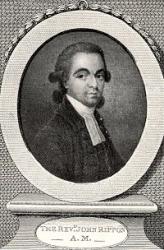
1751 - 1836 Person Name: John Rippon, 1751-1836 Topics: Scripture Author of "How Firm a Foundation" in Common Praise (1998) Rippon, John, D.D., was born at Tiverton, Devon, April 29, 1751, and was educated for the ministry at the Baptist College, Bristol. In 1773 he became Pastor of the Baptist church in Carter Lane, Tooley Street (afterwards removed to New Park Street), London, and over this church he continued to preside until his death, on Dec. 17, 1836. The degree of D.D. was conferred on him in 1792 by the Baptist College, Providence, Rhode Island. Dr. Rippon was one of the most popular and influential Dissenting ministers of his time. From 1790 to 1802 he issued the Baptist Annual Register, a periodical containing an account of the most important events in the history of the Baptist Denomination in Great Britain and America during that period, and very valuable now as a book of reference. But his most famous work is his Selection of hymns for public worship, which appeared in 1787. The full title of the first edition is A selection of Hymns from the best authors, intended as an Appendix to Dr. Watts's Psalms and Hymns. In 1791 he published a Selection of Psalm and Hymn Tunes from the Best Authors, adapted to Dr. Watts's Psalms and Hymns, and to his own Selection, and from that time the names of tunes were prefixed to the hymns in the successive editions of his hymn-book. In 1800 he published the 10th ed. of his Selections, containing more than sixty additional hymns.
In 1827 it was still further enlarged, and in 1844, after his death, appeared The Comprehensive Edition, commonly known as The Comprehensive Rippon, containing most of the additional hymns, with about 400 then first added, making in all upwards of 1170, in 100 metres. A rival to the Comprehensive was also afterwards published under the old title, somewhat enlarged. In the preparation of the original book, and its subsequent improvement, Dr. Rippon performed an important service to Baptist Hymnody, and also, it is said, gained for himself "an estate" through its immense sale. In the preface to the tenth edition lie claims for himself the authorship of some of the hymns, but as he refrained from affixing his name to any of the hymns it is impossible now to say with certainty which ought to be ascribed to him. There can, however, be no reasonable doubt that hymn 535, 3rd part, "The day has dawned, Jehovah comes" (q.v.), is one of his compositions. Other hymns, probably by him, are, "Amid the splendours of Thy state" (Love of God), 1800; and "There is joy in heaven, and joy on earth" (Joy over the Repenting Sinner), 1787. He also altered the texts of and made additions to several of the older hymns. Some of these altered texts are still in common use. In 1830 the additions given in the 27th ed., 1827, of Rippon's Selections were reprinted, with notes by Dr. Slater, as:—
Hymns Original and Selected; interspersed in the Twenty-seventh edition of the Selection, with Numerous Doxologies, in the Usual, the Peculiar, and in the less Common metres. By John Rippon, D.D.
A second edition of this pamphlet of 82 hymns and doxologies appeared in 1832. [Rev. W. R. Stevenson, M.A.]
--John Julian, Dictionary of Hymnology (1907)
John Rippon
George F. Root
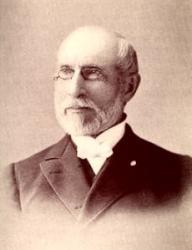
1820 - 1895 Topics: Choruses Scripture and Praise Composer of "CHILDREN" in The Hymnal for Worship and Celebration Root, George F., MUS. DOC, born in Sheffield, Berkshire County, Mass., Aug. 30, 1820. He is much more widely known as a composer of popular music than as a hymn writer. Four of his hymns are in I. D. Sankey's Sacred Songs & Solos, 1878. Nos. 16, 100, 293, and 297. A sympathetic biographical sketch, with portrait, is in The Tonic Sol-Fa Reporter, Sep. 1886. He died Aug. 6, 1895.
--John Julian, Dictionary of Hymnology, Appendix, Part II (1907)
=====================
George Frederick Root was born in Sheffield, Mass., August 30, 1820. His father moved to North Reading, near Boston, when the boy was six years old, and there his youth was spent.
He was always fond of music— not singing at all as a boy, but played upon every kind of instrument that came in his way. At thirteen it was his pride that he could "play a tune" on as many instruments as he was years old. His dream of life was to be a musician, although such an ambition was looked down upon by all his relatives and friends, excepting a fond mother. In the fall of 1838 he went to Boston and made an engagement to work for Mr. A. N. Johnson and take lessons on the piano.
His father and one of the brothers were at the time in South America, and the mother, with six younger children, was at home on the farm. When he secured the engagement with Mr. Johnson to receive three dollars a week and board and lessons, the neighbors became interested and encouraged him to go ahead, they promising to help look after the farm and see that the family got along. The young man's happiness over these events can better be imagined than described.
On the second day of October, 1838, he entered upon his duties in his new heaven on earth located at Harmony Hall, Mr. Johnson's music-room, in Boston. His duties were to see to the fires, care for the room, answer callers, give information about Mr. Johnson when he was out, and practice his lessons when not otherwise engaged. He worked industriously and made steady progress. It was but a few weeks till Mr. Johnson had him playing for the prayer-meeting, and but a few more till he began turning over pupils to him. In about seven weeks' time Mr. Johnson encouraged him by a considerable increase of salary. A most important event to him was meeting Dr. Lowell Mason and being accepted as a bass singer in the celebrated Bowdoin Street choir. Also, on Mr. Johnson's recommendation, he began taking private voice lessons of Mr. Geo. Jas. Webb, the then celebrated voice teacher of Boston. He continued at least a year with Mr. Webb.
His first real singing class was taught the following fall, 1839, at the North End. It lasted nearly through the winter, and on the closing night his class made him a present of a silver goblet, suitably engraved, which he kept among his treasures.
Before the first year was up Mr. Johnson proposed a five year partnership, by which Mr. Root was to receive one-third of their earnings, and the former was to have the privilege of visiting Germany part of the time if he chose. They then changed their quarters to three rooms in the basement of Park Street Church. The annual rental was six hundred dollars. They were kept quite busy.
At this time Dr. Mason's music teaching in the public schools was a growing success, and Messrs. Johnson and Root were employed to assist him. Drs. Mason and Webb had introduced what is now called Musical Conventions a year or two previous to this. They called them "The Teachers' Class." Teachers and singers were called to Boston from surrounding territory to study and practice pretty much as they do now at normals.
In 1841 Mr. Root became one of the teachers in this class. He taught vocal training and continued this work for years afterward in Dr. Mason's teachers' classes, and later incorporated the same method in his own normals. During this year Mr. Johnson went to Germany, and left the two large church choirs (Winter Street and Park Street) in charge of Mr. Root. One of the organs was played by a pupil — Mr. S. A. Bancroft.
Everything went smoothly during Mr. Johnson's absence as it did also after his return. During the last year of the five-year partnership, Mr. Root was called to take the organ at Bowdoin Street, Mr. Mason changing to Winter Street. An amicable settlement was made between Messrs. Johnson and Root, and the partnership dissolved.
In 1811, Mr. Jacob Abbott (father of Lyman Abbott)and his three brothers had established a young ladies' school in New York City. They wanted a music teacher, and offered the position to Mr. Root. They also secured him the organ and choir of the Mercer Street Church, with prospects for other good work. It required pretty strong persuasive arguments to tempt Mr. Root to leave Boston, he was doing well there, and as the sequel shows, there was an attraction in Boston that held him in too tight a grasp to be relinquished by the mere offer of greater power and place. He made up his mind, however, only after getting the consent of the powders of Boston to take with him this [to him] the greatest attraction of the city — Miss Mary Olive Woodman — an accomplished lady, a sweet singer, and a member of a prominent family of musicians. He went to New York first to prepare a home, and in August, 1845, returned for his bride, who took her place in his New York choir as leading soprano, and through his long and eventful career she was ever at his side, a true helpmeet.
He was soon employed at Rutger's Female Institute, Miss Haines' School for Young Ladies, Union Theological Seminary and the New York State Institution for the Blind. Within six weeks after he arrived in New York his time was fully occupied. He continued with Mr. Abbott's young ladies' school ten years.
While teaching in New York he continued his summer work with Messrs. Mason and Webb in Teachers' Classes. Up to the year 1849 he had written but little music; only a few hymn tunes while in Boston. He needed more music for the young ladies of his schools, so he made his first book, The Young Ladies' Choir, of which he had enough copies made for his own use, as he had no thought of offering it to the public. Then in connection with Mr. J. E. Sweetser, they compiled the Root and Sweetser's Collection.
Mr. Root did work enough for two men, hence broke down in health. Mr. Abbott suggested that he take a trip to Paris. After weighing the matter carefully, in December, 1853, he sailed, and in due time arrived at Paris, where he began studying French, voice culture and piano under celebrated teachers. After spending nearly a year abroad, he returned home in improved health and ready for active work. He began to feel the need of new music for his classes, and after some thought decided upon a musical play ; the subject and title, The Flower Queen.
At the Institution for the Blind was a young lady, a former pupil, but now a teacher who had shown some poetical talent. He asked her to help him with the words. He would suggest in prose what the flowers might say and she would put it into rhyme. She did it so well that it seldom needed any alteration. This lady was the now famous Fanny Crosby. The cantata became very popular. About this time Mr. Root wrote a half dozen simple songs for the people. They all sold pretty well, but Hazel Dell and Rosalie, the Prairie Flower, became the most popular, and had a large sale.
It was in the summer of 1853 that the first real normal was held. Mr. Root originated it, and held it in New York. The principal teachers were Messrs. Mason, Root, Hastings, and Bradbury. This school became famous. Sessions were also held at North Reading, Mass., a village near Mr. Root's "Willow Farm Home," with Dr. Mason, Mr. Webb, Mr. Bradbury and himself as principal teachers.
About this time Mr. Root decided to give up his work in New York, and devote himself entirely to conventions, normal work and authorship. He was eminently successful. Among the most eminent teachers and composers of our country have been students in Dr. Geo. F. Root's Normal Musical Institute.
In 1860 Dr. Root settled in Chicago and entered the music publishing business with his brother E. T. Root, and C. M. Cady, as "Root & Cady," Mr. Root's reputation being the most important capital of the firm. His books and popular songs soon made the new firm prosperous. Then came the war with its horror. Dr. Root wielded his musical sword in the way of writing war songs, which made him famous. The Battle Cry of Freedom, Just Before the Battle, Mother, and others, made thousands of dollars for the music house.
In the great Chicago fire of 1871 the interests of the firm of Root & Cady became engulfed in the general ruin. Their loss was upward of a quarter of a million dollars. They then sold their book catalogue, plates and copyrights to John Church & Co., of Cincinnati, and the sheet music plates and copyrights to S. Brainard's Sons, Cleveland. These sales realized about §130,000. The final result was that Dr. Root, his talented son F. W., and others became connected with John Church & Co. Under this new business relationship Mr. Root went right on with his normal and convention work; also issued a great many new books and cantatas. In 1872 the Chicago University very worthily conferred upon him the degree Doctor of Music.
In 1886 he made a trip to Scotland and England, and arranged with publishers to issue some of his cantatas. He was royally received.
Dr. Root was the author of about seventy-five books, nearly two hundred songs in sheet form, and many popular gospel songs. Dr. Root occupies a prominent place in the musical history of this country. It was Dr. Mason who lifted music from almost nothing and gave it an impetus, but he left no better follower than Dr. Root to carry on his work. He was a man of spotless integrity and high Christian character, and to know him was to love him.
At the time of Dr. Root's death he was at Bailey Island, Maine, a summer resort, where he and other relatives had cottages. On August 6, 1895, he was seized with neuralgia of the heart — and died within one hour. He was buried at North Reading, Mass., his old home.
--Hall, J. H. (c1914). Biographies of Gospel Song and Hymn Writers. New York: Fleming H. Revell Company.
George F. Root
Michael Schirmer
1606 - 1673 Person Name: Michael Schirmer, 1606-73 Topics: Scriptures Author of "O Holy Spirit, Enter In" in Lutheran Worship Schirmer, Michael, son of Michael Schirmer, inspector of wine casks at Leipzig, was born at Leipzig, apparently, in July, 1606, his baptism being entered as on July 18, in the registers of St. Thomas's Church there. He matriculated at the University of Leipzig, at Easter, 1619, and graduated M.A. in 1630. In 1636 he was appointed subrector, and in 1651 conrector of the Greyfriars Gymnasium at Berlin. During his conrectorship the rectorship fell vacant several times, and each time, after he had officiated as prorector during the vacancy, a younger man than he was set over him (probably on account of Schirmer's feeble health) till, last of all, in May, 1668, the sub-rector was promoted over his head. In the same year Schirmer retired from office. The remainder of his life he spent in Berlin, where he published, in the end of 1668, a version of the Aeneid in German Alexandrine verse, wrote various occasional poems, &c. He died at Berlin, apparently on May 4, and was certainly buried there, in the churchyard of the Kloster Kirche, on May 8, 1673….
Schirmer had many domestic and personal afflictions to bear. His wife and his two children predeceased him. The early part of his life in Berlin was spent amid the distress caused by the Thirty Years War, during which Brandenburg, and Berlin itself, suffered greatly from pestilence and poverty. In 1644 a deep melancholy fell upon him, which lasted for five years; and something of the same kind seems to have returned to him for a time, after his wife's death, in Feb. 1667. Schirmer was crowned as a poet in 1637. His earlier productions were mostly occasional pieces in German and Latin. In 1655 he published, at Berlin, a metrical version of Ecclesiasticus as, Das Buch Jesus Sirach, &c.; and in 1660, also at Berlin, a Scriptural play, which was acted by the scholars of the Gymnasium, and was entitled Der verfolgte David, &c. He also published, at Berlin, in 1650, versions of the Songs of the Old and New Testament as, Biblische Lieder und Lehrsprüche. The only compositions by him which have come into use as hymns, are those which he contributed to J. Crüger's Newes vollkömliches Gesang-Buch, Berlin, 1640; and to Crüger's Praxis pietatis melica, Berlin, 1648, &c. These, have in all, passed into many German hymnbooks of the 17th century, and most of them are still in use. They were reprinted by Dr. Bachmann …together with various selections irom his other poetical compositions. They are practical, clear, objective, churchly hymns, somewhat related to those of Gerhardt; and still more closely to those of Johann Heermann, from whom indeed Schirmer borrows a few expressions.
The only hymn by Schirmer which has passed into English is:—
0 heilger Geist, kehr bei uns ein. Whitsuntide. First published, 1640, as above, No. 75, in 7 stanzas of 10 lines, entitled, "Another short hymn for Whitsuntide, M. Michael Schirmers." …
Translated as:—
1. 0 Holy Ghost, desoend, we pray. This is a somewhat free translation of st. i., v., ii., iii., by W. M. Reynolds, as No. 794, in the American Lutheran Gen. Synod's Collection, 1850; and is repeated, with translations of st. iv., vi., vii., added, as No. 103, in the Ohio Lutheran Hymnal, 1880.
2. 0 Holy Spirit, enter in. This is a good translation, omitting st. ii., iv., by Miss Winkworth, in her Chorale Book for England, 1863, No. 70. It was repeated, as No. 249, in the Pennsylvania Luth. Church Book, 1868. In Dr. Thomas's Augustine Hymn Book, 1866, it is Nos. 480, 481; No. 481 beginning, "O mighty Rock, O source of Life," which is the tr. of st. v. [Rev. James Mearns, M.A.]
--Excerpts from John Julian, Dictionary of Hymnology (1907)
Michael Schirmer
Richard Redhead
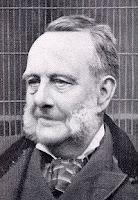
1820 - 1901 Topics: Holy Scriptures; Scriptures Composer of "REDHEAD NO. 76" in Great Songs of the Church (Revised) Richard Redhead (b. Harrow, Middlesex, England, 1820; d. Hellingley, Sussex, England, 1901) was a chorister at Magdalen College, Oxford. At age nineteen he was invited to become organist at Margaret Chapel (later All Saints Church), London. Greatly influencing the musical tradition of the church, he remained in that position for twenty-five years as organist and an excellent trainer of the boys' choirs. Redhead and the church's rector, Frederick Oakeley, were strongly committed to the Oxford Movement, which favored the introduction of Roman elements into Anglican worship. Together they produced the first Anglican plainsong psalter, Laudes Diurnae (1843). Redhead spent the latter part of his career as organist at St. Mary Magdalene Church in Paddington (1864-1894).
Bert Polman
Richard Redhead
John Fawcett
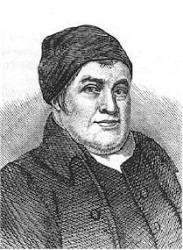
1740 - 1817 Topics: Holy Scriptures; Inspiration of Scriptures; Scriptures, The Holy Author of "How precious is the book divine" in The Hymnal An orphan at the age of twelve, John Fawcett (b. Lidget Green, Yorkshire, England, 1740; d. Hebden Bridge, Yorkshire, 1817) became apprenticed to a tailor and was largely self-educated. He was converted by the preaching of George Whitefield at the age of sixteen and began preaching soon thereafter. In 1765 Fawcett was called to a small, poor, Baptist country church in Wainsgate, Yorkshire. Seven years later he received a call from the large and influential Carter's Lane Church in London, England. Fawcett accepted the call and preached his farewell sermon. The day of departure came, and his family's belongings were loaded on carts, but the distraught congregation begged him to stay. In Singers and Songs of the Church (1869), Josiah Miller tells the story associated with this text:
This favorite hymn is said to have been written in 1772, to commemorate the determination of its author to remain with his attached people at Wainsgate. The farewell sermon was preached, the wagons were loaded, when love and tears prevailed, and Dr. Fawcett sacrificed the attraction of a London pulpit to the affection of his poor but devoted flock.
Fawcett continued to serve in Wainsgate and in the nearby village of Hebden Bridge for the remainder of his active ministry.
Bert Polman
===============
Fawcett, John, D.D., was born Jan. 6, 1739 or 1740, at Lidget Green, near Bradford, Yorks. Converted at the age of sixteen under the ministry of G. Whitefield, he at first joined the Methodists, but three years later united with the Baptist Church at Bradford. Having begun to preach he was, in 1765, ordained Baptist minister at Wainsgate, near Hebden Bridge, Yorks. In 1772 he was invited to London, to succeed the celebrated Dr. J. Gill, as pastor of Carter's Lane; the invitation had been formally accepted, the farewell sermon at Wainsgate had been preached and the wagons loaded with his goods for removal, when the love and tears of his attached people prevailed and he decided to remain. In 1777 a new chapel was built for him at Hebden Bridge, and about the same time he opened a school at Brearley Hall, his place of residence. In 1793 he was invited to become President of the Baptist Academy at Bristol, but declined. In 1811 he received from America the degree of D.D., and died in 1817, at the age of 78. Dr. Fawcett was the author of a number of prose works on Practical Religion, several of which attained a large circulation. His poetical publications are:—
(1) Poetic Essays, 1767; (2) The Christian's Humble Plea, a Poem, in answer to Dr. Priestley against the Divinity of our Lord Jesus Christ, 1772; (3) Three hymns, in the Gospel Magazine, 1777; (4) The Death of Eumenio, a Divine Poem, 1779; (5) Another poem, suggested by the decease of a friend, The Reign of Death, 1780; and (6) Hymns adapted to the circumstances of Public Worship and Private Devotion, Leeds, G. Wright & Son. 1782. They are 166 in number, and were mostly composed to be sung after sermons by the author.
Whilst not attaining a high degree of excellence as poetry, they are "eminently spiritual and practical," and a number of them are found in all the Baptist and Congregational hymn-books that have appeared during the last 100 years. The best known of these are, “Infinite excellence is Thine;" "How precious is the Book divine;" "Thus far my God hath led me on;" "Religion is the chief concern;" "Blest be the tie that binds;" “I my Ebenezer raise;" and "Praise to Thee, Thou great Creator." These hymns, together with others by Fawcett, are annotated under their respective first lines. [Rev. W. R. Stevenson, M.A.]
In addition the following hymns, also by Fawcett, but of less importance, are in common use:
1. Behold the sin-atoning Lamb. Passiontide. No. 60 of his Hymns, 1782, in 7 stanzas of 4 lines. In several hymnals in Great Britain and America.
2. I my Ebenezer raise. Birthday. No. 102 of his Hymns, in 10 stanzas of 4 lines. Usually given in an abbreviated form.
3. Infinite excellence is Thine. Jesus the Desire of Nations. No. 42 of his Hymns, in 12 stanzas of 4 lines. In several hymn-books in Great Britain and America in an abridged form.
4. Jesus, the heavenly Lover, gave. Redemption in Christ. No. 10 of his Hymns, &c., 1782, in 7 stanzas of 4 lines, and headed, "The marriage between Christ and the Soul." In Snepp's Songs of Grace & Glory, 1872, it reads, “Jesus, the heavenly Bridegroom, gave," and stanza v. is omitted.
5. Lord, hast Thou made me know Thy ways? Perseverance. No. 122 of his Hymns, &c., 1782, in 8 stanza of 4 lines. In the Baptist Hymnal, 1879, No. 451, stanzas iv.-vii. are omitted.
6. 0 God, my Helper, ever near. New Year. No. 108 of his Hymns, &c., 1782, in 6 stanzas of 4 lines. The New Congregational Hymn Book, 1859-69 omits st. vi.
7. 0, my soul, what means this sadness? Sorrow turned to Joy. No. 111 of his Hymns, &c., 1782, in 5 stanzas of 6 lines, and based upon the words, "Why art Thou cast down, O my soul?" &c. It is in common use in America, and usually with the omission of stanza ii. as in Dr. Hatfield's Church Hymn Book, 1872.
8. Sinners, the voice of God regard. Invitation to Repentance. No. 63 of his Hymns, &c., 1782, in 7 stanzas of 4 lines on Isaiah lv. 7, "Let the wicked forsake his way," &c. It is in common use in America, but usually in an abbreviated form.
9. Thy presence, gracious God, afford. Before Sermon. No 165 in his Hymns, &c., in 4 stanzas of 4 lines, and a chorus of two lines. In Dr. Hatfield's Church Hymnbook, 1872, No. 126, the chorus is omitted. Fawcett has another hymn on the same subject (No. 79) and beginning, "Thy blessing, gracious God, afford," but this is not in common use.
10. Thy way, 0 God, is in the sea. Imperfect Knowledge of God. No. 66 in his Hymns, &c., 1782, in 7 stanzas of 4 lines on 1 Corinthians xiii. 9, "We know in part," &c. It is in several American collections, usually abbreviated, and sometimes as, "Thy way, O Lord, is in the sea." In this form it is in The Sabbath Hymn Book, 1858, &c.
11. With humble heart and tongue. Prayer for Guidance in Youth. No. 86 in his Hymns, &c., 1782, in 7 stanzas of 4 lines on Psalms cxix. 9. "Wherewith shall a young man cleanse his way." It is No. 954 in the Baptist Psalms and Hymns, 1858-80.
About 20 of Fawcett's hymns are thus still in common use. Two hymns which have been ascribed to him from time to time, but concerning which there are some doubts, are fully annotated under their respective first lines. These are," Humble souls that seek salvation," and "Lord, dismiss us with Thy blessing."
-- John Julian, Dictionary of Hymnology (1907)
John Fawcett
Christina Georgina Rossetti
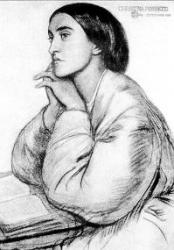
1830 - 1894 Topics: liturgical Scripture Songs Author of "In the Bleak Midwinter" Rossetti, Christina Georgina, daughter of Gabriel, and sister of Dante Gabriel and William Michael Rossetti, was born in London, Dec. 5, 1830, and received her education at home. Her published works include:—
(1) Goblin Market, and Other Poems, 1862; (2) The Prince's Progress, and Other Poems, 1866 ; (3) Poems, mainly a reprint of Nos. 1 and 2, 1875; (4) A Pageant, and Other Poems, 1881, &c.
In addition, Miss Rossetti has published several prose works, as:— Annus Domini (a book of prayers for every day in the year), 1874; Letter and Spirit of the Decalogue, 1883, and others. She has written very few hymns avowedly for church worship, but several centos have been compiled from her poems, and have passed into several hymn-books. These include:—
1. Dead is thy daughter, trouble not the Master. The raising of Jairus's daughter. From her Goblin Market, &c, 1862, into Lyra Mystica, 1865.
2. God the Father, give us grace. Invocation of the Holy Trinity. From Lyra Mystica into the Savoy Hymnary, for use in the Chapel Koyai, Savoy (see No. 8 below).
3. I bore with thee long weary days and nights. The Love of Christ. From her Goblin Market, &c, 1862, into Lyra Messianica, 1864.
4. I would have gone, God bade me stay. Resignation. From her Poems, Hymns, 1884, &c. 1875, into Horder's Congregational Hymns.
5. Once I thought to sit so high. A Body hast Thou prepared Me, or Passiontide. Contributed to Lyra Eucharistica, 1863.
6. The Advent moon shines cold and clear. Advent. From her Goblin Market, &c, 1862.
7 The flowers that bloom in sun and shade. The Eternity of God. In Mrs. C. Brock's Children's Hymn Book, 1881.
8. What are these that glow from afar? Martyrs. Part of the poem "We meet in joy though we part in sorrow," which appeared in Lyra Mystica, 1865, and then in Miss Rossetti's Prince's Progress, &c, 1866. It is the most widely used of her hymns. No. 2 above is also from the same poem.
Miss Rossetti's verses are profoundly suggestive and lyrical, and deserve a larger place than they occupy in the hymnody of the church. Her sonnets are amongst the finest in the English language. [Rev.W. Garrett Horder]
--John Julian, Dictionary of Hymnology (1907)
==============
Rossetti, Christina G., p. 978, i. The following hymns by Miss Rossetti have recently come into common use:—
1. A burdened heart that bleeds and bears. [Lent.] In her Time Flies: A Reading Diary, ed. 1897, p. 59, for March 26; and her Verses, &c., ed. 1898, p. 113. Included in Church Hymns, 1903.
2. Give me the lowest place, not that I dare. [Humility.] From her Prince's Progress, 1866, p. 216.
3. In the bleak midwinter. [Christmas.] In her Poetical Works, 1904, p. 246, as "Before 1872"; repeated in The English Hymnal, 1906.
4. None other Lamb, none other Name. [Jesus, All, and in All] From her The Face of the Deep, &c, 1892 (3rd ed. 1895, p. 176); and her Verses, &c, 1898, p. 36. It is the second of two poetical meditations on Rev. v. 6. In Church Hymns, 1903.
5. The shepherds had an angel. [Christmas.] In her Poetical Works, 1904, p. 187, this is entitled "A Christmas Carol. For my Godchildren," and dated 6 October, 1856. Repeated in the Sunday School Hymnary, 1905.
6. We know not a voice of that River. [The River of the Eternal City.] In The Face of the Deep, &c, 1892 (3rd ed. 1895, p. 523), as a poetical meditation on Rev, xxii. Also in her Verses, &c., 1898, p. 81.
Additional works by Miss Rossetti to those named on p. 978, i., include Time Flies A Reading Diary, 1885; Called to be Saints, 1881; Seek and Find, 1879; The Face of the Deep, A Devotional Commentary on the Apocalypse, 1892; and Verses ... reprinted fromCalled to be Saints, Time Flies, The Face of the Deep, 1893. It must be noted that (1) the hymn attributed to her, "Dead is thy daughter; trouble not the Master," is not by her, but by Mrs. C. F. Alexander, with whose name it appeared in Lyra Mystica, 1865; and (2) her “I would be gone; God bade me stay," is from her Prince's Progress, 1866, p. 204. Miss Rossetti d. Dec. 29, 1891.
--John Julian, Dictionary of Hymnology, New Supplement (1907)
Christina Georgina Rossetti
Kathrina von Schlegel
1697 - 1777 Person Name: Catharina A. von Schlegel Topics: Scripture Songs; Scripture Songs; Scripture Songs; Scripture Songs; Scripture Songs; Scripture Songs; Scripture Songs; Scripture Songs; Scripture Songs; Scripture Songs; Scripture Songs; Scripture Songs; Scripture Songs; Scripture Songs Author of "The Final Sentence" Schlegel, Catharina Amalia Dorothea von. Little is known of this lady. According to Koch, iv., p. 442, she was born Oct. 22, 1697, and was "Stiftsfräulein" in the Evangelical Lutheran Stift (i.e. Protestant nunnery) at Cöthen. On applying to Cöthen, however, her name did not occur in the books of the Stift; and from the correspondence which she carried on, in 1750-52, with Heinrich Ernst, Count Stolberg, it would rather seem that she was a lady attached to the little ducal court at Cöthen. (manuscript from Dr. Eduard Jacobs, Wernigerode, &c.) Further details of her life it has been impossible to obtain.
The only one of her hymns which has passed into English is:—
Stille, mein Wille, dein Jesus hilft siegen. Cross and Consolation. A fine hymn on waiting for God. It appeared in 1752, as above, No. 689, in 6 stanzas of 6 lines; and is included in Knapp's Evangelischer Lieder-Schatz, 1837, No. 2249 (1865, No. 2017). The translation in common "Be still my soul!—-the Lord is on thy side." This is a good translation, omitting stanzas iii., by Miss Borthwick, in Hymns from the Land of Luther, 2nd Ser., 1855, p. 37 (1884, p. 100). [Rev. James Mearns, M.A.]
--Excerpts from John Julian, Dictionary of Hymnology (1907)
==========
For a detailed biography of Schlegel, see James R. Eggert, “Catharina von Schlegel and Be Still, My Soul,” Logia, vol. 34, no. 2 (Eastertide 2025), pp. 37–44.
Kathrina von Schlegel
Pages




