You help make Hymnary.org possible. More than 10 million people from 200+ countries found hymns, liturgical resources and encouragement on Hymnary.org in 2025, including you. Every visit affirms the global impact of this ministry.

If Hymnary has been meaningful to you this year, would you take a moment today to help sustain it? A gift of any size—paired with a note of encouragement if you wish—directly supports the server costs, research work and curation that keep this resource freely available to the world.

Give securely online today, or mail a check to:
Hymnary.org
Calvin University
3201 Burton Street SE
Grand Rapids, MI 49546

Thank you for your partnership, and may the hope of Advent fill your heart.

Person Results

Topics:proper+5
In:people

Planning worship? Check out our sister site, ZeteoSearch.org, for 20+ additional resources related to your search.
Showing 151 - 160 of 357Results Per Page: 102050

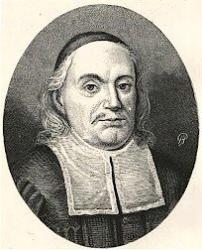
Paul Gerhardt

1607 - 1676 Topics: Proper 5 Year C Author of "Give to the Winds Your Fears" in Voices United Paul Gerhardt (b. Gräfenheinichen, Saxony, Germany, 1607; d. Lubben, Germany, 1676), famous author of Lutheran evangelical hymns, studied theology and hymnody at the University of Wittenberg and then was a tutor in Berlin, where he became friends with Johann Crüger. He served the Lutheran parish of Mittenwalde near Berlin (1651-1657) and the great St. Nicholas' Church in Berlin (1657-1666). Friederich William, the Calvinist elector, had issued an edict that forbade the various Protestant groups to fight each other. Although Gerhardt did not want strife between the churches, he refused to comply with the edict because he thought it opposed the Lutheran "Formula of Concord," which con­demned some Calvinist doctrines. Consequently, he was released from his position in Berlin in 1666. With the support of friends he became archdeacon at Lubben in 1669 and remained there until his death. Gerhardt experienced much suffering in his life;­ he and his parishioners lived in the era of the Thirty Years' War, and his family experi­enced incredible tragedy: four of his five children died young, and his wife died after a prolonged illness. In the history of hymnody Gerhardt is considered a transitional figure-he wrote at a time when hymns were changing from a more objective, confes­sional, and corporate focus to a pietistic, devotional, and personal one. Like other German hymns, Gerhardt's were lengthy and intended for use throughout a service, a group of stanzas at a time. More than 130 of his hymns were published in various editions of Cruger's Praxis Pietatis Melica, the Crüger-Runge Gesangbuch (1653), and Ebeling's Das andere Dutzeud geistliche Andachtslieder Herrn Paul Gerhardts (1666-1667). John Wesley and Catherine Winkworth both made famous English translations of Gerhardt's texts. Bert Polman ====================== Gerhardt, Paulus, son of Christian Gerhardt, burgomaster of Gräfenhaynichen, near Wittenberg, was born at Grafenhaynichen, Mar. 12, 1607. On January 2, 1628, he matriculated at the University of Wittenberg. In the registers of St. Mary's church, Wittenberg, his name appears as a godfather, on July 13, 1641, described still as "studiosus," and he seems to have remained in Wittenberg till at least the end of April, 1642. He appears to have gone to Berlin in 1642 or 1643, and was there for some time (certainly after 1648) a tutor in the house of the advocate Andreas Barthold, whose daughter (Anna Maria, b. May 19, 1622, d. March 5, 1668) became his wife in 1655. During this period he seems to have frequently preached in Berlin. He was appointed in 1651, at the recommendation of the Berlin clergy, Lutheran Probst (chief pastor) at Mittenwalde, near Berlin, and ordained to this post Nov. 18, 1651. In July, 1657, he returned to Berlin as third diaconus of St. Nicholas's church; but becoming involved in the contest between the Elector Friedrich Wilhelm (who was of the Reformed Church) and the Lutheran clergy of Berlin, he was deposed from his office in February, 1666, though he still remained in Berlin. In Nov. 1668, he accepted the post of archidiaconus at Lübben, on the Spree, was installed in June, 1669, and remained there till his death on June 7, 1676 (Koch, iii. 297-326; Allgemeine Deutsche Biographie, viii. 774-783, &c). The outward circumstances of Gerhardt's life were for the most part gloomy. His earlier years were spent amid the horrors of the Thirty Years' War. He did not obtain a settled position in life till he was 44 years of age. He was unable to marry till four years later; and his wife, after a long illness, died during the time that he was without office in Berlin; while of the five children of the marriage only one passed the period of childhood. The sunniest period of his life was during the early years of his Berlin ministry (i.e. 1657-1663), when he enjoyed universal love and esteem; while his latter years at Lübben as a widower with one surviving child were passed among a rough and unsympathising people. The motto on his portrait at Lübben not unjustly styles him "Theologus in cribro Satanae versatus." Gerhardt ranks, next to Luther, as the most gifted and popular hymnwriter of the Lutheran Church. Gervinus (ed. 1842, pt. iii. p. 366), the well-known historian of German literature, thus characterises him:— "He went back to Luther's most genuine type of hymn in such manner as no one else had done, only so far modified as the requirements of his time demanded. In Luther's time the belief in Free Grace and the work of the Atonement, in Redemption and the bursting of the gates of Hell was the inspiration of his joyful confidence; with Gerhardt it is the belief in the Love of God. With Luther the old wrathful God of the Romanists assumed the heavenly aspect of grace and mercy; with Gerhardt the merciful Righteous One is a gentle loving Man. Like the old poets of the people he is sincerely and unconstrainedly pious, naive, and hearty; the bliss fulness of his faith makes him benign and amiable; in his way of writing he is as attractive, simple, and pleasing as in his way of thinking." With a firm grasp of the objective realities of the Christian Faith, and a loyal adherence to the doctrinal standpoint of the Lutheran Church, Gerhardt is yet genuinely human; he takes a fresh, healthful view both of nature and of mankind. In his hymns we see the transition to the modern subjective tone of religious poetry. Sixteen of his hymns begin with, “I." Yet with Gerhardt it is not so much the individual soul that lays bare its sometimes morbid moods, as it is the representative member of the Church speaking out the thoughts and feelings he shares with his fellow members; while in style Gerhardt is simple and graceful, with a considerable variety of verse form at his command, and often of bell-like purity in tone. From the first publication of Gerhardt's hymns they at once came into favour among all ranks and creeds; and a large proportion are among the hymns most cherished and most widely used by German-speaking Christians at the present day. They appeared principally in the various editions of Crüger's Praxis, and the Crüger-Runge Gesang-Buch, 1653. The first collected edition was prepared by J. G. Ebeling, and published in separate "Dozens" 1-4 in 1666, 5-10 in 1667, i.e. 120 in all. In the edition of J. H. Feustking, Zerbst, 1707, a few stanzas were intercalated (from manuscripts in the possession of Gerhardt's surviving son), but no new hymns were added. Among modern editions of Gerhardt's hymns (mostly following the text of Ebeling) may be mentioned those by Langbecker, 1842; Schultz, 1842; Wackernagel, 1843; Becker, 1851; Goedeke, 1877, and Gerok, 1878. The Historico-Critical edition of Dr. J. F. Bachmann, 1866, is the most complete (with 11 additional pieces hardly Church hymns), and reverts to the pre-Ebeling text. The length of many of Gerhardt's hymns ("Ein Lämmlein" is 10 stanzas of 10 lines; "Fröhlich soil," 15 stanzas of 8 lines, &c), and the somewhat intricate metres of others, have caused his hymns to be less used in English than otherwise might have been the case; but a considerable proportion have come in some form or other into English hymnbooks. A large selection, translated with scrupulous faithfulness but not retaining much of the lyric grace of the originals, was published by the Rev. John Kelly, in 1867, as Paul Gerhardt’s Spiritual Songs; while many individual hymns have been translated by John Wesley, Miss Winkworth, Miss Cox, Miss Borthwick, and many others. His translations from St. Bernard are noted under "O Haupt voll Blut." There are separate notes on 19 of his greater hymns. Besides these the following have passed into English:— I. Hymns in English common use: i. Auf den Nebel folgt die Sonn. Thanksgiving after great sorrow and affliction. In Crüger's Praxis, 1656, No. 249, in 15 stanzas of 7 1.; thence in Wackernagel’s ed. of his Geistliche Lieder, No. 87, and Bachmann's ed., No. 64. In the Unverfälschter Liedersegen, 1851, No. 402. Translated as:— Cometh sunshine after rain. A good translation, omitting stanzas iv.-vii., x., xi., by Miss Winkworth, in her Lyra Germanica, 1st Ser., 1855, p. 100 (translations of x., xi. added to 2nd ed., 1856). Repeated, omitting the translations of stanzas ii., x.-xii., as No. 4 in her Chorale Book for England, 1863. In the Christian Hymn Book, Cincinnati, 1865, No. 799, begins with st. xiii., "Now as long as here I roam." Another translation is:—"After clouds we see the sun," by J. Kelly, 1867, p. 261. ii. Die Zeit ist nunmehr nah. Day of Judgment—Second Advent. Founded on Acts iii. 20. In the Crüger-Runge Gesang-Buch 1653, No. 367, iii 18 stanzas of 6 lines, and thence in Wackernagel's edition of his Geistliche Lieder, 1843, No. 119 (1874, No. 124), and Bachmann's edition, No. 40. In the Berlin Geistliche Lieder S., ed. 1863, No. 1517. Translated as:— O Christ! how good and fair. Being a translation of stanzas iii., iv., vi., vii., x.-xiii., xvii., by Mrs. Charles, in her Voice of Christian Life in Song, 1858, p. 242. Her translations of stanzas iii., x., xii., are No. 150 in G. S. Jellicoe's Collection, 1867. Other trs. are:—(1) "May I when time is o'er," of stanzas vii., viii. as part of No. 831 in the Moravian Hymn Book, 1789; in the 1801 and later eds. (1886, No. 1229), beginning, "I shall, when time is o'er." (2) “The time is very near," by J. Kelly, 1867, p. 341. iii. Gottlob, nun ist erschollen. Peace. Thanksgiving for the Proclamation of the Peace of Westphalia, in 1648, after the Thirty Years’ War. In Crüger's Praxis 1656, No. 409, in 6 stanzas of 12 lines, and thence in Wackernagel's edition of his Geistliche Lieder, No. 64, and Bachmann's ed., No. 84; and in the Unverfälschter Liedersegen, 1851, No. 589. Translated as: — Thank God it hath resounded. A full and good tr. by Miss Winkworth, in her Lyra Germanica, 2nd Ser., 1858, p. 156, repeated, omitting stanza ii., in her Chorale Book for England, 1863. St. i., v., vi., form No. 49 in M. W. Stryker's Christian Chorals, 1885. Another tr. is: ”Praise God! for forth hath sounded," by J. Kelly, 1867, p. 251. iv. Ich, der ich oft in tiefes Leid. Ps. cxlv. First published in J. G. Ebeling's edition of his Geistliche Andachten Dritte Dutzet, 1666, No. 27, in 18 stanzas of 7 lines. Thence in Wackernagel's ed., No. 95, and Bachmann's ed., No. 103; also in the Berlin Geistliche LiederSchatz, ed. 1863, No. 1004. Translated as:— I who so oft in deep distress . A good translation, omitting stanzas ii.-iv., by Miss Winkworth, in her Lyra Germanica, 2nd Ser., 1858, p. 149. Her translations of stanzas i., xiii.-xvi., xviii., were included as No. 224, and of stanzas vi., viii., ix., xi. altered, and beginning, "O God! how many thankful songs," as No. 168, in Holy Song, 1869. Another tr. is:—-"Who is so full of tenderness," of stanza viii. as stanza iv. of No. 1075 in the Supplement of 1808 to the Moravian Hymn Book, 1801 (1886, No. 537). v. Ich steh an deiner Krippen bier. Christmas. Included in Crüger's Praxis, 1656, No. 105, in 15 stanzas of 7 lines. Thence in Wackernagel's ed., No. 9, and Bachmann's ed., No. 45; and in the Berlin Geistliche LiederSchatz, ed. 1863, No. 167. A beautiful hymn, in which the poet puts himself in the place of the shepherds and the wise men visiting Bethlehem; and in praise and adoration tenders his devotion, his love and his all, to the Infant Saviour in the manger. Translated as:— My faith Thy lowly bed beholds. A translation of stanzas i., iv., vii., xv., by A. T. Russell, as No. 57 in his Psalms & Hymns, 1851. Other trs. are:— (1) "I stand beside Thy manger-bed," by Miss Manington, 1864, p. 38. (2) "Now at the manger here I stand," by J. Kelly, 1867, p. 32. vi. Ich weiss dass mein Erlöser lebt. Easter. Founded on Job xix. 25-27. First published in J. G. Ebeling's ed. of his Geistliche Andachten Zehende Dutzet, 1667, No. 119, in 9 stanzas of 7 lines; repeated in Wackernagel's ed., 1843, No. 118 (1874, No. 123); in Bachmann's ed., No. 119; and in the Berlin Geistliche Lieder S. ed. 1863, No. 301. Translated as:— I know that my Redeemer lives, In this my faith is fast. A full and spirited translation by J. Oxenford, in Lays of the Sanctuary, 1859, p. 122. His translations of stanzas i., iii., vii.-ix., were included, altered, as No. 779 in Kennedy, 1863. Another tr. is:— "I know that my Redeemer lives, This hope," &c, by Miss Manington, 1863, p. 78. vii. Ich weiss, mein Gott, dass all mein Thun. Supplication. A prayer for success in all Christian works and purpose; founded on Jeremiah x. 23, and Acts v. 38, 39. Included in Crüger's Praxis, 1656, No. 332, in 18 stanzas of 5 lines. In Wackernagel's ed., No. 40; Bachmann's ed., No. 71, and the Berlin Geistliche Lieder S., ed. 1863. Translated as:— I know, my God, and I rejoice. A good translation of stanzas i.-iii., viii., xi., ix., by Miss Winkworth, as No. 121 in her Chorale Book for England, 1863. Another translation is:— "My God! my works and all I do” by J. Kelly, 1867, p. 102. viii. Kommt, und lasst uns Christum ehren. Christmas. Founded on St. Luke ii. 15. First published in J. G. Ebeling's ed. of his Geistliche Andachten Fünffte Dutzet, 1667, No. 56, in 8 stanzas of 4 lines. Thence in Wackemagel's ed., No. 6; Bachmann's ed., No. 110; and the Unverfälschter Liedersegen, 1851, No. 43. Translated as:— 1. Come, unite in praise and singing. Omitting stanzas vi., vii., contributed by A. T. Russell to Maurice's Choral Hymnbook, 1861, No. 707. 2. Bring to Christ your best oblation. A full and good translation by P. Massie in his Lyra Domestica, 1864, p. 96; repeated in Snepp's Songs of Grace & Glory and Reid's Praise Book, 1872. Other translations are:— (1) "Come, and let us Christ revere now," by Miss Manington, 1864, p. 25. (2) "Come, and Christ the Lord be praising," by J. Kelly, 1867, p. 24. ix. Lobet den Herren, alle die ihn fürchten. Morning. Included in the Crüger-Runge Gesang-Buch 1653, No. 7, in 10 stanzas of 5 lines. In Wackernagel's ed., No. 100, and Bachmann's ed., No. 21, and in the Berlin Geistliche Lieder S. edition 1863, No. 1063. Translated as:— Praise God! revere Him! all ye men that fear Him! This is from the version in Bunsen's Allgemeine Gesangbücher, 1846, No. 167, stanza i. being from Gerhardt, and st. ii., iii., from "Lobet den Herren, denn er ist sehr freundlich" (q. v.); and appeared in the Dalston Hospital Hymnbook, 1848, No. 55, signed "A. G." Other translations are:— (1) "Our Lord be praising, All His glory raising," by H. J. Buckoll, 1842, p. 27. (2) "Praise ye Jehovah, all ye men who fear Him," by J. Kelly, 1867, p. 279. x. Micht so traurig, nicht so sehr. Christian Contentment. In the 3rd edition, 1648, of Crüger's Praxis, No. 251, in 15 stanzas of 6 1., repeated in Wackernagel's ed., No. 53; Bachmann's ed., No. 16, and the Berlin Geistliche Lieder S., ed. 1863, No. 851. It is founded on Ps. cxvi. 7; Ps. xlii. 6-12; 1 Tim. vi. 6. Translated as:— Ah! grieve not so, nor so lament. A free translation by Mrs. Findlater, of stanzas i., ii., vii.-x., xiii., xv., in the 1st Ser., 1854, of the Hymns from the Land of Luther, p. 48 (1884, p. 50). Repeated, abridged, in Holy Song, 1869, and Dale's English Hymnbook, 1875. Other translations are:- (l) "Why this sad and mournful guise," by Miss Dunn, 1857, p. 85. (2) "Not so darkly, not so deep," by Miss Warner, 1858 (1861, p. 58). (3) “0 my soul, why dost thou grieve," by J. Kelly, 1867. xi. Nun lasst uns gehn und treten. New Year. Included in the Crüger-Runge Gesang-Buch, 1653, No. 106, in 15 st. of 4 1. Thence in Wackernagel's ed., No. 12; Bachmann's ed., No. 24, and the Berlin Geistliche Lieder S., ed. 1863, No. 200. Evidently written during the Thirty Years' War. Translated as:— In pray'r your voices raise ye. In full, by J. Kelly, 1867, p. 45. From this, 8 st. are included as No. 48 in the Ohio Lutheran Hymnal, 1880. Other translations are:— (1) "Now let each humble Creature," in the Supplement to German Psalter, ed. 1765, p. 4, and Select Hymns from German Psalter, Tranquebar, 1754. p. 7. In the Moravian Hymnbook, 1789, No. 507 (1849, No. 1106), greatly altered, and beginning, “Year after year commenceth." (2) "0 come with prayer and singing," by R. Massie in the British Herald , Jan., 1865, p. 8. (3) “Christians all, with one accord," by E. Massie, 1867, p. 168. (4) "With notes of joy and songs of praise," by Dr. R. Maguire, 1883, p. 24. xii. Schaut! Schaut! was ist für Wunder dar? Christmas. First published in J. G. Ebeling's ed. of his Geistliche Andachten Fünffte Dutzet, 1667, No. 55, in 18 stanzas of 4 1. Thence in Wackernagel’s ed., No. 4; Bachmann's ed., No. 109. Translated as:— Behold! Behold! what wonders here. In full, by J. Kelly, 1867, p. 14. From this, 12 st. were included in the Ohio Lutheran Hymnal, 1880, as Nos. 25, 26: No. 26 beginning with the translation of st. xiii., "It is a time of joy today." xiii. Warum willt du draussen stehen. Advent. Suggested by Gen. xxiv. 31. Appeared in the Crüger-Runge Gesang-Buch, 1653, No. 78, in 9 stanzas of 8 lines; viz., stanzas i.—vii., xi., xii., of the full form; st. viii.-x. being added in Ebeling's Geistliche Andachten Fünffte Dutzet, 1667, No. 50. The full text, in 12 stanzas, is also in Wackernagel's ed., No. 2; Bachmann's ed., No. 23, and Geistliche Lieder S., 1851, No. 20. Translated as:— Wherefore dost Thou longer tarry. A good translation, omitting st. viii.-x., by Miss Winkworth, in her Lyrica Germanica, 2nd Ser., 1858, p. 6. In her Chorale Book for England, 1863, No. 153, the translations of st. iii., v., xi., are omitted. Other trs. are:- (l) “Wherefore dost Thou, blest of God," by R. Massie, in Lyra Domestica, 1864, p. 90. (2) “Why, without, then, art Thou staying," by J. Kelly, 1867, p. 5. xiv. Was alle Weisheit in der Welt. Trinity Sunday. In Crüger's Praxis, 1656, No. 212, in 8 stanzas of 9 lines. Thence in Wackernagel's ed., No. 1, and Bachmann's ed., No, 59, and the Berlin Geistliche Lieder S., ed. 1863, No. 50. Translated as:— Scarce tongue can speak, ne'er human ken. In full, by J. Kelly, 1867, p. 1, repeated as No. 111 in the Ohio Lutheran Hymnal, 1880. Another translation is:—"The mystery hidden from the eyes," by R. Massie, in Lyra Domestica, 1864, p. 87. xv. Was Gott gefällt, mein frommes Kind. Resignation. This beautiful hymn, on resignation to “what pleases God," first appeared in the Crüger-Runge Gesang-Buch, 1653, No. 290, in 20 stanzas of 5 lines. Thence in Wackernagel's ed., No. 60; Bachmann's ed., No. 37, and the Unverfälschter Liedersegen, 1851, No. 723. Translated as:—- What God decrees, child of His love. A good translation of stanzas i., ii., v., vi., viii., xii., xv., xviii., xx., by Mrs. Findlater, in the 3rd Ser., 1858, of the Hymns from the Land of Luther, p. 49 (1884, p. 170). Included, in full, in Bishop Ryle's Collection, 1860, No. 171; and abridged in Christian Hymns, Adelaide, 1872, and beginning, "What God decrees, take patiently," in Kennedy, 1863, No. 1344. Other translations are:— (1) "What pleaseth God with joy receive," by Miss Dunn, 1857, p. 94. (2) “What pleases God, 0 pious soul," by Miss Winkworth, 1858, p. 193, (3) ”What pleaseth God, my faithful child," by J. Kelly, 1867, p. 189. xvi. Wie schőn ists doch, Herr Jesu Christ. For Married Persons. Founded on Ps. cxxviii. First published in Ebeling's ed. of his Geistliche Andachten Vierte Dutzet, 1666, No. 38, in 8 st. of 12 1. Thence in Wackernagel's ed., 1843, No. 108 (1874, No. 109); Bachmann's ed., No. 105, and the Unverfälschter Liedersegen S., 1851, No. 680. Translated as:— Oh, Jesus Christ! how bright and fair. In full, by J. Kelly, 1867, p. 307, repeated, altered, and omitting st. iii.—v., in the Ohio Lutheran Hymnal, 1880, No. 339. II. Hymns not in English common use: xvii. Also hat Gott die Welt geliebt. Good Friday. On St. John iii. 16. In Crüger's Praxis, 1661, No. 372, in 17 stanzas. Translated as, "Be of good cheer in all your wants,” by P. H. Molther, of stanza 16, as No. 181 in the Moravian Hymnbook, 1789 (1886, No. 217). xviii. Auf, auf, mein Herz mit Freuden. Easter. In Crüger's Praxis, 1648, No. 141, in 9 stanzas. The translations are:-- (1) "Up! Up! my heart with gladness, See," by J. Kelly, 1867, p. 71. (2) "Up, up, my heart, with gladness; Receive," by N. L. Frothingham, 1870, p. 228. xix. Du bist zwar mein und bleibest mein. For the Bereaved. A beautiful hymn of consolation for parents on the loss of a son. Written on the death of Constantin Andreas, younger son of Johannes Berkov, pastor of St. Mary's Church, Berlin, and first printed as one of the "Dulcia amicorum solatia" at the end of the funeral sermon by Georg Lilius, Berlin, 1650. Included in Ebeline's ed. of Gerhardt's Geistliche Andachten Sechste Dutzet, Berlin, 1667, No. 72, in 12 stanzas. The translations are: (1) "Thou'rt mine, yes, still thou art mine own”, by Miss Winkworth, 1858, p. 123. (2) "Yes, thou art mine, still mine, my son," by J. D. Burns, in the Family Treasury, 1861, p. 8, and his Remains, 1869, p. 249. (3) "Mine art thou still, and mine shalt be," by J. Kelly, 1867, p. 333. (4) "Thou art mine own, art still mine own," by Dr. J. Guthrie, 1869, p. 100. xx. Du, meine Seele, singe. Ps. cxlvi. In the Crüger-Runge Gesang-Buch, Berlin, 1653, No. 183, in 10 stanzas. Translated as, “O come, my soul, with singing," by Miss Burlingham, in the British Herald, Jannary, 1866, p. 207, and as No. 423 in Reid's Praise Book, 1872. xxi. Gieb dich zufrieden, und sei stille. Cross and Consolation—-Ps. xxxvii. 7. In Ebeling Erstes Dutzet, 1666, No. 11, in 15 stanzas. Translated as: (1) “Be thou content: be still before," by Miss Winkworth, 1855, p. 156, and in Bishop Ryle's Collection, 1860, No. 269. (2) “Be thou contented! aye relying," by J. Kelly, 1867, p. 202. (3) “Tranquilly lead thee, peace possessing," by N. L. Frothingham, 1870, p. 246. xxii. Hőr an! mein Herz, die sieben Wort. Passiontide. On the Seven Words from the Cross. Founded on the hymn noted under Bőschenstein, J. (q.v.). In Crüger's Praxis, 1656, No. 137, in 15 stanzas. Translated as: (1) “Come now, my soul, thy thoughts engage," by Dr. H. Mills, 1845 (1856, p. 309). (2) "Seven times the Saviour spake my heart," by R. Massie, in the British Herald, Sept., 1865, p. 133. (3) "My heart! the seven words hear now," by J. Kelly, 1867, p. 63. xxiii. Ich hab in Gottes Herz und Sinn. Resignation. In Crüger's Praxis, 1648, No. 249, in 12 st. Translated as: (1) "I into God's own heart and mind," by J. Kelly, 1867, p. 219. (2) "To God's all-gracious heart and mind”, by Miss Winkworth, 1869, p. 213, repeated in Statham's Collection, Edinburgh, 1869 and 1870. xxiv. 0 Jesu Christ! dein Kripplein ist. Christmas. At the Manger of Bethlehem. In Crüger's Praxis, 1656, No. 101, in 15 stanzas. Translated as: (1) Be not dismay'd—-in time of need" (st. xi.) in the Moravian Hymnbook, 1789, No. 236. (2) "O blessed Jesus! This," by Miss Winkworth, 1858, p, 18. (3) "O Jesus Christ! Thy cradle is," by Miss Manington, 1864, p. 41. (4) "Thy manger is my paradise," by J. Kelly, 1867, p. 26. xxv. Voller Wunder, voller Kunst. Holy Matrimony. In Ebeling Vierte Dutzet, 1666, No. 40, in 17 st. Often used in Germany at marriages on the way to church. Translated as: (1) "Full of wonder, full of skill," by Dr. H. Mills, 1845 (1856, p. 215). (2) "Full of wonder, full of skill," in Mrs. Stanley Carr's translation of Wildenhahn's Paul Gerhardt, ed. 1856, p. 52. (3) "Full of wonder, full of art," by J. Kelly, 1867, p. 302. (4) "Full of wonder, full of art," by Miss Winkworth, 1869, p. 215. xxvi. Warum machet solche Schmerzen. New Year. On St. Luke ii. 21. In Crüger's Praxis, 1648, No. 97, in 4 stanzas. Bunsen, in his Versuch, 1833, No. 120, gives st. iii., iv. altered to "Freut euch, Sünder, allerwegen." Tr. as: (1) "Mortals, who have God offended," by Miss Cox, 1841, p. 21, from Bunsen. (2) "Why should they such pain e'er give Thee," by J. Kelly, 1867, p. 43. xxvii. Weg, mein Herz, mit den Gedanken. Lent. On St. Luke xv. In Crüger's Praxis, 1648, No. 36, in 12 stanzas. Translated as: (1) "Let not such a thought e'er pain thee," by J. Kelly, 1867, p. 83. (2) "Hence, my heart, with such a thought," by Miss Winkworth, 1869, p. 210. Besides the above, a considerable number of other hymns by Gerhardt have been translated by Mr. Kelly, and a few by Dr. Mills, Miss Manington, and others. The limits of our space forbid detailed notes on these versions. [Rev. James Mearns, M.A.] -- John Julian, Dictionary of Hymnology (1907) ============================= Gerhardt, Paulus, pp. 409, ii., 1565, i. The most recent edition of Gerhardt's hymns is in vol. iii. of the Fischer-Tümpel Deutsche evangelische Kirchenlied des Siebzehnten Jahr-hunderts, 1906, Nos. 389-495. In fixing the text the compilers have been enabled to use the recently discovered 1647, 1653 and 1657 Berlin editions of Cruger's Praxis Pietatis Melica. [Rev. James Mearns, M.A.] --John Julian, Dictionary of Hymnology, New Supplement (1907)

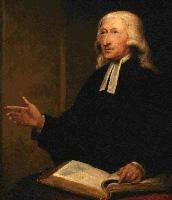
John Wesley

1703 - 1791 Topics: Proper 5 Year C Translator of "Give to the Winds Your Fears" in Voices United John Wesley, the son of Samuel, and brother of Charles Wesley, was born at Epworth, June 17, 1703. He was educated at the Charterhouse, London, and at Christ Church, Oxford. He became a Fellow of Lincoln College, Oxford, and graduated M.A. in 1726. At Oxford, he was one of the small band consisting of George Whitefield, Hames Hervey, Charles Wesley, and a few others, who were even then known for their piety; they were deridingly called "Methodists." After his ordination he went, in 1735, on a mission to Georgia. The mission was not successful, and he returned to England in 1738. From that time, his life was one of great labour, preaching the Gospel, and publishing his commentaries and other theological works. He died in London, in 1791, in his eighty-eighth year. His prose works are very numerous, but he did not write many useful hymns. It is to him, however, and not to his brother Charles, that we are indebted for the translations from the German. --Annotations of the Hymnal, Charles Hutchins, M.A., 1872 ====================== John Wesley, M.A., was born at Epworth Rectory in 1703, and, like the rest of the family, received his early education from his mother. He narrowly escaped perishing in the fire which destroyed the rectory house in 1709, and his deliverance made a life-long impression upon him. In 1714 he was nominated on the foundation of Charterhouse by his father's patron, the Duke of Buckingham, and remained at that school until 1720, when he went up, with a scholarship, from Charterhouse to Christ Church, Oxford. Having taken his degree, he received Holy Orders from the Bishop of Oxford (Dr. Potter) in 1725. In 1726 he was elected Fellow of Lincoln College, and remained at Oxford until 1727, when he returned into Lincolnshire to assist his father as curate at Epworth and Wroot. In 1729 he was summoned back to Oxford by his firm friend, Dr. Morley, Rector of Lincoln, to assist in the College tuition. There he found already established the little band of "Oxford Methodists" who immediately placed themselves under his direction. In 1735 he went, as a Missionary of the Society for the Propagation of the Gospel, to Georgia, where a new colony had been founded under the governorship of General Oglethorpe. On his voyage out he was deeply impressed with the piety and Christian courage of some German fellow travellers, Moravians. During his short ministry in Georgia he met with many discouragements, and returned home saddened and dissatisfied both with himself and his work; but in London he again fell in with the Moravians, especially with Peter Bohler; and one memorable night (May 24, 1738) he went to a meeting in Aldersgate Street, where some one was reading Luther's preface to the Epistle to the Romans. There, "About a quarter before nine, while he was describing the change which God works in the heart through faith in Christ, I felt my heart strangely warmed. I felt I did trust in Christ, Christ alone, for salvation; and an assurance was given me, that He had taken away my sins, even mine, and saved me from the law of sin and death." From that moment his future course was sealed; and for more than half a century he laboured, through evil report and good report, to spread what he believed to be the everlasting Gospel, travelling more miles, preaching more sermons, publishing more books of a practical sort, and making more converts than any man of his day, or perhaps of any day, and dying at last, March 2, 1791, in harness, at the patriarchal age of 88. The popular conception of the division of labour between the two brothers in the Revival, is that John was the preacher, and Charles the hymnwriter. But this is not strictly accurate. On the one hand Charles was also a great preacher, second only to his brother and George Whitefield in the effects which he produced. On the other hand, John by no means relegated to Charles the exclusive task of supplying the people with their hymns. John Wesley was not the sort of man to depute any part of his work entirely to another: and this part was, in his opinion, one of vital importance. With that wonderful instinct for gauging the popular mind, which was one element in his success, he saw at once that hymns might be utilized, not only for raising the devotion, but also for instructing, and establishing the faith of his disciples. He intended the hymns to be not merely a constituent part of public worship, but also a kind of creed in verse. They were to be "a body of experimental and practical divinity." "In what other publication," he asks in his Preface to the Wesleyan Hymn Book, 1780 (Preface, Oct. 20,1779), "have you so distinct and full an account of Scriptural Christianity; such a declaration of the heights and depths of religion, speculative and practical; so strong cautions against the most plausible errors, particularly those now most prevalent; and so clear directions for making your calling and election sure; for perfecting holiness in the fear of God?" The part which he actually took in writing the hymns, it is not easy to ascertain; but it is certain that more than thirty translations from the German, French and Spanish (chiefly from the German) were exclusively his; and there are some original hymns, admittedly his composition, which are not unworthy to stand by the side of his brother's. His translations from the German especially have had a wide circulation. Although somewhat free as translations they embody the fire and energy of the originals. It has been the common practice, however for a hundred years or more to ascribe all translations from the German to John Wesley, as he only of the two brothers knew that language; and to assign to Charles Wesley all the original hymns except such as are traceable to John Wesley through his Journals and other works. The list of 482 original hymns by John and Charles Wesley listed in this Dictionary of Hymnology have formed an important part of Methodist hymnody and show the enormous influence of the Wesleys on the English hymnody of the nineteenth century. -- Excerpts from John Julian, Dictionary of Hymnology (1907) =================== See also in: Hymn Writers of the Church

Henry J. Gauntlett

1805 - 1876 Person Name: H. J. Gauntlett, 1805-1876 Topics: Proper 5 Year C Composer of "UNIVERSITY COLLEGE" in Common Praise Henry J. Gauntlett (b. Wellington, Shropshire, July 9, 1805; d. London, England, February 21, 1876) When he was nine years old, Henry John Gauntlett (b. Wellington, Shropshire, England, 1805; d. Kensington, London, England, 1876) became organist at his father's church in Olney, Buckinghamshire. At his father's insistence he studied law, practicing it until 1844, after which he chose to devote the rest of his life to music. He was an organist in various churches in the London area and became an important figure in the history of British pipe organs. A designer of organs for William Hill's company, Gauntlett extend­ed the organ pedal range and in 1851 took out a patent on electric action for organs. Felix Mendelssohn chose him to play the organ part at the first performance of Elijah in Birmingham, England, in 1846. Gauntlett is said to have composed some ten thousand hymn tunes, most of which have been forgotten. Also a supporter of the use of plainchant in the church, Gauntlett published the Gregorian Hymnal of Matins and Evensong (1844). Bert Polman

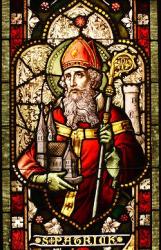
Saint Patrick

372 - 466 Person Name: St. Patrick Topics: The Church at Worship Opening and Morning Hymns; liturgical Opening Hymns; Angels; God Protection; Heaven(s)/Paradise; Jesus Christ Friend; Opening Hymns; Service Music Gathering, Call to Worship, Greeting; Sun; Trinity; Wisdom; Worship; Lent 5 Year A; Proper 22 Year C Author (attributed to) of "This Day God Gives Me" in Voices United Patrick, St., the 2nd Bishop and Patron Saint of Ireland, was the son of Calpurnius, a deacon, and grandson of Potitus, a presbyter, and great grandson of Odissus, a deacon, was born most probably near Dumbarton, in North Britain, in 372. According to his epistle to Coroticus, his father was also a decurio, a member of the local town council, and a Roman by descent. Hence probably the name Patricius. St. Patrick alludes in Coroticus, § 5, to his having been originally a freeman, and of noble birth. His birthplace is termed in his Confession, § 1, Bannavem Taberniæ. Some have identified that place with Boulogne-sur-Mer, in France. His mother's name was Concessa, said to have been sister of St. Martin of Tours. According to Tirechan's Collections (circa A.D. 690), Patrick had four names—-(1) Magonus, which Tirechan explains by clarus, illustrious; (2) Sucat (Succetus), god of war, or brave in war, said to have been his baptismal name; (3) Patricius; and (4) Cothraige (Cothrighe), given because he had been a slave to four masters. At the age of 16 he was carried off with many others to Ireland, and sold as a slave. There he remained six years with Milcho, or Miliuc. He was engaged in feeding cattle (pecora), though the later writers say that he fed swine. In his captivity he became acquainted with the Irish language. His misfortunes were the means of leading him to Christ, and be devoted himself to prayer, and often frequented, for that purpose, the woods on Mount Slemish. Having escaped after six years, he spent some years with his parents, and then was stirred up, when still a youth (puer), to devote himself to the evangelisation of Ireland. According to Secundinus's Hymn (St. Sechnall), which is probably not much later than the age of St. Patrick himself, the saint received his apostleship "from God," like St. Paul. No reference is made in that hymn, or in the later so-called Hymn of St. Fiacc, to any commission received from Pope Celestine, as is asserted by later writers. St. Patrick does not in his own writings allude to the external source whence he obtained ordination, and, as he speaks of his Roman descent, it would be strange for him not to have mentioned his Roman consecration, if it had been a fact. From some “sayings" of his, preserved on a separate page of the Book of Armagh, it is probable that he travelled through Gaul and Italy, and that he was ordained in Gaul as deacon, priest, and, afterwards, as bishop. He was probably a bishop when he commenced his missionary labours in Ireland. There were, however, Christians in Ireland before that period. Palladius, the senior Patrick, who preceded our saint by a few years, was, according to the chronicle of Prosper (the secretary of Pope Celestine), "ordained and sent to the Scots (the Irish) believing in Christ, by Pope Celestine, as their first bishop." Palladius's mission was a failure, while that of the second Patrick, which was quite independent of the former, was successful in a high degree. Its success, however, has been greatly exaggerated; for St. Patrick, in the close of his Confession, or autobiography, written in old age, speaks of the high probability of his having to lay down his life as a martyr for Christ. The date of St. Patrick's mission is not certain, but the internal evidence of his writings indicate that it was most probably about A.D. 425. The day and month of his death (March 17), but not the year [466] is mentioned in the Book of Armagh. St. Patrick's claim to a record in this Dictionary is associated with the celebrated hymn or “Breastplate," a history of which we now subjoin. 1. St. Patrick's Irish Hymn is referred to in Tirechan's Collections (A.D. 690). It was directed to be sung in "all monasteries and churches through the whole of Ireland," "canticum ejus scotticum semper canere," which is a proof that it was at that time universally acknowledged to be his composition. That regulation was very naturally lost sight of when the old Celtic Church lapsed into the Roman, (a) The expressions used in the hymn correspond entirely with the circumstances under which St. Patrick visited Tara. (b) Moreover, although all the ancient biographies of St. Patrick (with the exception of his own Confession, and of Secundinus's Hymn) speak of him as a worker of miracles, and as having performed miracles at Tara, there is no trace of such a fact in St. Patrick's Hymn, (c) Further, the phrase, "creator of doom," which twice occurs in it, according to the most approved translation, curiously corresponds with another fact that, "my God's doom," or “the doom," or "judgment of my God," was, according to the ancient biographies, one of St. Patrick's favourite expressions. 2. The first notice of the existence at the present time of an ancient manuscript copy of St. Patrick's "Hymn or Breastplate," was made known by the late Dr. Petrie in his Memoir of Tara, published in the Transactions of the Royal Irish Academy, 1839, vol. xviii. Dr. Petrie gave the original in Irish characters, an interlineary Latin version and an English translation by himself, together with copious notes. Dr. Petrie found the original in the Liber Hymnorum, in the Library of Trinity College, Dublin (iv. E. 4, 2, fol. 19 b). “The tradition respecting its primary use by the saint is that he recited it on Easter Sunday, when proceeding to encounter the droidical fire-worshippers, with their pagan king, Laoghaire, and his court, at Tara, the royal residence." (Lyra Hibernica Sacra, 1878, p. 2.) 3. Dr. Todd in his work, S. Patrick, Apostle of Ireland, 1864, gives a metrical rendering of the “Breastplate” which begins:— "I bind to myself today, The strong power of an invocation of the Trinity, The faith of the Trinity in Unity, The Creator of the elements." The translation, which extends to 78 lines, was mainly the work of Dr. Whitley Stokes. A more correct version by the same scholar is given in the Rolls's edition of the Tripartite Life, 1887; and that revised version, with a few modifications, accompanied with critical notes, explanatory of the alterations made on the former version, is given in the 2nd and 3rd editions of the Writings of St. Patrick, by Dr. V. H. H. Wright. Dr. Whitley Stokes, therefore, is to be regarded as the real translator from the original Irish. Dr. Petrie's translation, though highly meritorious as a first attempt, has been proved in many particulars to be erroneous. There is no mention of Tara in the hymn. An uncertainty yet exists as to the meaning of a few words. 4. In Dr. W. MacIlwaine's Lyra Hibernica Sacra, 1878, Dr. Todd's translation was repeated (with notes), together with a second translation by James Clarence Mangan, the opening lines of which are:— "At Tara to-day, in this awful hour, I call on the Holy Trinity! Glory to Him Who reigneth in power, The God of the elements, Father, and Son, And Paraclete Spirit, which Three are the One, The everlasting Divinity." 5. A popular version of the hymn for congregational use was written by Mrs. Cecil F. Alexander, for St. Patrick's Day, 1889, and sung generally throughout Ireland on that day. The opening lines are:— "I bind unto myself to-day The strong Name of the Trinity, By invocation of the same, The Three in One and One in Three. ”I bind this day to me for ever, By power of faith, Christ's Incarnation; His baptism in Jordan river; His death on Cross for my salvation; His bursting from the spiced tomb; His riding up the heav'nly way; His coming at the day of doom; I bind unto myself to-day." Mrs. Alexander's version is given, along with that of James Clarence Mangan, in the Appendix to the Writinqs of St. Patrick, edited by Dr. C. H. H. Wright (R.T.S.), 1889. 6. Another metrical version of this hymn was given in the Irish Ecclesiastical Gazette for April 5, 1889. It is by Joseph John Murphy, and the opening lines are:— "I bind as armour on my breast The Threefold Name whereon I call, Of Father, Son, and Spirit blest, The Maker and the Judge of all." 7. The translation in Stokes and Wright's edition of St. Patrick's writings was set to music as a cantata by Sir R. Stewart, and was performed for the first time in St. Patrick's Cathedral, Dublin, on St. Patrick's Day, 1888. 8. Mr. Thomas French, Assistant Librarian of Trinity College, Dublin, writes as follows respecting this hymn:— "The manuscript called the 'Liber Hymnorum' belonged to Archbishop Ussher, and forms one of the volumes of the Ussher Collection now in the Library of Trinity College, Dublin. There is no interlineary Latin translation in the original. It was given by Petrie in his account of the hymn 'for the satisfaction of the learned’ [The St. Patrick authorship is tradition only, so far as I know.] Dr. Todd in his S. Patrick, Apostle of Ireland, p. 426, says ‘It is undoubtedly of great antiquity, although it may now be difficult, if not impossible, to adduce proof in support of the tradition that St. Patrick was its author.'...... Petrie and Todd make the age of the manuscript 9th or 10th century, Whitley Stokes 11th or 12th." We may add that St. Patrick's Latin works were published by Sir James Ware, 1656, in the Acta Sanctorum of the Bollandist Fathers, 1668, by Villanueva, 1835, and by others, as B. S. Nicholson, 1868, Miss Cusack, 1871, and, above all, by Dr. Whitley Stokes, in the Rolls' Edition of the Tripartite Life, 1887. The latter three works contain also translations. Translations of the whole, or a portion of St. Patrick's writings, have been published by Rev. T. Olden, 1876; Sir S. Ferguson, LL.D. Transactions of Royal Irish Academy, 1885, and more completely in the Writings of St. Patrick, edited by Prof. G. T. Stokes and Dr. C. H. H. Wright, 1st ed. 1887, 2nd ed. 1888, 3rd ed., edited, with notes critical and historical, and an introduction by Dr. C. H. H. Wright revised and enlarged. London: Religious Tract Society, 1889. [Rev. Charles H. H. Wright, D.D., Ph.D.] --John Julian, Dictionary of Hymnology (1907) ==================== Patrick, St., p. 885, ii. (l) In the Oxford University Herald of April 6, 1889, is an anonymous paraphrase in 7 stanzas of 4 lines of a portion of "St. Patrick's Hymn," beginning- "Father, Son, and Holy Ghost! May Thine overshadowing might Be as armour to my soul, Be my weapon in the fight." (2) Note concerning § 3, on p. 885, i., that Dr., W. Stokes's translation appeared in its original form in the Saturday Review, Sept. 5, 1857. In his Goidilica, Calcutta, 1866, p. 66, in an altered form to that of 1857 and 1864. --John Julian, Dictionary of Hymnology, Appendix, Part II (1907)

Iona Community

Person Name: The Iona Community Topics: Proper 5 Year A Author of "Will You Come and Follow Me" in Voices United Iona Community, an ecumenical Christian group of men and women based on the small island of Iona off the coast of Scotland. The community began in 1938 when the Rev. George MacLeod of the Church of Scotland began a ministry among the unemployed poor who had been neglected by the church. He took a handful of men to the island to rebuild the ruins of a thousand-year-old abbey church. That rebuilding became a metaphor for the rebuilding of the common life, a return to the belief that daily activity is the stuff of godly service – work, and worship. The Community has since grown to include a group of members, associates, and friends all over the United Kingdom and many other countries. In addition to many conferences that attract people to Iona from around the world, the Community is known for its publishing of new songs and prayers for worship, both developed in community and gathered from around the world. For more information on the Iona Community, check their website: www.iona.org.uk. John Bell is probably the community’s most well-known member, having composed and arranged much of the community’s music. Sing! A New Creation

John L. Bell

b. 1949 Person Name: John L. Bell, b. 1949 Topics: Year A Proper 5 Author of "Will you come and follow me (The Summons)" in Complete Anglican Hymns Old and New John Bell (b. 1949) was born in the Scottish town of Kilmarnock in Ayrshire, intending to be a music teacher when he felt the call to the ministry. But in frustration with his classes, he did volunteer work in a deprived neighborhood in London for a time and also served for two years as an associate pastor at the English Reformed Church in Amsterdam. After graduating he worked for five years as a youth pastor for the Church of Scotland, serving a large region that included about 500 churches. He then took a similar position with the Iona Community, and with his colleague Graham Maule, began to broaden the youth ministry to focus on renewal of the church’s worship. His approach soon turned to composing songs within the identifiable traditions of hymnody that began to address concerns missing from the current Scottish hymnal: "I discovered that seldom did our hymns represent the plight of poor people to God. There was nothing that dealt with unemployment, nothing that dealt with living in a multicultural society and feeling disenfranchised. There was nothing about child abuse…,that reflected concern for the developing world, nothing that helped see ourselves as brothers and sisters to those who are suffering from poverty or persecution." [from an interview in Reformed Worship (March 1993)] That concern not only led to writing many songs, but increasingly to introducing them internationally in many conferences, while also gathering songs from around the world. He was convener for the fourth edition of the Church of Scotland’s Church Hymnary (2005), a very different collection from the previous 1973 edition. His books, The Singing Thing and The Singing Thing Too, as well as the many collections of songs and worship resources produced by John Bell—some together with other members of the Iona Community’s “Wild Goose Resource Group,” —are available in North America from GIA Publications. Emily Brink

Meyer Lyon

1751 - 1797 Topics: Year A Proper 5 Adapter of "LEONI" in The New Century Hymnal Died: 1797, Kingston, Jamaica. Pseudonym: Leoni. Lyon was a chorister at the Great Synagogue, Duke’s Place, London, and a public singer either at Drury Lane or Covent Garden. Subsequently he became the first qualified chazan of the English and German Synagogue in Jamaica. Sources: Julian, p. 1151 McCutchan, pp. 27-28 Music: LEONI http://www.hymntime.com/tch/bio/l/y/o/lyon_m.htm ================ http://en.wikipedia.org/wiki/Myer_Lyon

Erik Routley

1917 - 1982 Person Name: Erik Routley, 1917-1982 Topics: Joy, Praise and Thanksgiving; Year A Christmas 1; Year A Proper 18; Year B Christmas 1; Year C All Saints; Year C Christmas 1; Year C Easter 2; Year C Easter 5 Author of "New songs of celebration render" in Complete Anglican Hymns Old and New

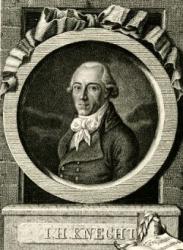
Justin Heinrich Knecht

1752 - 1817 Person Name: Justin H. Knecht Topics: Consecration; Stewardship and Creation; Year A Proper 16; Year A Proper 24; Year B Epiphany 2; Year B Proper 23; Year C Epiphany 5; Year C Thanksgiving; Youth Composer of "VIENNA" in The New Century Hymnal Justin Heinrich Knecht Germany 1752-1817. Born at Biberach Baden-Wurttemberg, Germany, he attended a Lutheran college in Esslingen am Neckar from 1768-1771. Having learned the organ, keyboard, violin and oratory, he became a Lutheran preceptor (professor of literature) and music director in Biberach. It was a free imperial city until 1803 and had a rich cultural life. He became organist of St. Martin’s Church in 1792, used by both Lutherans and Catholics, and was there for many years. He led an energetic, busy musical life, composing for both the theatre and church, organizing subscription concerts, teaching music theory, acoustics, aesthetics, composition, and instruments at the Gymnasium, affiliated to the Musikschule in 1806. He went to Stuttgart in 1806 in hopes of a post there as Kapellmeister, serving two years as Konzertmeister, but he was appointed Direktor Beim Orchester by the King of Wurttemberg in 1807. However, he returned to his former life in 1808 and remained there the rest of his life. He died at Biberach. He wrote 10 vocals, 11 opera and stage works, one symphony, 3 chamber music instrumentals, 7 organ works, 4 piano works, and 6 music theories. He was an author composer, editor, contributor, musician, compiler, and lyricist. John Perry

Cyril Alington

1872 - 1955 Person Name: Cyril Argentine Alington (1872-1955) Topics: Proper 5 Year B Author of "Ye that know the Lord is gracious" in Ancient and Modern Educated at Trinity College, Oxford, England, Cyril A. Alington (b. Ipswich, England, 1872; d. St. Leonards, Hertfordshire, England, 1955) was ordained a priest in the Church of England in 1901. He had a teaching career that included being headmaster at Shrewsbury School and Eton College. He was dean of Durham from 1933-1951 as well as chaplain to the king of England. His writings include literary works and Christianity in England, Good News (1945). Many of his hymns appeared in various twentieth-century editions of the famous British hymnal, Hymns Ancient and Modern. Bert Polman

Pages


Export as CSV
It looks like you are using an ad-blocker. Ad revenue helps keep us running. Please consider white-listing Hymnary.org or getting Hymnary Pro to eliminate ads entirely and help support Hymnary.org.