You help make Hymnary.org possible. More than 10 million people from 200+ countries found hymns, liturgical resources and encouragement on Hymnary.org in 2025, including you. Every visit affirms the global impact of this ministry.

If Hymnary has been meaningful to you this year, would you take a moment today to help sustain it? A gift of any size—paired with a note of encouragement if you wish—directly supports the server costs, research work and curation that keep this resource freely available to the world.

Give securely online today, or mail a check to:
Hymnary.org
Calvin University
3201 Burton Street SE
Grand Rapids, MI 49546

Thank you for your partnership, and may the hope of Advent fill your heart.

Person Results

Topics:closing+of+service
In:person

Planning worship? Check out our sister site, ZeteoSearch.org, for 20+ additional resources related to your search.
Showing 151 - 160 of 419Results Per Page: 102050

William G. Tomer

1833 - 1896 Person Name: William G. Tomer, 1833-96 Topics: Close of Service; Close of Service Composer of "GOD BE WITH YOU" in Christian Worship (1993) Born: Oc­to­ber 5, 1833, New Jer­sey. Died: Sep­tem­ber 26, 1896, New Jer­sey. Buried: Un­ion Cem­e­te­ry, Fines­ville, New Jer­sey. Tomer stu­died sing­ing and sang in the choir in Fines­ville, New Jer­sey, and be­gan teach­ing school at age 17. He served in the Un­ion army dur­ing the Amer­i­can ci­vil war, then worked as a clerk in Wash­ing­ton, DC, served as mu­sic di­rect­or for Grace Meth­od­ist Epis­co­pal Church, and taught school in New Car­pen­ters­ville and Green­wich, New Jer­sey. He was liv­ing in Green­wich as of 1880. --www.cyberhymnal.org/

Edward Caswall

1814 - 1878 Topics: Close of Service Translator of "The sun is sinking fast" in The New Laudes Domini Edward Caswall was born in 1814, at Yately, in Hampshire, where his father was a clergyman. In 1832, he went to Brasenose College, Oxford, and in 1836, took a second-class in classics. His humorous work, "The Art of Pluck," was published in 1835; it is still selling at Oxford, having passed through many editions. In 1838, he was ordained Deacon, and in 1839, Priest. He became perpetural Curate of Stratford-sub-Castle in 1840. In 1841, he resigned his incumbency and visited Ireland. In 1847, he joined the Church of Rome. In 1850, he was admitted into the Congregation of the Oratory at Birmingham, where he has since remained. He has published several works in prose and poetry. --Annotations of the Hymnal, Charles Hutchins, M.A. 1872 ===================== Caswall, Edward, M.A., son of the Rev. R. C. Caswall, sometime Vicar of Yately, Hampshire, born at Yately, July 15, 1814, and educated at Brasenose College, Oxford, graduating in honours in 1836. Taking Holy Orders in 1838, he became in 1840 Incumbent of Stratford-sub-Castle, near Salisbury, and resigned the same in 1847. In 1850 (Mrs. Caswall having died in 1849) he was received into the Roman Catholic communion, and joined Dr. Newman at the Oratory, Edgbaston. His life thenceforth, although void of stirring incidents, was marked by earnest devotion to his clerical duties and a loving interest in the poor, the sick, and in little children. His original poems and hymns were mostly written at the Oratory. He died at Edgbaston, Jan. 2, 1878, and was buried on Jan. 7 at Redwall, near Bromsgrove, by his leader and friend Cardinal Newman. Caswall's translations of Latin hymns from the Roman Breviary and other sources have a wider circulation in modern hymnals than those of any other translator, Dr. Neale alone excepted. This is owing to his general faithfulness to the originals, and the purity of his rhythm, the latter feature specially adapting his hymns to music, and for congregational purposes. His original compositions, although marked by considerable poetical ability, are not extensive in their use, their doctrinal teaching being against their general adoption outside the Roman communion. His hymns appeared in:— (1) Lyra Catholica, which contained 197 translations from the Roman Breviary, Missal, and other sources. First ed. London, James Burns, 1849. This was reprinted in New York in 1851, with several hymns from other sources added thereto. This edition is quoted in the indices to some American hymn-books as Lyra Cath., as in Beecher's Plymouth Collection, 1855, and others. (2) Masque of Mary, and Other Poems, having in addition to the opening poem and a few miscellaneous pieces, 53 translations, and 51 hymns. 1st ed. Lon., Burns and Lambert, 1858. (3) A May Pageant and Other Poems, including 10 original hymns. Lon., Burns and Lambert, 1865. (4) Hymns and Poems, being the three preceding volumes embodied in one, with many of the hymns rewritten or revised, together with elaborate indices. 1st ed. Lon., Burns, Oates & Co., 1873. Of his original hymns about 20 are given in the Roman Catholic Crown of Jesus Hymn Book, N.D; there are also several in the Hymns for the Year, N.D., and other Roman Catholic collections. --John Julian, Dictionary of Hymnology (1907) ====================== Caswall, E. , p. 214, ii. Additional original hymns by Caswall are in the Arundel Hymns, 1902, and other collections. The following are from the Masque of Mary, &c, 1858:— 1. Christian soul, dost thou desire. After Holy Communion. 2. Come, let me for a moment cast. Holy Communion. 3. O Jesu Christ [Lord], remember. Holy Communion. 4. Oft, my soul, thyself remind. Man's Chief End. 5. Sleep, Holy Babe. Christmas. Appeared in the Rambler, June 1850, p. 528. Sometimes given as "Sleep, Jesus, sleep." 6. The glory of summer. Autumn. 7. This is the image of the queen. B. V. M. His "See! amid the winter's snow,” p. 1037, i., was published in Easy Hymn Tunes, 1851, p. 36. In addition the following, mainly altered texts or centos of his translations are also in common use:— 1. A regal throne, for Christ's dear sake. From "Riches and regal throne," p. 870, ii. 2. Come, Holy Ghost, Thy grace inspire. From "Spirit of grace and union," p. 945, i. 3. Hail! ocean star, p. 99, ii,, as 1873. In the Birmingham Oratory Hymn Book, 1850, p. 158. 4. Lovely flow'rs of martyrs, hail. This is the 1849 text. His 1873 text is "Flowers of martyrdom," p. 947, i. 5. None of all the noble cities. From "Bethlehem! of noblest cities," p. 946, ii. 6. O Jesu, Saviour of the World. From “Jesu, Redeemer of the world," p. 228, ii. 7. 0 Lady, high in glory raised. From "O Lady, high in glory, Whose," p. 945, i. The Parochial Hymn Book, 1880, has also the following original hymns by Caswall. As their use is confined to this collection, we give the numbers only:— IS os. 1, 2, 3, 159 (Poems, 1873, p. 453), 209 (1873, p. 288), 299, 324 (1873, p. 323), 357, 402, 554, 555, 558, 569 (1873, p. 334). These are from his Masque of Mary 1858. Nos. 156, 207 (1873, p. 296), 208 (1873, p. 297), 518. These are from his May Pageant, 1865. As several of these hymns do not begin with the original first lines, the original texts are indicated as found in his Poems, 1873. [Rev. James Mearns, M.A.] --John Julian, Dictionary of Hymnology, New Supplement (1907)

William Hammond

1719 - 1783 Person Name: Rev. William Hammond ( -1783) Topics: Opening and Closing of Service Author of "Lord, we come before thee now" in Carmina Sanctorum, a selection of hymns and songs of praise with tunes Hammond, William, B.A, born at Battle, Sussex, Jan. 6, 1719, and educated at St. John's College, Cambridge. In 1743 he joined the Calvinistic Methodists; and in 1745, the Moravian Brethren. He died in London, Aug. 19, 1783, and was buried in the Moravian burial-ground, Sloane Street, Chelsea. He left an Autobiography in Greek, which remains unpublished. His original hymns, together with his translations from the Latin, were published in his:— Psalms, Hymns, and Spiritual Songs. To which is prefix'd A Preface, giving some Account of a Weak Faith, and a Full Assurance of Faith; and briefly stating the Doctrine of Sanctification; and shewing a Christian's Completeness, Perfection, and Happiness in Christ. By William Hammond, A.B., late of St. John's College, Cambridge. London: Printed by W. Strahan; and sold by J. Oswald, at the Rose and Crown in the Poultry, mdccxlv. A few of his original hymns from scriptural fidelity and earnestness have attained to a foremost position amongst English hymns. These include, "Awake, and sing the song," and "Lord, we come before Thee now." His translations of Latin hymns were amongst the earliest published after those contained in the Primers and other devotional works of 16th and 17th centuries. They are of merit, and worthy of attention. Greater use might also be made of his original compositions. In addition to those named above, the following are also in common use:— 1. Brightness of the Father's Face. God the Son. 2. How great the Christian's portion is. Possession of All in Christ. 3. If Jesus is yours. God's unchangeable Love. 4. In Thine own appointed way. Divine Worship. 5. Jesus, Who died the [a] world to save. Easter. 6. Lord, if on earth the thought of Thee. Heaven anticipated. 1. Now with joint consent we sing. Divine Worship. 8. O Lord, how little do we know. Quinquagesima. 9. Would you win a soul to God ? The Gospel Message. --John Julian, Dictionary of Hymnology (1907)

Thomas Cotterill

1779 - 1823 Person Name: Thomas Cotterill, 1779 - 1823 Topics: The Church Worship - The Close of Service Author of "Thee we adore, eternal Lord!" in Service Book and Hymnal of the Lutheran Church in America Thomas Cotterill (b. Cannock, Staffordshire, England, 1779; d. Sheffield, Yorkshire, England, 1823) studied at St. John's College, Cambridge, England, and became an Anglican clergyman. A central figure in the dispute about the propriety of singing hymns, Cotterill published a popular collection of hymns (including many of his own as well as alterations of other hymns), Selection of Psalms and Hymns in 1810. But when he tried to introduce a later edition of this book in Sheffield in 1819, his congregation protested. Many believed strongly that the Church of England should maintain its tradition of exclusive psalm singing. In a church court the Archbishop of York and Cotterill reached a compromise: the later edition of Selection was withdrawn, and Cotterill was invited to submit a new edition for the archbishop's approval. The new edition was published in 1820 and approved as the first hymnal for the Anglican church of that region. Cotterill's suppressed book, however, set the pattern for Anglican hymnals for the next generation, and many of its hymns are still found in modern hymnals. Bert Polman =============== Thomas Cotterill was born in 1779; studied at S. John's College, Cambridge, graduating M.A.; ordained in 1806, and enterred upon parochial work at Tutbury; afterwards removed to Lane End, where he remained for nine years among the Potteries; in 1817, became perpetual Curate of S. Paul's, Sheffield. He died in 1823. He was the author of several books; among them, "A Selection of Psalms and Hymns for Public and Private Use, adapted to the Services of the Church of England." In the preparation of this collection (the 8th ed., 1819), he had the assistance of Montgomery, who in this work did what he condemned in others, viz., altering and remodeling other authors' hymns. --Annotations of the Hymnal, Charles Hutchins, M.A., 1872. ====================== Cotterill, Thomas, M.A., was the son of a woolstapler at Cannock, Staffordshire, where he was born Dec. 4, 1779. After attending the local boarding-school of the Rev. J. Lomax, he proceeded to the Free School, Birmingham. He graduated at St. John's College, Cambridge (B.A. 1801, M.A. 1805), of which he became a Fellow. Taking Holy Orders, he became Curate of Tutbury in June, 1803 (not 1806, as stated by Miller in Singers & Songs of the Church). His subsequent charges were the Incumbency of Lane End, Staffordshire, 1808-17, and the Perpetual Curacy of St. Paul's Sheffield, 1817-23. He died at Sheffield Dec. 29, 1823 (not Jan. 5, 1824, as in the Gentleman’s Magazine), aged 44. His volume of Family Prayers attained to the sixth edi¬tion in 1824. As a hymn-writer, Cotterill is less known than as the compiler of a Selection of Psalms and Hymns which has had a most marked effect on modern hymnals. The first edition of that Selection was published in 1810, and the 9th in 1820. All subsequent issues were reprints of the last. The most important edition is the 8th, 1819. To that Selection Cotterill contributed at various dates 25 original hymns and versions of individual psalms. These, in common with all the hymns in the Selection, are given without author's name. Through the aid, however, of marked copies [in the collections of Brooke and Julian] and of members of Cotterill's family, we are enabled to identify most, if not all, of his original productions. In addition to those which are annotated under their first lines, we have— i. In his Selection of Psalms & Hymns for Public and Private Use, adapted to the Festivals of the Church of England, &c, 1st ed., 1810:— 1. Awake, O sword, the Father cried. Atonement. 2. Before Thy throne of grace, O Lord. Lent. 3. From Sinai's mount, in might array'd. The Law and the Gospel. 4. From Thine all-seeing Spirit, Lord. Ps. 139. 5. In all the ways and works of God. Ps. 145. 6. Out of the deeps, O Lord, we call. Ps. 130. 7. The Lord, who once on Calvary. The Intercessor. This is based on “Where high the heavenly temple stands," q. v. ii. In the Appendix to the 6th ed. of the same Selection, Staffordshire, 1815:— 8. Blessed are they who mourn for sin. Lent. 9. Father of mercies, let our songs [way, ways]. Thanksgiving. 10. I was alive without the law. Lent. 11. Lord of the Sabbath, 'tis Thy day. Sunday. iii. In the 8th edition of the same, 1819 :— 12. Help us, O Lord, Thy yoke to wear. Charity Sermons. This is sometimes given as "Lord, let us learn Thy yoke to wear," as in Kennedy, 1863, &c. 13. I love the Lord, for He hath heard. Ps. 116. 14. Lo in the East a star appears. Epiphany. This in an altered form begins in Kennedy, 1863, No. 188, with stanza ii., "The ancient sages from afar." 15. Lord, cause Thy face on us to shine. For Unity. 16. When Christ, victorious from the grave. Easter. The 9th ed. of the Selection, 1820, was practically a new work. It was compiled by Cotterill, but revised by Dr. Harcourt, the Archbishop of York, and was dedi¬cated to him. It was the outcome of the compromise in the legal proceedings over the 8th ed., 1819. The 8th ed. contained 367 hymns in addition to 128 versions of the Psalms and 6 Doxologies, the 9th only 152. Its full title was A Selection of Psalms and Hymns for Public Worship, Lond., T. Cadell, 1820. It may be noted that copies of the 8th ed., 1819, are found with two distinct title-pages. One of these, accompanied with the preface, was for the general public, the second, without the preface, for the use of the congregations of St. James's and St. Paul's, Sheffield. Of Cotterill's hymns the most popular are, "O'er the realms of pagan darkness," "Let songs of praises fill the sky," and "Jesus exalted far on high," but these are not distinguished by any striking features of excellence. He was more happy in some of his alterations of older hymns, and in the com¬piling of centos. Many of the readings introduced into the great hymns of the Church first appeared in his Selection. The most notable amongst these are, "Rock of Ages," in 3 stanzas, as in Hymns Ancient & Modern, 1861, the Wesleyan Hymn Book, and other collections; "Lo! He comes with clouds descending;" and “Great God, what do I see and hear." Cotterill's connection with the Uttoxeter Psalms & Hymns, 1805, is given in detail in the article on Staffordshire Hymn-books, and his lawsuit over the 8th ed. of his Selection, 1819, in the article on England Hymnody, Church of. --John Julian, Dictionary of Hymnology (1907)

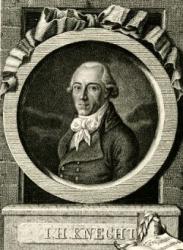
Justin Heinrich Knecht

1752 - 1817 Person Name: Justin H. Knecht Topics: Times and Seasons At the Close of Service Composer of "VIENNA" in Common Service Book of the Lutheran Church Justin Heinrich Knecht Germany 1752-1817. Born at Biberach Baden-Wurttemberg, Germany, he attended a Lutheran college in Esslingen am Neckar from 1768-1771. Having learned the organ, keyboard, violin and oratory, he became a Lutheran preceptor (professor of literature) and music director in Biberach. It was a free imperial city until 1803 and had a rich cultural life. He became organist of St. Martin’s Church in 1792, used by both Lutherans and Catholics, and was there for many years. He led an energetic, busy musical life, composing for both the theatre and church, organizing subscription concerts, teaching music theory, acoustics, aesthetics, composition, and instruments at the Gymnasium, affiliated to the Musikschule in 1806. He went to Stuttgart in 1806 in hopes of a post there as Kapellmeister, serving two years as Konzertmeister, but he was appointed Direktor Beim Orchester by the King of Wurttemberg in 1807. However, he returned to his former life in 1808 and remained there the rest of his life. He died at Biberach. He wrote 10 vocals, 11 opera and stage works, one symphony, 3 chamber music instrumentals, 7 organ works, 4 piano works, and 6 music theories. He was an author composer, editor, contributor, musician, compiler, and lyricist. John Perry

Ithamar Conkey

1815 - 1867 Person Name: Ithamar Conkey (1815-1867) Topics: Opening and Closing of Service Composer of "RATHBUN" in Carmina Sanctorum, a selection of hymns and songs of praise with tunes Ithamar D. Conkey USA 1815-1867. Born of Scottish ancestry in Shutesbury, MA, he became a wool merchant. He married Elizabeth Billings, and they had a daughter and two sons. He was organist at Central Baptist Church,Norwich, CN. After that, he went to NewYork City and served as bass soloist at Calvary Episcopal church and Grace Church. Later, he served as bass soloist and choir director of Madison Avenue Baptist Church. His famous hymn was written in 1849. Two years later, William Howard Doane was baptized in the same church. John Perry

George Kingsley

1811 - 1884 Person Name: Geo. Kingsley Topics: Close of Service Composer of "ELIZABETHTOWN" in The New Laudes Domini Born: July 7, 1811, Northampton, Massachusetts. Died: March 14, 1884, Northampton, Massachusetts. Kingsley played the organ at the Old South Church and Hollis Street Church in Boston, Massachusetts. He also taught music at Girard College in Philadelphia, Pennsylvania, served as music supervisor for public schools in Philadelphia, and compiled a number of music books, including: Sunday School Singing Book, 1832 The Harmonist, 1833 The Social Choir, 1836 The Sacred Choir, 1838 The Harp of David, 1844 The Young Ladies’ Harp, 1847 Templi Carmina (Northampton, Massachusetts: 1853) The Juvenile Choir, 1865 --www.hymntime.com/tch

George Washington Doane

1799 - 1859 Person Name: G. W. Doane Topics: Close of Service Author of "Evening" in Laudes Domini Doane, George Washington, D.D. Bishop Doane was born at Trenton, New Jersey, May 27, 1799, and graduated at Union College, Schenectady, New York. Ordained in 1821, he was Assistant Minister at Trinity Church, New York, till 1824. In 1824 he became a Professor at Trinity College, Hartford, Conn.; in 1828 Rector of Trinity Church, Boston; and, in 1832, Bishop of New Jersey. He founded St. Mary's Hall, Burlington, 1837, and Burlington College, Burlington, 1846. Died April 27, 1859.  Bishop Doane's exceptional talents, learning, and force of character, made him one of the great prelates of his time. His warmth of heart secured devoted friends, who still cherish his memory with revering affection. He passed through many and severe troubles, which left their mark upon his later verse. He was no mean poet, and a few of his lyrics are among our best. His Works, in 4 volumes with Memoir by his son, were published in 1860. He issued in 1824 Songs by the Way, a small volume of great merit and interest. This edition is now rare. A second edition, much enlarged, appeared after his death, in 1859, and a third, in small 4to, in 1875. These include much matter of a private nature, such as he would not himself have given to the world, and by no means equal to his graver and more careful lyrics, on which alone his poetic fame must rest.The edition of 1824 contains several important hymns, some of which have often circulated without his name. Two of these are universally known as his, having been adopted by the American Prayer Book Collection, 1826:-- 1. Softly now the light of day. Evening. This, in addition to its use in American hymnals, is also found in the English Collections, including Snepp's Songs of Grace & Glory.   Written in 1824. 2. Thou art the way, to Thee alone. Christ the Way. This, in the judgment of many, is the first of American hymns, and one of the most admirable and useful in the English language. In the United States its use is most extensive, and since its introduction into the English Collections by Bickersteth in 1833, Hall in his Mitre, in 1836, and others, it has grown in favour until it ranks with the most popular of the great English hymns. Near in merit to the foregoing stands a companion piece in the same work, which deserves to be better known :— 3.  Lord, should we leave Thy hallowed feet. The next three have been overlooked at home, but have obtained considerable circulation in English Collections. 4.  Father of mercies hear,  Thy pardon we implore.    Ash Wednesday or Lent.    A translation of "Audi, benigne Conditor" q.v.), published in his Songs by the Way, 1824, together with several other translations, thus anticipating by twelve years the great English movement in that direction.   Original translation in his Songs by the Way, 1875Miller (S. & S., p. 12) attributes this translation to Dr. Neale in error. 5.  Return and come to God.   Invitation.   In his Songs, &c, 1824.   It is found in  Hall’s Mitre, 1836; the Baptist Hymnal, 1879, and several others. 6.  To thee, 0 Lord, with dawning light.  Morning.    This hymn is attributed to Heber by Miller (S. & S. , p. 381) in error.  It is included in the Society for Promoting Christian Knowledge Hymns, 1852; in Windle and others.    It is from the Songs, &c, 1824. His later hymns, the dates of which are generally preserved in the last edition of his Songs by the Way, include the following, which are more or less in use :— 7.  Beloved, it is well.   All well in Christ.   This is entitled "To my wife"; is dated Mar. 12, 1833, and was written in a copy of Dr. Bedell's "It is well."    It is given in Kennedy, 1863. 8.  Broken-hearted, weep no more.    Assurance of Peace.    The date of this hymn is not preserved. It is found as early as 1829, when it appeared in the 2nd edition of Cleland's (Baptist) Hymns. 9.  Fling out the banner, let it float.    Missions, Home & Foreign.    This hymn, sometimes dated 1824 in error, was written at Riverside, 2nd Sunday in Advent, 1848, and is one of the author's latest effusions.    It is in extensive use both in Great Britain and America. 10.  He came not with His heavenly crown.   The two Advents. In his Songs by the Way, edition 1875, this poem is dated Dec. 1827.    In Dale's English Hymnbook, 1879, it is given with the omission of stanza iii., and in the American Protestant Episcopal  Hymnal,   1871,  it begins  with stanza iv., "Once more, O Lord, Thy sign shall be."    Full text in Lyra Sac. Amer., p. 92. 11.  Lift not thou the wailing voice.   Burial.   A funeral hymn, adopted by the Anglican Hymnbook, but dated 1826 in error, for 1830. 12.  What is that, mother?  The lark, my child. This is not a hymn, but a familiar and long popular song. 13.  "When darkness erst [once] at God's command. Israel in Egypt.    In Kennedy, 1863, No. 722. 14.  Young and happy while thou art.    Youth for Christ.   A favourite piece in many juvenile collections.   It is dated Sept., 1827, and is given in Songs by the Way, 1875. The Lyra Sacra Americana also contains the following:— 15.  Brightness of the Father's glory.    Morning. A tr. of "Consors Paterni luminis " (q.v.).   It is from the Songs, &c, 1824. 16.  Child that kneelest meekly there.     Child at Prayer.    Suggested by a cast from a piece of sculpture by Greenough representing a child at prayer. 17.  Grant me, Lord, Thy graces three.    Faith, Hope, and Charity desired. 18.  Perfect through suffering may it be.     Uses of suffering.    Dated in Songs by the Way, "The Breakers, June 1, 1853." 19.  Yes, it is a faithful saying.   Redemption. In his Songs, &c, 1824.             [Rev. F. M. Bird, M.A.] -- John Julian, Dictionary of Hymnology (1907)

Clement Cotterill Scholefield

1839 - 1904 Person Name: Rev. Clement C. Scholefield, 1839-1904 Topics: Close of Service Composer of "ST. CLEMENT" in Hymnal and Liturgies of the Moravian Church Rev. Clement C. Scholefield (b. Edgbaston, near Birmingham, Warwickshire, England, 1839; d. Goldalming, Surrey, England, 1904) Educated at St. John's College, Cambridge, he was ordained in the Church of England in 1867. He served at Hove, Brighton, St. Peter's in Kensington (1869-1879), and briefly at St. Luke's in Chelsea. From 1880 to 1890 he was chaplain at Eton College and from 1890 to 1895 vicar of Holy Trinity in Knightsbridge. Mainly self-taught as a musician, Scholefield became an accomplished pianist and composed some songs and hymn tunes. Bert Polman

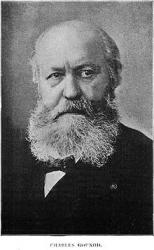
Charles F. Gounod

1818 - 1893 Topics: Times and Seasons At the Close of Service Composer of "GOUNOD" in Common Service Book of the Lutheran Church Charles F. Gounod (b. Paris, France, 1818; d. St. Cloud, France, 1893) was taught initially by his pianist mother. Later he studied at the Paris Conservatory, won the "Grand Prix de Rome" in 1839, and continued his musical training in Vienna, Berlin, and Leipzig. Though probably most famous for his opera Faust (1859) and other instrumental music (including his Meditation sur le Prelude de Bach, to which someone added the Ave Maria text for soprano solo), Gounod also composed church music-four Masses, three Requiems, and a Magnificat. His smaller works for church use were published as Chants Sacres. When he lived in England (1870-1875), Gounod became familiar with British cathedral music and served as conductor of what later became the Royal Choral Society. Bert Polman

Pages


Export as CSV
It looks like you are using an ad-blocker. Ad revenue helps keep us running. Please consider white-listing Hymnary.org or getting Hymnary Pro to eliminate ads entirely and help support Hymnary.org.