You help make Hymnary.org possible. More than 10 million people from 200+ countries found hymns, liturgical resources and encouragement on Hymnary.org in 2025, including you. Every visit affirms the global impact of this ministry.

If Hymnary has been meaningful to you this year, would you take a moment today to help sustain it? A gift of any size—paired with a note of encouragement if you wish—directly supports the server costs, research work and curation that keep this resource freely available to the world.

Give securely online today, or mail a check to:
Hymnary.org
Calvin University
3201 Burton Street SE
Grand Rapids, MI 49546

Thank you for your partnership, and may the hope of Advent fill your heart.

Person Results

Topics:example+of+christ
In:people

Planning worship? Check out our sister site, ZeteoSearch.org, for 20+ additional resources related to your search.
Showing 151 - 160 of 214Results Per Page: 102050

Sarah Bache

1771 - 1844 Person Name: Bache Topics: Christ Life, Office, and Example; The Love of Jesus Author of "See how he loved! exclaimed the Jews" in The Voice of Praise Bache, Sarah, 1771-1844, kept a school for many years in Birmingham. Her hymn, "'See how he loved,' exclaimed the Jews," Love of Christ, was contributed to the Exeter Collection, 1812. It is in Martineau’s Hymns for the Christian Church and Home and Belfast Collection, and most of the early books after its appearance. --John Julian, Dictionary of Hymnology (1907)

Edward Denny

1796 - 1889 Person Name: Edward Denny, Bart. Topics: Example of Christ Author of "What grace, O Lord, and beauty shone" in The Hymnal Denny, Sir Edward, Bart . Sir Edward Denny, son of Sir E. Denny, 4th baronet, of Tralee Castle, County of Kerry, was born 2 Oct., 1796, and succeeded his father in August, 1831. He is a member of the Plymouth Brethren, and has contributed largely to their hymnody. His first publication, in which many of his hymns appeared, was A Selection of Hymns, Lond. Central Tract Depot, 1839. This was followed by Hymns & Poems , Lond., 1848 (third ed., 1870). He has also published several prose works. Many of his hymns are popular, and are in extensive use as:—" A pilgrim through this lonely world"; "Bride of the Lamb, rejoice, rejoice"; “Bright with all His crowns of glory"; “Light of the lonely pilgrim's heart”; "Sweet feast of love divine," and several others. In addition to these, which are separately annotated, and those which are confined in their use to the congregations of the "Brethren," there are also nearly 20 in limited use in Great Britain and America. Of these the following appeared, first in his Selection of Hymns, 1839; then, in the Appendix to Hymns for the Poor of the Flock, 1841; and then in his Hymns & Poems, 1848-70 :— 1. Break forth, 0 earth, in praises. Praise for Redemption. This is given in several collections in Great Britain and America. 2. Children of God, in all your need. The Great High Priest. In limited use. 3. Children of light, arise and shine. Looking unto Jesus. In numerous hymnals in G. Britain and America. 4. Children of light, awake, awake. Advent . This hymn is an application of the Parable of the Ten Virgins to the Second Coming of Christ. 5. Dear Lord, amid the throng that pressed. The Holy Women at the Cross. The use of this hymn in America is somewhat extensive. 6. Hope of our hearts, 0 Lord, appear. The Second Advent desired. In the Hymns for the Poor of the Flock, 1837; and the author's Hymns & Poems, 1848-60, and various collections in Great Britain and America. 7. Joy to the ransomed earth. Jesus the King. Its use is limited. 8. Lo 'tis the heavenly army. The Second Advent. The original of this hymn is in 4 stanzas of 10 lines and as such it is usually given: but in the Peoples Hymnal, 1867, it is arranged in 4 stanzas of 8 lines, and is also slightly altered. 9. 0 grace divine! the Saviour shed. Good Friday. In limited use. 10. 0 what a bright and blessed world. The New Earth. This hymn is based upon Gen. v. 29, as interpreted from a Millennial point of view. Christ is regarded as the Rest (Noah-Rest) of His people, and the remover of the curse from the earth. 11. Sweet was the hour, 0 Lord, to Thee. Christ at the Well of Sychar. Limited in use. 12. Thou vain deceitful world, farewell. Forsaking the World for Christ. In several collections. 13. Through Israel's land the Lord of all . Mission to the Jews. In addition to its use in its full form, it is also given as: "O Zion, when thy Saviour came," as in Dr. Walker's Psalms & Hymns, 1855-71; Snepp's Songs of Grace & Glory, and others. This opens with stanza ii. 14. 'Tis finish'd all—our souls to win. Jesus the Guide and Friend. In several collections. 15. 'Tis He, the Mighty Saviour comes . Missions . Given in Snepp, and one or two others. 16. 'Tis night, but O the joyful morn. Hope. In a few hymnals; also, beginning with stanzas ii., "Lord of our hearts, beloved of Thee," in Dr. Hatfield's Church Hymn Book, N. Y., 1872. 17. To Calvary, Lord, in Spirit now. Good Friday. This is given in several hymnals, including Spurgeon's Our Own Hymn Book, 1866, &c. The next is in the Selection of 1839, and the Hymns & Poems, 1848-70:— 18. 0 Blessed Lord, Thy feeble Sheep. The Good Shepherd. Its use is limited. The three with which we close are from J. G, Deck's Psalms & Hymns, 1842, Pt. ii., and the Hymns & Poems, 1848-70:— 19. Hark to the trump! behold it breaks . The Resurrection . The design of this hymn is thus described, by the author: "These lines are supposed to be the utterance of the saints at the blessed moment when they are actually ascending to meet the Lord in the air, as described in 1 Cor. xv. 51-57 and 1 Thess. iv. 16-18. It is given in several collections." 20. Isles of the deep, rejoice, rejoice. Missions. 21. Where, in this waste unlovely [and desert] world! Rest for the Weary. Its use is limited. -- John Julian, Dictionary of Hymnology (1907) ===================== Denny, Sir Edward, Bart., p. 287, ii., died in London, June 13, 1889. Additional pieces from his Selection of Hymns, 1839, are in modern collections including:— 1. O wondrous hour! when, Jesus, Thou. Good Friday . 2. 'Tis past, the dark and dreary night. Easter. 3. While in sweet communion feeding. Holy Communion. --John Julian, Dictionary of Hymnology, Appendix, Part II (1907)

Ted Wilde

Topics: Peace and Justice; Christ's Example; Church--Unity; Community, nation and world; Spread of the Gospel Author of "Christ, Engage Us in Your Mission" in Moravian Book of Worship

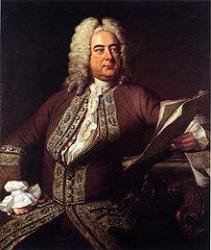
George Frideric Handel

1685 - 1759 Topics: Christ's Example; Christ--Life and ministry of; Christ's Example; Commitment; Discipleship Composer of "CANNONS" in Moravian Book of Worship George Frideric Handel (b. Halle, Germany, 1685; d. London, England, 1759) became a musician and composer despite objections from his father, who wanted him to become a lawyer. Handel studied music with Zachau, organist at the Halle Cathedral, and became an accomplished violinist and keyboard performer. He traveled and studied in Italy for some time and then settled permanently in England in 1713. Although he wrote a large number of instrumental works, he is known mainly for his Italian operas, oratorios (including Messiah, 1741), various anthems for church and royal festivities, and organ concertos, which he interpolated into his oratorio performances. He composed only three hymn tunes, one of which (GOPSAL) still appears in some modern hymnals. A number of hymnal editors, including Lowell Mason, took themes from some of Handel's oratorios and turned them into hymn tunes; ANTIOCH is one example, long associated with “Joy to the World.” Bert Polman

William Walker

1809 - 1875 Topics: Jesucristo Redentor Estación después de Epifanía; Año Cristiano Bautismo del Señor; Christian Year Baptism of the Lord; Discipulado y Servicio; Discipleship and Service; Jesucristo Ejemplo; Jesus Christ Example; Jesus Christ Composer (Attributed to) of "COMPLAINER" in Mil Voces para Celebrar

Richard Farrant

1525 - 1580 Person Name: R. Farrant Topics: Christ Example of Composer of "FARRANT" in Laudes Domini Like many composers of his day, the early years of Richard Farrant’s (c.1525- November 30, 1580) life are not well documented. The first acknowledgment of him is in a list of the Gentleman of the Chapel Royal in 1552. It is assumed from that list that his birth was around 1525. Although, that cannot be accurately determined. During his life he was able to establish himself as a successful composer, develop the English drama considerably, founded the first Blackfriar Theatre, and be the first to write verse-anthems. He married Anne Bower, daughter of Richard Bower who was Master of the Chapel Royal choristers at the time. With Anne he conceived ten children, one of whom was also named, Richard. As a member of the Gentleman of the Chapel Royal, Farrant was active in ceremonies surrounding the royal family. He began his work with the Chapel Royal around 1550 under the reign of Edward VI. Fortunately, for Farrant, this is a time that saw huge developments in Latin Church Music. Composers like William Byrd and Christopher Tye were busy expanding and elaborating on the Church Music of the day. In Farrant's twelve years with the Chapel Royal, he was able to participate in funerals for Edward VI and Mary I, and coronations for Mary I and Elizabeth I. After his work there, he took up a post as organist at St. George’s Chapel at Windsor. For Farrant, the post at at Windsor became a permanent one that he retained for the rest of his life. Along with this, he also acquired the position of Master of the Chapel Royal choristers in November of 1569. Having the choirs of both of these institutions at his disposal gave him an outlet to showcase all of his compositions and plays. In fact, every winter he was able to produce a play for the Queen herself. These positions also allowed him to move back to London in 1576 and begin a public theater of sorts where he rehearsed some of his choir music openly. It was soon after, in 1580, that he passed away, having left his house to his wife. Unlike many composers of his day that stuck to only music composition, Farrant also wrote many plays. One of his most important contributions to drama in England is of course the creation of the first Blackfriars Theatre. This eventually became one of the most important places in London for drama to develop during the Renaissance. Farrant is also one of the earliest and most well known composers that began to mix the two mediums of music and drama. It was this uncommon mixture that allowed him to begin to develop the composition style of 'verse.' This becomes prominent in a lot of his pieces including the anthems "When as we sat in Babylon" and "Call to remembrance" and "Hide not thou thy face." --en.wikipedia.org/wiki/

Carlton R. Young

b. 1926 Topics: Jesucristo Redentor Estación después de Epifanía; Año Cristiano Bautismo del Señor; Christian Year Baptism of the Lord; Discipulado y Servicio; Discipleship and Service; Jesucristo Ejemplo; Jesus Christ Example; Jesus Christ Harmonizer of "COMPLAINER" in Mil Voces para Celebrar

John J. Daniell

1819 - 1898 Person Name: Rev. J. J. Daniel Topics: Christ Example of Author of "Come sing with holy gladness" in Alleluia Daniell, John Jeremiah, born at Bath, Oct. 6, 1819. In 1848 he was ordained by the Bp. of Manchester. His subsequent charges included the curacies of Gerrans, Menheniot, Kington-Langley, and others, and the vicarages of Langley-Fitzurse, Winterborne-Stoke, and Berwick St. James, Wilts, and Langley-Burrell, having been preferred to the last in 1879. Mr. Daniell is the author of several prose works, as: Life of Mrs. Godolphin; The Geography of Cornwall, &c.; and of a poetical work, Lays of the English Cavaliers. His hymns in common use are:— 1. Alleluia, thanks and glory. Children praising Jesus. Contributed to the Society for Promoting Christian Knowledge Children's Hymns, No. 69. 2. Come, sing with holy gladness. Praise of Christ. Contributed to the Appendix of Hymns Ancient & Modern, 1868, and since adopted by several collections in Great Britain and America. Mr. Daniell has also written several hymns for local use: but these have not appeared in the larger and more widely used collections. He died Nov. 1, 1898. -- John Julian, Dictionary of Hymnology (1907)

William Dixon

1750 - 1825 Person Name: Robert Wm. Dixon, 1750-1825 Topics: Christ Life, Example, and Ministry; Christ Presence of; Following Christ; Humility; Perseverance Composer of "STAINCLIFFE" in Hymnal and Liturgies of the Moravian Church William Dixon b. ? Lndon, c. 1760; d. there 1825) composer, writer, teacher and music-engraver; lived partly in London, partly in Liverpool, where he was apparently connected with All Saints' Church. He composed 'Psalmodia Christiana," a collection of sacred music (1790); 'Euphonia,' 62 psalm and hymn tunes in 4 parts for All Saints' Church, Liverpool' Moralities, or verses on music, friendship, avarice, etc.' services, anthems, glees; also som numbers in Arnold's collection of hymn tunes. He also wrote an Introduction ot Singing, 1795) Groves Dictionary of Music and Musicians (vol. 2) by H. C. Colles (Macmillan Company, 1906)

John Richardson

1816 - 1879 Topics: Christ Example of Arranger of "ST. BERNARD" in The Hymnal of the Protestant Episcopal Church in the United States of America 1940

Pages


Export as CSV
It looks like you are using an ad-blocker. Ad revenue helps keep us running. Please consider white-listing Hymnary.org or getting Hymnary Pro to eliminate ads entirely and help support Hymnary.org.