1838 - 1904 Person Name: G. F. Cobb Topics: The Holy Scriptures Composer of "LAUDA SION" in The Church Hymnal Gerard Francis Cobb was born at Nettlestead (near Maidstone), Kent, on 15 October 1838, the youngest of five children of the Reverend William Francis Cobb (1795-1862) - the rector of Nettlestead - and his wife, Mary Blackburn. The five children were:- 1. Mary (1826-1906), 2. Clement Francis (1821-1896), 3. William Francis (1831-1916), 4. Francis (1834-1920), and 5. Gerard Francis (1838-1904). (The patronymic ‘Francis' occurs in several generations. Gerard's grandfather was Francis Cobb (1759-1831), a brewer and banker of Margate, whose sons were William Francis (Gerard's father), John Francis and Thomas Francis. Gerard's brother Clement also had a son Francis William (1872-1938). The parents were both musical, the mother being a pianist (and latterly organist at Nettlestead) and the father a ’cellist. Gerard early showed an aptitude for music and was able to pick out a tune on the piano while still a child, and without any formal instruction.
Gerard Francis Cobb was educated at Marlborough College from 1849 to 1857. (His brothers William and Clement were also educated there.) He was a bright pupil, reaching the Sixth Form in September 1854 (still aged 15) and winning several prizes - the Divinity Prize (Summer 1853), the Upper Fifth Prize (Summer 1854), the Lower Sixth Prize (Christmas 1854) and the English Essay Prize (1856). He was also appointed a College Prefect and (when he left school) donated a cup as an inter-house singing trophy. (Inter-house singing competitions continue to be popular at Marlborough to this day.) Two concert programmes from Marlborough College (Christmas 1854 and Christmas 1856) show his active involvement as singer, pianist and harmonium player, although in neither programme is there any indication of a composition by him.
From Marlborough Cobb went up to Trinity College, Cambridge, matriculating in 1857. He was elected a Scholar in 1860, and graduated B.A. in 1861 with a double first in the Classical and Moral Science Triposes. He then went to Dresden for a short time, to study music. While there, he perfected his knowledge of German, later providing English translations for three of the texts of his own Lieder und Gesang (1885); he was also proficient in French and Italian, as well as being an excellent classical scholar. (Cobb wrote the words of at least one of his own songs - "Reconciliation" (c.1891) - and inserted a verse of his own into another song - "Drawbacks" (1892), words by Henry S. Leigh.)
It may have been at this time that he decided not to make music his profession: he returned to Cambridge, where he spent the rest of his life. He was elected a Fellow of Trinity in 1863, proceeding M.A. in 1864, and in 1869 was appointed Junior Bursar of his college. This office, which he held for twenty-five years and in which he showed great business capacity, seems to have centered around the day-to-day running of the college, which included looking after the accommodation of some six hundred students (Trinity was the largest of all the Oxbridge colleges) and even making sure that the brewery horse had the correct number of nails in his shoes! (The college had a small brewery).
Cobb's interests were many and varied. There was music, of course, but (appropriately, as the son, brother and uncle of rectors) he was also much interested in Church matters: he was in sympathy with the Tractarian movement (associated with Newman, Pusey, Keble, Forbes and Froude) and at one time contemplated (but finally declined) holy orders. He actively advocated union between the Anglican and Roman communities, and published an elaborate treatise which caused a sensation in ecclesiastical circles. A second edition (with a sequel) followed and this, in turn, was followed by two short tracts. Even as late as the 1860s there was a form of religious intolerance which although not life-threatening (as in the reigns of earlier monarchs) nevertheless ensured that a career in the Church would no longer be an option for Cobb. His appointment at Trinity was timely, and his energies were then directed towards the running of the College and to the pursuit of music.
Cobb was a fine organist, and gave occasional recitals at Trinity. His writings include a history of the organ and an account of the choir which, apparently, he also trained. He was, too, the University’s representative on municipal affairs and produced pamphlets on rather more mundane matters than were normally dealt with in "the olive-grove of Academe".
When Cobb went up to Trinity in 1857 the Professor of Music was the recently appointed (1856) William Sterndale Bennett (1816-1875). Cobb enjoyed Bennett's friendship and was helpful to him in dealing with the Faculty of Music. In the last years of his life, Bennett made use of two bound octavo music note-books in which he jotted down sketches and ideas; these books had been brought to him from Germany by Cobb.
On Bennett's death, the Professorship passed to the blind George Macfarren (1813-1887). Cobb proved equally helpful to the new incumbent, particularly in the reform of the Faculty. He had been elected President of the Cambridge University Musical Society in 1874 and became Chairman of the University Board of Musical Studies in 1877, serving in that capacity for fifteen years.
Aside from his work at Trinity, and his musical, religious, and municipal interests, there is yet one more facet of this Victorian polymath which must command our attention. He was, perhaps surprisingly, a great lover of outdoor activities - swimming, walking, hill climbing, and - above all - cycling. He was one of the founders - and first President (1878) - of the National Cyclists' Union (originally the Bicycle Union) and was also President of the Cambridge University Cycling Club. For the International Health Exhibition (1884) he contributed a chapter on 'Cycling' to the handbook on athletics, part 11.
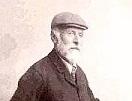
Cobb thought so much of cycling that his enthusiasm induced not only undergraduates but even many of the Dons to take to it (33). He celebrated his sixtieth birthday by undertaking a cycle run of sixty miles in company with one of his nephews. Cobb was not very tall and was almost equalled in height by his earlier high cycle, although in later years he rode what was then called a 'safety cycle' (which was smaller) and, eventually a 'free wheel bicycle'. (The cycle which features in the accompanying photograph is presumably a 'safety' or 'free wheel' machine.)
Little is known of Cobb's life outside Cambridge. His duties at Trinity would have kept him there for most of the year, and his dealings with his London publishers were probably conducted by letter. His name appears on the invitation lists of several of the Royal Society of Musicians' annual dinners in the 1880s and, although he did not attend any of these, he is recorded as having made several donations to the Society.
In 1893 Cobb married Elizabeth Lucy Parkinson, widow of Stephen Parkinson, Fellow and Tutor of St. John’s College, Cambridge, and (in accordance with the custom of the time) resigned his offices at Trinity. He continued to reside in Cambridge - at The Hermitage Silver Street - and devoted himself mainly to musical composition. From this last period of his life came the second (1893) and third (1897) sets of Barrack-Room Ballads (the first having appeared in 1892) and his delightful Twenty-four Songs for Little People (1897) to words by Norman Gale (d. 1942), as well as works on a larger canvas, including his most ambitious work - A Song of Trafalgar Op. 41, a Ballad for men's voices (solo and chorus) and orchestra (1900), to words by Edith Nesbit (1858-1924) - remembered today as the author of The Railway Children (1906).
Among Cobb's large-scale works is reputed to be a Symphony although no trace of this has yet come to light. What can be stated with certainty, however, is that on 27 November 1902 a concert was held at the Winter Gardens, Bournemouth, given by the Municipal Orchestra under the direction of Dan Godfrey, jun. - later Sir Dan Godfrey (1868-1939) - and Gerard Cobb, who conducted "For the first time in Bournemouth" (and probably the first time anywhere) three of his own works - Introduction and Allegro Giocoso in B flat, Valse Pathétique 'Niobe', and Romanza for Orchestra, in E flat (performed at a Prom in 1901); two of Cobb's earlier songs - "I wish to tune my quivering lyre" (written in 1868) and "Mount, Gallants all!" (published c.1890 were sung by Henry Corner. (An orchestral score and band parts for "Mount, Gallants all!" were available for hire from the publishers, and it must be assumed that both songs were given with orchestral accompaniment.)
Cobb's last-known compositions were three further settings of poems by Kipling - not from the Barrack-Room Ballads this time, but from a similar collection, Service Songs. The three songs. - "M.I." (Mounted Infantry of the Line), "The Married Man" (Reservist of the Line), and "Lichtenberg" (New South Wales Contingent) - had been commissioned by Charles Sheard, who had published his settings of the Barrack-Room Ballads and they were completed just a few days before his death. Sheard published them later that year.
Gerard Francis Cobb died at The Hermitage on 31 March 1904. having succumbed to an attack of pneumonia. He was cremated at Woking on 5 April at 12.00 noon, at which precise time a memorial service was held at Trinity College Chapel; the music was all by Cobb. His ashes were laid to rest on 8 April in the churchyard at Nettlestead, where his widow erected a handsome cross in his memory.
http://www.musicweb-international.com/classrev/2004/oct04
Gerard Francis Cobb


 My Starred Hymns
 My FlexScores
 My Hymnals
 My Purchased Files