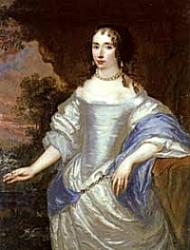
1627 - 1667 Author (attributed to) of "Jesus, My Redeemer, Lives" Luise Henriette, Electress of Brandenburg, daughter of Friedrich Heinrich, Prince of Nassau-Orange and Stadtholder of the United Netherlands, was born at 'S Gravenhage (The Hague), Nov. 27, 1627. She received a careful Christian training, not only in literature, but also in domestic economy and feminine handicrafts. On Dec. 7, 1646, she was married, at the Hague, to the Elector Friedrich Wilhelm of Brandenburg, who was then residing at Cleve, but remained at the Hague to nurse her father, who died March 14, 1647. She then, in June, 1647, joined her husband at Cleve, where her first child, Wilhelm Heinrich, was born in May 1648. In the autumn of 1619 she set out with her husband and child on the way to Berlin, but in the inclement weather the child sickened and died at Wesel, Oct. 24,1649, and it was not till April 10, 1650, that she entered Berlin. On the birth of her second son, Carl Emil (who died 1674), at Oranienburg, near Berlin, on Feb. 16, 1655, she founded an orphanage there as a thank-offering (now the Oranienburg Orphanage at Berlin). On July 11, 1657, her third son, afterwards King Friedrich I. of Prussia, was born at Königsberg. After the birth of her youngest son, Ludwig, at Cleve, in 1666, she never entirely recovered. In the spring of 1667 she was conveyed to Berlin in a litter, and died there June 18, 1667. (Koch, iv. 158; Allgemeine Deutsche Biographie, xix. 623; Goedeke's Grundrias, vol. iii., 1887, p. 319, &c.)
Luise Henriette was a woman of noble character; a devoted wife who accompanied her husband in many of his expeditions, and was his right-hand counsellor in matters of state; and a true mother of her people, introducing the culture of the potato, founding model farms, establishing elementary schools, and in many ways interesting herself in restoring their welfare after the ravages of the Thirty Years' War. She was, like the Elector, a member of the Reformed Church, but earnestly desired to promote peace between the Lutheran and Reformed communions, and exerted herself especially on behalf of P. Gerhardt. Another of her efforts in this direction was by means of the Union Hymn Book, which Christoph Runge edited at her direction, and published in 1653. To this book she herself contributed four hymns. In his dedication to the Electress, Runge says she had "augmented and adorned it with your own hymns, viz.: ‘Ein ander stelle sein Vertrauen'; ‘Gott der Reichthumb deiner Güter'; 'Jesus meine Zuversicht'; 'Ich wil von meiner Missethat.' Your Electoral Highness has not only in those your now mentioned hymns (itzt gemeldten geistreichen Ihren eigenen Liedern) made known to all the world your Christian spirit; how your confidence is directed to God alone; how you ascribe to him with thankful heart all the benefits you enjoy; and how you rest the hope of your future everlasting life in Heaven on Christ alone as on a steadfast rock, but have also," &c. &c.
The question however remains. Did Runge here mean more than that she had sent for insertion certain hymns which were favourites of her own, perhaps written for her, but not necessarily written by her? Such cases were common enough at an earlier period. It is certainly strange that her name should not be given in any of the many hymn-books in which the third of these ("Jesus meine Zuversicht") was included during the next century. It was not till 1769 that Runge's dedication suggested to D. G. Schöber, and, after him, to other compilers, the idea of the Electress's authorship; but once suggested it was soon generally accepted. Fischer, i. 390-396, gives various additional reasons that make this theory unlikely; such as that while in Runge's dedication they are mentioned as above, yet her name is not affixed to the individual hymns in the body of the book; that in the funeral oration by her private chaplain, no mention is made of her poetical gifts; that Crüger gave them in his Praxis pietatis melica without her name (in the 1664 and later editions the first was omitted), and that in particular the third is too classic and correct in style to have been written by so poor a German scholar as the Electress. This last objection would of course be met if we could suppose with Koch (iv. p. 169) that the hymn was originally written in Dutch, or with Dutch idioms, and was revised and corrected by her minister, Otto von Schwerin, or by Runge.
In view of the present evidence we can only say that if the Electress were not the author of these hymns there is at least no proof of any kind to show that they were composed by any of those whose names have sometimes been attached to them; such as Otto von Schwerin (b. 1616, d. 1679), Caspar Ziegler (b. 1621, d. 1690), Hans von Assig (b. 1650, d. 1694), and others. In this state of uncertainty the case must be left till definite proof be forthcoming.
Two of these hymns have passed into English, viz.:—
i. Ich will von meiner Missethat. Lent. This beautiful hymn first appeared in the Crüger-Runge Gesang-Buch, 1653, No. 45, in 16 st. of 7 1., entitled, "Hymn of Penitence," and without signature. Koch, iv. 160, conjectures that it may have been written at Cleve in 1648. In the Unverfälschter Liedersegen 1851, No. 380. The translations are :—
(1) "With sorrow now for past misdeeds," by Miss Cox, 1864, p, 204. (2) "I will return unto the Lord," by Miss Winkworth, 1869, p. 221.
ii. Jesus meine Zuversicht. Easter. This beautiful hymn, founded on Job xix. 25-27 and 1 Cor. xv. 35 ff., appeared in the Crüger-Runge Gesang-Buch, 1653, No. 140, in 10 st. of 6 l., and without signature. Its origin is thus given by Lauxmann, in Koch, viii. 69:—
"It dates from the early years of her married life. In the autumn of 1649 she lost her first child, the Crown Prince Wilhelm Heinrich, at Wesel, while on her journey [to Berlin], by which death for a long time the hope of succession in the Electoral House and in the Hohenzollern family line seemed to be lost. At Tangermünde, in the Altmark [on the Elbe], she had to spend some quiet winter months, and here probably the princess of twenty-two years poured out her heart before the Lord in this hymn."
This, however, is conjecture rather than history; for, as stated above, it is not yet clearly proved that the Electress wrote any hymns. The hymn itself is of the first rank; and A. J. Rambach calls it "an acknowledged masterpiece of Christian poetry;" while C. von Winterfeld says, "it will ever remain a treasure among the hallowed songs of the Evangelical Church." It bears a certain resemblance to the concluding section of the Apotheosis of A. C. Prudentius (lines 1063-1085, with the subtitle "De resurrectione carnis humanae," and beginning, "Nosco meum in Christo corpus consurgere. Quid me"); but can hardly be called a translation of it. It was included in Crüger's Praxis, 1656, No. 182, passed into almost all later hymn-books, and is No. 866 in the Unverfälschter Liedersegen, 1851.
The beautiful chorale (as in the Chorale Book for England) appeared in its first form in 1653, along with the hymn. C. von Winterfeld conjectured that it may have been by the Electress. The form now in use is modified from that given by Crüger in his Praxis, 1656. Translated as:—
1. Christ, my Rock, my sure Defence. Omitting st. ix., as No. 51 in the Moravian Hymn Book 1769. In the edition of 1789. No. 833, st. viii. was omitted, and a translation from Christian Gregor’s "Nein, ach nein, er lasst mich nicht," was added as st. iii. (ed. 1886, No. 1241). Abridged forms are in J. A. Latrobe's Collection, 1841, and Dr. Hook's Church School Hymn Book, 1850.
2. Jesus, on Whose name I rest. A good translation of st. i.-iv., vi., by A. T. Russell, as No. 264, in his Psalms & Hymns, 1851.
3. Jesus, my Redeemer, lives. A good translation, omitting st. iv., v., by Miss Winkworth, in her Lyra Germanica 1st Ser., 1855, p. 93. Repeated, in full, in the Ohio Evangelical Lutheran Hymnal
Electress Luise Henriette


 My Starred Hymns
 My FlexScores
 My Hymnals
 My Purchased Files