

 My Starred Hymns
 My FlexScores
 My Hymnals
 My Purchased Files
Planning worship?
Check out our sister site, ZeteoSearch.org,
for 20+ additional resources related to your search.
- |
User Links
Person Results
Edward Perronet
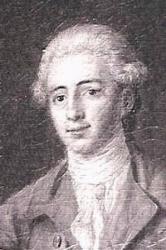
1721 - 1792 Person Name: Edwrad Perronet, 1726-1792 Scripture: Genesis 3:1-15 Author of "All hail the power of Jesu's name!" in Singing the Faith Edward Perronet was the son of the Rev. Vincent Perronet, Vicar of Shoreham, Kent. For some time he was an intimate associate of the Wesleys, at Canterbury and Norwich. He afterwards became pastor of a dissenting congregation. He died in 1792. In 1784, he published a small volume, entitled "Occasional Verses, Moral and Social;" a book now extremely rare. At his death he is said to have left a large sum of money to Shrubsole, who was organist at Spafield's Chapel, London, and who had composed the tune "Miles Lane" for "All hail the power of Jesus' Name!"
--Annotations of the Hymnal, Charles Hutchins, M.A. 1872.
------
Perronet, Edward. The Perronets of England, grandfather, father, and son, were French emigres. David Perronet came to England about 1680. He was son of the refugee Pasteur Perronet, who had chosen Switzerland as his adopted country, where he ministered to a Protestant congregation at Chateau D'Oex. His son, Vincent Perronet, M.A., was a graduate of Queen's College, Oxford, though his name is not found in either Anthony Woods's Athenae Oxonienses nor his Fasti, nor in Bliss's apparatus of additional notes. He became, in 1728, Vicar of Shoreham, Kent. He is imperishably associated with the Evangelical Revival under the Wesleys and Whitefield. He cordially cooperated with the movement, and many are the notices of him scattered up and down the biographies and Journals of John Wesley and of Selina, Countess of Huntingdon. He lived to the venerable age of ninety-one; and pathetic and beautiful is the account of John Wesley's later visits to the white-haired saint (b. 1693, d. May 9, 1785).* His son Edward was born in 1726. He was first educated at home under a tutor, but whether he proceeded to the University (Oxford) is uncertain. Born, baptized, and brought up in the Church of England, he had originally no other thought than to be one of her clergy. But, though strongly evangelical, he had a keen and searching eye for defects. A characteristic note to The Mitre, in referring to a book called The Dissenting Gentleman's answer to the Rev. Mr. White, thus runs:—"I was born, and am like to die, in the tottering communion of the Church of England; but I despise her nonsense; and thank God that I have once read a book that no fool can answer, and that no honest man will". The publication of The Mitre is really the first prominent event in his life. A copy is preserved in the British Museum, with title in the author's holograph, and manuscript notes; and on the fly-leaf this:— "Capt. Boisragon, from his oblig'd and most respectful humble servt. The Author. London, March 29th, 1757." The title is as follows:— The Mitre; a Sacred Poem (1 Samuel ii. 30). London: printed in the year 1757. This strangely overlooked satire is priceless as a reflex of contemporary ecclesiastical opinion and sentiment. It is pungent, salted with wit, gleams with humour, hits off vividly the well-known celebrities in Church and State, and is well wrought in picked and packed words. But it is a curious production to have come from a "true son" of the Church of England. It roused John Wesley's hottest anger. He demanded its instant suppression; and it was suppressed (Atmore's Methodist Memorial, p. 300, and Tyerman, ii. 240-44, 264, 265); and yet it was at this period the author threw himself into the Wesleys' great work. But evidences abound in the letters and journals of John Wesley that he was intermittently rebellious and vehement to even his revered leader's authority. Earlier, Edward Perronet dared all obloquy as a Methodist. In 1749 Wesley enters in his diary:
"From Rochdale went to Bolton, and soon found that the Rochdale lions were lambs in comparison with those of Bolton. Edward Perronet was thrown down and rolled in mud and mire. Stones were hurled and windows broken" (Tyerman's Life and Times of the Rev. John Wesley, M.A., 3 vols., 1870 ; vol. ii. 57).
In 1750 John Wesley writes:
”Charles and you [Edward Perronet] behave as I want you to do; but you cannot, or will not, preach where I desire. Others can and will preach where I desire, but they do not behave as I want them to do. I have a fine time between the one and the other. I think Charles and you have in the general a right sense of what it is to serve as sons in the gospel; and if all our helpers had had the same, the work of God would have prospered better both in England and Ireland. I have not one preacher with me, and not six in England, whose wills are broken to serve me" (ibid. ii. 85, and Whitehead's Life of Wesley, ii. 259).
In 1755 arrangements to meet the emergency created by its own success had to be made for Methodism. As one result, both Edward and Charles Perronet broke loose from John Wesley's law that none of his preachers or "helpers" were to dispense the Sacraments, but were still with their flocks to attend the parish churches. Edward Perronet asserted his right to administer the Sacraments as a divinely-called preacher ibid. ii. 200). At that time he was resident at Canterbury, "in a part of the archbishop's old palace" (ibid. ii. 230. In season and out of season he "evangelized." Onward, he became one of the Countess of Huntingdon's "ministers" in a chapel in Watling Street, Canterbury. Throughout he was passionate, impulsive, strong-willed; but always lived near his divine Master. The student-reader of Lives of the Wesleys will be "taken captive" by those passages that ever and anon introduce him. He bursts in full of fire and enthusiasm, yet ebullient and volatile. In the close of his life he is found as an Independent or Congregational pastor of a small church in Canterbury. He must have been in easy worldly circumstances, as his will shows. He died Jan. 2, 1792, and was buried in the cloisters of the great cathedral, Jan. 8. His Hymns were published anonymously in successive small volumes. First of all came Select Passages of the Old and New Testament versified; London: Printed by H. Cock, mdcclvi. … A second similar volume is entitled A Small Collection of Hymns, &c, Canterbury: printed in the year dcclxxxii. His most important volume was the following:— Occasional Verses, moral and sacred. Published for the instruction and amusement of the Candidly Serious and Religious. London, printed for the Editor: And Sold by J. Buckland in Paternoster Row; and T. Scollick, in the City Road, Moorfields, mdcclxxxv. pp. 216 (12°). [The British Museum copy has the two earlier volumes bound up with this.] The third hymn in this scarce book is headed, “On the Resurrection," and is, ”All hail the power of Jesus' name". But there are others of almost equal power and of more thorough workmanship. In my judgment, "The Lord is King" (Psalm xcvi. 16) is a great and noble hymn. It commences:—
“Hail, holy, holy, holy Loud!
Let Pow'rs immortal sing;
Adore the co-eternal Word,
And shout, the Lord is King."
Very fine also is "The Master's Yoke—the Scholar's Lesson," Matthew xi. 29, which thus opens:—
O Grant me, Lord, that sweet content
That sweetens every state;
Which no internal fears can rent,
Nor outward foes abate."
A sacred poem is named "The Wayfaring Man: a Parody"; and another, "The Goldfish: a Parody." The latter has one splendid line on the Cross, "I long to share the glorious shame." "The Tempest" is striking, and ought to be introduced into our hymnals; and also "The Conflict or Conquest over the Conqueror, Genesis xxxii. 24". Still finer is "Thoughts on Hebrews xii.," opening:—
"Awake my soul—arise!
And run the heavenly race;
Look up to Him who holds the prize,
And offers thee His grace."
"A Prayer for Mercy on Psalm cxix. 94," is very striking. On Isaiah lxv. 19, is strong and unmistakable. "The Sinner's Resolution," and "Thoughts on Matthew viii. 2," and on Mark x. 51, more than worthy of being reclaimed for use. Perronet is a poet as well as a pre-eminently successful hymnwriter. He always sings as well as prays. It may be added that the brief paraphrase after Ovid given below, seems to echo the well-known lines in Gray's immortal elegy:—
"How many a gem unseen of human eyes,
Entomb'd in earth, a sparkling embryo lies;
How many a rose, neglected as the gem,
Scatters its sweets and rots upon its stem:
So many a mind, that might a meteor shone,
Had or its genius or its friend been known;
Whose want of aid from some maternal hand,
Still haunts the shade, or quits its native land." [Rev. A. B. Grosart, D.D., LL.D.]
* Agnew's Protestant Exiles from France in the Reign of Louis XIV. confounds Vincent the father with Edward his son.
-- John Julian, Dictionary of Hymnology (1907)
Edward Perronet
John Rippon
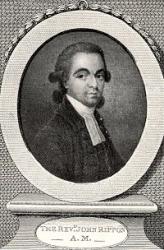
1751 - 1836 Person Name: John Rippon, 1751-1836 Scripture: Genesis 3:1-15 Adapter of "All hail the power of Jesu's name!" in Singing the Faith Rippon, John, D.D., was born at Tiverton, Devon, April 29, 1751, and was educated for the ministry at the Baptist College, Bristol. In 1773 he became Pastor of the Baptist church in Carter Lane, Tooley Street (afterwards removed to New Park Street), London, and over this church he continued to preside until his death, on Dec. 17, 1836. The degree of D.D. was conferred on him in 1792 by the Baptist College, Providence, Rhode Island. Dr. Rippon was one of the most popular and influential Dissenting ministers of his time. From 1790 to 1802 he issued the Baptist Annual Register, a periodical containing an account of the most important events in the history of the Baptist Denomination in Great Britain and America during that period, and very valuable now as a book of reference. But his most famous work is his Selection of hymns for public worship, which appeared in 1787. The full title of the first edition is A selection of Hymns from the best authors, intended as an Appendix to Dr. Watts's Psalms and Hymns. In 1791 he published a Selection of Psalm and Hymn Tunes from the Best Authors, adapted to Dr. Watts's Psalms and Hymns, and to his own Selection, and from that time the names of tunes were prefixed to the hymns in the successive editions of his hymn-book. In 1800 he published the 10th ed. of his Selections, containing more than sixty additional hymns.
In 1827 it was still further enlarged, and in 1844, after his death, appeared The Comprehensive Edition, commonly known as The Comprehensive Rippon, containing most of the additional hymns, with about 400 then first added, making in all upwards of 1170, in 100 metres. A rival to the Comprehensive was also afterwards published under the old title, somewhat enlarged. In the preparation of the original book, and its subsequent improvement, Dr. Rippon performed an important service to Baptist Hymnody, and also, it is said, gained for himself "an estate" through its immense sale. In the preface to the tenth edition lie claims for himself the authorship of some of the hymns, but as he refrained from affixing his name to any of the hymns it is impossible now to say with certainty which ought to be ascribed to him. There can, however, be no reasonable doubt that hymn 535, 3rd part, "The day has dawned, Jehovah comes" (q.v.), is one of his compositions. Other hymns, probably by him, are, "Amid the splendours of Thy state" (Love of God), 1800; and "There is joy in heaven, and joy on earth" (Joy over the Repenting Sinner), 1787. He also altered the texts of and made additions to several of the older hymns. Some of these altered texts are still in common use. In 1830 the additions given in the 27th ed., 1827, of Rippon's Selections were reprinted, with notes by Dr. Slater, as:—
Hymns Original and Selected; interspersed in the Twenty-seventh edition of the Selection, with Numerous Doxologies, in the Usual, the Peculiar, and in the less Common metres. By John Rippon, D.D.
A second edition of this pamphlet of 82 hymns and doxologies appeared in 1832. [Rev. W. R. Stevenson, M.A.]
--John Julian, Dictionary of Hymnology (1907)
John Rippon
Thomas Phillips
1735 - 1807 Person Name: Thomas Phillips, 1735-1807 Scripture: Genesis 3:15-24 Composer of "LYDIA" in Together in Song
Thomas Phillips
Sir Arthur Somervell
1863 - 1937 Person Name: Arthur Somervell (1863-1937) Scripture: Genesis 3:1-15 Composer of "CHORUS ANGELORUM (SOMERVELL)" in Church Hymnary (4th ed.) b. June 5, 1863, Windermere, d. May 2, 1937, London; English composer and educationist
Sir Arthur Somervell
Frederick M. Lehman
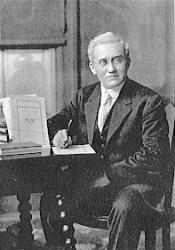
1868 - 1953 Scripture: Genesis 3:8-9 Author of "The Love of God" in Hymns of Faith Frederick Martin Lehman, 1868-1953
Born: August 7, 1868, Mecklenburg, Schwerin, Germany.
Died: February 20, 1953, Pasadena, California.
Buried: Forest Lawn Memorial Park, Glendale, California.
Lehman emigrated to America with his family at age four, settling in Iowa, where he lived most of childhood. He came to Christ at age 11, as he relates:
One glad morning about eleven o’clock while walking up the country lane, skirted by a wild crab-apple grove on the right and an osage fence, with an old white-elm gate in a gap at the left, suddenly Heaven let a cornucopia of glory descend on the eleven-year old lad. The wild crab-apple grove assumed a heavenly glow and the osage fence an unearthly lustre. That old white-elm gate with its sun-warped boards gleamed and glowed like silver bars to shut out the world and shut him in with the ’form of the fourth,’ just come into his heart. The weight of conviction was gone and the paeans of joy and praise fell from his lips.
Lehman studied for the ministry at Northwestern College in Naperville, Illinois, and pastored at Audubon, Iowa; New London, Indiana; and Kansas City, Missouri. The majority of his life was devoted to writing sacred songs; his first was written while a pastor in Kingsley, Iowa, in 1898. He wrote and published hundreds of songs, and compiled five song books. In 1911, he moved to Kansas City, where he helped found the Nazarene Publishing House.
--www.hymntime.com/tch
Frederick M. Lehman
Thomas Jarman
1776 - 1861 Scripture: Genesis 3:15 Composer of "LYNGHAM" in Psalter Hymnal (Gray) Thomas Jarman was born on 21st December 1776 in Clipston, a small village near the northern border of the County of Northampton. His father was not only a Baptist lay preacher, but also a tailor, and Thomas was brought up in the same trade, although his brother, John, followed his father’s calling to become a minister.
His natural taste for music, however, considerably interfered with his work, and he was frequently reduced to dire straits, from which only the extreme liberality of his publishers relieved him. He was a man of fine, commanding presence, but self-willed, and endowed with a considerable gift of irony, as choirs frequently found to their cost. Weston quotes from Kant that Jarman neglected his work and ‘this kept him poor and soured his temper’.
He joined the choir of the Baptist chapel in his native village when quite a youth, and soon became the choirmaster there. He adopted music as a profession (with occasional returns to his old trade), and was engaged as teacher of harmony and singing in many of the neighbouring villages. He was a successful choir-trainer, spending several years at Leamington, and conducted concerts as well as services, for which he was ‘constantly composing works’. The village choir festival held under his direction at Naseby, in 1837, is said to have been the talk of the district for long after. He spent some six or seven years at Leamington, during which time he enjoyed the friendship of C. Rider, a wealthy Methodist who did much good for the psalmody of Lancashire and elsewhere some fifty or sixty years ago.
Jarman published an enormous quantity of music, including over six hundred hymn-tunes, besides anthems, services, and similar pieces.
Amongst his many anthems written for special occasions there is one for the opening of the new Baptist chapel at Clipston. Another is a MAGNIFICAT for Dr Marsh's Episcopal chapel at Leamington, where Thomas Jarman was called to assist the quire in their study and performance of psalmody.
Thomas Jarman lived to the good old age of eighty-five, dying in 1861, and lies buried in the graveyard attached to the Baptist chapel at Clipston in Northants.
--immanuelsground.com/composers/ (excerpts)
Thomas Jarman
Henry J. Gauntlett
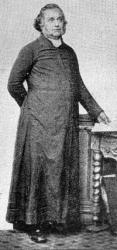
1805 - 1876 Person Name: H. J. Gauntlett, 1805-1876 Scripture: Genesis 3:14 Composer of "ST FULBERT" in Common Praise Henry J. Gauntlett (b. Wellington, Shropshire, July 9, 1805; d. London, England, February 21, 1876) When he was nine years old, Henry John Gauntlett (b. Wellington, Shropshire, England, 1805; d. Kensington, London, England, 1876) became organist at his father's church in Olney, Buckinghamshire. At his father's insistence he studied law, practicing it until 1844, after which he chose to devote the rest of his life to music. He was an organist in various churches in the London area and became an important figure in the history of British pipe organs. A designer of organs for William Hill's company, Gauntlett extended the organ pedal range and in 1851 took out a patent on electric action for organs. Felix Mendelssohn chose him to play the organ part at the first performance of Elijah in Birmingham, England, in 1846. Gauntlett is said to have composed some ten thousand hymn tunes, most of which have been forgotten. Also a supporter of the use of plainchant in the church, Gauntlett published the Gregorian Hymnal of Matins and Evensong (1844).
Bert Polman
Henry J. Gauntlett
Eleanor Farjeon
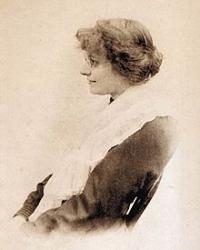
1881 - 1965 Person Name: Eleanor Farjeon (1881-1965) Scripture: Genesis 3:15 Author of "People, look East. The time is near" in Church Hymnary (4th ed.) Eleanor Farjeon, (born Feb. 13, 1881, London--died June 5, 1965, Hampstead, London), English writer for children whose magical but unsentimental tales, which often mock the behaviour of adults, earned her a revered place in many British nurseries.
The daughter of a British novelist and granddaughter of a U.S. actor, Eleanor Farjeon grew up in the bohemian literary and dramatic circles of London. Attending opera and theatre at 4 and writing on her father’s typewriter at 7, Farjeon came to public attention at 16 as the librettist of an opera, with music by her brother Harry, which was produced by the Royal Academy of Music.
Her success with Nursery Rhymes of London Town (1916), simple tunes originally for adults but adapted and sung in junior schools throughout England, spurred her writing. In addition to such favourites as Martin Pippin in the Apple Orchard (1921) and The Little Bookroom (1955), which won the Carnegie Medal and the first Hans Christian Anderson Award, Farjeon’s prolific writings include children’s educational books, among them Kings and Queens (1932; with Herbert Farjeon); adult books; and memoirs, notably A Nursery in the Nineties (1935; rev. ed. 1960).
--www.britannica.com/EBchecked/topic/201881/Eleanor-Farjeon
Eleanor Farjeon
Martin Shaw
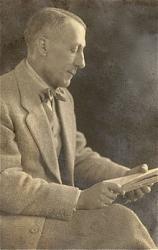
1875 - 1958 Person Name: Martin Edward Fallas Shaw (1875-1958) Scripture: Genesis 3:15 Harmonizer of "BESANÇON" in Church Hymnary (4th ed.) Martin F. Shaw was educated at the Royal College of Music in London and was organist and choirmaster at St. Mary's, Primrose Hill (1908-1920), St. Martin's in the Fields (1920-1924), and the Eccleston Guild House (1924-1935). From 1935 to 1945 he served as music director for the diocese of Chelmsford. He established the Purcell Operatic Society and was a founder of the Plainsong and Medieval Society and what later became the Royal Society of Church Music.
Author of The Principles of English Church Music Composition (1921), Shaw was a notable reformer of English church music. He worked with Percy Dearmer (his rector at St. Mary's in Primrose Hill); Ralph Vaughan Williams, and his brother Geoffrey Shaw in publishing hymnals such as Songs of Praise (1925, 1931) and the Oxford Book of Carols (1928). A leader in the revival of English opera and folk music scholarship, Shaw composed some one hundred songs as well as anthems and service music; some of his best hymn tunes were published in his Additional Tunes in Use at St. Mary's (1915).
Bert Polman
Martin Shaw
John Kelly
1833 - 1890 Person Name: John Kelly, 1833-90 Scripture: Genesis 3:15 Translator of "Awake, My Heart, with Gladness" in Lutheran Service Book Kelly, John, was born at Newcastle-on-Tyne, educated at Glasgow University, studied theology at Bonn, New College, Edinburgh, and the Theological College of the English Presbyterian Church (to which body he belongs) in London. He has ministered to congregations at Hebburn-on-Tyne and Streatham, and was Tract Editor of the Religious Tract Society. His translations of Paul Gerhardt's Spiritual Songs were published in 1867. Every piece is given in full, and rendered in the metre of the originals. His Hymns of the Present Century from the German were published in 1886 by the Religious Tract Society. In these translations the metres of the originals have not always been followed, whilst some of the hymns have been abridged and others condensed. His translations lack poetic finish, but are faithful to the originals. [Rev. W. Garrett Horder]
-- John Julian, Dictionary of Hymnology (1907)
==================
Kelly, John, p. 614, i. He died while on a visit to Braemar, July 19, 1890.
--John Julian, Dictionary of Hymnology, Appendix, Part II (1907)
John Kelly
Pages




