

 My Starred Hymns
 My FlexScores
 My Hymnals
 My Purchased Files
Planning worship?
Check out our sister site, ZeteoSearch.org,
for 20+ additional resources related to your search.
- |
User Links
Person Results
Joseph P. Holbrook
1822 - 1888 Composer of "REFUGE" in The Hymnal Joseph P. Holbrook was a tune writer in the parlor music style, and used the popular melodies of Mason and Hastings, Bradbury and Root, Greatorex and Kingsley in his collections. He furnished settings for the choir hymns in Songs for the Sanctuary in his Quartet and chorus Choir (New York, 1871, and sought more recogniation than had been given him in a hymnal of his own, Worship in Song (New York, 1880); a book that found no welcome.
from The English hymn: its development and use in worship
By Louis FitzGerald Benson
Joseph P. Holbrook
Thomas M. Westrup
1837 - 1909 Person Name: Tomás M. Westrup, 1837-1909 Translator (sts. 1-3) of "Jesus, Lover of My Soul (Cariñoso Salvador)" in Santo, Santo, Santo Thomas Martin Westrup moved with his family from London to Mexico when he was fifteen years old. He translated hundreds of hymns and, along with his son, Enrique, published a three-volume hymnal Incienso Christiano.
Dianne Shapiro from Celebremos su Gloria (Colombia/Illinois: Libros Alianza/Celebration), 1992
Thomas M. Westrup
John T. Grape
1835 - 1915 Person Name: J. T. Grape Arranger of "STONE" in Loving Voices John Thomas Grape USA 1835-1915. Born at Baltimore, MD, he became a successful coal merchant. He married Sophia F MacCubbin, and they had one daughter, Agnes. He was a member of Monument St. Methodist Church in Baltimore, where he played the organ, directed the choir, and was active in the Sunday school. Later, he directed the choir at the Hartford Avenue Methodist Church. The hymn noted below was composed by Grape in 1868, with lyrics composed by Envina Mable Hall of the same church in 1865 while sitting in the choir loft during a sermon. Both words and music had been given to the pastor, Rev George W Schreck, at different times, and one day he remembered he had been given both. Grape's tune had a refrain, so Ms Hall, hearing it, then added words to her poem for that, and the hymn was complete. At Schreck's urging they sent the hymn to Professor Theodore Perkins, publisher of “Sabbath Carols” periodical, and it became popular. Grape died in Baltimore.
John Perry
John T. Grape
Adam Geibel
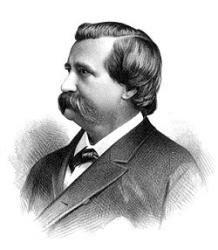
1855 - 1933 Composer of "[Jesus, lover of my soul]" in Uplifted Voices Born: September 15, 1855, Neuenheim, Germany.
Died: August 3, 1933, Philadelphia, Pennsylvania.
Though blinded by an eye infection at age eight, Geibel was a successful composer, conductor, and organist. Emigrating from Germany probably around 1864, he studied at the Philadelphia Institute for the Blind, and wrote a number of Gospel songs, anthems, cantatas, etc. He founded the Adam Geibel Music Company, later evolved into the Hall-Mack Company, and later merged to become the Rodeheaver Hall-Mack Company. He was well known for secular songs like "Kentucky Babe" and "Sleep, Sleep, Sleep." In 1885, Geibel organized the J. B. Stetson Mission. He conducted the Stetson Chorus of Philadelphia, and from 1884-1901, was a music instructor at the Pennsylvania Institution for the Instruction of the Blind. His works include:
Evening Bells, 1874
Saving Grace, with Alonzo Stone (Philadelphia, Pennsylvania: Stone & Bechter, Publishers, 1898)
Consecrated Hymns, (Philadelphia, Pennsylvania: Geibel & Lehman, 1902)
Uplifted Voices, co-editor with R. Frank Lehman (Philadelphia, Pennsylvania: Geibel & Lehman, 1901)
World-Wide Hosannas, with R. Frank Lehman (Philadelphia, Pennsylvania: Geibel & Lehman, 1904)
Hymns of the Kingdom, co-editor with R. Frank Lehman et al. (Philadelphia, Pennsylvania: Geibel & Lehman, 1905)
--www.hymntime.com/tch/
Adam Geibel
Charlie D. Tillman
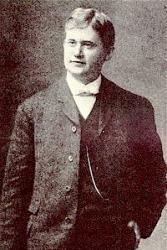
1861 - 1943 Arranger of "[Jesus, lover of my soul]" in The Revival No. 2 Tillman, Charles "Charlie" Davis. (Tallahassee, Talapoosa County, Alabama, March 20, 1861--1943). Married Anna Killingsworth (Dec. 24, 1889); four daughters, one son (d.1910).
--Keith C. Clark, DNAH Archives
Charlie D. Tillman
T. C. O'Kane
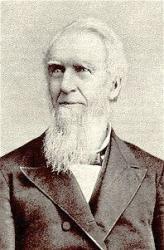
1830 - 1912 Composer of "EDWARD" in Unfading Treasures O'Kane, Tullius Clinton, an American writer, born March 10, 1830, is the author of "O sing of Jesus, Lamb of God" (Redemption); and "Who, who are these beside the chilly wave?" (Triumph in Death), in I. D. Sankey's Sacred Songs and Solos, 1878 and 1881.
--John Julian, Dictionary of Hymnology, Appendix, Part II (1907)
===========================
Tullius Clinton O'Kane was born in Fairfield County, Ohio, March 10, 1830. He resided with his parents in this vicinity until the spring of 1849, when he went to Delaware, Ohio, and entered the Ohio Wesleyan University, from which he graduated in 1852, with the degree A. B., and received his A. M. degree three years later from his Alma Mater.
Immediately upon his graduation, he was tendered a position in the Faculty as Tutor of Mathematics, which he accepted and successfully filled for five years. The students always called him "Professor," by which title he is known to the present day.
His musical abilities were early recognized in the University, and for years he was the musical precentor in the daily chapel devotions. He organized and maintained a Choral Society in the College, and was the first musical instructor in the Ohio Wesleyan Female College, which a few years ago was incorporated into the University.
In 1857 he was elected to a principalship in the Cincinnati public schools, and served in that capacity until 1861, when he resigned his position to accept a place in the piano establishment of Philip Phillips & Co. He remained with this house until its removal to New York City in 1867, when, although urged to be transferred with the house to that city, he preferred to remove with his family back to Delaware, Ohio.
For the ensuing six years he traveled over the state of Ohio as the general agent for the Smith American Organ Co., of Boston, Mass. During this time he visited conferences, Sunday-school conventions, both State and County, introducing his Sunday-school singing books, and in this way became well known throughout his native state, and quite extensively in some of the adjoining states.
His musical compositions were first published in Philip Phillips' Musical Leaves, in 1865, and since then but few Sunday-school singing books have appeared without one or more of his compositions.
His first music book, Fresh Leaves, was issued in 1868. This was followed at intervals by Dew Drops, Songs of Worship, Every Sabbath, Jasper and Gold, Redeemer's Praise, Glorious Things and Morning Stars. In connection with his son, Edward T. O'Kane, who is himself a most excellent composer and a very skillful organist, in 1882 he issued Selected Anthems, a book designed for use by the more advanced choirs. In association with J. R. Sweney and "Chaplain" McCabe, he issued Joy to the World, a song book for prayer-meetings, and the same editors, with the addition of W. J. Kirkpatrick, compiled Songs of Redeeming Love, No. 1, in 1882, and No. 2 in 1884. He also issued Songs of Praises, Unfading Treasures and Forward Songs.
Some of Professor O'Kane's best known songs are Glorious Fountain, The Home Over There, On Jordan's Stormy Banks, Say, are You Ready? and many others. With Mr. O'Kane, music and musical composition have ever been a recreation, rather than a profession. He is an excellent leader of choirs, but his forte seems to be in leading large congregations, Sunday-schools and social religious meetings in sacred song. He sings "with the spirit and the understanding also " — with a due appreciation of both words and music — and very naturally infuses his enthusiasm into his audiences so that they cannot "keep from singing." In his music he endeavors to catch the spirit of the hymn, and then give it expression in the music he composes for it. This sometimes seems to have been almost an inspiration, and could be illustrated by a reference to the circumstances under which many of his compositions have been made.
One of his earlier and more widely known pieces is that entitled, Over There. He says he cut this hymn out of some newspaper and put it with others in his portfolio, intending some time when he felt like it to give it a musical setting. One Sunday afternoon, after studying his lesson for the next session of his Sunday-school, he opened his portfolio, and turning over the selections, found these words, and something seemed to say, "Now's your time." He sat down at the organ, studied the hymn intently for a few moments, and then, as his fingers touched the keys of the instrument, melody and harmony were in every movement, and when the stanza was ended, melody and harmony found their expression in the chorus, and Over There was finished.
Another of his well known songs is Sweeping Through the Gates. One cold, blustery day he had occasion to go from his residence to the railroad depot, about a mile distant, and in his route had to cross the river on a suspension foot-bridge. As he came down to the bridge, he thought of the "river of death," so cold, with no bridge, and then the words of the dying Cookman came to his mind, and he exclaimed to himself:
'Who, who are these beside the chilly wave? "
Words, melody and refrain seemed to come all at once and all together, so that by the time he arrived back at his home, the composition was complete.
Professor O'Kane is a genial, modest Christian gentleman, who carries sunshine wherever he goes. His greatest joy comes from the consciousness that his music has cheered and comforted the hearts of Christian people all over the world, and has been the means of winning thousands from the pleasures of the world to the higher enjoyments of the Christian religion. His song, Sweeping Through the Gates, will be sung till all the ransomed are gathered Over There.
-Hall, J. H. (c1914). Biographies of Gospel Song and Hymn Writers. New York: Fleming H. Revell Company.
========================
O'Kane, Tullius Clinton. Died 10 February 1912, Delaware, Ohio. Buried in Oak Grove Cemetery, Delaware, Ohio.
--DNAH Archives
T. C. O'Kane
William J. Kirkpatrick
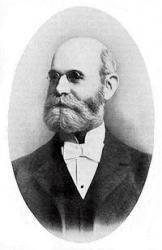
1838 - 1921 Person Name: Wm. J. Kirkpatrick Composer of "YATMAN" in Songs of Joy and Gladness William J. Kirkpatrick (b. Duncannon, PA, 1838; d. Philadelphia, PA, 1921) received his musical training from his father and several other private teachers. A carpenter by trade, he engaged in the furniture business from 1862 to 1878. He left that profession to dedicate his life to music, serving as music director at Grace Methodist Church in Philadelphia. Kirkpatrick compiled some one hundred gospel song collections; his first, Devotional Melodies (1859), was published when he was only twenty-one years old. Many of these collections were first published by the John Hood Company and later by Kirkpatrick's own Praise Publishing Company, both in Philadelphia.
Bert Polman
William J. Kirkpatrick
R. E. Winsett
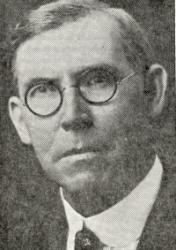
1876 - 1952 Composer of "[Jesus, lover of my soul]" in Songs of the Kingdom Robert Emmett Winsett (January 15, 1876 — June 26, 1952 (aged 76) was an American composer and publisher of Gospel music.
Winsett was born in Bledsoe County, Tennessee, and graduated from the Bowman Normal School of Music in 1899.
He founded his own publishing company in 1903, and his first publication, Winsett's Favorite Songs, quickly became popular among the Baptist and Pentecostal churches of the American South. Pentecostal Power followed in 1907; that year Winsett completed postgraduate work at a conservatory.
He married Birdie Harris in 1908, and had three sons and two daughters with her. He settled in Fort Smith, Arkansas, continuing to compose gospel songs, of which he would write over 1,000 in total. He became a minister in 1923, and was affiliated with the Church of God (Seventh Day).
Birdie Harris died late in the 1920s, and shortly thereafter Winsett moved back to Tennessee. He founded a new company in Chattanooga, and published more shape note music books. He remarried, to Mary Ruth Edmonton, in 1930, and had three further children.
Winsett's final publication, Best of All (1951), sold over 1 million copies, and in total his books sold over ten million copies. His song "Jesus Is Coming Soon" won a Dove Award for Gospel Song of the Year at the 1969 awards. He has been inducted into the Southern Gospel Museum and Hall of Fame.
--www.wikipedia.org
R. E. Winsett
Jakob Hintze
1622 - 1702 Composer of "ALLE MENSCHEN MÜSSEN STERBEN (Salzburg)" in The Harvard University Hymn Book Partly as a result of the Thirty Years' War and partly to further his musical education, Jakob Hintze (b. Bernau, Germany, 1622; d. Berlin, Germany, 1702) traveled widely as a youth, including trips to Sweden and Lithuania. In 1659 he settled in Berlin, where he served as court musician to the Elector of Brandenburg from 1666 to 1695. Hintze is known mainly for his editing of the later editions of Johann Crüger's Praxis Pietatis Melica, to which he contributed some sixty-five of his original tunes.
Bert Polman
Jakob Hintze
R. M. McIntosh
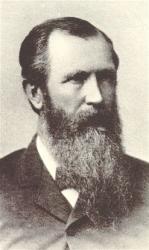
1836 - 1889 Arranger of "REFUGE" in Prayer and Praise Used Pseudonym: Robert M. McIntosh
==========
Rigdon (Robert) McCoy McIntosh USA 1836-1899 Born at Maury County, TN, into a farming family, he attended Jackson College in Columbia, TN, graduating in 1854. He studied music under Asa Everett in Richmond, VA, and became a traveling singing school teacher. He also served briefly in the Civil War. He wrote several hymns during this period of his life. In 1860 he married Sarah McGlasson, and they had a daughter, Loulie Everett. In 1875 he was appointed head of the Vanderbilt University Music Department in Nashville, TN. In 1877 he joined the faculty of Emory College, Oxford, GA. In 1895 he left Emory College to devote his time to the R M McIntosh Publishing Company. He also served as music editor of the Methodist Episcopal Church South Publishing House for over 30 years. His song book publications include: “Good news” (1876), “Light & life” (1881), “Prayer & praise” (1883), “New life” (1879), “New life #2” (1886), and “Songs of service” (1896). He died in Atlanta, GA.
John Perry
R. M. McIntosh
Pages




