

 My Starred Hymns
 My FlexScores
 My Hymnals
 My Purchased Files
Planning worship?
Check out our sister site, ZeteoSearch.org,
for 20+ additional resources related to your search.
- |
User Links
Person Results
John Reynell Wreford
1800 - 1891 Person Name: Wreford Topics: Devout Exercise Author of "Lord, I believe, Thy power I own" in Hymns for Christian Devotion Wreford, John Reynell, an English Unitarian minister, was born December 12, 1800, at Barnstaple; educated at Manchester College, and in 1826 became pastor of a Church in Birmingham. In 1831, on account of the failure of his voice, he withdrew from the active work of the ministry and, in conjunction with Rev. Hugh Hutton, established a school at Edgbaston. He wrote a History of Presbyterian Nonconformity in Birmingham, 1832, and Lays of Loyalty, 1837. He contributed fifty-five hymns to Rev. J. R. Beard's Collection, 1837. His most popular and valuable hymn is the one given in this book. The last years of his life were spent in retirement at Bristol, where he died in 1891.
—Hymn Writers of the Church by Charles Nutter
=================
Wreford, John Keynell, D.D., born Dec. 12, 1800, educated at Manchester College, York, and in 1826 succeeded the Rev. James Yates as co-pastor to the Rev. John Kentish at the New Meeting, Birmingham. In 1830 he published a translation of Cellerier's Discourse on the Authenticity and Divine Origin of the Old Testament. In the following year, in consequence of failure of voice, he withdrew from the Ministry, and in conjunction with the Rev. Hugh Hutton, Minister of the Old Meeting, opened a school at Edgbaston. In 1832 he published a Sketch of the History of Presbyterian Nonconformity in Birmingham; and in 1837, Lays of Loyalty, in celebration of the Queen's accession. He also contributed, in 1837, to the Rev. J. R. Beard's Collection of Hymns for Public and Private Worship 55 hymns, of which the following are still in common use:—
1. God of the ocean, earth, and sky. God seen in His Works. In various collections, including those by Page Hopps, G. Dawson, and others.
2. Lord, I believe; Thy power I own. For increase of Faith. In Martineau's Hymns, &c, 1840.
3. Lord, while for all mankind we pray. National Hymn. This is in a large number of collections of various denominations, and is by far the most popular of his hymns. Sometimes it begins with stanza iii., "O! guard our shores from every foe."
4. When my love to Christ[God]grows weak. Passiontide. In Longfellow and Johnson's Unitarian Hymns of the Spirit, Boston, U. S. A., 1864, "When my love to God grows weak." This is repeated in Martineau's Hymns, &c, 1873.
Dr. Wreford was also the author of several volumes of verse, chiefly devotional. The latter years of his life he spent in retirement at Bristol, and died there in 1881.
[Rev. Valentine D. Davis, B.A.]
-- John Julian, Dictionary of Hymnology (1907)
John Reynell Wreford
P. H. Brown
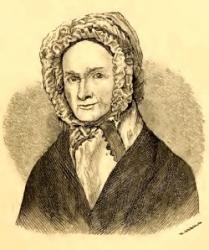
1783 - 1861 Person Name: Mrs. Brown Topics: Devout Exercise Author of "I love to steal awhile away" in Hymns for Christian Devotion Brown, Phoebe, née Hinsdale. A member of the Congregational body, born at Canaan, Columbia County, New York, May 1, 1783, she was left an orphan when two years old. At nine she fell into the hands of a relative who kept a county gaol. These, says her son, "were years of intense and cruel suffering. The tale of her early life which she has left her children is a narrative of such deprivations, cruel treatment, and toil, as it breaks my heart to read." Escaping from this bondage at 18, she was sought by kind people, and sent for three months to a common school at Claverack, N.Y., where she learned to write, and made profession of faith in Christ. In 1805 she was married to Timothy H. Brown, a painter, and subsequently lived at East Windsor and Ellington, Connecticut, Monison, Mass., and at Marshall, Henry County, Illinois. She died at the last-named place, Oct 10, 1861. Most of her hymns were written at Monison, Mass. Through a life of poverty and trial she was "a most devoted mother, wife, and Christian." Her son, the Rev. S. R. Brown, D.D. became the first American Missionary to Japan, and two of her grandchildren are now in the same mission. In addition to her hymns, two or more volumes of prose by her have been published. Her Autobiography and Poems were being prepared for publication, when the editor died, and they are yet to appear. Despite all her disadvantages, Mrs. Brown's talents and work are superior to those of any other early female hymnist of America. It is hoped that her manuscript may some day be competently examined, and selected portions from them be published. Four of her hymns appeared in Nettleton's Village Hymns, 1824, with the signature "B."
1. As once the Saviour took His seat. Penitence.
2. Go, messenger of love, and bear. Missions.
3. I love to steal awhile away. Retirement.
4. Welcome, ye hopeful heirs of heaven. Young Converts.
Of these No. 2 is a Missionary hymn, written in 1817, but first published in the Village Hymns, 1824; No. 3 was written in 1818, and few hymns have a more pathetic history. It is this:—
Mrs. Brown was living at Ellington with "four little children, in a small unfinished house, a sick sister in the only finished room, and not a place above or below where I could retire for devotion." Not far off stood the finest house in the neighbourhood, with a large garden. To-wards this the poor woman used to bend her steps at dusk, loving, as she writes, “to smell the fragrance of fruits and flowers, though I could not see them," and commune with Nature and God. This she did, never dreaming that she was intruding, her habits watched, or her motives misconstrued, till one day the lady of the mansion turned rudely upon her with "Mrs. Brown, why do you come up at evening so near our house, and then go back without coming in? If you want anything, why don't you come in and ask for it?" Mrs. B. adds, "There was something in her manner more than her words, that grieved me. I went home, and that evening was left alone. After my children were all in bed, except my baby, I sat down in the kitchen with my child in my arms, when the grief of my heart burst forth in a flood of tears. I took pen and paper, and gave vent to my oppressed heart."
The Poem then written is headed "An Apology for my Twilight Rambles, addressed to a Lady, Aug. 1818.” The original has nine stanzas, the second beginning “I love to steal awhile away.” Years after, when Nettleton was seeking original matter for his Village Hymns (1824), this piece was abridged and altered into the present familiar form, either by Mrs. Brown herself, her pastor (Mr. Hyde), or Nettleton. Its popularity was great from the first. In 1853 it was included in the Leeds Hymn Book, and thus became known to English collections. It is found in Lyra Sacra Americana, p. 29.
In 1819 Mrs. Brown wrote two hymns which were strangely overlooked by Nettleton, and did not appear till 1831 in Hastings's Spiritual Songs. These are:—
5. How sweet the melting lay. Morning.
6. 0 Lord, Thy work revive. For a Revival. Both are found in Lyra Sacra Americana, pp. 28-30.
No. 6 was altered by the author for Nason's Congregational Hymn Book, 1857. This, according to Nason, is her authorized text. It is widely used in America, and is also found in a few English collections, including Reed's Hymn Book and the New Congregational Hymn Book, and sometimes is attributed in error to Hastings.
7. Great God, we would to Thee make known. This appeared in the Mother's Hymn Book, 1834.
8. We come, 0 Lord, before Thy throne. For Sailors.
9. Grant the abundance of the sea. For Sailors. Two hymns for sailors, which appeared in Linsley and Davis's Select Hymns, 1836.
10. Assembled at [round] Thine altar, Lord. Holy Communion. This also appeared in the Select Hymns, 1836, and was altered for Nason's Congregational Hymn Book, 1857. It is a good hymn, and deserves wider adoption.
11. Jesus, this mid-day hour. Noon. "Written by special request for the Fulton Street [Noon] Prayer Meeting," about 1857.
In addition to the foregoing there are four hymns by her in Parish Hymns (Phila.), 1843, to which they were contributed; and there may be many others in various collections which are uncredited. [Rev. F. M. Bird, M.A.]
-- John Julian, Dictionary of Hymnology (1907)
P. H. Brown
James Merrick
1720 - 1769 Person Name: Merrick Topics: Devout Exercise Author of "Author of good, to thee we turn" in Hymns for Christian Devotion Merrick, James , M.A., was born in 1720, and educated at Oxford, where he became a Fellow of Trinity College. He entered Holy Orders, but his health would not admit of parish work. He died at Reading, 1769. His publications include:—
(1) Messiah, a Divine Essay. Humbly dedicated to the Reverend the Vice-Chancellor of the University of Oxford and the Visitors of the Free School in Reading. By James Merrick, Ætat. 14, Senior Scholar of the School at their last Terminal Visitation, the 7th of October, 1734. Reading. (2) The Destruction of Troy. Translated from the Greek of Tryphiodorus into English Verse, with Notes, &c. 1742. (3) Poems on Sacred Subjects. Oxford . 1763. (4) The Psalms of David Translated or Paraphrased in English Verse. By James Merrick, M.A., late Fellow of Trinity College, Oxford. Reading. J. Carnan and Co. 1765. 2nd ed. 1766. A few only of these paraphrases were divided into stanzas. In 1797 the Rev. W. D. Tattersall pulished the work "Divided into stanzas for Parochial Use, and paraphrased in such language as will be intelligible to every capacity . . . with a suitable Collect to each Psalm from the Works of Archbishop Parker."
Merrick's paraphrases, although weak and verbose, were in extensive use in the early part of the present century, both in the Church of England and with Nonconformists. They have, however, fallen very much into disuse. Those in modern hymn-books, mainly in the form of centos, include:—
1. Blest Instructor, from Thy ways. Ps. xix.
2. Descend, O Lord! from heaven descend. Ps. cxliv. (In time of National Peril.)
3. Far as creation's bounds extend. Ps. cxlv.
4. God of my strength, the wise, the just. Ps. xxxi.
5. He who with generous pity glows. Ps. xli.
6. How pleasant, Lord.Thy dwellings are. Ps. lxxxiv.
7. Lift up your voice and thankful sing. Ps. cxxxvi.
8. Lo, my Shepherd's hand divine. Ps. xxiii.
9. Lord, my Strength, to Thee I pray. Ps. xxviii.
10. My heart its noblest theme has found. Ps.xlv.
11. O let me, [gracious] heavenly Lord extend. Ps. xxxix.
12. O turn, great Ruler of the skies. Ps. li.
13. Praise, O praise the Name divine. Ps. cl.
14. Sing, ye sons of [men] might, O sing. Ps. xxix.
15. Teach me, O teach me, Lord, Thy way. Ps. cxix.
16. The festal morn, my [O] God, is come. Ps. cxxii, (Sunday Morning.)
17. The morn and eve Thy praise resound. Ps. lxv. (Harvest.)
18. To Thy pastures, fair and large. Ps. xxiii.
From his Poems on Sacred Subjects, 1763, the following centos have also come into common use: --
19. Author of good, to Thee we turn. Resignation.
20. Eternal God, we look to Thee. Resignation.
21. 'Tis enough, the hour is come. Nunc Dimittis.
John Julian, Dictionary of Hymnology (1907)
James Merrick
Alexander Pope
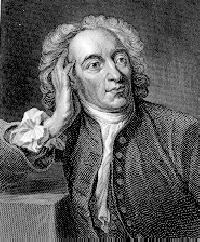
1688 - 1744 Person Name: Pope Topics: Devout Exercise Author of "Father of all, in every age" in Hymns for Christian Devotion Alexander Pope was born in London, in 1688. His parents were Roman Catholics. He had a feeble constitution, was deformed in person, and attained the age of only fifty-six. He early acquired the means of independence by his literary gifts, and purchased his celebrated villa at Twickenham, whither he went to reside at the age of thirty. Of his many published works, his translation of the "Iliad" and "Odyssey" of Homer has given him the greatest reputation. As an English satirist, also, he stands very high. Nearly all his works, however, are imitations. He died at Tickenham, in 1744.
--Annotations of the Hymnal, Charles Hutchins, M.A., 1872
========
Pope, Alexander, the poet, son of a wholesale linen merchant in Lombard Street, London, was born in Plough Court, Lombard Street, May 21, 1688. His father being a Roman Catholic, he was first placed under the charge of Father Taverner, who taught him the rudiments of Greek and Latin. Later he attended a school at Winchester, and then at Hyde Park Corner. When about twelve he retired with his parents to Binfield, in Windsor Forest, and from thenceforth his education was mainly in his own hands. His subsequent success as a writer and poet is a matter of history, and has been dealt with in detail by Dr. Johnson in his Lives of the Poets, and by others. He died May 30, 1744, and was buried in a vault in Twickenham Church. For distinct public use, so far as we are aware, Pope wrote no hymns. His "Messiah"; his "Universal Prayer"; and his "Vital Spark" (q.v.), have been made use of for congregational purposes, but as a Roman Catholic he had no object in writing a hymn in a language which, at that time, his Church would refuse to use. In modern hymn-books his name is identified with the following pieces:--
1. Father of all, in every age. Universal Prayer. The Lord's Prayer. This Prayer was published in 1738, as a conclusion to his Essay on Man, in 13 st. of 4 1. Warburton in his Advertisement of the 1748 ed. of the Essay, says:—
"Concerning the Universal Prayer which concludes the Essay, it may be proper to observe that some pas¬sages in the Essay having been unjustly suspected of a tendency towards Fate and Naturalism, the author composed that Prayer as the sum of all, to show that hi a system was founded in Freewill, and terminated in Piety: that the First Cause was as well the Lord and Governor as the Creator of the Universe; and that by submission to His will (the great principle enforced throughout the Essay) was not meant the suffering ourselves to be carried along with a blind determination; but a religious acquiescence, and confidence full of hope and immortality. To give all this the greater weight and reality, the Poet chose for his model The Lord's Prayer, which of all others best deserves the title prefixed to his Paraphrase."
The title here referred to is "The Universal Prayer, Deo Opt. Max." The hymn is found in common use in the following forms:—
(1.) Father of all in every age. This is an abbreviated form, and has been in use, especially in Unitarian hymnbooks, from an early date.
(2.) Father of all, [and] Thou God of love. This cento was given in 6 st. of 4 1. in the 1815 edition of Cotterill's Selections, No. 2; again in the 1819 ed., 141; in Stowell's Psalms & Hymns, 1831, No. 179; and again in later collections.
(3.) Not to this earth's contracted span. In Collyer's Collection 1812, No. 629, in 4 st. of 4 1., and others.
(4.) Teach me to feel another's woe. Also in Collyer's Collection, 1812, No. 630, in 4 st. of 4 1., and others.
(5.) Thou Great First Cause, least understood. Also in Collyer's Collection, 1812, No. 628, in 4 st. of 4 1., and later hymnals.
(6.) When I am right Thy grace impart. Given in Kennedy, 1863, No. 1166.
2. Ye nymphs of Solyma! begin the song. The Messiah. In No. 378 of the Spectator for Wednesday, May 14, 1712, Addison gave this poem with the introduction :—
"I will make no apology for entertaining the reader with the following poem, which is written by a great genius, a friend of mine, in the country, who is not ashamed to employ his wit in the praise of his Maker."
Then follows the poem with the heading, “Messiah. A Sacred Eclogue, composed of several passages of Isaiah the Prophet. Written in imitation of Virgil's Pollio." It consists of 107 lines. When republished by Pope this heading was expanded into a paragraph as an "Advertisement." As a poem it is unknown to the hymn-book; but from it the following centos have passed into common use:--
(1.) As the Good Shepherd tends his fleecy care. This was given in Collyer's Collection, 1812, No. 626, in 6 st. of 4 1., and has been repeated in later hymnals, but usually in an abridged form.
(2.) From Jesse's root, behold a branch arise No. 624 in Collyer's Collection, 1812, in 5 st. of 4 1.; and again in later hymnals.
(3.) Hark! a glad voice the lonely desert cheers. No. 625 in Collyer's Collection, 1812, in 4 st. of 4 1.; in Bishop Heber's posthumous Hymns, &c, 1827, p. 106; and again in later collections.
(4.) Rise crowned with light, imperial Salem rise. In the Leeds Hymn Book, 1853, No. 687, in 3 st. of 8 1., and several later collections.
(5.) The Saviour comes! by ancient seers foretold. In Mercer's Church Psalm & Hymn Book, 1864, and others.
It may be noted that 1. 46 of The Messiah reads in the original "He wipes the tears for ever from our eyes." This was altered by Pope at the suggestion of Steele, made to Pope in a letter dated June 1, 1712, to "From every face He wipes off every tear." This latter is the poet's authorized reading, is given in his Works, and is found also in the book form reprints of the Spectator.
-- John Julian, Dictionary of Hymnology (1907)
Alexander Pope
Sir Walter Scott
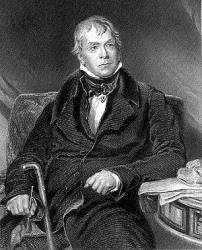
1771 - 1832 Person Name: Sir W. Scott Topics: Devout Exercise Author of "When Israel, of the Lord beloved" in Hymns for Christian Devotion Walter Scott was born in Edinburgh, August 15, 1771. In 1786, he commenced his apprenticeship as writer to the Signet. In 1796, he first appeared before the public in a translation of Burger's "William and Helen." Many poetical works followed, until in 1814, he began the series of "Waverly Novels." He died at Abbotsford, September 21, 1832. It is related that on his death-bed he distinctly repeated portions of the Latin original, upon which "That day of wrath, that dreadful day" is based.
--Annotations of the Hymnal, Charles Hutchins, M.A., 1872
======================
Scott, Sir Walter, Bart., was born in Edinburgh, Aug. 15, 1771, and died at Abbotsford, Sept. 21, 1832. Although so successful and widely known as a poet, he made no direct contributions to hymnody whatever. His condensed rendering of the “Dies Irae", and his hymn of Rebecca in Ivanhoe, "When Israel of the Lord beloved" (q.v.) were utilized as hymns for congregational use by others, but were never intended for such a purpose by himself. His work and rank as poet, novelist, and historian are fully set forth in his Life by J. G. Lockhart.
--John Julian, Dictionary of Hymnology (1907)
Sir Walter Scott
Sarah Josepha Buell Hale
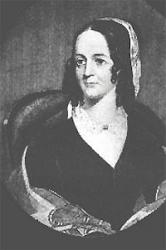
1788 - 1879 Person Name: Mrs. Hale Topics: Devout Exercise Author of "Our Father in heaven we hallow thy name" in Hymns for Christian Devotion Hale, Sarah Josepha, née Buell, born at Newport, New Hampshire, 1795, and married to David Hale, a lawyer, who died in 1822. Mrs. Hale edited The Ladies' Magazine, Boston, from 1828; and Godey's Ladies’ Book, Philadelphia, from 1837, besides publishing several works. Her hymn, “Our Father in heaven, we hallow Thy name" (The Lord's Prayer), appeared in Mason & Greene's Church Psalmody, 1831, No. 553, in 2 stanzas of 8 lines. Mrs. Hale, who was a member of the Protestant Episcopal Church, died in 1879. [Rev. F. M. Bird, M.A.]
--John Julian, Dictionary of Hymnology (1907)
Sarah Josepha Buell Hale
Henry Moore
1732 - 1802 Topics: Devout Exercise Author of "Supreme and universal light" in Hymns for Christian Devotion Moore, Henry, 1732-1802. Son of a Presbyterian minister of the same name at Plymouth. Educated at Doddridge's Academy at Northampton, from 1757 to 1788 minister at Modbury, and then at Liskeard. Author of Lyrical and Miscellaneous Poems, published posthumously with a memoir by Dr. Aikin. Of his hymns, which are frequent in the books later than Kippis, the Dukinfield Collection, 1822, gives 5.
1. All earthly charms, however dear. The unfading beauty of holiness.
2. Amidst a world of hopes and fears. A prayer for guidance.
3. Assist us, Lord, to act, to be. Divine Help Solicited.
4. My God, thy boundless love I praise. The divine Love.
5. Soft are the fruitful showers that bring. A song of spring and New Life.
6. Supreme and universal light. Prayer for spiritual excellence.
--John Julian, Dictionary of Hymnology (1907)
Henry Moore
William Roscoe
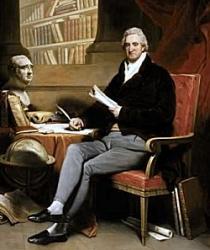
1753 - 1831 Person Name: Roscoe Topics: Devout Exercise Author of "When human hopes and joys depart" in Hymns for Christian Devotion Roscoe, William, the father, was born March 8, 1753, in Liverpool, of humble origin. After very meagre schooling, and three years of work in his father's market garden, he was articled to an attorney, and subsequently practised in Liverpool till 1796, when he withdrew from the profession. From the first literature was his chief delight, and throughout a long career of public usefulness he united its pursuit with the efforts of enlightened patriotism and the advocacy of higher education and reform. Liverpool was a centre of the old slave-trade, and Roscoe was one of the first to raise his voice against the iniquity. At the age of 20 he had already uttered a protest in his descriptive poem Mount Pleasant, and in 1787 he published a longer poem, The Wrongs of Africa (Pt. ii. 1788), devoted to the subject. During his brief parliamentary experience as member for Liverpool, in 1807, he had further opportunity of advocating the cause of liberty and humanity. His first great historical work, the Life of Lorenzo dé Medici, was published in 1796, and the Life and Pontificate of Leo the Tenth, in 1805. After withdrawing from his legal practice, Roscoe had hoped to be able to devote himself entirely to letters, but the claims of friendship induced him in 1800 to enter into a banking business, which involved him in commercial troubles, ending in 1820 in his bankruptcy. His library had to be sold, but part of it was bought by friends, and presented to the Liverpool Athenæum, which in 1789 Roscoe had been instrumental in founding. In 1822 he published Illustrations of the Life of Lorenzo dé Medici, defending the views adopted in his former history, and two years later edited a new edition of Pope's works, with a life of the poet. He died June 30, 1831. (Cf. The Life of William Roscoe, by his son, Henry Roscoe, in 2 vols., London, T. Cadell, 1833.)
As a member of the congregation of Unitarians meeting in Renshaw Street Chapel, Liverpool, Roscoe took part in preparing A Selection of Psalms and Hymns for Public and Private Worship, printed for their use in 1818. He contributed eight hymns and the concluding anthem. Of these hymns the following are in common use at the present time:—
1. Let our loud song of praise arise. Praise.
2. Go, suffering habitant of earth. Life, a Warfare.
3. Great God, beneath Whose piercing eye. Divine Providence.
4. Thus said Jesus, Go and do. Love to our Neighbour.
5. What is the first and great command ? The Commandments.
These hymns are in several Unitarian collections, including Martineau's Hymns, 1840. No. 3 was written in 1788, as a "secular hymn" of ten stanzas, to be sung at the Benn's Garden Chapel on the Centenary of the Revolution.
--John Julian, Dictionary of Hymnology (1907)
William Roscoe
John Patrick
1632 - 1695 Person Name: Patrick Topics: Devout Exercise Author of "God, who is just and kind" in Hymns for Christian Devotion John Patrick, a brother of Bishop Simon Patrick, was Prebendary of Peterborough, 1685; Precentor of Chichester, 1690; and preacher at the Charter-House, in the Chapel of which he was buried on his death, in 1695. His "Psalms of David, in Metre," were much used by Presbyterians and Independents until superseded by the compositions of Watts.
----Annotations of the Hymnal, Charles Hutchins, M.A. 1872.
John Patrick
Boethius
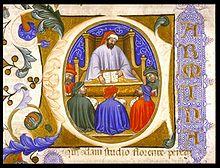
480 - 524 Topics: Devout Exercise Author of "O thou whose power o'er moving worlds presides" in Hymns for Christian Devotion Anicius Manlius Severinus Boëthius, commonly called Boethius(English: /boʊˈiːθiəs/; also Boetius /boʊˈiːʃəs/; c. 480–524 AD), was a Roman senator, consul, magister officiorum, and philosopher of the early 6th century.
See more in:
Wikipedia
Boethius
Pages




