

 My Starred Hymns
 My FlexScores
 My Hymnals
 My Purchased Files
Planning worship?
Check out our sister site, ZeteoSearch.org,
for 20+ additional resources related to your search.
- |
User Links
Person Results
Jakob Hintze
1622 - 1702 Person Name: Jakob Hintze, 1622-1702 Topics: Unity and Fellowship Composer of "SALZBURG" in Lift Up Your Hearts Partly as a result of the Thirty Years' War and partly to further his musical education, Jakob Hintze (b. Bernau, Germany, 1622; d. Berlin, Germany, 1702) traveled widely as a youth, including trips to Sweden and Lithuania. In 1659 he settled in Berlin, where he served as court musician to the Elector of Brandenburg from 1666 to 1695. Hintze is known mainly for his editing of the later editions of Johann Crüger's Praxis Pietatis Melica, to which he contributed some sixty-five of his original tunes.
Bert Polman
Jakob Hintze
John Oxenham
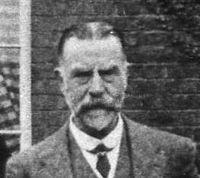
1852 - 1941 Person Name: John Oxenham, 1852-1941 Topics: Unity; Unity; Unity Author of "In Christ There Is No East or West" in Journeysongs (2nd ed.) John Oxenham is a pseudonym for William Arthur Dunkerley, and is used as the name authority by the Library of Congress.
John Oxenham
Shirely Judd
b. 1932 Person Name: Shirley Judd, 1932- Topics: Christian unity Translator (French) of "We Are One in the Spirit" in Community of Christ Sings
Shirely Judd
Federico J. Pagura

1923 - 2016 Topics: Unity and Fellowship Translator (into Spanish) of "All People That on Earth Do Dwell" in Psalms for All Seasons Federico José Pagura was an Argentine Methodist bishop and author and translator of hymns.
Leland Bryant Ross
Federico J. Pagura
Phil Lawson Johnston
Topics: The Church of Jesus Christ Unity of the Church Author of "This is the mystery (Let the bride say, 'Come!')" in Complete Mission Praise
Phil Lawson Johnston
Christopher Willcock
b. 1947 Person Name: Christopher Willcock, 1947- Topics: Unity of Humanity Composer of "PSALM 96" in Together in Song
Christopher Willcock
Thomas H. Troeger
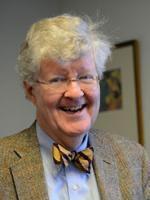
1945 - 2022 Topics: Christian unity; Church Nature and Unity Adapter (st. 3) of "Christ Is Made the Sure Foundation" in The New Century Hymnal Thomas Troeger (1945-2022), professor of Christian communication at Yale Divinity school, was a well known preacher, poet, and musician. He was a fellow of Silliman College, held a B.A. from Yale University; B.D. Colgate Rochester Divinity School; S.T. D. Dickinson College, and was awarded an honorary D.D. from Virginia Theological Seminary. He was ordained in the Presbyterian Church in 1970 and the Episcopal Church in 1999, and remained dually aligned with both traditions. Troerger led conferences and lectures in worship and preaching throughout North America, as well as in Denmark, Holland, Australia, Japan, and Africa. He served as national chaplain to the American Guild of Organists, and for at least three years he hosted the Season of Worship broadcast for Cokesbury. He was president of the Academy of Homiletics as well as Societas Homiletica. He had, as of 2009, written 22 books in the areas of preaching, poetry, hymnody, and worship. Many of his hymn texts are found in New Hymns for the Lectionary (Oxford, 1992), and God, You Made All Things for Singing (Oxford, 2009).
Laura de Jong
Thomas H. Troeger
Dan Damon
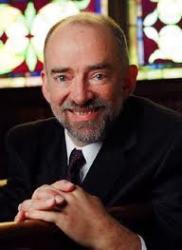
b. 1955 Topics: Christian unity Author of "Shadow and Substance" in The New Century Hymnal Daniel Charles Damon (b. 1955) is an internationally published writer of hymn texts and tunes and is Associate Editor of Hymnody for Hope Publishing Company, Carol Stream, Illinois. Damon is also a jazz pianist and has played in many hotels and clubs in the San Francisco Bay area. He holds degrees from Greenville College, Greenville, Illinois (BME, 1977) and Pacific School of Religion, Berkeley, California (MDiv, 1987). He is an ordained Elder in the United Methodist Church in the San Francisco Bay area and a life member of the Hymn Society in the United States and Canada.
Several single-author collections of Damon's hymns have been published: Faith Will Sing (Carol Stream, 1993), The Sound of Welcome (Carol Stream, 1998), To the Thirsty World (Nashville, 2002), Fields of Mercy (Carol Stream, 2007), and Garden of Joy (Carol Stream, 2011). He collaborated with text writer Gracia Grindal in A Treasury of Faith: Lectionary Hymns Series A (Colfax. 2012). Damon's hymns have been included in several major hymnals and supplements. He has also written hymn translations from Vietnamese, Portuguese, and Shona languages, and, with Patrick Matsikenyiri, edited Njalo, A Collection of 16 Hymns in the African Tradition (Nashville, 1996). He has released three recordings of hymns, carols, and traditional songs, and a solo piano recording of jazz standards (available at www.damonstuneshop.com).
Damon has presented his work at national conferences of the Hymn Society in the United States and Canada and the Fellowship of United Methodists in Music and Worship Arts. He is a contributor to the Canterbury Dictionary of Hymnology.
In 2016, Damon was made a Fellow of the hymn Society, the highest honor The Hymn Society can confer.
Dan Damon
Dan Damon
Rabanus Maurus
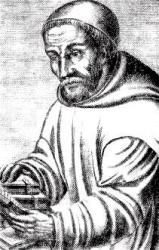
776 - 856 Person Name: Rabanus Maurus, c. 776-856 Topics: Christian unity Author of "Come, Holy Ghost, our souls inspire" in Complete Anglican Hymns Old and New Rabanus Maurus (c. 776-856) or Hrabanus Magnentius Maurus, was born of noble parents at Mainz, and educated at Fulda and Tours under Alcuin, who is reputed to have given him the surname, Maurus, after the saint of that name. In 803, he became director of the school at the Benedictine Abbey at Fulda. He was ordained priest in 814, spending the following years in a pilgrimage to Palestine. In 822, he became Abbott at Fulda, retiring in 842. In 847, he became archbishop of Mainz. He died at Winkel on the Rhine, February 4, 856. This distinguished Carolingian poet-theologian wrote extensive biblical commentaries, the Encyclopaedic De Universo, De Institutione Clericorum, and other works which circulated widely during the Middle Ages. Some of his poems, with English translations, are in Helen Waddell's Mediaeval Latin Lyrics. He is the author of:
O Come, Creator Spirit, come
Christ, the fair glory of the holy angels
Come, Holy Ghost, our souls inspire
Come, Holy Ghost, Creator blest
Creator Spirit, by whose aid
--The Hymnal 1940 Companion, New York: The Church Pension Fund (1949)
===========================
Hrabanus (Rabanus) Maurus, son of one Ruthard, was born probably at Mainz, about 776. At an early age he was sent to the Monastery of Fulda to receive a religious education. In 801 he was ordained Deacon, and the following year he went to the monastic school of St. Martin at Tours to study under Alcuin, a celebrated teacher of that time, who gave to Hrabanus the name of Maurus to which Hrabanus added Magnentius. On his return to Fulda in 804 he became the head of the school connected with the Monastery. Towards him Ratgar the abbot showed great unkindness, which arose mainly from the fact that Ratgar demanded the students to build additions to the monastery, whilst Hrabanus required them at the same time for study. Hrabanus had to retire for a season, but Ratgar's deposition by Ludwig the Pious, in 817, opened up the way for his return, and the reopening of the school In the meantime, in 814, he had been raised to the Priesthood. Egil, who succeeded Ratgar as abbot, died in 822, and Hrabanus was appointed in his stead. This post he held for some time, until driven forth by some of the community. In 847, on the death of Archbishop Otgar, Ludwig the younger, with whom Hrabanus had sided in his demand for German independence as against the imperialism of his elder brother Lothar, rewarded him with the Archbishopric of Mainz, then the metropolitan see of Germany. He held this appointment to his death on Feb. 4, 856. He was buried first in St. Alban's, Mainz, and then, during the early days of the Reformation, in St. Maurice, Halle, possibly because of the opposition he is known to have made to the doctrine of Transubstantiation.
With German historians Hrabanus is regarded as the father of the modern system of education in that country. His prose works were somewhat numerous, but the hymns with which his name is associated are few. We have the "Christe sanctorum decus Angelorum”; “Tibi Christe, splendor Patris”; and the "Veni Creator Spiritus”; but recent research convinces us that the ascription in each case is very doubtful; and none are received as by Hrabanus in Professor Dümmler's edition of the Carmina of Hrabanus in the Poetae Latini aevi Carolini, vol. ii. 1884. Dümmler omits them even from the "hymns of uncertain origin."
--John Julian, Dictionary of Hymnology, Appendix I (1907)
=======================
http://en.wikipedia.org/wiki/Rabanus_Maurus
Rabanus Maurus
Pages




