

 My Starred Hymns
 My FlexScores
 My Hymnals
 My Purchased Files
Planning worship?
Check out our sister site, ZeteoSearch.org,
for 20+ additional resources related to your search.
- |
User Links
Person Results
Johann Andreas Rothe
1688 - 1758 Person Name: J. A. Rothe Author of "Unverwandt auf Christum sehen" in Gesangbuch der Evangelischen Gemeinschaft Rothe, Johann Andreas, son of Aegidius Rother, pastor at Lissa, near Görlitz, in Silesia, was born at Lissa, May 12, 1688. He entered the University of Leipzig in 1708, as a student of Theology, graduated M.A., and was then, in 1712, licensed at Gorlitz as a general preacher. In 1718 he became tutor in the family of Herr von Schweinitz at Leube, a few miles south of Gorlitz, and while there frequently preached in neighbouring churches. During 1722 Count N. L. von Zinzendorf, happening to hear him preach at Gross-Hennersdorf, was greatly pleased with him, and when the pastorate at Berthelsdorf became vacant shortly thereafter, gave him the presentation. He entered on his duties at Berthelsdorf Aug. 30, 1722. There he took a great interest in the Moravian community at Herrnhut, which formed part of his parish. But when, in 1737, he had to report to the higher ecclesiastical authorities regarding the doctrinal views of the Moravians, Zinzendorf showed his resentment in various ways, so that Kothe was glad to accept a call to Hermsdorf, near Gorlitz. Finally, in 1739, Count von Promnitz appointed him assistant pastor at Thommendorf, near Bunzlau, where he became chief pastor in 1742, and died there July 6, 1758. (Koch, v. 240; Wetzel’s Analecta Hymnica, ii. 756, &c.)
Rothe was a man of considerable gifts and of unbending integrity, a good theologian, and an earnest, fearless, and impressive preacher. His hymns, about 40 in number, though they can hardly be said to rank high as poetry, are yet often characterised by glow and tenderness of feeling, and by depth of Christian experience. They are somewhat akin to Zinzendorf s better productions, but this resemblance may arise from the alterations which Zinzendorf seems to have made in them. The be6t known of them first appeared in Zinzendorf's hymn-books, and were for a time looked upon with suspicion, because as Zinzendorf did not affix authors' names, the new hymns were at first all ascribed to himself.
Those of Rothe's hymns which have passed into English are:—
i. Ich habe nun den Grand gefunde. Joy in Believing. …At first the Lutherans suspected it, thinking that it was by Zinzendorf, but on discovering that it was by Rothe, soon adopted it. It is a powerful and beautiful hymn, is found in many recent German collections (e.g. the Berlin Geistliche Lieder, ed. 1863, No. 78), and in its English forms has found a very wide acceptance, and proved a comfort and blessing to many. It was doubtless suggested by Heb. vi. 19.
Rothe's hymn under consideration ("Ich habe nun ") has been translated as:—
1. Now I have found the ground wherein. A fine but somewhat free translation of st. i., ii., iv., v., vi., x., by J. Wesley.
It has also appeared in full, or abridged, under the following first lines:—
(1) Now I have found the blessed ground (st. i ). Lady Huntingdon's Selections, 1780.
(2) Now have I found the ground wherein (st. i.). W. F. Stevenson's Hymns for Church & Home, 1873.
(3) 0 Lord I Thy everlasting grace (st. ii.). Horder's Congregational Hymns, 1884.
(4) Father, Thine everlasting grace (st. ii.). J. Bickersteth's Psalms & Hymns1832.
(5) 0 Love, thou bottomless abyss (st. iii.). Evangelical Union Hymnal, 1878.
(6) Jesus, I know hath died for me (st. iv.). Pennsylvanian Lutheran Church Book, 1868.
(7) Though waves and storms go o'er my head (st. v.). Andover Sabbath Hymn Book, 1858.
2. I now have found, for hope of heaven. In full, by Dr. H. Mills, in theEvang. Review, Gettys¬burg, Jan. 1850, and in his Horae Germanica, 1850, p. 68.
3. My soul hath now the ground attained. A good tr. of st. i., iii., v., x., by A. T. Russell, as No. 167 in his Psalms & Hymns, 1851.
4. My soul hath found the steadfast ground. A good tr, (omitting st. v.-ix., and with a st. iv. not by Rothe), by Mrs. Bevan, in her Songs of Eternal Life, 1858, p. 55.
5. Now I have found the firm foundation. By G. F. Krotel, as No. 251 in the OhioLutheran Hymnal, 1880, omitting st. vi.-viii.
6. Now I have found the ground to hold. By J. Sheppard, in his Foreign Sacred Lyre, 1857, p. 91.
ii. Vor wahrer Herzensanderung. The Forgiveness of Sin. first pub. as No. 448 in the 3rd ed., 1731, of Zinzendorf's Sammlung as above, and in 7 stanzas of 4 lines. In the Brüder Gesang-Buch , 1778, it is No. 392. The translations are:—
(1) "Thanks be to Thee, Thou slaughtered Lamb!" (st. vii.). This is No. 345 in pt. ii., 1746, of the Moravian Hymn Book, (2) "Before conversion of the heart." A tr. of st. i., iv., by B. Latrobe, as No. 255 in the Moravian Hymn Book,1789, with the above tr. of st. vii. added. In the 1801 and later eds. (1886, No. 426) the tr. of st. vii. was alone retained.
iii. Wenn kleine Himmelserben. Death of a Child. Written on the death of one of his daughters. The trs. are:—
(1) "When children, bless'd by Jesus." This is No. 1196 in the Supplement of 1808 to the Moravian Hymn Book, 1801 (1886, No. 1258). (2) "When summons hence by Death is given." By E. Massie, 1867, p. 105. [Rev. James Mearns, M.A.]
--excerpts from John Julian, Dictionary of Hymnology (1907)
Johann Andreas Rothe
Hans Adolf Brorson
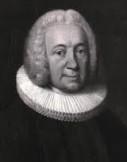
1694 - 1764 Person Name: H. A. Brorson Author of "Moa isaoranao ny Tompo" in Protestant Madagascar Hymnal, 2001
Hans Adolf Brorson
M. B. Landstad
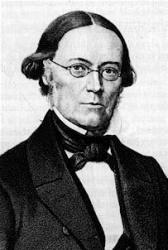
1802 - 1880 Author of "Speak, O Lord, Thy Servant Heareth" in American Lutheran Hymnal Magnus Brostrup Landstad (born 7 October 1802 in Måsøy, Norway and died 8 October 1880 in Kristiania) was a Norwegian minister, psalmist and poet who published the first collection of authentic Norwegian traditional ballads in 1853. This work was criticized for unscientific methods, but today it is commonly accepted that he contributed significantly to the preservation of the traditional ballads.
Landstad lived with his father Hans Landstad (1771–1838) who was also a minister, first in 1806 to Øksnes, to Vinje in 1811 and to Seljord in 1819. He took a theological degree (cand. theol) in 1827, and worked after that as the resident chaplain in Gausdal for six years. After that he worked in different parishes in Telemark, Østfold before he became minister of Sandar in Vestfold in 1859. He married Wilhelmine Margrete Marie Lassen, in 1828. He is well known for introducing popular, contemporary Norwegian language into the hymns he wrote, contributing significantly to the spirit of Norwegian romantic nationalism which grew in Norway in this period.
His greatest single achievement was the Landstad Hymnbook (Kirkepsalmebog), which with later revisions was used in Norwegian (bokmål) parishes from 1869 until 1985. The current official church hymnbook contains a lot of his hymns and his translations of foreign hymns.
He was the cousin of Hans Peter Schnitler Krag.
The Landstad-institute, which lies in Seljord, is named after him.
He was a great grandfather of Magny Landstad, also a famous writer.
Publications--
1852: Norske Folkeviser. 3 vols. Christiania: C. Tönsberg, [1852-]1853.
1869: Kirkesalmebok: efter offentlig Foranstaltning. Kristiania: J. W. Cappelens Forlag, 1871
--http://en.wikipedia.org/wiki/
See also in:
Wikipedia
M. B. Landstad
J. J. Rambach

1693 - 1735 Author of "Ewge Liebe, mein Gemüte" in Gesangbuch für deutsche Gemeinden Rambach, Johann Jakob, D.D., son of Hans Jakob Rambach, cabinet maker at Halle on the Saale, was born at Halle, Feb. 24, 1693. In 1706 he left school and entered his father's workshop, but, in the autumn of 1707, he dislocated his ankle. During his illness he turned again to his schoolbooks; the desire for learning reawoke; and on his recovery, early in 1708, he entered the Latin school of the Orphanage at Halle (Glaucha). On Oct. 27, 1712, he matriculated at the University of Halle as a student of medicine, but soon turned his attention to theology. He became specially interested in the study of the Old Testament under J. H. Michaelis. In May 1715 he became one of Michaelis's assistants in preparing his edition of the Hebrew Bible, for which he wrote the commentary on Ruth, Esther, Nehemiah, &c. His health began to suffer in the spring of 1719, and he gladly accepted the invitation of Count von Heukel to stay at Polzig, near Ronneburg, where he spent several months. By August he had quite recovered, and went to pay a visit to Jena, where a number of the students asked him to lecture to them. For this purpose he settled at Jena in Oct., 1719, and lived in the house of Professor Buddeus (J. F. Budde). He graduated M.A. in March 1720.
In 1723 he was appointed adjunct of the Theological Faculty at Halle, as also inspector of the Orphanage; in 1726 extraordinary professor of theology; and in 1727, after A. H. Francke's death, ordinary professor as well as preacher at the Schulkirche. Here he was very popular, both as preacher and professor, but the jealousy of his colleagues induced him to accept an offer from the Landgrave Ernst Ludwig of Hesse, who, in 1731, invited him to Giessen as superintendent and first professor of theology (before leaving Halle he graduated D.D., June 28, 1731), and in Aug., 1732, appointed him also director of the Paedagogium at Giessen. In 1734 he was, for various reasons, greatly inclined to accept the offer of the first professorship of theology in the newly-founded University of Göttingen, but eventually, at the earnest request of the Landgrave, remained in Giessen, where he died of fever, April 19, 1735 (Die Familie Rambach. By Dr. T. Hansen, Gotha, 1875: Allgemeine Deutsche Biographie, xxvii. 196; Blätter fur Hymnologie, 1883, pp. 113, 129, 145, 163, 186; 1884, p. 20; 1885, p. 13, &c.)
Rambach was a voluminous author in various departments of practical theology, e.g. his Institutiones hermeneuticae sacrae, Jena, 1724, which passed through four editions in his lifetime; hisErbauliches Handbüchlein fur Kinder, 1734 (see below), which reached an eighth edition in 1736, and a 14th in 1766; his various volumes of sermons, &c. He justly earned his popularity by the thoroughness of his researches, and the clear and concise way in which he set forth the results of his investigations. It is however as a hymnwriter that his name is likely to be best known. While not entitled to rank with the best hymn-writers of the 16th and 17th centuries, he yet takes a high place among his contemporaries, and deserves to be remembered as much as almost any of the 18th cent, hymnwriters. His style is good and dignified; his thought is profound yet clearly expressed. While his hymns are often sufficiently didactic, they are generally scriptural and churchly in tone, and are characterised by lyric force, lively imagination, and earnest, sober piety. Of hymns, in the strict sense, he wrote over 180, a large number of which passed into the German hymn-books of the 18th cent. (e.g. the Hannover Gesang-Buch, 1740, and Lüneburg Gesang-Buch, 1767, contains 52 by him), and a good many are still found in modern hymn-books. Of these Dr. J. L. Pasig gives 165 in his edition of Rambach's Geistliche Lieder, Leipzig, 1844, and the rest are printed by Hansen as above, while the first lines of the whole are given in the Blätter as above. Four are recasts (practically originals), made for the 11th edition, 1719, of Freylinghausen's Gesang-Buch, to replace similar hymns in the ed. of 1705. The rest principally appeared in the following works by Rambach, viz.: (1) Geistliche Poesien, Halle. 1720 [British Museum] The first part contains 72 cantatas on the Gospels for Sundays and festivals; the second part includes 20 hymns, mostly written at Polzig in 1719. (2) Poetische Fest-Gedancken. Jena and Leipzig, 1723 [Royal Library, Berlin]. Included are 15 pieces which may be called hymns. The second edition of 1727 [Brit. Mus.] has 28 new hymns; and the 3rd ed., 1729 [Gottingen Library], has 22 more. (3) Erbauliches Handbuchlein für Kinder, Giessen, 1734 [Hamburg Library]. The 3rd part contains 8 new hymns. (4) Geistreiches Haus-Gesang-Buch, Frankfurt and Leipzig, 1735 [Hamburg Library], with a preface dated April 10, 1735. This contains 112 hymns by Rambach, of which 58 are practically new, 11 of these, however, being recasts of his own earlier hymns. (5) Wander der bis zum Tode des Kreutzes erniedrigten Liebe, Giessen, 1750 [Berlin Library]. This includes 27 new hymns.
Rambach's hymns …which have passed into English are:—
i. Auf! Seele, schicke dich. Holy Communion. Written, by request for the eleventh edition, 1719, of Freylinghausen's Gesang-Buch, 1704, as No. 229, in 16 stanzas of 6 lines in order to replace the hymn "Auf, Seele, sey gerüst."
This hymn, by George Heine, was included in the Geistreiches Gesang-Buch, Halle, 1697, p. 433. In the second ed., 1771, of the complete book formed by the fusion of pt. i., 1704, and its supplement of 1705 with pt. ii., 1714, of Freylinghausen's Gesang-Buch, both hymns are given, Heine's as No. 524, and Rambach's as No. 522, both marked as being No. 229 in pt. i., 1704.
Rambach's hymn is in his Haus Gesang-Buch, 1735, No. 369; the Berlin Geistliche Lieder, ed. 1863, No. 471, &c. In Pasig's edition of his Geistliche Lieder, 1844, p. 112, entitled "Before the reception of Holy Communion." It has been translated as:—
My soul prepare to meet. Omitting st. i., 11. 4-6 ; ii., 11. 4-6; vii., xiv., as No. 570 in the Moravian Hymn Book, 1789 (1849, No. 966). In the edition of 1886, No. 979 begins with st. iv., "How should I, slaughtered Lamb"; and No. 1012 with st. xi., "Lord, of Thy wondrous love."
ii. Mein Jesu, der du vor dem Scheiden. Holy Communion. Appeared in Freylinghausen's Gesang-Buch, 11th ed., 1719, as No. 238, in 9 st. of 6 1. It was written to replace the hymn "Mein Jesn, hier sind deine Brüder" (Geistreiches Gesang-Buch, Halle, 1697, p. 363), in the first edition of Freylinghausen's Gesang-Buch. It is in his Haus Gesang-Buch, 1735, No. 365; the Berlin Geistliche Lieder, ed. 1863, No. 1601; and in Pasig, 1844, p. 110, entitled, "On the treasures of Grace in Holy Communion." The translations are:—
1. Lord Jesus, Who before Thy passion. Omitting st. ix., this is No. 1181 in the Supplement of 1808 to the Moravian Hymn Book, 1801 (1886, No. 963).
2. 0 Lord, Who on that last sad eve. A good translation omitting st. ix., by Miss Cox, contributed to Lyra Eucharistica, 1863, p. 15, and repeated in her Hymns from the German, 1864, p. 75. Included, omitting st. iii., in G. S. Jellicoe's Collection, 1867.
iii. 0 Lehrer, dem kein Andrer gleich. Christ our Prophet. In his Haus Gesang-Buch1735, No. 107, in 8 st. of 6 1., entitled, "On the prophetical office of Jesus Christ." Repeated in the Berlin Geistliche Lieder, ed. 1863, No. 118, and in Pasig, 1844, p. 51. Translated as:—
Surely none like Thee can teach. By Miss Fry, in 102 lines, in her Hymns of the Reformation,1845, p. 126. A recast in 3 st. of 8 1., beginning, "Saviour, none like Thee can teach," was included in J. Whittemore's Supplement to all Hymn Books, 1860, No. 263, and repeated in the Methodist New Congregational Hymn Book, 1863, No. 62.
iv. Wie herrlich ists ein Schäflein Christi werden. Joy in Believing. In his Poetiche Fest-Gedancken, 2nd ed. 1727, p. 131, in 6 st. of 6 l., entitled, "The Blessedness of the Sheep of Christ. John x. 28, ‘I give my sheep eternal life.'" In his Haus Gesang-Buch 1735, No. 325; the Berlin Geistliche Lieder, ed. 1863, No. 645; and Pasig, 1844, p. 139. Translated as:—
How great the bliss to be a sheep of Jesus. A translation of st. i., ii., v., by C. J. Latrobe, as No. 293, in the Moravian Hymn Book, 1789 (1886, No. 385).
Hymns not in English common use:—
v. Allwissender, vollkommner Geist. The Omniscient One. In his Haus Gesang-Buch, 1735, No. 12, in 6 stanzas; the Berlin Geistliche Lieder, ed. 1863; and in Pasig, p. 8. Translated as, "Thou Spirit, perfect and allwise." By Dr. H. Mills, 1856, p. 11.
vi. Frommes Lamm, von was für Hunden. Passiontide. In his Poetische Fest-Gedancken, 2nd ed., 1727, p. 49, in 8 st. In his Haus Gesang-Buch, 1735, No. 151, it begins, "Frommes Lamm, durch dessen Wunden." Also in Pasig, p. 67. Translated as, "Great Thy sorrows, injur'd Jesus." By Dr. H. Mills, 1845 (1856, p. 297).
vii. Gesetz und Evangelium, Law and Gospel. In his Haus Gesang-Buch, 1735, No. 356, in 10 st.; the Berlin Geistliche Lieder, ed. 1863; and Pasig, p. 105. Translated as, "The holy law and gospel, both." By Dr. II. Mills, 1845 (1856, p. 27.)
viii. Herr, du hast nach dem Fall. Before Work. In his Haus Gesang-Buch, 1735, No. 565, in 4 st.; and Pasig, p. 150. In the Berlin Gesang-Buch, 1765, No. 206, it is altered (probably by J. S. Diterich), and begins "Du hast uns, Heir die Pflicht." This is translated as, “Lord, Thou hast bid us labour, bid us toil." By Miss Warner, 1858, p. 230.
ix. Hier bin ich Herr, du rufest mir. Christian Work. In his Haus Gesang-Buch, 1735, No. 269, in 6 st.; the Württemberg Gesang-Buch, 1842, No. 306; and Pasig, p. 119. The translations are (1) "Here am I, Lord, Thou callest me, Thou drawest me." By Miss Warner, 1858, p. 209. (2) "Here am I, Lord, Thou callest me, Thou drawest and." By Mrs. Findlater, in Hymns from the Land of Luther, 4th series, 1862.
x. Höchste Vollkommenheit, reineste Sonne. God's Majesty . Written for the 11th ed., 1719, of Freylinghausen's Gesang-Buch, No. 170 (in 20 st.), to replace an anonymous hymn in the first edition, 1704, which began "Höchste Vollkommenheit, alles in Einem." In his Haus Gesang-Buch 1735, No. 8, Rambach reduced it to 12 st., and rewrote it to an easier metre, so as to begin "Höchstes Wesen, reinste Sonne." Both forms are in Pasig, pp. 3-6. Translated as "If Heav'ns and Earths there were innumerable," a tr. of st. iii., viii., xi., xv., xvii., xix., xx., as No. 672, in pt. i. of the Moravian Hymn Book, 1754.
xi. O grosser Geist, dess Wesen Alles füllet. The Omnipresent One. In his Geistliche Poesien, 1720, p. 330, in 9 st.; his Haus Gesang-Buch, 1735, No. 13; the Württemberg Gesang-Buch, 1842, No. 44 ; and Pasig, p. 7. Translated as, “Eternal God, Thy dwelling-place." By Dr. G. Walker, 1860, p. 73.
xii. 0 grosser Geist! O Ursprung aller Dinge. God's Holiness. In his Geistliche Poesien, 1729, p. 327, in 9 st.; his Haus Gesang-Buch, 1735, No. 19; and Pasig, p. 15. Translated as, "O mighty Spirit! Source whence all things sprung." By Miss Winkworth, 1858, p. 153.
xiii. Verklärte Majestät, anbetungs-würdigst Wesen. God's Majesty. Founded on 1 Tim. vi. 15, 16. In his Geistliche Poesien, 1720, p. 303, in 11 st.; his Haus Gesang-Buch, 1735, No. 7; and Pasig, p. 2. The form translation is "Anbetungswürdger Gott," a recast (probablv by J. S. Diterich), which is No. l in the Berlin Gesang-Buch 1765, and No. 5 in the Berlin Geistliche Lieder, ed. 1863. Translated as, "Dread Majesty above." By Dr. H. Mills, 1845 (1856, p. 8).
xiv. Wirf, blöder Sinn, den Kummer hin. Christmas. In his Haus Gesang-Buch, 1735, No. 129, in 6 st. (founded on Rom. viii. 31, 32). In Pasig, p. 6, and the Unverfälschter Liedersegen 1851, No. 60. Translated as, "Throw, soul, I say, thy fears away." By Miss Manington, 1864, p. 28. [Rev. James Mearns, M.A.]
--John Julian, Dictionary of Hymnology (1907
J. J. Rambach
Christian Heinrich Zeller
1779 - 1860 Person Name: Zeller Author of "Wann der Herr einst die Gefang'nen" in Gesangbuch der Evangelischen Gemeinschaft Zeller, Christian Heinrich, son of Christian David Zeller, Hofrath at Hohenentringen, near Tubingen, was born at Hohenentringen, March 29, 1779. He matriculated at the University of Tübingen in 1797, as a student of law. After completing his studies he chose, however, the profession of teaching. He became director of the Latin School at Zoffingen, Switzerland, in 1809, and finally removed in April, 1820; to Beuggen on the Rhine (Baden), near Basel, as director of the newly founded Institution there, meant for the education of poor children and for the training of teachers for poor children. He died at Beuggen, May 18, 1860 (Koch, vii. 188, &c).
Zeller was best known as an educationist, and in con¬nection with the working of the Institution at Beuggen. His hymns, which are simple, Scriptural and earnest, were written primarily for use at Beuggen, and mostly appeared in the Monatsblatt (begun in 1828), and other publications of the Institution. They came into notice through their reception into Knapp's Evangelischer Lieder-Schatz, 1837. They were collected by Zeller's son, and published in 1871, as Lieder der Armenschullehrer-Anstalt Beuggen, 58 being original.
Two of these hymns have passed into English, viz.:—
i. Gott bei mir an jedem Orte. Omnipresence. On the joy of God's Presence with us. This appeared in the Monatsblatt in 1828, and was included in the 1871 as above, p. 88. In Knapp's Evangelischer Lieder-Schatz , 1837, No. 32 (1865, No. 32), in 6 stanzas of 6 lines; in the Berlin Geistliche Lieder, ed. 1863, No. 1554, &c. The translation in common use is:—
My God with me in every place. This is a good translation, omitting st. v., by Mrs. Findlater in Hymns from the Land of Luther, 1st Ser., 1854, p. 30 (1884, p. 33); repeated, omitting st. iv., in Holy Song, 1869, No. 588. In Miss Warner's Hymns of the Church Militant, 1858, it begins, "My God is with me every place."
Another translation is: "God in every place is near me." By R. Massie, in the British Herald, May, 1865, p. 70, and in Reid's Praise Book, 1872, No. 438.
ii. Treuer Heiland, wir sind hier. Public Worship. This is in the 1871 as above, p. 64. Included in Knapp's Evangelischer Lieder-Schatz 1837, No. 857 (1865, No. 1256), in 5 stanzas of 7 lines; and repeated in the Württemberg Gesang-Buch, 1842, No. 235. For this hymn Conrad Kocher wrote the well-known melody which in Hymns Ancient & Modern is called Dix, and which first appeared, set to Zeller's hymn, in Kocher's Stimmen aus dem Meiche Gottes, Stuttgart, 1838, No. 201. Translates as:—
Saviour, here to Thee we come. This is a free translation of stanzas i., ii., v., marked as by "F. C. C.” as No. 155 in Dr. Pagenstecher's Collection, 1864. [Rev. James Mearns, M.A.]
--John Julian, Dictionary of Hymnology (1907)
Christian Heinrich Zeller
Ralph Wardlaw
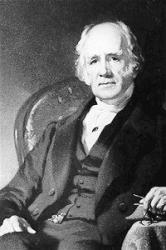
1779 - 1853 Author of "Christ, of all my hopes the ground" in Laudamus Wardlaw, Ralph, D.D. This venerable and (in his generation) influential Scottish divine contributed twelve hymns to the praise of the Church Universal that are likely to live in a humble and useful way. As having so done, and besides edited several collections of hymns, he claims a place of honour in this work. Critically, and regarded as literature, his hymns have little of poetry in them; no "winged words" to lift the soul heavenward. They reflect simply and plainly the lights and shadows of everyday experiences of the spiritual life, rather than its etherialities and subtleties. His "Lift up to God the voice of praise " is the most widely known; and there is a certain inspiriting clangour about it when well sung; yet it is commonplace. His "Hail morning, known among the blest," is narrative and prosaic, though it filled a gap at the time in Sabbath morning worship. “At the time by God appointed," "Remember Thee! remember Christ!" and "Contemplate, saints, the source divine," have vanishing gleams of imaginative light and fine and tender emotion. "O how good the hallowed union," "Where the sounds of plaintive wailing," and "See the Sun of truth arise," are melodious and singable, and pleasant but shallow. “Christ of all my hopes the ground," (Pt. ii.) "When with wasting sickness worn," is much too long, but is a fairly good song of Zion. Wardlaw published in 1803 a Selection of Hymns, to displace what was called The Tabernacle Collection, 1800, that had been used by the Congregationalists of Scotland, and to which he contributed a few hymns. He was assisted in the preparation of this compilation by Dr. Charles Stuart, of Dunearn. The first edition contained 322 hymns. In 1817 a Supplement was added of 171, bringing up the number to 493. Of these eleven (or twelve strictly) were by Wardlaw. Two of these had previously appeared in the Scottish Missionary Magazine (vol. viii. 48). His hymns bear so very slight a proportion to Dr. Wardlaw's writings as a profound theologian and expositor and thoroughly-equipped controversialist on the chief problems of the period, as to make it necessary to refer the reader to his remarkable Life, by the Rev. Dr. W. L. Alexander, entitled, Memoirs of the Life and Writings of Ralph Wardlaw, D.D. (2nd ed., 1856).
Wardlaw was born at Dalkeith on December 22, 1779, where he received his early education, later attending Glasgow University. His only church was in Glasgow. He died at Easterhouse near Glasgow on Dec. 17, 1853, and his public funeral is still remembered for the representative character of the vast multitude who attended it. [Rev. A. B. Grosart, D.D., LL.D.]
Of Dr. Wardlaw's hymns the following are still in common use:—
1. Glad when they saw the Lord. Easter.
2. Hail, morning known amongst the blest [saints]. Sunday Morning.
3. Lift up to God the voice of praise. Praise to the Father.
4. 0 Lord our God, arise. Missions.
5. Remember Thee, remember Christ. Holy Communion.
6. See the Sun of Truth arise. Christ the Light.
Of these Nos. 3-5 appeared in the Tabernacle Collection, 1800.
-- John Julian, Dictionary of Hymnology (1907)
=============
Wardlaw, R., p. 1232, ii. Of his hymns, Nos. 1, 2 are in his Selection, 1803, and No. 6 was added in the Supplement of 1817. This Supplement also contains "O how good the hallowed union," and "Whence the sounds of plaintive wailing," p. 1232, ii.
--John Julian, Dictionary of Hymnology, New Supplement (1907)
Ralph Wardlaw
Calvin Seerveld
b. 1930 Versifier of "I Was Glad They Came to Call Me" in Psalter Hymnal (Gray) Calvin Seerveld (b. 1930) was professor of aesthetics at the Institute for Christian Studies in Toronto from 1972 until he retired in 1995. Educated at Calvin College, Grand Rapids, Michigan; the University of Michigan; and the Free University of Amsterdam (Ph.D.), he also studied at Basel University in Switzerland, the University of Rome, and the University of Heidelberg. Seerveld began his career by teaching at Bellhaven College in Jackson, Mississippi (1958-1959), and at Trinity Christian College in Palos Heights, Illinois (1959-1972). A fine Christian scholar, fluent in various biblical and modern languages, he is published widely in aesthetics, biblical studies, and philosophy. His books include Take Hold of God and Pull (1966), The Greatest Song: In Critique of Solomon (1967), For God's Sake, Run with Joy (1972), Rainbows for the Fallen World: Aesthetic Life and Artistic Task (1980), and On Being Human (1988). He credits the Dutch musician Ina Lohr for influencing his compositions of hymn tunes. Most of his Bible versifications and hymns were written for the Psalter Hymnal (1987), on whose revision committee he ably served.
Bert Polman
Calvin Seerveld
Martin Janus
1620 - 1682 Author of "Jesus, joy of man's desiring" in The Mennonite Hymnal Janus, Martin, seems to have been a native of Silesia, and to have been born about 1620. After receiving his license in theology, he became Precentor of the two churches at Sorau, in Silesia, then, about 1653, was appointed Rector of the Evangelical School at Sagan, and Precentor at the church near the Eckersdorf gate. He became Pastor at Eckersdorf about 1664, but was expelled by the Imperial Edict of March 13, 1668, by which all Evangelical pastors and teachers were driven out of the principality. He is said to have become Precentor at Ohlau, in Silesia, and died there about 1682. The only hymn by him translation into English is:—
Jesu meiner Seelen Wonne. Love to Christ. Included in the Christlich Herzens Andacht, Nürnberg, 1665 [Wolfenbüttel], No. 24, in 18 stanzas, repeated with his name in the Nürnberg Gesang-Buch, 1676, &c, and in Porst's Gesang-Buch, ed. 1855, No. 715. Sometimes erroneously ascribed to J. Scheffler. The translation is, "0! at last I did discover," beginning with stanza v. as No. 464 in pt. i. of the Moravian Hymn Book, 1754. In the 1789 and later eds. (1886, No. 338) it begins "0! at last I've found my Saviour." [Rev. James Mearns, M. A.]
--John Julian, Dictionary of Hymnology (1907)
Martin Janus
Richard Massie
1800 - 1887 Translator of "Thou, Whose Coming Seers And Sages" in The Cyber Hymnal Massie, Richard, eldest son of the Rev. R. Massie, of Goddington, Cheshire, and Rector of Eccleston, was born at Chester, June 18, 1800, and resides at Pulford Hall, Coddington. Mr. Massie published a translation of Martin Luther’s Spiritual Songs, London, 1854. His Lyra Domestica, 1st series, London, 1860, contains translations of the 1st Series of Spitta's Psalter und Harfe. In 1864 he published vol. ii., containing translations of Spitta's 2nd Series, together with an Appendix of translations of German hymns by various authors. He also contributed many translations of German hymns to Mercer's Church Psalter & Hymn Book; to Reid's British Herald; to the Day of Rest, &c. He died Mar. 11,1887.
-- John Julian, Dictionary of Hymnology (1907)
Richard Massie
Theoktistos, ho Stouditēs
800 - 900 Person Name: Theoktistus Author of "Jesus, Name All Names Above" in Rejoice in the Lord
Theoktistos, ho Stouditēs
Pages




