You help make Hymnary.org possible. More than 10 million people from 200+ countries found hymns, liturgical resources and encouragement on Hymnary.org in 2025, including you. Every visit affirms the global impact of this ministry.

If Hymnary has been meaningful to you this year, would you take a moment today to help sustain it? A gift of any size—paired with a note of encouragement if you wish—directly supports the server costs, research work and curation that keep this resource freely available to the world.

Give securely online today, or mail a check to:
Hymnary.org
Calvin University
3201 Burton Street SE
Grand Rapids, MI 49546

Thank you for your partnership, and may the hope of Advent fill your heart.

Person Results

Topics:god+-+the+father
In:person

Planning worship? Check out our sister site, ZeteoSearch.org, for 20+ additional resources related to your search.
Showing 201 - 210 of 340Results Per Page: 102050

Adam Geibel

1855 - 1933 Topics: Church; Father; God; Praise; Thanksgiving; Worship Composer of "[Holy Father, we adore Thee]" in Consecrated Hymns Born: September 15, 1855, Neuenheim, Germany. Died: August 3, 1933, Philadelphia, Pennsylvania. Though blinded by an eye infection at age eight, Geibel was a successful composer, conductor, and organist. Emigrating from Germany probably around 1864, he studied at the Philadelphia Institute for the Blind, and wrote a number of Gospel songs, anthems, cantatas, etc. He founded the Adam Geibel Music Company, later evolved into the Hall-Mack Company, and later merged to become the Rodeheaver Hall-Mack Company. He was well known for secular songs like "Kentucky Babe" and "Sleep, Sleep, Sleep." In 1885, Geibel organized the J. B. Stetson Mission. He conducted the Stetson Chorus of Philadelphia, and from 1884-1901, was a music instructor at the Pennsylvania Institution for the Instruction of the Blind. His works include: Evening Bells, 1874 Saving Grace, with Alonzo Stone (Philadelphia, Pennsylvania: Stone & Bechter, Publishers, 1898) Consecrated Hymns, (Philadelphia, Pennsylvania: Geibel & Lehman, 1902) Uplifted Voices, co-editor with R. Frank Lehman (Philadelphia, Pennsylvania: Geibel & Lehman, 1901) World-Wide Hosannas, with R. Frank Lehman (Philadelphia, Pennsylvania: Geibel & Lehman, 1904) Hymns of the Kingdom, co-editor with R. Frank Lehman et al. (Philadelphia, Pennsylvania: Geibel & Lehman, 1905) --www.hymntime.com/tch/

John Page Hopps

1834 - 1911 Person Name: John P. Hopps Topics: God Father Author of "Father, lead me day by day" in Elmhurst Hymnal Hopps, John Page, was born in London, Nov. 6, 1834, and educated at the G. Baptist College, Leicester. Commencing public work in 1856, after a brief ministry at Hugglescote and Ibstock, in Leicestershire, he became colleague with George Dawson at the Church of the Saviour, Birmingham. From 1860 to 1876 he ministered to Unitarian congregations at Sheffield, Dukinfield, and Glasgow. Since 1876 he has preached in Leicester. Mr. Hopps has published many books and pamphlets, chiefly volumes of Sermons and Lectures. Most of his smaller works are controversial. In 1863 he commenced a monthly periodical called The Truthseeker. He has compiled the following hymnbooks for Congregational, Mission, or School purposes:— (1) Hymns for Public Worship and the Home, 1858; (2) Hymns of Faith and Progress, c. 1865; (3) Hymns for Public Worship, 1873; (4) One hundred Hymns for Sunday Schools, 1873; (5) Hymns, Chants and Anthems for Public Worship, 1877; (6) The Children's Hymn Book, 1879; (7) The Young People's Book of Hymns, 1881; (8) and six different editions of Hymns for Special Services (for Sunday afternoon and evening gatherings in the Temperance Hall and Floral Hall, Leicester). Mr. Hopps has himself written various hymns, some of considerable merit. Several have appeared in Congregational, Baptist, Unitarian and other collections. Among the best known are the following:— 1. Cold and cheerless, dark and drear. Winter. 2. Father, lead me day by day. Child's Prayer for Divine Guidance. 3. Father, let Thy kingdom come. God's Kingdom desired. 4. God bless the little children. Prayer for Children. 5. We praise Thee oft for hours of bliss. The blessings of Sorrow. These hymns are from his Hymns, Chants, and Anthems, &c. 1877, and the Hymns for Special Services. The most popular is No. 2. [Rev. W. R .Stevenson, M.A.] --John Julian, Dictionary of Hymnology (1907)

Clarence A. Walworth

1820 - 1900 Person Name: Clarence A. Walworth, 1820-1790 Topics: God Father Translator of "Holy God, We Praise Thy Name" in Rejoice Hymns Walworth, Clarence Alphonsus, born in 1820, graduated at Union College, 1838, admitted to the Bar 1841, studied for the ministry of Protestant Episcopal Church, but subsequently was ordained as a priest of the Roman Catholic communion, and became Rector of St. Mary's, Albany, in 1864. He was one of the founders of the Order of the Paulists in the U.S.A. He published The Gentle Skeptic, N.Y., 1863, and Andiatoroctè, or the Eve of Lady Day, &c, N.Y., 1888. His paraphrase of the Te Deum, "Holy God, we. praise Thy name," p. 1133, ii. 7, is in the Catholic Psalmist, Dublin, 1858, p. 170. In the American Episcopal Hymnal, 1892, it begins with stanza ii., slightly altered, as "Hark, the loud celestial hymn." He died in 1900. [Rev. L. F. Benson, D.D.] --John Julian, Dictionary of Hymnology, New Supplement (1907)

Edmund S. Carter

1845 - 1923 Person Name: Rev. Edmund S. Carter Topics: God our Father Composer of "CARTER" in The New Baptist Praise Book Born: Feb­ru­a­ry 3, 1845, New Mal­ton, York­shire, Eng­land. Died: May 23, 1923, Scar­bo­rough, York­shire, Eng­land. Carter at­tend­ed Wor­ces­ter Coll­ege, Ox­ford (BA & MA 1871). He was or­dained dea­con in 1871, and priest in 1872. He served as Cur­ate of Christ Church, Eal­ing, Mid­dle­sex (1871-75); Vi­car chor­al of York Min­ster (1875); Rec­tor of St. Mar­tin, Mic­kle­gate, York (1877-82); and Vi­car of St. Mi­chael Bel­fry, York (1882). Music: DAY BY DAY WREFORD --www.hymntime.com/tch/

Meyer Lyon

1751 - 1797 Topics: Father and Creator; God; God--Majesty and greatness of; God--Sovereignty Adapter of "LEONI (YIGDAL)" in Moravian Book of Worship Died: 1797, Kingston, Jamaica. Pseudonym: Leoni. Lyon was a chorister at the Great Synagogue, Duke’s Place, London, and a public singer either at Drury Lane or Covent Garden. Subsequently he became the first qualified chazan of the English and German Synagogue in Jamaica. Sources: Julian, p. 1151 McCutchan, pp. 27-28 Music: LEONI http://www.hymntime.com/tch/bio/l/y/o/lyon_m.htm ================ http://en.wikipedia.org/wiki/Myer_Lyon

Pauline M. Mills

1898 - 1991 Topics: God Our Father : His Works in Creation Author of "Thou Art Worthy" in The Hymnal for Worship and Celebration Pauline Michael Mills. In her teens, Pauline was a pianist for Stockton, California, area churches. In 1975, she was ordained by L.I.F.E. Bible College in Los Angeles. On an evangelism tour, her son told a congregation to offer their favorite scripture and--without telling her in advance--said his mother would write music for it before the service was over. "Thou Art Worthy" was the result. --Daniel Mahraun (from fredbockmusic.com)

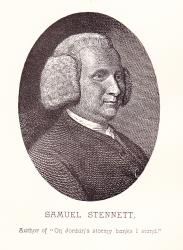
Samuel Stennett

1727 - 1795 Person Name: Stennett Topics: God Father Author of "Adoption" in Psalms and Hymns and Spiritual Songs Samuel Stennett was born at Exeter, in 1727. His father was pastor of a Baptist congregation in that city; afterwards of the Baptist Chapel, Little Wild Street, London. In this latter pastorate the son succeeded the father in 1758. He died in 1795. Dr. Stennett was the author of several doctrinal works, and a few hymns. --Annotations of the Hymnal, Charles Hutchins, M.A. 1872. ====================== Stennett, Samuel, D.D., grandson of Joseph Stennett, named above, and son of the Rev. Joseph Stennett, D.D., was born most pro;bably in 1727, at Exeter, where his father was at that time a Baptist minister. When quite young he removed to London, his father having become pastor of the Baptist Church in Little Wild Street, Lincoln's Inn Fields. In 1748, Samuel Stennett became assistant to his father in the ministry, and in 1758 succeeded him in the pastoral office at Little Wild Street. From that time until his death, on Aug. 24, 1795, he held a very prominent position among the Dissenting ministers of London. He was much respected by some of the statesmen of the time, and used his influence with them in support of the principles of religious freedom. The celebrated John Howard was a member of his congregation and an attached friend. In 1763, the University of Aberdeen conferred on him the degree of D.D. Dr. S. Stennett's prose publications consist of volumes of sermons, and pamphlets on Baptism and on Nonconformist Disabilities. He wrote one or two short poems, and contributed 38 hymns to the collection of his friend, Dr. Rippon (1787). His poetical genius was not of the highest order, and his best hymns have neither the originality nor the vigour of some of his grandfather's. The following, however, are pleasing in sentiment and expression, and are in common use more especially in Baptist congregations:— 1. And have I, Christ, no love for Thee? Love for Christ desired. 2. And will the offended God again? The Body the Temple of the Holy Ghost. 3. As on the Cross the Saviour hung. The Thief on the Cross. 4. Behold the leprous Jew. The healing of the Leper. 5. Come, every pious heart. Praise to Christ. 6. Father, at Thy call, I come. Lent. 7. Great God, amid the darksome night. God, a Sun. 8. Great God, what hosts of angels stand. Ministry of Angels. 9. Here at Thy Table, Lord, we meet. Holy Communion. 10. How charming is the place. Public Worship. 11. How shall the sons of men appear? Acceptance through Christ alone. 12. How soft the words my [the] Saviour speaks. Early Piety. 13. How various and how new. Divine Providence. 14. Not all the nobles of the earth. Christians as Sons of God. 15. On Jordan's stormy banks I stand. Heaven anticipated. 16. Prostrate, dear Jesus, at thy feet. Lent. Sometimes, "Dear Saviour, prostrate at Thy feet." 17. Should bounteous nature kindly pour. The greatest of these is Love. From this, "Had I the gift of tongues," st. iii., is taken. 18. Thy counsels of redeeming grace. Holy Scripture. From "Let avarice, from shore to shore." 19. Thy life 1 read, my dearest Lord. Death in Infancy. From this "'Tis Jesus speaks, I fold, says He." 20. 'Tis finished! so the Saviour cried. Good Friday. 21. To Christ, the Lord, let every tongue. Praise of Christ. From this,"Majestic sweetness sits enthroned," st. iii., is taken. 22. To God, my Saviour, and my King. Renewing Grace. 23. To God, the universal King. Praise to God. 24. What wisdom, majesty, and grace. The Gospel. Sometimes, “What majesty and grace." 25. Where two or three with sweet accord. Before the Sermon. 26. Why should a living man complain? Affliction. From this, "Lord, see what floods of sorrow rise," st. iii., is taken. 27. With tears of anguish I lament. Lent. 28. Yonder amazing sight I see. Good Friday. All these hymns, with others by Stennett, were given in Rippon's Baptist Selection, 1787, a few having previously appeared in A Collection of Hymns for the use of Christians of all Denominations, London. Printed for the Booksellers, 1782; and No. 16, in the 1778 Supplement to the 3rd edition of the Bristol Baptist Selection of Ash and Evans. The whole of Stennett's poetical pieces and hymns were included in vol. ii. of his Works, together with a Memoir, by W. J. Jones. 4 vols., 1824. [Rev. W. R. Stevenson, M.A.] --John Julian, Dictionary of Hymnology (1907)

Ron Hamilton

1950 - 2023 Person Name: Ron Hamilton, 1950- Topics: God Father Author of "Abba, Father" in Rejoice Hymns

Henry Ware

1794 - 1843 Person Name: Henry Ware, Jr., 1794-1843 Topics: Family and Relationships; Fathers; Marriage / Wedding; Mothers; Presence of God; Unity Author of "Happy the Home When God ls There" in Hymns for a Pilgrim People Henry Ware was born in Hingham, Massachusetts, in 1793. His father was a Unitarian minister; afterwards a Professor in Harvard College. Young Ware graduated at Harvard, studied theology, and became minister of the Second Unitarian Society, in Boston, in 1817. After a ministry of twelve years, he made a foreign tour, and on his return was elected "Parkman Professor of Pulpit Eloquence and Pastoral Theology" in Harvard College. In this position he obtained eminence. He died in September, 1843. His collected works in four volumes, were edited after his death, by the Rev. Chandler Robbins. --Annotations of the Hymnal, Charles Hutchins, M.A., 1872 =================== Ware, Henry, D.D., son of Dr. H. Ware, pastor of the Unitarian congregation at Hingham, Massachusetts, and afterward Hollis Professor of Divinity at Cambridge, U.S.A., was born at Hingham, April 21, 1794. Before going to Harvard College, in 1808, he was under the care of Dr. Allyn, at Duxbury, and then of Judge Ware, at Cambridge. He graduated at Harvard in high honours, in 1812; and was then for two years an assistant teacher in Exeter Academy. He was licensed to preach by the Boston Unitarian Association, July 31, 1815; and ordained pastor of the Second Church of that city, Jan. 1, 1817. In 1829, in consequence of his ill health, he received the assistance of a co-pastor in the person of Ralph Waldo Emerson. In the same year Ware was appointed Professor of Pulpit Eloquence and Pastoral Care in the Cambridge Theological School. He entered upon his duties in 1830, and resigned in 1842. He removed to Framingham, and died there, Sept. 25, 1843. His D.D. degree was conferred upon Memoir, published by his brother John Ware, M.D., were numerous and on a variety of topics. He edited the Christian Disciple, which was established in 1813, and altered in title to the Christian Examiner in 1824, for some years before the change of title, and gave it his assistance subsequently. The Rev. Chandler Robbins collected his works and published them in four volumes, in 1847. His hymns, many of which are of more than usual excellence, are given in vol. i. Of these the following are in common use: 1. All nature's works His praise declare. Opening of an Organ. Dated Nov. 9, 1822. It is in Horder's English Congregational Hymns, 1884. 2. Around the throne of God The host angelic throngs. Universal Praise. Dated 1823, and printed in the Christian Disciple, vol. v., and in Putnam, 1874. A fine hymn of praise. 3. Father of earth and heaven, Whose arm upholds creation. Thanksgiving for Divine Mercies. Appeared in Cheever's American Common Place Book, 1831; and in Lyra Sacra Americana, 1868. 4. Father, Thy gentle chastisement. In Sickness. Dated March, 1836; and in Lyra Sacra Americana, 1868. 5. Great God, the followers of Thy Son. Ordination. Written for the Ordination of Jared Sparks, the historian, as pastor of the Unitarian Church, Baltimore, 1819. Given in Lyra Sacra Americana, 1868, and Putnam, 1874. 6. In this glad hour when children meet. Family Gatherings. Dated Aug. 20, 1835. In Lyra Sac. Americana, 1868, and Putnam, 1874. 7. Lift your glad voices in triumph on high. Easter. Dated 1817, and was published in the Christian Disciple of that year, in 2 stanzas of 8 lines. It is in Lyra Sac. Americana, 1868; Putnam, 1874, and numerous hymnbooks. Sometimes stanza ii. is given separately as, "Glory to God, in full anthems of joy." 8. Like Israel's hosts to exile driven. American National Hymn. Written for the Centennial Celebration of the Boston Thursday Lecture, Oct. 17,1833, and given in Lyra Sac. Americana, 1868, and Putnam, 1874. It is a quasi American National Hymn in praise of the Pilgrim Fathers. 9. 0 Thou in Whom alone is found. Laying Foundation Stone of a Place of Worship. In Lyra Sacra Americana, 1868, and Thring's English Collection, 1882. 10. 0 Thou Who on Thy chosen Son. Ordination. Written for an Ordination, March, 1829. In Putnam, 1874, and Dale's English Hymn Book, 1874. 11. Oppression shall not always reign. Against Slavery. "This was Mr. Ware's last composition in verse. It bears date March 15, 1843. In its original form it is longer than as presented here [in 3 stanzas of 8 lines], and is unsuited to a church-book. The following stanzas, taken from one of the Collections [stanzas i., ii. are in Longfellow and Johnson's Book of Hymns, 1848] are a part of the original, altered and transposed, and thus adapted to sacred worship." 12. To prayer, to prayer; for the morning breaks. Prayer. This poem of 10 stanzas of 6 lines is dated 1826, and is given in Lyra Sac. Americana, 1868, and Putnam, 1874. Two centos therefrom are in common use The first begins with stanza i., adapting it for Morning, and the second with stanza ii., "To prayer, for the glorious sun is gone," for Evening. 13. We rear not a temple, like Judah of old. Dedication of a Place of Worship. This is dated 1839, and is given in Putnam, 1874. 14. With praise and prayer our gifts we bring. Opening of a Place of Worship. In Dale's English Hymn Book. 1874. With American Unitarians Dr. Ware ranks very high, and by them his hymns are widely used. [Rev. F. M. Bird, M.A.] -- John Julian, Dictionary of Hymnology (1907) ================== Ware, H., p. 1233, i. Another of his hymns in common use is "Great King of all, our nation's God" (National Humiliation). His hymn "To prayer, to prayer," is in Cheever's American Common-Place Book of Poetry, 1831. --John Julian, Dictionary of Hymnology, Appendix, Part II (1907)

Communauté de Taizé

Person Name: Community of Taizé Topics: Cloud; Our Father; Goodness of God; Life; Light; Love (Human); Righteousness; God's Nature; Cloud; Our Father; Goodness of God; Life; Light; Love (Human); Righteousness Author of "With You, O Lord" in Worship and Song

Pages


Export as CSV
It looks like you are using an ad-blocker. Ad revenue helps keep us running. Please consider white-listing Hymnary.org or getting Hymnary Pro to eliminate ads entirely and help support Hymnary.org.