You help make Hymnary.org possible. More than 10 million people from 200+ countries found hymns, liturgical resources and encouragement on Hymnary.org in 2025, including you. Every visit affirms the global impact of this ministry.

If Hymnary has been meaningful to you this year, would you take a moment today to help sustain it? A gift of any size—paired with a note of encouragement if you wish—directly supports the server costs, research work and curation that keep this resource freely available to the world.

Give securely online today, or mail a check to:
Hymnary.org
Calvin University
3201 Burton Street SE
Grand Rapids, MI 49546

Thank you for your partnership, and may the hope of Advent fill your heart.

Person Results

Topics:closing+of+service
In:person

Planning worship? Check out our sister site, ZeteoSearch.org, for 20+ additional resources related to your search.
Showing 221 - 230 of 419Results Per Page: 102050

Josua Stegmann

1588 - 1632 Person Name: Josua Stegmann, 1588-1632 Topics: Close of Service; Close of Service Author of "Abide, O Dearest Jesus" in Christian Worship (1993) Stegmann, Josua, D.D., son of Ambrosius Stegmann, Lutheran pastor at Sülzfeld, near Meiningen, and finally, in 1593, superintendent at Eckartsberga, near Merseburg, was born at Sülzfeld, Sept. 14,1588. He entered the University of Leipzig in 1608, M.A. in 1611, and was for sometime adjunct of the Philosophical Faculty. In 1617 he was appointed Superintendent of the district (Grafschaft) of Schaumburg, and also pastor at Stadthagen, and first professor of the Gymnasium there; and before entering on his duties graduated D.D. at Wittenberg, on Oct. 24, 1617. When the Gymnasium was erected into a university, and transferred (1621) to Rinteln, he became ordinary professor of Theology there. By the outbreak of war he was forced to flee from Rinteln, in 1623. After his return he was appointed, in 1625, Ephorus of the Lutheran clergy of Hesse-Schaumburg. By the Edict of Restitution, promulgated by the emperor on March 6, 1629, he was greatly harassed; for the Benedictine monks, after they had settled in Rinteln, in 1630, claimed to be the rightful professors, and demanded the restoration of the old church lands, and especially the property formerly belonging to the nunnery at Rinteln, but which had been devoted to the payment of the stipends of the Lutheran professors. They sent soldiers into Stegmann's house to demand that he should refund his salary, and on July 13, 1632, compelled him to hold a disputation, at which they annoyed him in every possible way. Soon after he was seized with fever, and died Aug. 3, 1632. (Koch, iii., 128; Wetzel, iii., 251; Einladungsschrift des Gymnasium Bernhardinum, Meiningen, 1888; manuscript from Pastor A. Bicker, Rinteln; Dr. Förstemann, Leipzig), &c. Stegmann was known as a writer of Latin verse while yet a student at Leipzig, and by his contemporaries was reckoned as a hymn writer. It is, however, very difficult to discriminate his productions. The hymns interspersed in his devotional works are given without any indications of authorship, and many of them are certainly by earlier writers, or recasts founded on earlier hymns….Two hymns, which are usually ascribed to Stegmann, and are not found earlier than in his works, have passed into English as follows:— i. Ach bleib mit deiner Gnade. Supplication. In 1630 it is given in 6 stanzas of 4 lines, as a "Closing Hymn," after the "Prayer for the Preservation of the Doctrine, and of the Church of God." It is a simple and beautiful hymn, and is found in most recent German hymnals, e.g. as No. 208 in the Unverfälschter Liedersegen, 1851. Lauxmann, in Koch, viii., 146, relates various incidents regarding its use (it was, e.g., a favourite hymn of king Friedrich Wilhelm IV. of Prussia), and thus analyses it:— "It has as its keynote the saying of the two disciples at Emmaus, 'Abide with us.' St. i. puts this prayer simply before the Lord Jesus; st. ii.—vi. develop it in detail: Abide with us with Thy Word as our Saviour (ii.); with the illumination of Thy Spirit as our ever-guiding Truth (iii.) ; with Thy blessing as the God rich in power (iv.); with Thy protection as the Conqueror in battle (v.); and with Thy Faithfulness as our Rock in the time of need (vi.). The translations are:— 1. Abide with us, our Saviour. This is a free translation of st. i.-iii., as No. 51, in the Dalston Hospital Hymn Book, 1848; and repeated in the Pennsylvania Lutheran Church Book, 1868. 2. 0 Saviour, go beside us. This is a free translation of st. i., iv.,i v., with an original " Shepherd " st., as st. ii., by J. S. Stallybrass, in the Tonic Solfa Reporter, July 1857. 3. Abide among us with Thy grace. This is a good and full translation, in CM., by Miss Winkworth, in her Lyra Germanica, 2nd ser., 1858, p. 84; and her Chorale Book for England, 1863, No. 14. 4. Abide with us, Lord Jesus! Thy grace. This is a complete translation, as No. 8 in the Ohio Lutheran Hymnal, 1880, and marked as a compilation. 5. Come, abide with Thy grace, in our hearts, 0 Lord. By Dr. R. Maguire, 1872, p. 197. ii. Wie schon leuchtet der Morgenstern, Vom Firmament des Himmels fern. Morning. Included in 1630, as above, p. 10, in 8 stanzas of 10 lines, entitled, "Morning Hymn." The translation in common use is — How beautiful the Morning Star shines from the firmament afar. This was contributed by Philip Pusey to A. R. Reinagle's Psalm & Hymn Tunes, Oxford, 1840, p. 130. Other trs. are :—(1) "How fair shines forth the Morning-star." By H. J. Buckoll, 1842, p. 24. (2) "How lovely now the morning-star." By Miss Cox, 1864, p. 3. (3) “How beautiful the morning star, Shines in." By R. Massie, in the Day of Rest, 1876, p. 472. [Rev. James Mearns, M.A.] --Excerpts from John Julian, Dictionary of Hymnology (1907)

Tom Fettke

b. 1941 Topics: Closing of Service Hymns and Songs Author of "Grace, Love and Fellowship" in The Hymnal for Worship and Celebration Thomas E. Fettke (b. Bronx, New York City, 1941) Educated at Oakland City College and California State University, in Hayward, CA, Fettke has taught in several public and Christian high schools and served as minister of music in various churches, all in California. He has published over eight hundred composi­tions and arrangements (some under the pseudonyms Robert F. Douglas and David J. Allen) and produced a number of recordings. Fettke was the senior editor of The Hymnal for Worship and Celebration (1986). Bert Polman

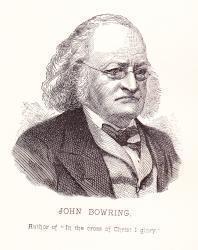
John Bowring

1792 - 1872 Person Name: Sir John Bowring (1792-1872) Topics: Opening and Closing of Service Author of "God is love, his mercy brightens" in Carmina Sanctorum, a selection of hymns and songs of praise with tunes James Bowring was born at Exeter, in 1792. He possessed at an early age a remarkable power of attaining languages, and acquired some reputation by his metrical translations of foreign poems. He became editor of "The Westminster Review" in 1825, and was elected to Parliament in 1835. In 1849, he was appointed Consul at Canton, and in 1854, was made Governor of Hong Kong, and received the honour of knighthood. He is the author of some important works on politics and travel, and is the recipient of several testimonials from foreign governments and societies. His poems and hymns have also added to his reputation. His "Matins and Vespers" have passed through many editions. In religion he is a Unitarian. --Annotations of the Hymnal, Charles Hutchins, M.A., 1872 ======================================= Bowring, Sir John, LL.D., a distinguished man of letters, was born at Exeter, Oct. 17, 1792. His studies extended to philology, poetry, politics, and other branches of learning, whilst as editor of the Westminster Review for some years (he received the appointment in 1825) he did considerable work as a reviewer. He held several official appointments under the Government as Commissioner to France on commercial matters (1831-5); British Consul at Hong Kong (1849); and Governor of Hong Kong (1854). He was twice Member of Parliament, and was knighted in 1854. He died Nov. 23rd, 1872. His published works are very numerous, and display an astonishing acquaintance with various languages. Those specially bearing on poetry include:— (1) Russian Anthology, with Biographical and Critical notices of the Poets of Russia, 1821; (2) Specimens of the Russian Poets, 1823; (3) Ancient Poetry and Romance of Spain, 1824; (4) Batavian Anthology, or Specimens of Dutch Poets, 1824; (5) Servian Popular Poetry, 1821; (6) Specimens of Polish Poets, 1827; (1) Poetry of the Magyars, 1830; (8) History of the Poetical Literature of Bohemia, 1832, &c. In addition to these works, which are mainly translations, Sir John Bowring wrote original verse. This was published interspersed with a few translations, as follows:— (1) Matins and Vespers with Hymns and Occasional Devotional Pieces, Lond., 1823; 2nd edition, enlarged, 1824; 3rd edition, again enlarged, 1841; and the 4th, still further enlarged, in 1851. (2) Hymns: as a Sequel to the Matins, 1825. In addition he contributed to a few Unitarian hymnals, especially that of the Rev. J. R. Beard of Manchester, 1837. In that Collection many of the hymns added to the 3rd edition of Matins, &c, 1841, were first published A selection from these, together with a biographical sketch, was published by Lady Bowring in 1873, as a Memorial Volume of Sacred Poetry. This work contains hymns from the Matins and Vespers, together with others from Periodicals, and from his manuscripts. Of his hymns a very large percentage have come into common use. A few have been adopted by almost all denominations, as, "God is love, His mercy brightens;" "How sweetly flow'd the gospel sound;" "In the Cross of Christ I glory;" "Watchman, tell us of the night;"; and others, but the greater portion are confined to the Unitarian collections of Great Britain and America, of which denomination he was a member. In addition to the more important, which are annotated under their first lines, there are also the following in common use:—- 1. Clay to clay, and dust to dust. Burial. From his Hymns, 1825, into the Hymn & Tune Book, Boston, U.S., 1868, &c. 2. Come the rich, and come the poor. Divine Worship. Contributed to Beard's Collection, 1837, No. 290, and repeated in Bowring's Matins, &c., 3rd edition, 1841. It is in a few American collections. 3. Drop the limpid waters now. Holy Baptism. From Matins and Vespers, 3rd edition, 1841, into Kennedy, 1863. 4. Earth's transitory things decay. The Memory of the Just. From his Hymns, 1825, into Beard, 1837; the American Plymouth Collection, 1855; and the Songs for the Sanctuary, N.Y., 1865, &c. 5. Father, glorify Thy name. The Father glorified. Also from Hymns, 1825, into Beard, 1837; the Hymns of the Spirit, Boston, U.S., 1864, &c. 6. Father and Friend, Thy light, Thy love. Omnipresence. From Matins and Vespers, 2nd edition, 1824, into several collections, and sometimes in an abbreviated form. 7. Father of Spirits, humbly bent before Thee. Also in Hymns, 1825, and Dr. Martineau's Hymns of Praise & Prayer, 1873. In Longfellow and Johnson's Hymns of the Spirit, Boston, U.S., 1864, it is given as, "Father of Spirits, gathered now before Thee." 8. From all evil, all temptation. Preservation implored. Contributed to Beard's Collection, 1837. 9. From the recesses of a lowly spirit. Prayer of trust. From Matins and Vespers, 1st edition, 1823, into several American collections. 10. Gather up, 0 earth, thy dead. Published in his Matins & Vespers, 3rd ed., 1841, in 3 stanzas of 8 lines and repeated, slightly altered, in Kennedy, 1863, No. 753. 11. Gently the shades of night descends Evening. A cento from his poem on "Sunday Evening," in the Matins, &c, 1st edition, 1823, p. 6. It is given in the Boston Hymns of the Spirit, 1864; the Boston Hymn & Tune Book, 1868, and other collections. 12. How dark, how desolate. Hope. 1st published in his Matins, &c, 1823, p. 246. In Dr. Martineau's Hymns of Praise & Prayer, 1873, it is No. 515. 13. How shall we praise Thee, Lord of Light! Evening. A cento from the same poem as No. 7 above. It is given in the Hymns of the Spirit, 1864, and other American collections. 14. Lead us with Thy gentle sway. Divine Guidance desired. Hymns, 1825, into Hymns of the Spirit, 1864, and others. 15. Lord, in heaven, Thy dwelling-place. Praise. Contributed to Beard's Collection, 1837, No. 70, repeated in the author's Matins, &c, 3rd edition 1841, p. 235, and given in a few American collections. In the Hymns of the Spirit, 1864, it is altered to "Lord of every time and place." 16. 0 let my [thy] trembling soul be still. Resignation. From the 1st edition of the Matins, &c, 1823, p. 251, in 3 stanzas of 6 lines, into Beard's Collection, 1837; the Hymns of the Spirit, 1864, and others. It is sometimes given as, "0 let thy," &c. 17. 0, sweet it is to feel and know. Monday Morning. A poem in 16 stanzas of 4 lines, given in his Matins, &c, 1823, p. 60. In 1837 stanzas i.-iii. were given in Beard's Collection as No. 448, and entitled "God near in sorrow." In the 3rd edition of the Matins, &c, 1841, this cento was repeated (p. 245), with the same title, notwithstanding the full poem was in the same book. 18. On the dust I'm doomed to sleep. Resurrection. Appeared in his Matins, &c, 1st edition, 1823, p. 252, in 2 stanzas of 8 lines. In the 2nd edition, 1824, p. 232, it was altered to "In the dust," &c. This was repeated in 1841. In some hymnals it reads:— 19. The heavenly spheres to Thee, 0 God. Evening. This "Hymn to the Deity" appeared in the 2nd edition of his Matins, &c, 1824, pp. 235-6, in 4 stanzas of 4 double lines. It is also in the 3rd edition, 1841; the Boston Hymns of the Spirit, 1864 and other American collections. 20. When before Thy throne we kneel. Divine Worship. From his Hymns, 1825, into Beard's Collection, 1837, No. 93; the Boston Hymn & Tune Book, 1868, No. 21, and others. 21. Where is thy sting, 0 death! Death. Also from the Hymns, 1825, into the same collections as No. 20 above. It will be noted that Beard's Collection, 1837, is frequently named above. The full title of that hymnal is— A Collection of Hymns for Public and Private Worship. Compiled by John R. Board, Lond., John Green, 1837. The Rev. John Relly Beard was an Unitarian Minister in Manchester, and the collection is dedicated "To the Manchester Meeting of Ministers." It contained a large number of original hymns. Bowring contributed 82, of which 33 were published therein for the first time. Some of his hymns are of great merit, and most of them are characterised by great earnestness and deep devotion. -- John Julian, Dictionary of Hymnology (1907) ================== Bowring, Sir John, p. 166, i. In the article on Bowring the hymns numbered therein as 4 and 20 are stated to have appeared in his Hymns, 1825, but in error. The earliest date to which we can positively trace them is Beard's Collection, 1837. From the Hymns, 1825, we find, however, that the following are in modern hymnals:— 1. Our God is nigh. Divine Presence. 2. 'Tis not the gift; but 'tis the spirit. Outward and Inward Virtue. 3. When the storms of sorrow gather. God our Guide. From the various editions of his Matins and Vespers additional hymns arc also in modern use:— 4. If all our hopes and all our fears. Heaven Anticipated. (1823.) 5. In Thy courts let peace be found. Public Worship. (1841.) 6. The offerings to Thy throne which rise. Heart Worship. (1824.) 7. Who shall roll away the stone? Easter. In Beard's Collection, 1837, and Matins & Vespers, 1841. --John Julian, Dictionary of Hymnology, Appendix, Part II (1907)

Charlotte Elliott

1789 - 1871 Topics: Prayer and Invocation; Close of Worship; Opening of Service; Prayer; Close of Worship; Opening of Service; Prayer Author of "The hour of prayer" in Laudes Domini Elliott, Charlotte, daughter of Charles Elliott, of Clapham and Brighton, and granddaughter of the Rev. H. Venn, of Huddersfield, was born March 18, 1789. The first 32 years of her life were spent mostly at Clapham. In 1823 she removed to Brighton, and died there Sept. 22, 1871. To her acquaintance with Dr. C. Malan, of Geneva, is attributed much of the deep spiritual-mindedness which is so prominent in her hymns. Though weak and feeble in body, she possessed a strong imagination, and a well-cultured and intellectual mind. Her love of poetry and music was great, and is reflected in her verse. Her hymns number about 150, a large percentage of which are in common use. The finest and most widely known of these are, "Just as I am” and "My God, my Father, while I stray." Her verse is characterized by tenderness of feeling, plaintive simplicity, deep devotion, and perfect rhythm. For those in sickness and sorrow she has sung as few others have done. Her hymns appeared in her brother's Psalms & Hymns and elsewhere as follows:— (1) Psalms and Hymns for Public, Private, and Social Worship; selected by the Rev. H. V. Elliott, &c., 1835-48. In this Selection her signature is "C. E." (2) The Christian Remembrancer Pocket Book. This was originally edited by Miss Kiernan, of Dublin. Miss Elliott undertook the editorship in 1834. (3) The Invalid's Hymn Book. This was originally compiled by Miss Kiernan, but before publication was re-arranged by Miss Elliott, who also added 23 hymns in the first edition., 1834. These were increased in the following edition to the sixth in 1854, when her contributions amounted to 112. From that date no change was made in the work. (4) Hours of Sorrow Cheered and Comforted; or, Thoughts in Verse, 1836. (5) Morning and Evening Hymns for a Week, printed privately in 1839 for sale for a benevolent institution in Brighton, and published in 1842. (6) Thoughts in Verse on Sacred Subjects, 1869. Miss Elliott's Poems were published, with a Memoir by her sister, Mrs. Babington, in 1873, and an additional volume of Leaves from her unpublished Journals and Poems, also appeared in 1870. In addition to her more important hymns, which are annotated under their respective first lines, there are in common use:— i. From The Invalid's Hymn-book, 1834-1841:— 1. Clouds and darkness round about thee. (1841.) Resignation. 2. Not willingly dost Thou afflict [reject]. (1841.) Divine Chastisement. 3. O God, may I look up to Thee. (1841.) Teach us to Pray. 4. This is enough; although 'twere sweet. (1834.) On being debarred from Divine Worship. 5. With tearful eyes I look around. (1841.) The Invitation "Come Unto Me." ii. From H. V. Elliott's Psalms & Hymns, 1835-1839:— 6. Glorious was that primal light. Christmas. 7. Hail, holy day, most blest, most dear. Easter. 8. My only Saviour, when I feel. Jesus His people's Rest. 9. Now let our heavenly plants and flowers. Monday Morning. 10. The Sabbath-day has reached its close. Sunday Evening. iii. From Miss Elliott's Hours of Sorrow, 1836:— 11. Father, when Thy child is dying. Prayer for a Departing Spirit. 12. Leaning on Thee, my Guide, my Friend. Death Anticipated. 13. My God, is any hour so sweet? The Hour of Prayer. 14. O faint and feeble-hearted. Resignation enforced. 15. There is a holy sacrifice. The Contrite Heart. iv. From her Hymns for a Week, 1839:— 16. Guard well thy lips; none, none can know. Thursday Morning. 17. There is a spot of consecrated ground. Pt. i. 18. This is the mount where Christ's disciples see. Pt. ii. Monday Evening. 19. This is the day to tune with care. Saturday Morning. v. From Thoughts in Verse on Sacred Subjects, 1869:— 20. As the new moons of old were given. On a Birthday. 21. I need no other plea. Pt. i. 22. I need no prayers to saints. Pt. ii. Christ, All in All. 23. Jesus, my Saviour, look on me. Christ, All in All. Several of the earlier of these hymns were repeated in the later works, and are thus sometimes attributed to the wrong work. [Rev. James Davidson, B.A.] -- John Julian, Dictionary of Hymnology (1907) ================ Elliott, Charlotte, p. 328, i. Other hymns are:— 1. O how I long to reach my home. Heaven desired. From the Invalid's Hymn Book, 1834. 2. The dawn approaches, golden streaks. Second Advent. From Thoughts in Verse, &c, 1869. Of her hymns noted on p. 328, Nos. 6, 7, 8, 9, 10,11, and 13, all appeared in the 1st edition of Elliott's Psalms & Hymns, 1835. --John Julian, Dictionary of Hymnology, Appendix, Part II (1907) ======================== Elliott, Charlotte, pp. 328, i.; 1561, ii. Further research enables us to give amended dates to some of her hymns as follows:— 1. With tearful eyes I look around (No. 5). This is in the 1835 Appendix to The Invalid's Hymn Book. 2. My only Saviour, when I feel (No. 8). Also in the 1835 Appendix. 3. Father, when Thy child is dying (No. 11). In the 1833 Appendix. 4. I want that adorning divine, p. 559, i. In the Christian Remembrancer 1848, p. 22. --John Julian, Dictionary of Hymnology, New Supplement (1907)

Samuel Johnson

1822 - 1882 Topics: Close of Service Author of ""Trust, strength, calmness"" in Laudes Domini Johnson, Samuel, M.A, was born at Salem, Massachusetts, Oct. 10, 1822, and educated at Harvard, where he graduated in Arts in 1842, and in Theology in 1846. In 1853 he formed a Free Church in Lynn, Massachusetts, and remained its pastor to 1870. Although never directly connected with any religious denomination, he was mainly associated in the public mind with the Unitarians. He was joint editor with S. Longfellow (q. v.) of A Book of Hymns for Public and Private Devotion, Boston, 1846; the Supplement to the same, 1848; and Hymns of the Spirit, 1864. His contributions to these collections were less numerous than those by S. Longfellow, but not less meritorious. He died at North Andover, Massachusetts, Feb. 19, 1882. His hymns were thus contributed:— i. To A Book of Hymns, 1846. 1. Father [Saviour] in Thy mysterious presence kneeling. Divine Worship. 2. Go, preach the gospel in my name. Ordination. 3. Lord, once our faith in man no fear could move. In Time of War. 4. O God, Thy children gathered here. Ordination. 5. Onward, Christians, [onward] through the region. Conflict. In the Hymns of the Spirit, 1864, it was altered to "Onward, onward through the region." 6. Thy servants' sandals, Lord, are wet. Ordination. 7. When from Jordan's gleaming wave. Holy Baptism. ii. To the Supplement, 1848. 8. God of the earnest heart. Trust. iii. To the Hymns of the Spirit, 1864. 9. City of God, how broad, how far. The Church the City of God. 10. I bless Thee, Lord, for sorrows sent. Affliction— Perfect through suffering. 11. Life of Ages, richly poured. Inspiration. 12. Strong-souled Reformer, Whose far-seeing faith. Power of Jesus. 13. The Will Divine that woke a waiting time. St. Paul. 14. Thou Whose glad summer yields. Prayer for the Church. 15. To light that shines in stars and souls. Dedication of a Place of Worship. Of these hymns No. 8 was "Written for the Graduating Exercises of the Class of 1846; in Cambridge Divinity Schools ; and No. 10 “Written at the request of Dorothea L. Dix for a collection made by her for the use of an asylum." It is undated. A few only of these hymns are in use in Great Britain. [Rev. F. M. Bird, M.A.] -- John Julian, Dictionary of Hymnology (1907)

L. G. Hayne

1836 - 1883 Person Name: Leighton G. Hayne Topics: Adoration Close of Service Composer of "BUCKLAND" in The Lutheran Hymnal Born: February 28, 1836, St. David’s Hall, Exeter, England. Died: March 3, 1883, Bradfield, Essex, England. Son of Richard Hayne, Rector of Mistley, Leighton graduated from Eton and Queen’s College, Oxford (BMus 1856, DMus 1860); at school, he was Eton College’s organist and conducted the Oxford University chorus. He also served as chaplain of Queen’s College; Vicar of Helston, Cornwall (1866-67); Succentor of Eton (1867-71); and Rector of Mistley, Essex (1871-83), and was well known as an organ builder. Music: BUCKLAND CHALVEY ST. CECILIA ST. LAWRENCE --www.hymntime.com/tch/

Ludvig Mathias Lindeman

1812 - 1887 Person Name: Ludvig M. Lindeman, 1812-1887 Topics: Close of Service Composer of "FRED TIL BOD" in Lutheran Book of Worship Ludvig M. Lindeman (b. 1812; d. 1887) was a Norwegian composer and organist. Born in Trondheim, he studied theology in Oslo where he remained the rest of his life. In 1839 he succeeded his brother as the organist and cantor of Oslo Cathedral, a position he held for 48 years up until his death. Lindeman was appointed Knight of the Royal Norwegian Order of St. Olav, and was invited to both help christen the new organ in Royal Albert Hall in London, as well as compose for the coronation of King Oscar II and Queen Sophie of Sweden. In 1883, he and his son started the Organist School in Oslo. Lindeman is perhaps best known for his arrangements of Norwegiam folk tales; over the course of his life he collected over 3000 folk melodies and tunes. Laura de Jong

Keith Getty

b. 1974 Person Name: Keith Getty, b. 1974 Topics: Close of Service Author of "May the Peace of God" in Christian Worship (2008) Keith Getty (b. December 16, 1974) is a world-renowned modern hymn writer. Keith developed a passion for writing good songs for the church in his twenties, and began writing for his small Baptist church. He writes and performs with his wife, Kristyn and they regularly tour the United States and the United Kingdom. (Also known as Julian Keith Getty) Laura de Jong

Stuart Townend

Person Name: Stuart Townend, b. 1963 Topics: Close of Service Author of "May the Peace of God" in Christian Worship (2008) Stuart Townend (b. 1963) grew up in West Yorkshire, England, the youngest son of an Anglican vicar. He started learning piano at a young age, and began writing music at age 22. He has produced albums for Keith Routledge and Vinesong, among many others, and has also released eight solo albums to date. Some of his better-known songs include “How Deep the Father’s Love,” “The King of Love,” and “The Power of the Cross.” He continues to work closely with friends Keith and Kristyn Getty, and is currently a worship leader in Church of Christ the King in Brighton, where he lives with wife Caroline, and children Joseph, Emma and Eden. Laura de Jong

Kurt Kaiser

1934 - 2018 Topics: Closing of Service Hymns and Songs Author of "The Lord Whom We Love" in The Hymnal for Worship and Celebration Kurt Kaiser was born December 17, 1934, in Chicago. He attended American Conservatory of Music and Northwestern University. He moved to Waco, Texas in 1959 in order to join Word Music, where he later worked as vice president and director of music. He arranged and produced several albums. He composed more than 300 songs, and with Ralph Carmichael developed Christian youth musicals. He was a longtime member of the Seventh & James Baptist Church in Waco, Texas. He later helped start Dayspring Baptist Church in Waco. He was an acclaimed pianist who accompanied George Beverly Shea at Billy Graham crusades. He received the Lifetime Achievement Award from the American Society of Composers, Authors and Publishers and was elected to the Gospel Music Hall of Fame. He died November 12, 2018, in Waco. Dianne Shapiro, from obituary in "Baptist Standard" (https://www.baptiststandard.com/news/obituaries/obituary-kurt-kaiser/) and "Gospel Music Hall of Fame" (http://gospelmusichalloffame.org/kurt-kaiser/) accessed 2-8-2019

Pages


Export as CSV
It looks like you are using an ad-blocker. Ad revenue helps keep us running. Please consider white-listing Hymnary.org or getting Hymnary Pro to eliminate ads entirely and help support Hymnary.org.