

 My Starred Hymns
 My FlexScores
 My Hymnals
 My Purchased Files
Planning worship?
Check out our sister site, ZeteoSearch.org,
for 20+ additional resources related to your search.
- |
User Links
Person Results
Will L. Thompson
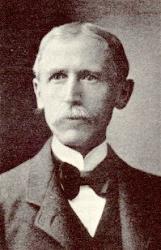
1847 - 1909 Scripture: Philippians 3:7-8 Author of "Jesus Is All the World to Me" in Praise for the Lord (Expanded Edition) Will Lamartine Thompson (1847-1909)
Born: November 7, 1847, East Liverpool, Ohio.
Died: September 20, 1909, New York, New York.
Buried: Riverview Cemetery, East Liverpool, Ohio.
Rebuffed in an early attempt to sell his songs to a commercial publisher, Thompson started his own publishing company. He later expanded, opening a store to sell pianos, organs and sheet music. Both a lyricist and composer, he ensured he would always remember words or melodies that came to him at odd times:
"No matter where I am, at home or hotel, at the store or traveling, if an idea or theme comes to me that I deem worthy of a song, I jot it down in verse. In this way I never lose it."
Thompson took ill during a tour of Europe, and his family cut short their travels to return home. He died a few weeks later.
Music--
1.Jesus Is All the World to Me
2.Lead Me Gently Home, Father
3.Softly and Tenderly Jesus Is Calling
4.There’s a Great Day Coming
--hymntime.com/tch
==================================
Various biographical sketches and newspaper articles about Thompson are available in the DNAH Archives.
Will L. Thompson
Herbert Stanley Oakeley
1830 - 1903 Person Name: Sir Herbert Oakeley Scripture: Philippians 3:13-14 Composer of "EDINA" in The Presbyterian Book of Praise
Herbert Stanley Oakeley
Thomas Phillips
1735 - 1807 Person Name: Thomas Phillips, 1735-1807 Scripture: Philippians 3:9 Composer of "LYDIA" in Complete Anglican Hymns Old and New
Thomas Phillips
Christian Gregor
1723 - 1801 Scripture: Philippians 3:14 Recast of "Jesus, Still Lead On" in Moravian Book of Worship Gregor, Christian, son of Georg Gregor, a peasant living in the Silesian village of Dirsdorf, near Peilau, was born at Dirsdorf, Jan. 1, 1723. In 1742 he went to Herrnhut, where he was at first employed in tuition. He became leader of the music in the [Moravian] Brethren's congregation at Herrnhaag, in 1748, and in 1749 at Zeist; but in 1753 he returned to Herrnhut as cashier of the Brethren's Board of Direction. He was, in 1756, ordained diaconus, in 1767 presbyter, and in 1789 bishop of the Brethren's Church. On Nov. 6,1801, he attended a meeting, held at Herrnhut, of the Board of Direction of which he had been a member from 1764. Just as he entered his house at Berthelsdorf, near Herrnhut, he was struck with paralysis, and died that same day. (Koch, vi. 436; Allgemeine Deutsche Biographie, ix. 630.)
He was a man greatly beloved and respected, simple of heart, loving, earnest and hardworking; and was entrusted with many important missions and visitations. His hymns are characterised by childlike fervour of devotion to his crucified Lord. A number appeared in Des kleinen Brüder-Gesangbuchs dritter Theil, Barby, 1767; but they were mostly contributed to the Gesang-buch zum Gebrauch der evangelischen Brüder Gemeinen, Barby, 1778, of which he was the principal editor. He was also an excellent organist, and edited, in 1784, a collection of accompanying tunes for the hymnbook of 1778, contributing thereto various melodies by himself. A little volume entitled Historische Nachrteht vom Brüder-Gesangbuche des Jahres 1778, und von dessen Lieder-Verfassern, Gnadau, 1835 (2nd ed., 1851), occasionally referred to in these pages, is based on materials collected by Gregor.
His hymns in English common use are:—
i. Bis dereinst mein Stündlein schlägt. [Love to Christ.] 1778, No. 640, in 5 st. of 4 1. Translated as:—
Till permitted hence to go, of st. i., ii., iv., as No. 563 in the Moravian Hymn Book, 1801 (1886, No. 1228). In 1826 an original st.anza by T. Bird was added, beginning, " Till the day when I shall tread." Repeated thus in 1886, No. 1228, and in J. A. Latrobe's Collection, 1841, No. 484.
ii. Die Gottes Cherubim. [The Angels.] Appeared as No. 1877 in Appendix xii. c, 1746, to the Herrnhut Gesang-Buch of 1735, thus :—
"Die Gottes Cherubim
Erheben ihre Stimm,
(Funkelnd von Blitz und Strahl,)
Ihr Lied ist, wenn ichs sagen darf,
Dazu spielt mehr als eine Harf:
Ehre dem Seitenmaal!"
In 1778 it is included as No. 1600, beginning, "Die Gottes Seraphim," and expanded to three stanzas; i. of the Angels; ii. of the Redeemed; iii. of the Church on Earth. Here the song, "Ehre dem Seitenmaal," is given to the Church on Earth, and a paraphrase of Is. vi. 3, to the Angels. The only translation in common use is :—
The Seraphim of God, in full from the 1778, by J. Miller and F. W. Foster, as No. 792 in the Moravian Hymn Book, 1789 (1886, No. 1220), repeated in J. A. Latrobe's Collection, 1841, No. 424. Another translation is The Cherubims of God," from the original form, as No. 93 in pt. iii. of the Moravian Hymn Book, 1748.
iii. Heiliger, heiliger, heiliger, Herr Zebaoth. [Public Worship.] The introductory hymn in 1778, in 4 st. of 81, as on "The Word of God." The only translation is:—
Holy Lord, Holy lord, Holy and Almighty Lord, by F. W. Foster, C. G. Clemens, and J. Swertner, as No. 1 in the Moravian Hymn Book, 1789 (1886, No. 1). Included from the text of 1801, as No. 217 in Dr. Pagenstecher's Collection, 1864.
iv. Nach tausendfachen Plagen. [Passiontide.] 1778, No. 128, in 8 1. It is translated as :—
Behold, my soul, Thy Saviour, by P. H. Molther, as No. 352 in the Moravian Hymn Book, 1789. See No. vi.
v. 0 angenehme Augenblicke. [Eternal Life.] Written in 1766. In 1778, No. 1749, in 2 st. of 8 1. The translations are :—
1. What heavenly joy and consolation, by P. H, Molther, of st. i., as No. 886 in the Moravian Hymn Book, 1789 (1886, No. 1314, st. iii.). Included as st. iii. of No. 403 in the Irish Church Hymnal, 1873.
2. 0 what joy, 0 what joy awaiteth me. No. 988 in the Moravian Hymn Book, 1801. In the 1886 edition it is marked as a translation of No. v. as above. It bears more resemblance, however, to "O wie wallt mein Herz," which is No. 268 in the 1806 Appendix to the Brüder Gesang-Buchof 1778.
vi. 0 süsse Seelenweide. [Passiontide.] 1778, No. 167, in 11 st. of 8 1. St. i., ii. are ascribed to Gregor; iii., iv., xi. to Johann Prätorius ; and v.-x. to C. B. von Zinzendorf (taken from Nos. 40 and 41 of the collected edition of his hymns, 1754). The translation is:—
How is my soul delighted, a translation of st. i., ii., iv., v., vii., x. by F. W. Foster, and J. Miller, as No. 360 in the Moravian Hymn Book, 1789. In the 1801 and later editions (1886, No. 407), Molther's translation of No. iv. was prefixed as st. i., new trranslations of st. viii., x. given, and the rest altered. In the Book of Common Praise, ed. 1872, No. 86, is st. i., ii., 11. 5-8, and iii., by Gregor; and iv., 11. 5-8, by Prätorius, beginning, "Behold, my soul, thy Saviour."
vii. 0 Tage wahrer Seligkeit. [Joy of Forgiveness.] 1778, No. 398, in 6 st. of 8 1., included in the Berlin Geistliche Lieder S. , ed. 1863. Translated as:—
O days of solid happiness in full as No. 340 in the Moravian Hymn Book, 1801 (1886, No. 386). Two centos from the text of 1849 are in common use :—
1. "What days of solid happiness," st. i.-iv., as No. 433 in the edition of 1857 of Mercer's The Church Psalter & Hymnbook.
2. "Whene'er we contemplate the grace," st. iv.-vi. as No. 396 in the Irish Church Hymnal, 1873.
viii. Wenn schlägt die angenehme Stunde. [Ascension.] Written for Aug. 17, 1765, and included as No. 113 in 1767, as above, in 8 1. Translated as :—
When, O when shall I have the favour, by P. H. Molther, c. 1774, included as No. 839 in the Moravian Hymnbook, 1789, repeated as st. ii. of No, 403, in the Irish Church Hymnal, 1873. In the 1886 ed. of the Moravian Hymnbook, No. 1314, it begins, "O when shall I have that great favour."
ix. Wie wifd mir einst dooh sein. [Eternal Life.] 1778, No. 1743, in 10 st. of 6 1. In the Historische Nachricht thereto, st. i.-iii. are marked as by Gregor, and st. iv.-x. as by N. L. von Zinzendorf. St. iv.-x. are recast from a hymn beginning, "Die Bäume blühen ab," writ¬ten in the autumn of 1721, and included as No. 1245 in the 3rd edition, 1731, of his Sammlung geistund lieblicher Lieder, in 46 st. of 4 1., the stanza of the original used being in order 39, 42, 34, 18, 22, 29, 45. The only translation in common use is:—
What shall I feel, when I, in full from the 1778, by J. A. Latrobe, as No. 885 in the Moravian Hymnbook, 1789 (1886, No. 1301). Two centos are in use:-
1. "How shall the joy be told"; st. i.-iv., vi., viii. altered in J. A. Latrobe's Collection, 1841, No. 498.
2. "I hear the enraptured song"; st. 2, 6, 9, 10, as No. 582 in the App. of 1873 to Mercer's The ChurchPsalter & Hymnbook.
Hymns not in English common use:—
x. Ach mein Heir Jesu! dein Nahesein. Communion with Christ. 1767, as above, No. 432, in 10 st. In the Berlin Geistliche Lieder S.,, ed. 1863, No. 925. Justly characterised by Dr. Schaff in his Christ in Song, 1869, p. 496, as "One of the sweetest hymns from the holy of holies of the believer's personal communion with his Saviour, and very characteristic of Moravian piety in its best form." The trsanslations are (1) "What peace divine, what perfect happiness," by P. H. Molther, as No. 278 in the Moravian Hymn Book, 1789 (1849, No. 362). In the 1886 ed. of the Moravian Hymn Book, No. 359, it begins with the translation of st. v., "Gracious Redeemer, grant to us while here." (2) "Jesus, our Lord, when Thou art near," by Dr. H. Mills, 1845 (1856, p. 122). (3) "Ah dearest Lord! to feel that Thou art near," by Miss Winkworth, 1858, p. 168. (4) "Ah, Jesus, Lord, Thou art near to me," in the British Herald, Dec, 1866, p. 372, and as No. 304 in Reid's Praise Book, 1872. (5) "Jesus, my Lord, Thy nearness does impart," by E. Reynolds for Schaff’s Christ in Song, 1869, p. 496.
xi. Hallelujah! der Heiland lebt. Easter. 1778, No. 203, in 17 st. (st. xiv. being by Matthaus Stach, and first published as st. ii. of No. 109, in 1767). Translated as "Sing Hallelujah, Christ doth live," as No. 131 in the Moravian Hymn Book, 1801 (1886, No. 142), repeated in Bishop Ryle's Collection, 1860, No. 131. Beginning with the translation of st. ix., “The God of Peace, to guilty man," 6 st. were included as No. 90 in Reid's Praise Book, 1872. [Rev. James Mearns, M.A.]
-- John Julian, Dictionary of Hymnology (1907)
Christian Gregor
Jane Borthwick
1813 - 1897 Person Name: Jane L. Borthwick Scripture: Philippians 3:14 Translator of "Jesus, Still Lead On" in Moravian Book of Worship Miss Jane Borthwick, the translator of this hymn and many others, is of Scottish family. Her sister (Mrs. Eric Findlater) and herself edited "Hymns from the Land of Luther" (1854). She also wrote "Thoughts for Thoughtful Hours (1859), and has contributed numerous poetical pieces to the "Family Treasury," under the signature "H.L.L."
--Annotations of the Hymnal, Charles Hutchins, M.A. 1872.
=================================
Borthwick, Jane, daughter of James Borthwick, manager of the North British Insurance Office, Edinburgh, was born April 9, 1813, at Edinburgh, where she still resides. Along with her sister Sarah (b. Nov. 26, 1823; wife of the Rev. Eric John Findlater, of Lochearnhead, Perthshire, who died May 2, 1886) she translated from the German Hymns from the Land of Luther, 1st Series, 1854; 2nd, 1855; 3rd, 1858; 4th, 1862. A complete edition was published in 1862, by W. P. Kennedy, Edinburgh, of which a reprint was issued by Nelson & Sons, 1884.
These translations, which represent relatively a larger proportion of hymns for the Christian Life, and a smaller for the Christian Year than one finds in Miss Winkworth, have attained a success as translations, and an acceptance in hymnals only second to Miss Winkworth's. Since Kennedy's Hymnologia Christiana, 1863, in England, and the Andover Sabbath Hymn Book, 1858, in America, made several selections therefrom, hardly a hymnal in England or America has appeared without containing some of these translations. Miss Borthwick has kindly enabled us throughout this Dictionary to distinguish between the 61 translations by herself and the 53 by her sister. Among the most popular of Miss Borthwick's may be named "Jesus still lead on," and "How blessed from the bonds of sin;" and of Mrs. Findlater's "God calling yet!" and "Rejoice, all ye believers."
Under the signature of H. L. L. Miss Borthwick has also written various prose works, and has contributed many translations and original poems to the Family Treasury, a number of which were collected and published in 1857, as Thoughts for Thoughtful Hours (3rd edition, enlarged, 1867). She also contributed several translations to Dr. Pagenstecher's Collection, 1864, five of which are included in the new edition of the Hymns from the Land of Luther, 1884, pp. 256-264. Of her original hymns the best known are “Come, labour on” and "Rest, weary soul.” In 1875 she published a selection of poems translated from Meta Heusser-Schweizer, under the title of Alpine Lyrics, which were incorporated in the 1884 edition of the Hymns from the Land of Luther. She died in 1897. [Rev. James Mearns, M.A.]
-- John Julian, Dictionary of Hymnology (1907)
========================
Borthwick, Jane, p. 163, ii. Other hymns from Miss Borthwick's Thoughtful Hours, 1859, are in common use:—
1. And is the time approaching. Missions.
2. I do not doubt Thy wise and holy will. Faith.
3. Lord, Thou knowest all the weakness. Confidence.
4. Rejoice, my fellow pilgrim. The New Year.
5. Times are changing, days are flying. New Year.
Nos. 2-5 as given in Kennedy, 1863, are mostly altered from the originals.
--John Julian, Dictionary of Hymnology, Appendix, Part II (1907)
=============
Works:
Hymns from the Land of Luther
Jane Borthwick
Adam Drese
1620 - 1701 Scripture: Philippians 3:14 Composer of "SEELENBRÄUTIGAM" in Moravian Book of Worship Drese, Adam, was born in Dec. 1620, in Thuringia, probably at Weimar. He was at first musician at the court of Duke Wilhelm, of Sachse-Weimar; and after being sent by the Duke for further training under Marco Sacchi at Warsaw, was appointed his Kapellmeister in 1655. On the Duke's death in 1662, his son, Duke/Bernhard, took Drese with him to Jena, appointed him his secretary, and, in 1672, Town Mayor. After Duke Bernhard's death, in 1678, Drese remained in Jena till 1683, when he was appointed Kapellmeister at Arnstadt to Prince Anton Günther, of Schwarzburg-Sondershausen. He died at Arnstadt, Feb. 15, 1701 (Koch, iv. 270-274; Allg. Deutsche Biog., v. 397; Wetzel, i. 1934, and A. H. , vol. i., pt. iv., pp. 28-30).
In 1680, the reading of Spener's writings and of Luther on the Romans led to a change in his religious views, and henceforth under good and evil report he held prayer meetings in his house, which became a meeting-place for the Pietists of the district. "His hymns," says Wetzel, "of which he himself composed not only the melodies, but also, as I have certain information, the text also, were Bung at the meetings of pious persons in his house, before they came into print."
One has been translated into English, viz.:—
Seelenbräutigam, Jesus, Gottes Lamm, appeared in the Geistreiches Gesang-Buch, Halle, 1697, p. 147, in 15 stanzas of 6 1., repeated (with the well-known melody by himself added, which in the Irish Church Hymnal is called "Thuringia"), in the Darmstadt Gesang-Buch, 1698, p. 134, as No. 197 in Freylinghausen's Gesang-Buch, 1704, and recently as No. 119 in the Berlin G. L.S. , ed. 1863. In Wagner's Gesang-Buch, Leipzig, 1697, vol. iii. p. 420, it begins, "Jesu, Gottes Lamm." The translation in common use is:—
Bridegroom, Thou art mine, a translation of stanzas 1, 2, 4, 8, 13-15, by Dr. M. Loy, as No. 283 in the Ohio Lutheran Hymnal, 1880.
Another translation is, "God and man indeed," of stanza iii. as stanza i. of No. 463 in the Moravian Hymnbook, 1189 (1886, No. 224). [Rev. James Mearns, M.A.]
-- John Julian, Dictionary of Hymnology (1907)
Adam Drese
Georg Weissel
1590 - 1635 Person Name: Georg Weissel, 1590-1635 Scripture: Philippians 3:10-16 Author of "Lift up your heads, you mighty gates" in Together in Song Weissel, Georg, son of Johann Weissel, judge and afterwards burgomaster at Doranau, near Königsberg, was born at Domnau in 1590. He studied at the University of Königsberg, from 1608 to 1611, and thereafter, for short periods, at Wittenberg, Leipzig, Jena, Strassburg, Basel and Marburg In 1614 he was appointed rector of the school at Friedland near Domnau, but resigned this post after three years, and returned to Königsberg to resume his studies in theology. Finally, in 1623, he became pastor of the newly erected Altrossgart church at Königsberg, where he remained till his death, on August 1, 1635.
Weissel was one of the most important of the earlier hymn-writers of Prussia. His hymns, about 20 in all, are good in style, moderate in length, and varied in metre. The earliest seem to have been written for use at the consecration of the Altrossgart church on the 2nd Sunday in Advent, 1623. The majority are for the greater festivals of the Christian year. The best are No. ii. below, and those for the dying. They appeared mostly in the Königsberg hymn-books, 1639-1650, and in the Preussische Fest-Lieder, pt. i., Elbing, 1642; pt. ii., Königsberg, 1644 [Berlin Library].
Those of Weissel's hymns which have passed into English are:—
i. Im finstern Stall, o W under gross. Christmas. First published in B. Derschau's Ausserlesene geistliche Lieder, Königsberg, 1639, p. 7, in 5 stanzas of 5 lines In the Preussische Fest-Lieder, pt. i., 1642, No. 14, it is entitled "On the Birth of Christ, Lux in tenebris lucet.” The translation in common use is:—
0 miracle of love and might This is a somewhat free translation, omitting stanza v., by Dr. Kennedy, as No. 104 in his Hymnologia Christiana, 1863.
ii. Macht hoch die Thür, das Thor macht weit. Advent. This is a Hymn of Triumph for the Entry of the King of Glory, founded on Ps. xxiv.; and is one of the finest German Advent hymns. First published in the Preussische Fest-Lieder, pt. i., 1642, No. 2, in 5 stanzas of 8 lines, marked as "On the 1st Sunday of Advent."
The translations in common use are:—
1. Lift up your heads, ye mighty gates. This is a good and full translation by Miss Winkworth, in herLyra Germanica, 1st Ser., 1855, p. 10, and her Chorale Book for England, 1863, No. 25. In the Congregational Church Hymnal, 1887, the Evangelical Hymnal, N. Y., 1880, and others, the original form is followed. Other forms are:—
(1) Behold One cometh from afar (i. alt.). This (partly from Mercer) is in the Supplement to the New Congregational Hymn Book, and the 1874 Appendix. to the Leeds Hymn Book.
(2) Behold He cometh from afar. In J. L. Porter's Collection, 1876, altered from No. l.
(3) Oh! hallowed is the land and blest (iii. lines 1, alt.). In the American Sabbath Hymn Book, 1858, &c.
(4) 0 blest the souls, for ever blest (iii. lines1, alt.). In Hymns of the Spirit, Boston, U.S., 1864.
(5) Fling wide the portals of your heart (iv.). In the American Unitarian Hymn Book, 1868.
2. The mighty gates of earth unbar. This is by W. Mercer, based on Miss Winkworth's translation, in his Church Psalm & Hymn Book, 1857, No. 14 (Ox. ed., 1864, No. 71), repeated in Kennedy, 1863. Another translation is: "Lift up, lift up your heads, ye gates," by G. Moultrie, in his Espousals of St. Dorothea, 1870.
iii. Wo ist dein Stachel nun, o Tod? Easter. Founded on 1 Cor. xv., 55-58. First published as No. 3 in pt. ii., 1644, of the Preussische Fest-Lieder, in 5 stanzas of 8 lines, entitled "For the Easter festival." Thence in the Königsberg Gesang-Buch, 1650, p. 193, and others. The form which has passed into English is that in the Hannover Gesang-Buch, 1657, No. 74, in 10 stanzas. This, beginning "O Tod, wo ist dein Stachel nun," is entirely rewritten, probably by Justus Gesenius. Translated as:—
O Death! where is thy cruel sting? This is a full and good version of the 1657 text, as No. 80 in the Ohio Lutheran Hymnal, 1880, marked as a compilation. [Rev. James Mearns, M.A.]
-- Excerpts from John Julian, Dictionary of Hymnology (1907)
Georg Weissel
John Gambold
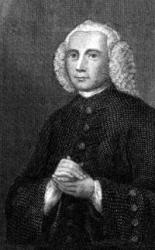
1711 - 1771 Scripture: Philippians 3:8 Author of "Worldly vanity renounced" in Hymnal of the Methodist Episcopal Church Gambold, John, M.A., was b. April 10, 1711, at Puncheston, Pembrokeshire, where his father was vicar. Educated at Christ Church, Oxford, where he graduated B.A. in 1730, M.A. in 1734. Taking Holy Orders, he became, about 1739, Vicar of Stanton Harcourt, Oxfordshire, but resigned his living in Oct. 1742, and joined the United Brethren [Moravians], by whom lie was chosen one of their bishops in 1754. He d. at Haverfordwest, Sept. 13, 1771. He published an edition of the Greek Testament; Maxims and Theological Ideas; Sermons, and a dramatic poem called Ignatius. About 26 translations and 18 original hymns in the Moravian Hymn Books are assigned to him. One or two of his hymns, which were published by the Wesleys, have been claimed for them, but the evidence is in favour of Gambold. A collected ed. of his works was published at Bath in 1789, and afterwards reprinted. [George Arthur Crawford, M.A.]
--John Julian, Dictionary of Hymnology (1907)
John Gambold
John Fawcett
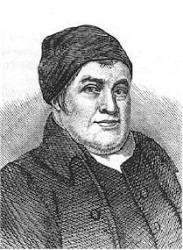
1740 - 1817 Scripture: Philippians 3:8 Author of "Religion is the chief concern" in The Complete Church Hymnal An orphan at the age of twelve, John Fawcett (b. Lidget Green, Yorkshire, England, 1740; d. Hebden Bridge, Yorkshire, 1817) became apprenticed to a tailor and was largely self-educated. He was converted by the preaching of George Whitefield at the age of sixteen and began preaching soon thereafter. In 1765 Fawcett was called to a small, poor, Baptist country church in Wainsgate, Yorkshire. Seven years later he received a call from the large and influential Carter's Lane Church in London, England. Fawcett accepted the call and preached his farewell sermon. The day of departure came, and his family's belongings were loaded on carts, but the distraught congregation begged him to stay. In Singers and Songs of the Church (1869), Josiah Miller tells the story associated with this text:
This favorite hymn is said to have been written in 1772, to commemorate the determination of its author to remain with his attached people at Wainsgate. The farewell sermon was preached, the wagons were loaded, when love and tears prevailed, and Dr. Fawcett sacrificed the attraction of a London pulpit to the affection of his poor but devoted flock.
Fawcett continued to serve in Wainsgate and in the nearby village of Hebden Bridge for the remainder of his active ministry.
Bert Polman
===============
Fawcett, John, D.D., was born Jan. 6, 1739 or 1740, at Lidget Green, near Bradford, Yorks. Converted at the age of sixteen under the ministry of G. Whitefield, he at first joined the Methodists, but three years later united with the Baptist Church at Bradford. Having begun to preach he was, in 1765, ordained Baptist minister at Wainsgate, near Hebden Bridge, Yorks. In 1772 he was invited to London, to succeed the celebrated Dr. J. Gill, as pastor of Carter's Lane; the invitation had been formally accepted, the farewell sermon at Wainsgate had been preached and the wagons loaded with his goods for removal, when the love and tears of his attached people prevailed and he decided to remain. In 1777 a new chapel was built for him at Hebden Bridge, and about the same time he opened a school at Brearley Hall, his place of residence. In 1793 he was invited to become President of the Baptist Academy at Bristol, but declined. In 1811 he received from America the degree of D.D., and died in 1817, at the age of 78. Dr. Fawcett was the author of a number of prose works on Practical Religion, several of which attained a large circulation. His poetical publications are:—
(1) Poetic Essays, 1767; (2) The Christian's Humble Plea, a Poem, in answer to Dr. Priestley against the Divinity of our Lord Jesus Christ, 1772; (3) Three hymns, in the Gospel Magazine, 1777; (4) The Death of Eumenio, a Divine Poem, 1779; (5) Another poem, suggested by the decease of a friend, The Reign of Death, 1780; and (6) Hymns adapted to the circumstances of Public Worship and Private Devotion, Leeds, G. Wright & Son. 1782. They are 166 in number, and were mostly composed to be sung after sermons by the author.
Whilst not attaining a high degree of excellence as poetry, they are "eminently spiritual and practical," and a number of them are found in all the Baptist and Congregational hymn-books that have appeared during the last 100 years. The best known of these are, “Infinite excellence is Thine;" "How precious is the Book divine;" "Thus far my God hath led me on;" "Religion is the chief concern;" "Blest be the tie that binds;" “I my Ebenezer raise;" and "Praise to Thee, Thou great Creator." These hymns, together with others by Fawcett, are annotated under their respective first lines. [Rev. W. R. Stevenson, M.A.]
In addition the following hymns, also by Fawcett, but of less importance, are in common use:
1. Behold the sin-atoning Lamb. Passiontide. No. 60 of his Hymns, 1782, in 7 stanzas of 4 lines. In several hymnals in Great Britain and America.
2. I my Ebenezer raise. Birthday. No. 102 of his Hymns, in 10 stanzas of 4 lines. Usually given in an abbreviated form.
3. Infinite excellence is Thine. Jesus the Desire of Nations. No. 42 of his Hymns, in 12 stanzas of 4 lines. In several hymn-books in Great Britain and America in an abridged form.
4. Jesus, the heavenly Lover, gave. Redemption in Christ. No. 10 of his Hymns, &c., 1782, in 7 stanzas of 4 lines, and headed, "The marriage between Christ and the Soul." In Snepp's Songs of Grace & Glory, 1872, it reads, “Jesus, the heavenly Bridegroom, gave," and stanza v. is omitted.
5. Lord, hast Thou made me know Thy ways? Perseverance. No. 122 of his Hymns, &c., 1782, in 8 stanza of 4 lines. In the Baptist Hymnal, 1879, No. 451, stanzas iv.-vii. are omitted.
6. 0 God, my Helper, ever near. New Year. No. 108 of his Hymns, &c., 1782, in 6 stanzas of 4 lines. The New Congregational Hymn Book, 1859-69 omits st. vi.
7. 0, my soul, what means this sadness? Sorrow turned to Joy. No. 111 of his Hymns, &c., 1782, in 5 stanzas of 6 lines, and based upon the words, "Why art Thou cast down, O my soul?" &c. It is in common use in America, and usually with the omission of stanza ii. as in Dr. Hatfield's Church Hymn Book, 1872.
8. Sinners, the voice of God regard. Invitation to Repentance. No. 63 of his Hymns, &c., 1782, in 7 stanzas of 4 lines on Isaiah lv. 7, "Let the wicked forsake his way," &c. It is in common use in America, but usually in an abbreviated form.
9. Thy presence, gracious God, afford. Before Sermon. No 165 in his Hymns, &c., in 4 stanzas of 4 lines, and a chorus of two lines. In Dr. Hatfield's Church Hymnbook, 1872, No. 126, the chorus is omitted. Fawcett has another hymn on the same subject (No. 79) and beginning, "Thy blessing, gracious God, afford," but this is not in common use.
10. Thy way, 0 God, is in the sea. Imperfect Knowledge of God. No. 66 in his Hymns, &c., 1782, in 7 stanzas of 4 lines on 1 Corinthians xiii. 9, "We know in part," &c. It is in several American collections, usually abbreviated, and sometimes as, "Thy way, O Lord, is in the sea." In this form it is in The Sabbath Hymn Book, 1858, &c.
11. With humble heart and tongue. Prayer for Guidance in Youth. No. 86 in his Hymns, &c., 1782, in 7 stanzas of 4 lines on Psalms cxix. 9. "Wherewith shall a young man cleanse his way." It is No. 954 in the Baptist Psalms and Hymns, 1858-80.
About 20 of Fawcett's hymns are thus still in common use. Two hymns which have been ascribed to him from time to time, but concerning which there are some doubts, are fully annotated under their respective first lines. These are," Humble souls that seek salvation," and "Lord, dismiss us with Thy blessing."
-- John Julian, Dictionary of Hymnology (1907)
John Fawcett
Pages




