You help make Hymnary.org possible. More than 10 million people from 200+ countries found hymns, liturgical resources and encouragement on Hymnary.org in 2025, including you. Every visit affirms the global impact of this ministry.

If Hymnary has been meaningful to you this year, would you take a moment today to help sustain it? A gift of any size—paired with a note of encouragement if you wish—directly supports the server costs, research work and curation that keep this resource freely available to the world.

Give securely online today, or mail a check to:
Hymnary.org
Calvin University
3201 Burton Street SE
Grand Rapids, MI 49546

Thank you for your partnership, and may the hope of Advent fill your heart.

Person Results

Topics:epiphany+5
In:person

Planning worship? Check out our sister site, ZeteoSearch.org, for 20+ additional resources related to your search.
Showing 251 - 260 of 355Results Per Page: 102050

Michael Forster

b. 1946 Person Name: Michael Forster, b. 1946 Topics: Confirmation; Grace and Providence; Redemption and Salvation; The Holy Trinity; Year A Epiphany 3; Year A Second Sunday Before Lent; Year A Palm Sunday: Liturgy of the Passion; Year A Proper 21; Year A Proper 23; Year A Proper 24; Year B All Saints; Year B Baptism of Christ; Year B Christ the King; Year B Easter 2; Year B Lent 1; Year B Palm Sunday: Liturgy of the Passion; Year B Second Sunday Before Lent; Year C Baptism of Christ; Year C Easter 2; Year C Easter 5; Year C Easter 7; Year C Lent 2; Year C Palm Sunday: Liturgy of the Passion; Year C Proper 25; Years A, B, and C Christmas 2 Author of "God is our strength from days of old" in Complete Anglican Hymns Old and New

John L. Bell

b. 1949 Person Name: John L. Bell, b. 1949 Topics: Aid and development; Confirmation; Evangelism; Faith, Trust and Commitment; Lent; The Journey of Life; The Wholeness of Creation; Year A Epiphany 3; Year A Proper 5; Year A Third Sunday Before Advent; Year B Easter 7; Year B Epiphany 2; Year B Third Sunday Before Advent; Year C Bible Sunday; Year C Easter 7; Year C Epiphany 3; Year C Proper 8 Author of "Will you come and follow me (The Summons)" in Complete Anglican Hymns Old and New John Bell (b. 1949) was born in the Scottish town of Kilmarnock in Ayrshire, intending to be a music teacher when he felt the call to the ministry. But in frustration with his classes, he did volunteer work in a deprived neighborhood in London for a time and also served for two years as an associate pastor at the English Reformed Church in Amsterdam. After graduating he worked for five years as a youth pastor for the Church of Scotland, serving a large region that included about 500 churches. He then took a similar position with the Iona Community, and with his colleague Graham Maule, began to broaden the youth ministry to focus on renewal of the church’s worship. His approach soon turned to composing songs within the identifiable traditions of hymnody that began to address concerns missing from the current Scottish hymnal: "I discovered that seldom did our hymns represent the plight of poor people to God. There was nothing that dealt with unemployment, nothing that dealt with living in a multicultural society and feeling disenfranchised. There was nothing about child abuse…,that reflected concern for the developing world, nothing that helped see ourselves as brothers and sisters to those who are suffering from poverty or persecution." [from an interview in Reformed Worship (March 1993)] That concern not only led to writing many songs, but increasingly to introducing them internationally in many conferences, while also gathering songs from around the world. He was convener for the fourth edition of the Church of Scotland’s Church Hymnary (2005), a very different collection from the previous 1973 edition. His books, The Singing Thing and The Singing Thing Too, as well as the many collections of songs and worship resources produced by John Bell—some together with other members of the Iona Community’s “Wild Goose Resource Group,” —are available in North America from GIA Publications. Emily Brink

Diana McLeod

Topics: Epiphany 5 Year B Composer (descant) of "FESTAL SONG" in Voices United

R. Gerald Hobbs

b. 1941 Topics: Epiphany 5 Year C Translator (v. 4, into English) of "Song of Praise to the Holy Trinity (Grand Dieu, Nous Te Bénissons) (Holy God, We Praise Your Name)" in Voices United

Godfrey Hewitt

1909 - 2002 Topics: Epiphany 5 Year C Composer (descant) of "NICÆA" in Voices United

R. B. Y. Scott

1899 - 1987 Topics: Epiphany 5 Year B Author of "Eternal, Unchanging, We Sing" in Voices United Scott, Robert Balgarnie Young. (Toronto, Ontario, July 18, 1899--November 1, 1987). United Church. University of Toronto, B.A., 1922; M.A., 1924; Ph.D., 1928. Pastorate at Long Branch, Ont., 1926-1928; professor of Old Testament at Union College (Vancouver), 1928-1931; United Theological College (Montreal), 1931-1955; Princeton University, 1955-1968; also dean of divinity at McGill University (Montreal), 1945-1955. Published many translations of, and commentaries on, Old Testament material, as well as on the Dead Sea Scrolls. Most of his hymns date from his years in Montreal. --Hugh D. McKellar, DNAH Archives

Jacques de Réland

Topics: Epiphany 5 Year C Translator (into French) of "Amazing Grace, How Sweet the Sound" in Voices United

Isao Koizumi

1907 - 1992 Topics: Epiphany 5 Year A Composer of "TOKYO" in Voices United Isao Koizumi (b. 1907; d. 1992) graduated from the Osaka University of Commerce in 1932. For the next ten years he taught at that school, was an organist in Tokyo, and then went on to work in the import-export business. He has served as the conductor of the Tokyo Choral Society and edited various hymnals, including The Hymnal 1954 for the United Church of Christ in Japan, The Sunday School Hymnal (1954), and Hymns of Praise (1967 edition). A writer and translator of books and articles on church music, Koizumi has also composed and arranged hymn tunes. He is considered a leading figure in modern Japanese hymnody. Bert Polman

Moses Maimonides

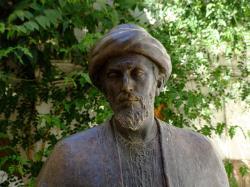
1135 - 1204 Person Name: Moses Maimonides, 12th century Topics: Adoration and Praise God; Biblical Names; God Law of; Processional Hymns; Year A Lent 2; Year A Proper 5; Year B Epiphany 8; Year B Lent 2 Author of "Yigdal Elohim Chai (The God of Abraham Praise)" in The New Century Hymnal Moses Maimonides, original name Moses Ben Maimon, also called Rambam, Arabic name Abū ʿImran Mūsā ibn Maymūn ibn ʿUbayd Allāh (born March 30, 1135, Córdoba [Spain]—died Dec. 13, 1204, Egypt), Jewish philosopher, jurist, and physician, the foremost intellectual figure of medieval Judaism. His first major work, begun at age 23 and completed 10 years later, was a commentary on the Mishna, the collected Jewish oral laws. A monumental code of Jewish law followed in Hebrew, The Guide for the Perplexed in Arabic, and numerous other works, many of major importance. His contributions in religion, philosophy, and medicine have influenced Jewish and non-Jewish scholars alike. --www.britannica.com/ Maimonides's full name was Moses ben Maimon; in Hebrew he is known by the acronym of Rabbi Moses ben Maimon, Rambam. He was born in Spain shortly before the fanatical Muslim Almohades came to power there. To avoid persecution by the Muslim sect — which was wont to offer Jews and Christians the choice of conversion to Islam or death — Maimonides fled with his family, first to Morocco, later to Israel, and finally to Egypt. He apparently hoped to continue his studies for several years more, but when his brother David, a jewelry merchant, perished in the Indian Ocean with much of the family's fortune, he had to begin earning money. He probably started practicing medicine at this time. Maimonides's major contribution to Jewish life remains the Mishneh Torah, his code of Jewish law. His intention was to compose a book that would guide Jews on how to behave in all situations just by reading the Torah and his code, without having to expend large amounts of time searching through the Talmud. Needless to say, this provocative rationale did not endear Maimonides to many traditional Jews, who feared that people would rely on his code and no longer study the Talmud. Despite sometimes intense opposition, the Mishneh Torah became a standard guide to Jewish practice: It later served as the model for the Shulkhan Arukh, the sixteenth­century code of Jewish law that is still regarded as authoritative by Orthodox Jews. Philosophically, Maimonides was a religious rationalist. His damning attacks on people who held ideas he regarded as primitive — those, for example, who understood literally such biblical expressions as “the finger of God” so infuriated his opponents that they proscribed parts of his code and all of The Guide to the Perplexed. Other, more liberal, spirits forbade study of the Guide to anyone not of mature years. An old joke has it that these rabbis feared that a Jew would start reading a section in the Guide in which Maimonides summarizes a rationalist attack on religion, and fall asleep before reading Maimonides's counterattack-thereby spending the night as a heretic. How Maimonides's opponents reacted to his works was no joke, however. Three leading rabbis in France denounced his books to the Dominicans, who headed the French Inquisition. The Inquisitors were only too happy to intervene and burn the books. Eight years later, when the Dominicans started burning the Talmud, one of the rabbis involved, Jonah Gerondi, concluded that God was punishing him and French Jewry for their unjust condemnation of Maimonides. He resolved to travel to Maimonides's grave in Tiberias, in Israel, to request forgiveness. Throughout most of the Jewish world, Maimonides remained a hero, of course. When he died, Egyptian Jews observed three full days of mourning, and applied to his death the biblical verse "The ark of the Lord has been taken" (I Samuel 4:11). To this day, Maimonides and the French­Jewish sage Rashi are the most widely studied Jewish scholars. Contemporary yeshiva students generally focus on the Mishneh Torah, and his Book of Commandments (Sefer ha­Mitzvot) a compilation of the Torah's 613 commandments. Maimonides also formulated a credo of Judaism expressed in thirteen articles of faith, a popular reworking of which (the Yigdal prayer) appears in most Jewish prayerbooks. Among other things, this credo affirms belief in the oneness of God, the divine origins of the Torah, and the afterlife. Its twelfth statement of faith — “I believe with a full heart in the coming of the Messiah, and even though he may tarry I will still wait for him” — was often among the last words said by Jews being marched into Nazi gas chambers. Maimonides was one of the few Jewish thinkers whose teachings also influenced the non­Jewish world; much of his philosophical writings in the Guide were about God and other theological issues of general, not exclusively Jewish, interest. Thomas Aquinas refers in his writings to “Rabbi Moses,” and shows considerable familiarity with the Guide. In 1985, on the 850th anniversary of Maimonides's birth, Pakistan and Cuba — which do not recognize Israel — were among the co­sponsors of a UNESCO conference in Paris on Maimonides. Vitali Naumkin, a Soviet scholar, observed on this occasion: “;Maimonides is perhaps the only philosopher in the Middle Ages, perhaps even now, who symbolizes a confluence of four cultures: Greco­Roman, Arab, Jewish, and Western.” More remarkably, Abderrahmane Badawi, a Muslim professor from Kuwait University, declared: “I regard him first and foremost as an Arab thinker.” This sentiment was echoed by Saudi Arabian professor Huseyin Atay, who claimed that “if you didn't know he was Jewish, you might easily make the mistake of saying that a Muslim was writing.” That is, if you didn't read any of his Jewish writings. Maimonides scholar Shlomo Pines delivered perhaps the most accurate assessment at the conference: “Maimonides is the most influential Jewish thinker of the Middle Ages, and quite possibly of all time” (Time magazine, December 23, 1985). As a popular Jewish expression of the Middle Ages declares: “From Moses [of the Torah] to Moses [Maimonides] there was none like Moses.” Source: Joseph Telushkin. Jewish Literacy. NY: William Morrow and Co., 1991. Reprinted by permission of the author. --www.jewishvirtuallibrary.org/jsource/biography/Maimonides.html

Pauline Martin

Topics: The Christian Year Holy Week; Calling and Response; Choruses and Refrains; Commitment; Consecration; Conversion; God Love; Humility; Jesus Christ Atonement; Jesus Christ Blood; Jesus Christ Love of; Jesus Christ Passion; Love; Ministry; Penitence; Redemption; Sacrifice; Suffering; Victory; Epiphany 4 Year A; Palm/Passion Sunday Year A; Good Friday Year A; Proper 6 Year A; Lent 2 Year B; Lent 3 Year B; Palm/Passion Sunday Year B; Good Friday Year B; Proper 9 Year B; Proper 19 Year B; Proper 27 Year B; Lent 5 Year C; Palm/Passion Sunday Year C; Good Friday Year C; Proper 18 Year C; Proper 19 Year C; Monday in Holy Week Year ABC; Good Friday Year ABC Translator (into French) of "When I Survey the Wondrous Cross" in Voices United

Pages


Export as CSV
It looks like you are using an ad-blocker. Ad revenue helps keep us running. Please consider white-listing Hymnary.org or getting Hymnary Pro to eliminate ads entirely and help support Hymnary.org.





