You help make Hymnary.org possible. More than 10 million people from 200+ countries found hymns, liturgical resources and encouragement on Hymnary.org in 2025, including you. Every visit affirms the global impact of this ministry.

If Hymnary has been meaningful to you this year, would you take a moment today to help sustain it? A gift of any size—paired with a note of encouragement if you wish—directly supports the server costs, research work and curation that keep this resource freely available to the world.

Give securely online today, or mail a check to:
Hymnary.org
Calvin University
3201 Burton Street SE
Grand Rapids, MI 49546

Thank you for your partnership, and may the hope of Advent fill your heart.

Person Results

Topics:proper+7
In:person

Planning worship? Check out our sister site, ZeteoSearch.org, for 20+ additional resources related to your search.
Showing 261 - 270 of 315Results Per Page: 102050

Johann Ludwig Steiner

1688 - 1761 Topics: Proper 7 Year A Composer of "GOTT WILL'S MACHEN" in Voices United

David McK. Williams

1887 - 1978 Person Name: David McKinley Williams Topics: Jesus Christ Praise and Thanksgiving; The Christian Year Advent; Adoration and Praise; Christian Year Epiphany; Church Permanence; Commitment; Freedom; Hope; Jesus Christ Adoration and Praise; Jesus Christ Ascension and Reign; Jesus Christ Kingship, Conqueror; Jesus Christ Love For; Jesus Christ name; Jesus Christ Praise; Jesus Christ Reign; Jesus Christ Youth; Kingdom of God; Morning; Music and Singing; Prisoner(s); Processionals (Opening of Worship); Proclamation; Recessionals; Rest; Testimony; Vision/Dream; Worship; Advent 2 Year A; Advent 3 Year A; Epiphany Year A; Baptism of Jesus Year A; Ascension Year A; Easter 7 Year A; Proper 9 Year A; Reign of Christ Year A; Epiphany Year B; Lent 5 Year B; Easter 7 Year B; Reign of Christ Year B; Epiphany Year C; Epiphany 3 Year C; Epiphany 3 Year C; Ascension Year C; Proper 4 Year C; Proper 6 Year C; Reign of Christ Year C Composer (descant) of "DUKE STREET" in Voices United David McKinley Williams (Conductor) Born: February 20, 1887 - Carnarvonshire, Wales, UK Died: March 13, 1978 - Oakland, California, USA The Welsh-born American church musician, composer, and teacher, David McKinley Williams, began his career in church music as a chorister in the choir of the Cathedral of St. John, Denver. At the age of 13 he became the organist of St. Peter's Church, Denver. In 1908 David McKinley Williams went to New York to serve as the organist of Grace Church Chapel. He moved to Paris in 1911 for study with some of the best known French organists of the time. Upon his return, he served as organist of the Church of the Holy Communion in New York. He served in the Royal Canadian Artillery in World War I and returned to his New York position in 1920. After only six months, he was appointed organist and choirmaster of St. Bartholomew's Church, New York. He held this position until his retirement in 1947. David McKinley Williams developed one of the most outstanding music programs in the USA at St. Bartholomew's. He was head of the organ department of the Juilliard School of Music and a member of the faculty of the School of Sacred Music, Union Theological Seminary. He also served as a member of the Joint Commission on Church Music and the Joint Commission on the Revision of the Hymnal that produced The Hymnal (1940). The Hymnal 1982 uses five of his tunes, including MALABAR used with "Strengthen for Service" (Hymn 312), CANTICUM REFECTIONIS, used with "This is the hour of banquet and of song" (Hymn 316), and GEORGETOWN, used with "They cast their nets in Galilee" (Hymn 661). Source: The Episcopal Church - Liturgy Music Website

W. H. Turton

1856 - 1938 Person Name: Wiliam Henry Turton, 1856-1938 Topics: Christian unity; Holy Communion; The Body of Christ; The Communion of Saints; Year A Easter 7; Year A Proper 15; Year B Easter 4; Year B Easter 7; Year C Easter 7 Author of "O thou, who at thy Eucharist didst pray" in Complete Anglican Hymns Old and New Turton, W. H., a Lieut. in the Royal Engineers, has published A Few Hymns written by A Layman between the Festivals of All Saints, 1880 and 1881. This contains 12 hymns. The Second Series, "written between the Festivals of All Saints, 1881 and 1882," also contains 12 hymns, and the Third Series, 1882-1883, another 12. These hymns are worthy of attention. Those which have passed into common use include;— 1. And now our Eucharist is o'er (1881-1882). Holy Communion. 2. 0 Thou who at Thy Eucharist didst pray. For Unity. "This hymn was used at S. Mary Magdalene's, Munster Square, N. W., in the Anniversary Service of the English Church Union, June 22,1881. It is intended to be sung after the ‘Agnus Dei,' at a choral celebration." In the 1889 Supplemental Hymns to Hymns Ancient & Modern it reads "Thou, Who at Thy first Eucharist didst pray." "This hymn was used at S. Mary Magdalene's, Munster Square, N. W., in the Anniversary Service of the English Church Union, June 22,1881. It is intended to be sung after the ‘Agnus Dei,' at a choral celebration." In the 1889 Supplemental Hymns to Hymns Ancient & Modern it reads "Thou, Who at Thy first Eucharist didst pray." These hymns are in the Altar Hymnal, 1884, together with a third, "Behold! the star is shining." (Epiphany.) Lieut. Turton's signature on A Few Hymns is "R. E." and his publishers, The Church Printing Co., London. --John Julian, Dictionary of Hymnology, Appendix, Part II (1907)

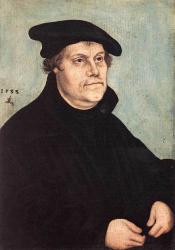
Martin Luther

1483 - 1546 Person Name: Martin Luther, 1483-1546 Topics: Confirmation; Grace and Providence; Redemption and Salvation; The Holy Trinity; Year A Epiphany 3; Year A Second Sunday Before Lent; Year A Palm Sunday: Liturgy of the Passion; Year A Proper 21; Year A Proper 23; Year A Proper 24; Year B All Saints; Year B Baptism of Christ; Year B Christ the King; Year B Easter 2; Year B Lent 1; Year B Palm Sunday: Liturgy of the Passion; Year B Second Sunday Before Lent; Year C Baptism of Christ; Year C Easter 2; Year C Easter 5; Year C Easter 7; Year C Lent 2; Year C Palm Sunday: Liturgy of the Passion; Year C Proper 25; Years A, B, and C Christmas 2 Composer of "EIN FESTE BURG" in Complete Anglican Hymns Old and New Luther, Martin, born at Eisleben, Nov. 10, 1483; entered the University of Erfurt, 1501 (B.A. 1502, M.A.. 1503); became an Augustinian monk, 1505; ordained priest, 1507; appointed Professor at the University of Wittenberg, 1508, and in 1512 D.D.; published his 95 Theses, 1517; and burnt the Papal Bull which had condemned them, 1520; attended the Diet of Worms, 1521; translated the Bible into German, 1521-34; and died at Eisleben, Feb. 18, 1546. The details of his life and of his work as a reformer are accessible to English readers in a great variety of forms. Luther had a huge influence on German hymnody. i. Hymn Books. 1. Ellich cristlich lider Lobgesang un Psalm. Wittenberg, 1524. [Hamburg Library.] This contains 8 German hymns, of which 4 are by Luther. 2. Eyn Enchiridion oder Handbuchlein. Erfurt, 1524 [Goslar Library], with 25 German hymns, of which 18 are by Luther. 3. Geystliche Gesangk Buchleyn. Wittenberg, 1524 [Munich Library], with 32 German hymns, of which 24 are by Luther. 4. Geistliche Lieder auffs new gebessert. Wittenberg. J. Klug, 1529. No copy of this book is now known, but there was one in 1788 in the possession of G. E. Waldau, pastor at Nürnberg, and from his description it is evident that the first part of the Rostock Gesang-Buch, 1531, is a reprint of it. The Rostock Gesang-Buch, 1531, was reprinted by C. M. Wiechmann-Kadow at Schwerin in 1858. The 1529 evidently contained 50 German hymns, of which 29 (including the Litany) were by Luther. 5. Geistliche Lieder auffs new gebessert. Erfurt. A. Rauscher, 1531 [Helmstädt, now Wolfenbüttel Library], a reprint of No. 4. 6. Geistliche Lieder. Wittenberg. J. Klug, 1535 [Munich Library. Titlepage lost], with 52 German hymns, of which 29 are by Luther. 7. Geistliche Lieder auffs new gebessert. Leipzig. V. Schumann, 1539 [Wernigerode Library], with 68 German hymns, of which 29 are by Luther. 8. Geistliche Lieder. Wittenberg. J. Klug, 1543 [Hamburg Library], with 61 German hymns, of which 35 are by Luther. 9. Geystliche Lieder. Leipzig. V. Babst, 1545 [Gottingen Library]. This contains Luther's finally revised text, but adds no new hymns by himself. In pt. i. are 61 German hymns, in pt. ii. 40, of which 35 in all are by Luther. For these books Luther wrote three prefaces, first published respectively in Nos. 3, 4, 9. A fourth is found in his Christliche Geseng, Lateinisch und Deudsch, zum Begrebnis, Wittenberg, J. Klug, 1542. These four prefaces are reprinted in Wackernagel’s Bibliographie, 1855, pp. 543-583, and in the various editions of Luther's Hymns. Among modern editions of Luther's Geistliche Lieder may be mentioned the following:— Carl von Winterfeld, 1840; Dr. C. E. P. Wackernagel, 1848; Q. C. H. Stip, 1854; Wilhelm Schircks, 1854; Dr. Danneil, 1883; Dr. Karl Gerok, 1883; Dr. A. F. W. Fischer, 1883; A. Frommel, 1883; Karl Goedeke, 1883, &c. In The Hymns of Martin Luther. Set to their original melodies. With an English version. New York, 1883, ed. by Dr. Leonard Woolsey Bacon and Nathan H. Allen, there are the four prefaces, and English versions of all Luther's hymns, principally taken more or less altered, from the versions by A. T. Russell, R. Massie and Miss Winkworth [repub. in London, 1884]. Complete translations of Luther's hymns have been published by Dr. John Anderson, 1846 (2nd ed. 1847), Dr. John Hunt, 1853, Richard Massie, 1854, and Dr. G. Macdonald in the Sunday Magazine, 1867, and his Exotics, 1876. The other versions are given in detail in the notes on the individual hymns. ii. Classified List of Luther's Hymns. Of Luther's hymns no classification can be quite perfect, e.g. No. 3 (see below) takes hardly anything from the Latin, and No. 18 hardly anything from the Psalm. No. 29 is partly based on earlier hymns (see p. 225, i.). No. 30 is partly based on St. Mark i. 9-11, and xvi., 15, 16 (see p. 226, ii.). No. 35 is partly based on St. Luke ii. 10-16. The following arrangement, however, will answer all practical purposes. A. Translations from the Latin. i. From Latin Hymns: 1. Christum wir sollen loben schon. A solis ortus cardine 2. Der du bist drei in Einigkeit. O Lux beata Trinitas. 3. Jesus Christus unser Heiland, Der von. Jesus Christus nostra salus 4. Komm Gott Schopfer, heiliger Geist. Veni Creator Spiritus, Mentes. 5. Nun komm der Beidenheiland. Veni Redemptor gentium 6. Was flirchst du Feind Herodes sehr. A solis ortus cardine ii. From Latin Antiphons, &c.: 7. Herr Gott dich loben wir. Te Deum laudamus. 8. Verleih uns Frieden gnädiglich. Dapacem, Domine 9. Wir glauben all an einen Gott. iii. Partly from the Latin, the translated stanzas being adopted from Pre-Reformation Versions: 10. Komm, heiliger Geist, Herre Gott. 11. Mitten wir im Leben sind. Media vita in morte sumus. B. Hymns revised and enlarged from Pre-Reformation popular hymns. 12. Gelobet seist du Jesus Christ. 13. Gott der Vater wohn uns bei. 14. Gott sei gelobet und gebenedeiet. 15. Nun bitten wir den heiligen Geist. C. Psalm versions. 16. Ach Gott vom Himmel, sieh darein. 17. Aus tiefer Noth schrei ich zu dir. 18. Ein' feste Burg ist unser Gott. 19. Es spricht der Unweisen Mund wohl. 20. Es wollt uns Gott genädig sein. 21. War Gott nicht mit uns diese Zeit. 22. Wohl dem, der in Gotten Furcht steht. D. Paraphrases of other portions of Holy Scripture. 23. Diess sind die heilgen zehn Gebot. 24. Jesaia dem Propheten das geschah. 25. Mensch willt du leben seliglich. 26. Mit Fried und Freud ich fahr dahin. 27. Sie ist mir lieb die werthe Magd. 28. Vater unser im Himmelreich. E. Hymns mainly Original. 29. Christ lag in Todesbanden. 30. Christ unser Herr zum Jordan kam. 31. Ein neues Lied wir heben an. 32. Erhalt uns Herr bei deinem Wort. 33. Jesus Christus unser Heiland, Der den, 34. Nun freut euch lieben Christengemein. 35. Vom Himmel hoch da komm ich her. 36. Vom Himmel kam der Engel Schaar. In addition to these — 37. Fur alien Freuden auf Erden. 38. Kyrie eleison. In the Blätter fur Hymnologie, 1883, Dr. Daniel arranges Luther's hymns according to what he thinks their adaptation to modern German common use as follows:— i. Hymns which ought to be included in every good Evangelical hymn-book: Nos. 7-18, 20, 22, 28, 29, 30, 32, 34, 35, 36, 38. ii. Hymns the reception of which into a hymn-book might be contested: Nos. 2, 3, 4, 19, 21, 22, 23, 24, 25, 33. iii. Hymns not suited for a hymn-book: Nos. 1, 5, 6, 27, 31, 37. [Rev. James Mearns, M.A.] --John Julian, Dictionary of Hymnology (1907)

Job Hupton

1762 - 1849 Person Name: Job Hupton (1762-1849) Topics: Proper 7 Year A Author of "Come, ye faithful, raise the anthem" in Ancient and Modern Hupton, Job, was born in 1762, at a small village near Burton-on-Trent. He was brought up to work at a forge, but after his conversion through the preaching of the Rev. John Bradford, one of Lady Huntingdon's ministers, whom he heard at Walsal, he began to preach; and after a few months at Trevecca College, was himself employed by Lady Huntingdon for some years as one of her itinerating ministers. Having changed his views on the subject of Baptism, he became, in 1794, pastor of the Baptist church at Claxton, in Norfolk, where he laboured with much success for many years. He died Oct. 19, 1849. Hupton wrote much both in prose and verse, his compositions appearing in the Gospel Magazine under the signatures of “Ebenezer," "Eliakini, and "J. H—n." His prose writings were collected and published in 1843, under the title The Truth as it is in Jesus. In 1861, D. Sedgwick reprinted his Hymns & Spiritual Poems, with a brief memoir. Of his 22 hymns three only are in common use:— 1. Come ye saints and raise an anthem. Praise. 2. Glorious, high, and lofty One. The Dominion of God. In Gospel Magazine, June, 1806. 3. Jesus, Omnipotent to save. Lent. The first of these, "Come ye," &c. (q.v.), in its altered form by Dr. Neale, is in extensive use, the rest ore in a few hymn-books only. Hupton had a bold and vigorous imagination and great command of language. If in early life he had enjoyed better educational advantages, he would probably have attained to eminence as a poet. [Rev. W. R. Stevenson, M. A.] -- John Julian, Dictionary of Hymnology

W. S. Marshall

Topics: Year B Proper 7 Composer of "BLESSED QUIETNESS" in The New Century Hymnal He composed tunes for gospel lyric writers. John Perry

Tom Colvin

1925 - 2000 Topics: Church in the World Discipleship: Love in Action; Church Mission; Jesus Christ Love of; Last Supper; Love for Others; Service; Holy Thursday Year A; Proper 8 Year A; Proper 24 Year B; Proper 26 Year B; Epiphany 7 Year C; Easter 3 Year C; Proper 5 Year C; Proper 10 Year C; Proper 18 Year C Translator of "Jesu, Jesu, Fill Us with Your Love" in Voices United Tom Colvin (b. 1925; d. 2000) was trained as an engineer and worked in that profession in Burma and Singa­pore from 1945 to 1948. After studying theology at Trinity College, Glasgow University, he was ordained in the Church of Scotland in 1954. He served as missionary in Nyasa­land (now Malawi) from 1954 to 1958, in Ghana from 1958 to 1964, and again in Nyasa­land from 1964 to 1974. His work there included preaching, education, and community development. After completing his missionary work, Colvin became a minister in the United Reformed Church of England and served an inner-city church in London. He returned to Africa in 1984 as a development consultant to the Zimbabwe Christian Council. Colvin's writings include Christ's Work in Free Africa (1964) and three collections of hymns, many written in collaboration with African Christians–Free to Serve (1966), Leap My Soul (1976), and Fill Us with Your Love (1983). Bert Polman

Somerset Corry Lowry

1855 - 1932 Person Name: S. C. Lowry, 1855-1932 Topics: Proper 7 Year B Author of "Son of God, eternal Saviour" in Common Praise Lowry, Somerset Corry, M.A., son of James Corry Lowry, Q.C., of Rockdale, Dungannon, Ireland, b. in 1855, and educated at Repton and Trin. Hall, Camb., B.A. 1877, M.A. 1880. Ordained in 1879 to the Curacy of Doncaster. Subsequently Vicar of North Holmwood, Surrey, 1891-1900, and of St. Augustin's, Bournemouth, from 1900. He has published The Work of the Holy Spirit, 1894; Convalescence, 1897; Lessons from the Passion, 1899, &c. His hymns include:— 1. Behold, Lord! how the nations rage, [In Time of War.] Written "For Use during the War between Russia and Japan," in 1904, and printed as a leaflet by Jarvis & Co., Bournemouth. 2. Lord, while afar our brothers fight. [In Time of War.] Written at Holmwood, Surrey, in 1899, after the reverse of Colenso, and extensively used during the S. African War. Given in the 1904 ed. of Hymns Ancient & Modern. 3. 0 Saviour, once again the ebbing year. [For a Memorial Service.] Written at Holmwood, in 1898, for Queen Victoria's annual Service in memory of the Prince Consort. Included in Hymns of the Christ. Centuries, 1903. 4. 0 Son of God, enthroned above. [Advent] Written at Holmwood, in 1892, and given in M. Woodward's Children's Service Book, 1897. 5. Pressing forward. [Processional.] Also in Woodward's Children's Service Book, 1897. Written at Bournemouth, in 1888. 6. Son of God, Eternal Saviour. [For Unity.] Written at Holmwood, in 1893 ; printed in Goodwill, Feb. 1894, and included in the 1904 ed. of Hymns Ancient & Modern. 7. We meet as we have never met before. [Burial.] Written for use after a Child's Funeral, Holmwood, 1892, and given in Woodward's Children's Service Book, 1897. --John Julian, Dictionary of Hymnology, New Supplement (1907)

Jim Strathdee

b. 1941 Topics: The Church at Worship Opening and Morning Hymns; liturgical Opening Hymns; Hallelujah; Opening Hymns; Praise; Service Music Gathering, Call to Worship, Greeting; Epiphany 2 Year A; Epiphany Last/Transfig. Year A; Proper 12 Year A; Proper 17 Year A; Trinity Sunday Year B; Advent 1 Year C; Easter 7 Year C Author of "God, We Praise You for the Morning" in Voices United

Patrick Appleford

1925 - 2018 Person Name: Patrick Appleford, b. 1924 Topics: Proper 7 Year C Author of "Lord Jesus Christ " in Common Praise

Pages


Export as CSV
It looks like you are using an ad-blocker. Ad revenue helps keep us running. Please consider white-listing Hymnary.org or getting Hymnary Pro to eliminate ads entirely and help support Hymnary.org.





