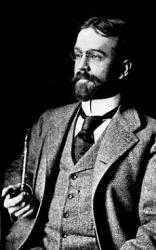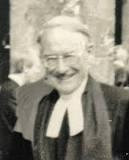
1917 - 1984 Person Name: George Bradford Caird, 1917-1984 Topics: The Holy Scriptures Author (attributed to) of "Not far beyond the sea nor high" in Singing the Faith George Bradford Caird (17 July 1917 – 21 April 1984), D.Phil., D.D., FBA, was a British churchman, theologian, humanitarian, and biblical scholar. At the time of his death he was Dean Ireland's Professor of the Exegesis of Holy Scripture at the University of Oxford.
Born in London, England to parents from Dundee, Scotland, George Caird's early years were spent in Birmingham, England, where his father was a construction engineer, and where he attended King Edward's School. His university education began at Peterhouse, Cambridge, where he received the B.A. in 1939, First-Class Honours in both parts of the Classical Tripos, with distinction in Greek and Latin verse. A lifelong Congregationalist, he then left Cambridge to study theology at Mansfield College, Oxford, and acquired the Oxford M.A., First-Class Honours, in 1943. In 1944 he was granted the Oxford D.Phil. for his thesis "The New Testament Conception of Doxa (Glory)".
After serving three years as a pastor in Highgate, London, in 1946 Caird and his young bride, Viola Mary Newport, known to all as "Mollie," pulled up stakes and left for Canada. Virtually fluent in ancient Hebrew, there he was quickly made Professor of Old Testament at St. Stephen's College, Edmonton, Alberta, and later (simultaneously) Professor of New Testament at McGill University and Principal of the United Theological College of Montreal.
In 1959 Caird returned to Oxford and the Congregationalist stronghold of Mansfield College, where he was first Senior Tutor (under John Marsh) and later Principal (1970–1977). Because he was non-Church of England, and because Mansfield was still a Permanent Private Hall and had not yet achieved status as a constituent College of the University (see Colleges of the University of Oxford) during this period (1969–1977), Caird was barred from holding an official university lectureship. However, as a compensation he was granted the honorary position of Reader (academic rank) in Biblical Studies, a status somewhere between Senior Lecturer and Professor. And whenever he lectured on the New Testament at Mansfield, students from all over the university came and filled the large lecture hall to capacity. According to Henry Chadwick, "He lectured as he preached, almost always without a note . . . with nothing before him but a Greek New Testament, usually upside down, for he knew the text by heart". In 1975-1976 Caird took on almost full-time administration, serving as Moderator of the United Reformed Church, and during his tenure he visited South Africa. His work in the fields of Old and New Testament (he remains one of the few modern biblical interpreters to have held chairs in both) led to four honorary doctorates (including the Oxford D.D.), election to the British Academy (and the granting of its Burkitt Medal for Biblical Studies), and appointment to be the Dean Ireland's Professor and Professorial Fellow at The Queen's College, Oxford.
In 1980 he won the Collins Religious Book Award for his work The Language and Imagery of the Bible. His final years involved biblical translation as a member of the translation panel of The Revised English Bible, as previously he had been a translator of The New English Bible's Apocrypha. He also co-edited (with Henry Chadwick ) Oxford's The Journal of Theological Studies from 1977-1984. In his lifetime he wrote nearly sixty articles, over a hundred book reviews, and six books. Following his resignation as Principal of Mansfield and his taking up of the Dean Ireland's chair, the Cairds left Oxford and moved into the sixteenth century thatched-roof "Brook Cottage" at Letcombe Regis, next to Wantage, Oxfordshire, seventeen miles southwest of Oxford. There they converted the cottage's back storeroom into "the Dusty" - a study for Caird to write in during his imminent retirement; it was there that he was working on his seventh major work, New Testament Theology, when he was felled by a heart attack on Easter Eve, 1984. His funeral was held in Mansfield College Chapel on 28 April, with Principal Donald Sykes delivering the eulogy; a memorial celebration was later conducted (13 October) in Great St. Mary's Church, Oxford, with his close friend Henry Chadwick delivering the address. A Festschrift was at the time in the works, which was subsequently converted into a memorial volume, The Glory of Christ in the New Testament: Studies in Christology in Memory of George Bradford Caird, edited by two of his students, Lincoln Hurst (L. D. Hurst) and Tom Wright (N. T. Wright), and published by Oxford University Press in late 1987. Shortly after his death, some quick decisions needed to be made, particularly that involving his half-completed New Testament Theology; accordingly, Hurst was appointed Caird's Literary Executor. In addition, his children (see below) set up a foundation, The G. B. Caird Memorial Trust, the proceeds from which might enable (successfully, as it turned out) a new senior position to be set up in his name at Mansfield College: the G. B. Caird Fellow in New Testament Theology. It is currently occupied by Dr. John Muddiman. Caird's academic legacy is also seen in that during the course of his career he taught numerous people who went on to garner serious scholarly attention. These include Marcus Borg, Colin Gunton, Lincoln Hurst, David P. Moessner, John Muddiman, Allison Trites, Francis Watson, and N. T. Wright. According to British Old Testament scholar James Barr, Caird was sometimes "practically adored" by students.
While to some Caird could appear austere, even intimidating, "he was in fact full of fun and humour". In his leisure time he enjoyed (most famously) bird-watching, croquet, snooker, music, theatre, reading mysteries, ping pong, chess, and all forms of puzzles — especially the crossword and jigsaw variety. Music in particular occupied his time: it "was important to him, and he wrote several hymns, some of which were included within standard hymnals such as Congregational Praise and Hymns Ancient and Modern". He and Mollie had four children: James, Margaret (Meg) Laing, John, and George (Geordie). To Caird the home was never just a house: it was a bastion of the family - a center of games, poetry, music, and other cultural activity, where he was, according to Henry Chadwick, "sublimely happy . . . it was a microcosm of vigorous debate and breathtaking wit, sparkling with his wife and his three sons and his daughter, whose gifts were a source of deep joy for him. From Mollie he caught his love for bird-watching, and from his children he loved to learn about architecture [James], drama [John], music [Geordie], and medieval philology [Meg]". Also, "no picture of George would be right which omitted his intense affection for his grandchildren."
--en.wikipedia.org/wiki/ (excerpts)
George Bradford Caird


 My Starred Hymns
 My FlexScores
 My Hymnals
 My Purchased Files