You help make Hymnary.org possible. More than 10 million people from 200+ countries found hymns, liturgical resources and encouragement on Hymnary.org in 2025, including you. Every visit affirms the global impact of this ministry.

If Hymnary has been meaningful to you this year, would you take a moment today to help sustain it? A gift of any size—paired with a note of encouragement if you wish—directly supports the server costs, research work and curation that keep this resource freely available to the world.

Give securely online today, or mail a check to:
Hymnary.org
Calvin University
3201 Burton Street SE
Grand Rapids, MI 49546

Thank you for your partnership, and may the hope of Advent fill your heart.

Person Results

Topics:trust+in+god
In:people

Planning worship? Check out our sister site, ZeteoSearch.org, for 20+ additional resources related to your search.
Showing 281 - 290 of 790Results Per Page: 102050

W. F. Lloyd

1791 - 1853 Person Name: W. F. Lloyd, 1791-1853 Topics: Trust, in God Author of ""My times are in Thy hand"" in Methodist Hymn and Tune Book Lloyd, William Freeman, was born at Uley, Gloucestershire, Dec. 22, 1791. As he grew up he took great interest in Sunday school work, and was engaged in teaching both at Oxford and at London. In 1810 he was appointed one of the Secretaries of the Sunday School Union. He also became connected with the Religious Tract Society in 1816. Miller (to whom we are indebted for these details) says in his Singers and Songs of the Church, 1869, p. 418:— "He commenced the Sunday School Teacher's Magazine, conducted for years the Child's Companion and the Weekly Visitor, and suggested the preparation of a large number of books for children and adults. His own literary productions were various, including several useful books for Sunday School teachers and scholars, and numerous tracts. He was also much engaged in compilation and revision." Mr. Lloyd died at the residence of his brother, the Rev. Samuel Lloyd, at Stanley Hall, Gloucestershire, April 22, 1853. Several of his hymns and poetical pieces were given in the Religious Tract Society Child's Book of Poetry (N.D.), and the Royal Tract SocietyMy Poetry Book (N.D.). In 1853 he collected his pieces and published them as, Thoughts in Rhyme, By W. F. Lloyd, London, Hamilton & Co., and Nisbet & Co. Of his hymns the following are common use:— 1. Come, poor sinners, come to Jesus. Invitation. (1835.) 2. Give thy young heart to Christ. A Child’s Dedication to Christ. 3. My [our] times are in Thine hand. My God, I Wish them there. Resignation. (1835.) 4. Sweet is the time of spring. Spring. 5. Wait, my soul, upon the Lord. In Affliction. (1835.) The date given above, 1835, is from Spurgeon's 0ur Own Hymn Book, 1866, and was supplied to the editor by D. Sedgwick. We have no other authority for that date. The earliest we can find is No. 3, which is in Hymns for the Poor of the Flock, 1838. That hymn is very popular. --John Julian, Dictionary of Hymnology (1907), p. 680

Matt Redman

b. 1974 Topics: God Trust in Author of "Better Is One Day" in Psalms for All Seasons Matt Redman (b. February 14, 1974) began leading worship full-time at age 20, serving churches in Chorleywood, Brighton, West Sussex, and Atlanta, Georgia, where he worked with Chris Tomlin and Louie Giglio for the Passion Conferences. He is known for songs such as “The Heart of Worship,” “Better is One Day,” and “Blessed Be Your Name.” His 2012 song “10,000 Reasons (Bless the Lord),” co-written with Jonas Myrin, won two Grammy awards in 2013. Redman has written a number of books, including Mirror Ball and The Unquenchable Worshipper. He and his wife Beth have five children, and are currently based at St. Peters Church in Brighton, England. Laura de Jong

Michael Joncas

b. 1951 Person Name: J. Michael Joncas, b. 1951 Topics: God Trust in Author of "On Eagle's Wings" in Psalms for All Seasons

ICEL

Topics: Trust in God Author (Response) of "My God, my god, why have you abandoned me?" in Together in Song

Graham Kendrick

b. 1950 Topics: God Trust in Author of "The Earth Is the Lord's" in Psalms for All Seasons Graham Kendrick (b. England, August 2, 1950), the son of a Baptist minister in Northamptonshire, is one of the most prolific Christian singer-songwriters in the United Kingdom. He’s written music for over thirty years, and to date has released thirty-eight albums. He is best known for his songs “Shine, Jesus, Shine,” “Knowing You,” and “The Servant King.” Kendrick has received honorary doctorates in divinity from Brunel University and Wycliffe College. In 1987 he helped co-found the March for Jesus, which today is a global phenomenon in which Christians take their faith to the streets in a celebration of Christ. In 1995 Kendrick received a Dove Award for his international work, and he remains an active advocate for Compassion International, which is a Christian child sponsorship organization dedicated to the long-term development of children living in poverty around the world, and also is a contributor to CompassionArt, an organization with the aim of generating income from works of art to assist in the relief of suffering around the planet. Laura de Jong

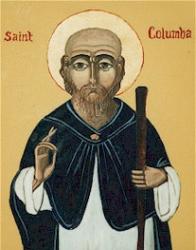
Columba

521 - 597 Person Name: St Columba, 521-97 Topics: Trust in God Author of "Christ is the world’s redeemer" in Together in Song Saint Columba (Irish: Colm Cille, 'church dove'; 7 December 521 – 9 June 597) was an Irish abbot and missionary credited with spreading Christianity in present-day Scotland. He founded the important abbey on Iona, which became a dominant religious and political institution in the region for centuries. He is the Patron Saint of Derry. He was highly regarded by both the Gaels of Dál Riata and the Picts, and is remembered today as a Christian saint and one of the Twelve Apostles of Ireland. Columba reportedly studied under some of Ireland's most prominent church figures and founded several monasteries in the country. Around 563 he and his twelve companions sailed to Iona in Scotland, then part of the Irish kingdom of Dál Riata, where they founded a new abbey as a base for spreading Christianity among the northern Pictish kingdoms who were pagan. He remained active in Irish politics, though he spent most of the remainder of his life in Scotland. Three surviving early medieval Latin hymns may be attributed to him. Columba was born to Fedlimid and Eithne of the Cenel Conaill in Gartan, near Lough Gartan, in modern County Donegal, Ulster in the north of Ireland. On his father's side, he was great-great-grandson of Niall of the Nine Hostages, an Irish high king of the 5th century. He was baptised in Temple-Douglas, in the County Donegal parish of Conwal (mid-way between Gartan and Letterkenny), by his teacher and foster-uncle Saint Crunathan. When sufficiently advanced in letters he entered the monastic school of Moville under St. Finnian who had studied at St. Ninian's "Magnum Monasterium" on the shores of Galloway. He was about twenty, and a deacon when, having completed his training at Moville, he travelled southwards into Leinster, where he became a pupil of an aged bard named Gemman. On leaving him, Columba entered the monastery of Clonard, governed at that time by Finnian, noted for sanctity and learning. Here he imbibed the traditions of the Welsh Church, for Finnian had been trained in the schools of St. David. In early Christian Ireland the druidic tradition collapsed due to the spread of the new Christian faith. The study of Latin learning and Christian theology in monasteries flourished. Columba became a pupil at the monastic school at Clonard Abbey, situated on the River Boyne in modern County Meath. During the sixth century, some of the most significant names in the history of Irish Christianity studied at the Clonard monastery. It is said that the average number of scholars under instruction at Clonard was 3,000. Twelve students who studied under St. Finnian became known as the Twelve Apostles of Ireland; Columba was one of them. He became a monk and eventually was ordained a priest. Another preceptor of Columba was St. Mobhi, whose monastery at Glasnevin was frequented by such famous men as St. Canice, St. Comgall, and St. Ciaran. A pestilence which devastated Ireland in 544 caused the dispersion of Mobhi's disciples, and Columba returned to Ulster, the land of his kindred. He was a striking figure of great stature and powerful build, with a loud, melodious voice which could be heard from one hilltop to another. The following years were marked by the foundation of several important monasteries, Derry, Durrow, Kells, and Swords. While at Derry it is said that he planned a pilgrimage to Rome and Jerusalem, but did not proceed farther than Tours. Thence he brought a copy of those gospels that had lain on the bosom of St. Martin for the space of 100 years. This relic was deposited in Derry. Tradition asserts that, sometime around 560, he became involved in a quarrel with Saint Finnian of Movilla Abbey over a psalter. Columba copied the manuscript at the scriptorium under Saint Finnian, intending to keep the copy. Saint Finnian disputed his right to keep the copy. The dispute eventually led to the pitched Battle of Cúl Dreimhne in 561, during which many men were killed. A second grievance that he led him to induce the clan Neill to rise and engage in battle against King Diarmait at Cooldrevny in 561 was the king's violation of the right of sanctuary belonging to Columba's person as a monk on the occasion of the murder of Prince Curnan, the saint's kinsman. Prince Curnan of Connaught, who had fatally injured a rival in a hurling match and had taken refuge with Columba, was dragged from his protector's arms and slain by Diarmaid's men, in defiance of the rights of sanctuary. A synod of clerics and scholars threatened to excommunicate him for these deaths, but St. Brendan of Birr spoke on his behalf with the result that he was allowed to go into exile instead. Columba's own conscience was uneasy, and on the advice of an aged hermit, Molaise, he resolved to expiate his offense by going into exile and win for Christ as many souls as had perished in the terrible battle of Cuil Dremne. He left Ireland, to return only once, many years later. Columba's copy of the psalter has been traditionally associated with the Cathach of St. Columba. In 563, he travelled to Scotland with twelve companions, in a wicker coracle covered with leather, and according to legend he first landed on the Kintyre Peninsula, near Southend. However, being still in sight of his native land, he moved further north up the west coast of Scotland. The island of Iona was made over to him by his kinsman Conall, king of the British Dalriada, who perhaps had invited him to come to Scotland in the first place. However, there is a sense in which he was not leaving his native people, as the Irish Gaels had been colonizing the west coast of Scotland for the previous couple of centuries. Aside from the services he provided guiding the only centre of literacy in the region, his reputation as a holy man led to his role as a diplomat among the tribes; there are also many stories of miracles which he performed during his work to convert the Picts, the most famous being his encounter with the Loch Ness Monster in 565 AD, where he banished a ferocious "water beast" to the depths of the River Ness after it had killed a Pict and then tried to attack Columba's disciple (see Vita Columbae Book 2 below). He visited the pagan King Bridei, King of Fortriu, at his base in Inverness, winning the Bridei's respect, although not his conversion. He subsequently played a major role in the politics of the country. He was also very energetic in his work as a missionary, and, in addition to founding several churches in the Hebrides, he worked to turn his monastery at Iona into a school for missionaries. He was a renowned man of letters, having written several hymns and being credited with having transcribed 300 books. One of the few, if not the only, times he left Scotland was towards the end of his life, when he returned to Ireland to found the monastery at Durrow. Columba died on Iona and was buried in AD 597 by his monks in the abbey he created. In AD 794, the Vikings descended on Iona. Columba's relics were finally removed in AD 849 and divided between Scotland and Ireland. The parts of the relics which went to Ireland are reputed to be buried in Downpatrick, County Down, with St. Patrick and St. Brigid or at Saul Church neighbouring Downpatrick. (Names of Iona), Inchcolm and Eilean Chaluim Chille. Columba is credited as being a leading figure in the revitalization of monasticism. It is known that Clan MacCallum and Clan Malcolm are descended from the original followers of Columba, It is also said that Clan Robertson are heirs of Columba. Clan MacKinnon may also have some claim to being spiritual descendants of St Columcille as after he founded his monastery on Isle Iona, the MacKinnons were the abbots of the Church for centuries. This would also account for the fact that Clan MacKinnon is amongst the ancient clans of Scotland. The cathedral of the Catholic Diocese of Argyll and the Isles is placed under the patronage of St. Columba, as are numerous Catholic schools and parishes throughout the nation. The Scottish Episcopal Church and Church of Scotland also have parishes dedicated to him. The village of Kilmacolm in Renfrewshire is also derived from Columba's name. Columba is the patron-saint of the city of Derry, where he founded a monastic settlement in c.AD 540. The name of the city in Irish is Doire Colmcille and is derived from the native oak trees in the area and the city's association with Columba. The Catholic Church of Saint Columba's Long Tower stands at the spot of this original settlement. The Church of Ireland Cathedral in Derry is dedicated to St Columba. St. Colmcilles Primary School and St. Colmcilles Community School are two schools in Knocklyon, Dublin, named after St. Colmcille, with the former having an annual day dedicated to the saint on 9 June. Aer Lingus, Ireland's national flag carrier has named one of its Airbus A330 aircraft in commemoration of the saint (reg: EI-DUO). As of 2011, Canadians who are of Scottish ancestry are the third largest ethnic group in the country and thus Columba's name is to be found attached to Catholic, Anglican and Presbyterian parishes. This is particularly the case in eastern Canada apart from Quebec which is French-speaking. Throughout the U.S.A. there are numerous parishes within the Catholic and Episcopalian denominations dedicated to Columba. Within the Protestant tradition the Presbyterian Church (which has its roots in Scottish Presbyterianism) also has parishes named in honour of Columba. There is even an Orthodox Church monastery dedicated to the saint in the Massachusetts town of Southbridge. St. Columba is the Patron Saint of the Roman Catholic Diocese of Youngstown, OH. The Cathedral there is named for him. --en.wikipedia.org/wiki (excerpts)

Johann Olearius

1611 - 1684 Person Name: Joh. Olearius, 1611-1684 Topics: Christian Life Trust in God Author of "Sollt ich meinem Gott nicht trauen" in Evang.-Lutherisches Gesangbuch Johannes Olearius (b. Halle, Germany, 1611; d. Weissenfels, Germany, 1684) Born into a family of Lutheran theologians, Olearius received his education at the University of Wittenberg and later taught theology there. He was ordained a Lutheran pastor and appointed court preacher to Duke August of Sachsen-Weissenfels in Halle and later to Duke Johann Adolph in Weissenfels. Olearius wrote a commentary on the entire Bible, published various devotional books, and produced a translation of the Imitatio Christi by Thomas a Kempis. In the history of church music Olearius is mainly remembered for his hymn collection, which was widely used in Lutheran churches. Bert Polman ======================= Olearius, Johannes, son of Johann Olearius, pastor of St. Mary's Church and superintendent at Halle, was born at Halle, Sept. 17, (N.S.) 1611. He entered the University of Wittenberg in 1629 (M.A. 1632, D.D. 1643], where he became lecturer, and, in 1635, adjunct of the philosophical faculty. In 1637 he became Superintendent at Querfurt; and, in 1643, was appointed by Duke August of Sachsen-Weissenfels as his chief court preacher, and private chaplain at Halle, where he became in 1657 Kirchenrath, and in 1664 General Superintendent. When, on the death of Duke August in 1680, the administration of Magdeburg fell to the Elector of Brandenburg, Duke Johann Adolf gave Olearius similar appointments at Weissenfels, which he held till his death on April 24, 1684 (Koch, iii. 346; Allgemeine Deutsche Biographie xxiv. 279, &c). Olearius was the author of a Commentary on the whole Bible, and of various devotional works. He was also the compiler of one of the largest and most important German hymn-books of the 17th century, viz. the Geistliche Singe-Kunst, of which the first edition appeared at Leipzig in 1671, with 1207 (1218) hymns, and the second at Leipzig in 1672, with 1340. The first edition contained 302 hymns by Olearius himself, and marked "D. J. O." They may best be described as useful, being for times and seasons hitherto unprovided for, and filling up many gaps in the various sections of the German hymn-books. They are mostly short, many of only two verses, simple and easy of comprehension, often happy in expression and catching, and embodying in a concise form the leading ideas of the season or subject. Many were speedily adopted into German hymn-books, and a considerable number are still in use. Of Olearius's hymns the following have passed into English:— i. Gelobet sei der Herr. Trinity Sunday. One of his best hymns. Founded on the Gospel for Trinity Sunday. Included in 1(571 as above, No. 709, in 5 stanzas of 8 lines, and entitled "Encouragement from the Gospel to thankful meditation on this great mystery." In the Berlin Geistliche Lieder ed. 1863, No. 17. Translated as:— 1. Blest be my Lord and God. A good translation, omitting st. v. by A. T. Russell, as No. 134, in his Psalms & Hymns 1851. 2. 0 praise the Lord! His name extol. A version of st. i.-iii., as No. 115 in the Ohio Lutheran Hymnal, 1880. ii. Herr Jesu Christ, dein theures Blut. Passiontide. His finest hymn. Founded on I St. John i. 7. In 1671 as above, No. 576, in 4 stanzas of 4 lines and entitled "Meditation on the Precious Blood of Jesus Christ." St. ii. is based on the hymn “In Christi Wunden schlaf ich ein" (p. 319, ii.). In the Berlin Geistliche Lieder, edition 1863, No. 233. Translated as:— 1. Lord Jesu Christ! Thy precious blood Brings to my soul. A good and full translation by A. T. Russell, as No. 161 in his Psalms & Hymns, 1851. 2. Lord Jesus Christ! Thy precious blood Is to my soul. In full by C. H. L. Schnette, as No. 77 in the Ohio Lutheran Hymnal, 1880. Another translation is "Lord Jesus Christ, Thy blessed blood." By Miss Manington, 1863, p. 43. iii. Herr, öffhe mir die Herzensthür. Holy Scripture. After Sermon. In 1671 as above, No. 975, in 2 stanzas and a doxology. In the Berlin Geistliche Lieder, ed. 1863, No. 422. The translation in common use is:— Lord, open Thou my heart to hear, And by Thy Word to me draw near. In full by Dr. M. Loy in the Ohio Lutheran Hymnal, 1880. iv. Nun kommt das neue Kirchenjahr. Advent. In 1671 as above, No. 384, in 3 stanzas and a doxology. In the Berlin Geistliche Lieder, ed. 1863, No. 145. The translation is:— The new Church year again is come. By E. Cronenwett, as No. 15 in the Ohio Lutheran Hymnal, l880. v. Tröstet, tröstet meine Lieben. St. John Baptist's Day. In 1671 as above, No. 733, in 4 stanzas of 8 lines, and entitled "Meditation on the Lesson of the Festival. Isaiah xl." In the Berlin Geistliche Lieder, ed. 1863, No. 124. Translated as:— Comfort, comfort ye my people. A full and good translation by Miss Winkworth, as No. 83 in her Chorale Book for England, 1863. Repeated in full in the Parish Hymn Book, 1865, and the Ohio Lutheran Hymnal, 1880, and, omitting st. ii. in the Pennsylvania Lutheran Church Book, 1868. Other hymns by Olearius have been translated into English, viz.:— vi. Gott Lob, mein Jesus macht mich rein. Presentation in the Temple. In 1671 as above, No. 507, as a hymn on the Purification in 6 stanzas, and entitled "Encouragement from the Gospel," viz. St. Luke ii. 22-32. In the Berlin Geistliche Lieder, ed. 1863, No. 1270. The form tr. is "Durch Jesum kann ich auch mit Freud," which is No. 428 in Knapp's Evangelischer Liederschatz, 1837, and is st. iv.-vi. altered. Translated as "I too, through Jesus, may in peace." By Dr. H. Mills, 1845 (1856, p. 277). vii. Sollt ich meinem Gott nicht trauen. Trust in God. In 1671 as above, No. 878, in 6 stanzas, and entitled “Encouragement from the Gospel," viz. St. Matt. vi. 24 ff, the Gospel for the 15th Sunday after Trinity. In the Berlin Geistliche Lieder, ed. 1863, No. 857. Tr. as, "Shall I not trust my God." By Miss Warner, 1858, p. 206. viii. Wenn dich Unglüick hat betreten. Cross and Consolation. In 1671 as above, No. 827, in 6 st., and entitled "Encouragement from the Gospel," viz. St. Matt. xv. 21-28, the Gospel for Reminiscere Sunday (2nd Sunday in Lent). In Porst's Gesang-Buch, ed. 1855, No. 997. The translations are (1) "When afflictions sore oppress you." By Miss Cox, 1841, p. 129. (2) "When affliction rends the heart." By Lady E. Fortescue, 1843, p. 55. [Rev. James Mearns, M.A.] --John Julian, Dictionary of Hymnology (1907)

Robert J. Fryson

Person Name: Robert J. Fryson, 1944-1994 Topics: Cross; Discipleship; Evangelization; Holiness; Hunger and Thirst; Life in Christ, Christian Life; Mission; Promise of God; Salvation; Going Forth, Sending Forth; Trust in Jesus Christ; Witness Adapter of "LIFT HIM UP" in Lead Me, Guide Me (2nd ed.)

Maltbie D. Babcock

1858 - 1901 Person Name: Rev. Maltbie D. Babcock Topics: God the Father God in Nature; Courage and Loyalty; Creation, The; God Nature, His Glory in; God Presence, His Abiding; Joy; Loyalty and Courage; Nature Services; Trust and Confidence Author of "This is my Father's world" in The Hymnal Maltbie D. Babcock (b. Syracuse, NY, 1858; d. Naples, Italy, 1901) graduated from Syracuse University, New York, and Auburn Theological Seminary (now associated with Union Theological Seminary in New York) and became a Presbyterian minister. He served the Brown Memorial Presbyterian Church in Baltimore, Maryland, and the Brick Presbyterian Church in New York City. In Baltimore he was especially popular with students from Johns Hopkins University, but he ministered to people from all walks of life. Babcock wrote hymn texts and devotional, poems, some of which were published in The School Hymnal (1899). Bert Polman =================== Babcock, Maltbie Davenport, D.D., was born at Syracuse, N.Y., Aug. 3, 1858. Graduating from Syracuse University, he was ordained to the Presbyterian Ministry and was pastor of churches in Lockport, N.Y., Baltimore, and N.Y. City. He died at Naples, Italy, May 18th, 1901. He was richly gifted, and his short career was memorable for the extraordinary influence of his personality and his preaching. Extracts from his sermons and poems were published in 1901 as Thoughts for Every Day Living; and his Biography by Dr. C. E. Robinson in 1904. He contributed to the Presbyterian School Hymnal, 1899, the following hymns:— 1. Gaily the bells are ringing. Faster. 2. O blessed Saviour, Lord of love. Unto Me. 3. Shining Sun, shining sun. Child's Hymn. The tunes to these hymns were of his own composing. In The Pilgrim Hymnal, 1904, there is:— 4. Rest in the Lord, my soul. Trust and Peace and in the American Methodist Hymnal, 1905:— 5. Be strong: we are not here to play. Activity in God's Service. Nos. 4 and 5 are from Thoughts for Every Day Living, 1901; but undated. [Rev. L. F. Benson, D.D.] --John Julian, Dictionary of Hymnology, New Supplement (1907)

Alfred B. Smith

1916 - 2001 Person Name: Alfred B Smith Topics: Living the Christian Life Faith and Trust in God Author of "I do not know what lies ahead" in Complete Mission Praise Used pseudonym B. C. Laurelton ---------- In 1930, he began playing on radio broadcasts in Jersey City, New Jersey, on "The Old Fashioned Gospel Hour." After meeting Wendell P. Loveless, Alfred enrolled at the Moody Bible Institute in Chicago and became a member of the WMBI staff. During service as Minister of Music at The Church of the Open Door in Philadelphia, he taught at The Philadelphia School of the Bible in the fall of 1938. During that year, he wrote "For God So Loved the World" after visiting the ninety-four year-old hymn writer George C. Stebbins. Smith met Billy Graham when they were both students at Wheaton College. During their long collaboration, they founded Singspiration in 1941. After graduating from Wheaton, Smith, Graham, and George Beverly Shea started "Youth for Christ" in Chicago. --Daniel Mahraun (from livinghymns.org)

Pages


Export as CSV
It looks like you are using an ad-blocker. Ad revenue helps keep us running. Please consider white-listing Hymnary.org or getting Hymnary Pro to eliminate ads entirely and help support Hymnary.org.