

 My Starred Hymns
 My FlexScores
 My Hymnals
 My Purchased Files
Planning worship?
Check out our sister site, ZeteoSearch.org,
for 20+ additional resources related to your search.
- |
User Links
Person Results
Joseph Addison
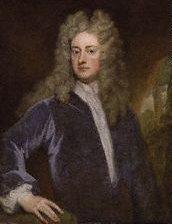
1672 - 1719 Person Name: Addison Author of "The Death Line" in The Joy Bells of Canaan or Burning Bush Songs No. 2 Addison, Joseph, born at Milston, near Amesbury, Wiltshire, May 1, 1672, was the son of the Rev. Lancelot Addison, sometime Dean of Lichfield, and author of Devotional Poems, &c, 1699. Addison was educated at the Charterhouse, and at Magdalen College, Oxford, graduating B.A. 1691 and M.A. 1693. Although intended for the Church, he gave himself to the study of law and politics, and soon attained, through powerful influence, to some important posts. He was successively a Commissioner of Appeals, an Under Secretary of State, Secretary to the Lord Lieutenant of Ireland, and Chief Secretary for Ireland. He married, in 1716, the Dowager Countess of Warwick, and died at Holland House, Kensington, June 17, 1719. Addison is most widely known through his contributions to The Spectator, The Toiler, The Guardian, and The Freeholder. To the first of these he contributed his hymns. His Cato, a tragedy, is well known and highly esteemed. Addison's claims to the authorship of the hymns usually ascribed to him, or to certain of them, have been called in question on two occasions. The first was the publication, by Captain Thompson, of certain of those hymns in his edition of the Works of Andrew Marvell, 1776, as the undoubted compositions of Marvell; and the second, a claim in the Athenaeum, July 10th, 1880, on behalf of the Rev. Richard Richmond. Fully to elucidate the subject it will be necessary, therefore, to give a chronological history of the hymns as they appeared in the Spectator from time to time.
i. The History of the Hymns in The Spectator. This, as furnished in successive numbers of the Spectator is :—
1. The first of these hymns appeared in the Spectator of Saturday, July 26, 1712, No. 441, in 4 stanzas of 6 lines. The article in which it appeared was on Divine Providence, signed “C." The hymn itself, "The Lord my pasture shall prepare," was introduced with these words:—
"David has very beautifully represented this steady reliance on God Almighty in his twenty-third psalm, which is a kind of pastoral hymn, and filled with those allusions which are usual in that kind of writing As the poetry is very exquisite, I shall present my readers with the following translation of it." (Orig. Broadsheet, Brit. Mus.)
2. The second hymn appeared in the Spectator on Saturday, Aug. 9, 1712, No. 453, in 13 st. of 4 1., and forms the conclusion of an essay on " Gratitude." It is also signed " C," and is thus introduced:—
“I have already obliged the public with some pieces of divine poetry which have fallen into my hands, and as they have met with the reception which they deserve, I shall, from time to time, communicate any work of the same nature which has not appeared in print, and may be acceptable to my readers." (Orig. Broadsheet, British Museum)
Then follows the hymn:—"When all Thy mercies, 0 my God."
3. The number of the Spectator for Tuesday, Aug. 19, 1712, No. 461, is composed of three parts. The first is an introductory paragraph by Addison, the second, an unsigned letter from Isaac Watts, together with a rendering by him of Ps. 114th; and the third, a letter from Steele. It is with the first two we have to deal. The opening paragraph by Addison is:—
“For want of time to substitute something else in the Boom of them, I am at present obliged to publish Compliments above my Desert in the following Letters. It is no small Satisfaction, to have given Occasion to ingenious Men to employ their Thoughts upon sacred Subjects from the Approbation of such Pieces of Poetry as they have seen in my Saturday's papers. I shall never publish Verse on that Day but what is written by the same Hand; yet shall I not accompany those Writings with Eulogiums, but leave them to speak for themselves." (Orig. Broadsheet, British Museum
Joseph Addison
Isaac Watts
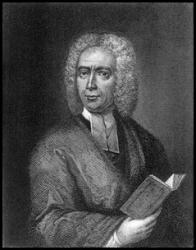
1674 - 1748 Author of "Hark! from the tomb a doleful sound" in The Sacred Harp Isaac Watts was the son of a schoolmaster, and was born in Southampton, July 17, 1674. He is said to have shown remarkable precocity in childhood, beginning the study of Latin, in his fourth year, and writing respectable verses at the age of seven. At the age of sixteen, he went to London to study in the Academy of the Rev. Thomas Rowe, an Independent minister. In 1698, he became assistant minister of the Independent Church, Berry St., London. In 1702, he became pastor. In 1712, he accepted an invitation to visit Sir Thomas Abney, at his residence of Abney Park, and at Sir Thomas' pressing request, made it his home for the remainder of his life. It was a residence most favourable for his health, and for the prosecution of his literary labours. He did not retire from ministerial duties, but preached as often as his delicate health would permit.
The number of Watts' publications is very large. His collected works, first published in 1720, embrace sermons, treatises, poems and hymns. His "Horae Lyricae" was published in December, 1705. His "Hymns" appeared in July, 1707. The first hymn he is said to have composed for religious worship, is "Behold the glories of the Lamb," written at the age of twenty. It is as a writer of psalms and hymns that he is everywhere known. Some of his hymns were written to be sung after his sermons, giving expression to the meaning of the text upon which he had preached. Montgomery calls Watts "the greatest name among hymn-writers," and the honour can hardly be disputed. His published hymns number more than eight hundred.
Watts died November 25, 1748, and was buried at Bunhill Fields. A monumental statue was erected in Southampton, his native place, and there is also a monument to his memory in the South Choir of Westminster Abbey. "Happy," says the great contemporary champion of Anglican orthodoxy, "will be that reader whose mind is disposed, by his verses or his prose, to imitate him in all but his non-conformity, to copy his benevolence to men, and his reverence to God." ("Memorials of Westminster Abbey," p. 325.)
--Annotations of the Hymnal, Charles Hutchins, M.A., 1872.
=================================
Watts, Isaac, D.D. The father of Dr. Watts was a respected Nonconformist, and at the birth of the child, and during its infancy, twice suffered imprisonment for his religious convictions. In his later years he kept a flourishing boarding school at Southampton. Isaac, the eldest of his nine children, was born in that town July 17, 1674. His taste for verse showed itself in early childhood. He was taught Greek, Latin, and Hebrew by Mr. Pinhorn, rector of All Saints, and headmaster of the Grammar School, in Southampton. The splendid promise of the boy induced a physician of the town and other friends to offer him an education at one of the Universities for eventual ordination in the Church of England: but this he refused; and entered a Nonconformist Academy at Stoke Newington in 1690, under the care of Mr. Thomas Rowe, the pastor of the Independent congregation at Girdlers' Hall. Of this congregation he became a member in 1693.
Leaving the Academy at the age of twenty, he spent two years at home; and it was then that the bulk of the Hymns and Spiritual Songs (published 1707-9) were written, and sung from manuscripts in the Southampton Chapel. The hymn "Behold the glories of the Lamb" is said to have been the first he composed, and written as an attempt to raise the standard of praise. In answer to requests, others succeeded. The hymn "There is a land of pure delight" is said to have been suggested by the view across Southampton Water. The next six years of Watts's life were again spent at Stoke Newington, in the post of tutor to the son of an eminent Puritan, Sir John Hartopp; and to the intense study of these years must be traced the accumulation of the theological and philosophical materials which he published subsequently, and also the life-long enfeeblement of his constitution.
Watts preached his first sermon when he was twenty-four years old. In the next three years he preached frequently; and in 1702 was ordained pastor of the eminent Independent congregation in Mark Lane, over which Caryl and Dr. John Owen had presided, and which numbered Mrs. Bendish, Cromwell's granddaughter, Charles Fleetwood, Charles Desborough, Sir John Hartopp, Lady Haversham, and other distinguished Independents among its members. In this year he removed to the house of Mr. Hollis in the Minories. His health began to fail in the following year, and Mr. Samuel Price was appointed as his assistant in the ministry. In 1712 a fever shattered his constitution, and Mr. Price was then appointed co-pastor of the congregation which had in the meantime removed to a new chapel in Bury Street. It was at this period that he became the guest of Sir Thomas Abney, under whose roof, and after his death (1722) that of his widow, he remained for the rest of his suffering life; residing for the longer portion of these thirty-six years principally at the beautiful country seat of Theobalds in Herts, and for the last thirteen years at Stoke Newington. His degree of D.D. was bestowed on him in 1728, unsolicited, by the University of Edinburgh. His infirmities increased on him up to the peaceful close of his sufferings, Nov. 25, 1748. He was buried in the Puritan restingplace at Bunhill Fields, but a monument was erected to him in Westminster Abbey.
His learning and piety, gentleness and largeness of heart have earned him the title of the Melanchthon of his day. Among his friends, churchmen like Bishop Gibson are ranked with Nonconformists such as Doddridge. His theological as well as philosophical fame was considerable. His Speculations on the Human Nature of the Logos, as a contribution to the great controversy on the Holy Trinity, brought on him a charge of Arian opinions. His work on The Improvement of the Mind, published in 1741, is eulogised by Johnson. His Logic was still a valued textbook at Oxford within living memory. The World to Come, published in 1745, was once a favourite devotional work, parts of it being translated into several languages. His Catechisms, Scripture History (1732), as well as The Divine and Moral Songs (1715), were the most popular text-books for religious education fifty years ago. The Hymns and Spiritual Songs were published in 1707-9, though written earlier. The Horae Lyricae, which contains hymns interspersed among the poems, appeared in 1706-9. Some hymns were also appended at the close of the several Sermons preached in London, published in 1721-24. The Psalms were published in 1719. The earliest life of Watts is that by his friend Dr. Gibbons. Johnson has included him in his Lives of the Poets; and Southey has echoed Johnson's warm eulogy. The most interesting modern life is Isaac Watts: his Life and Writings, by E. Paxton Hood. [Rev. H. Leigh Bennett, M.A.]
A large mass of Dr. Watts's hymns and paraphrases of the Psalms have no personal history beyond the date of their publication. These we have grouped together here and shall preface the list with the books from which they are taken.
(l) Horae Lyricae. Poems chiefly of the Lyric kind. In Three Books Sacred: i.To Devotion and Piety; ii. To Virtue, Honour, and Friendship; iii. To the Memory of the Dead. By I. Watts, 1706. Second edition, 1709. (2) Hymns and Spiritual Songs. In Three Books: i. Collected from the Scriptures; ii. Composed on Divine Subjects; iii. Prepared for the Lord's Supper. By I. Watts, 1707. This contained in Bk i. 78 hymns; Bk. ii. 110; Bk. iii. 22, and 12 doxologies. In the 2nd edition published in 1709, Bk. i. was increased to 150; Bk. ii. to 170; Bk. iii. to 25 and 15 doxologies. (3) Divine and Moral Songs for the Use of Children. By I. Watts, London, 1715. (4) The Psalms of David Imitated in the Language of the New Testament, And apply'd to the Christian State and Worship. By I. Watts. London: Printed by J. Clark, at the Bible and Crown in the Poultry, &c, 1719. (5) Sermons with hymns appended thereto, vol. i., 1721; ii., 1723; iii. 1727. In the 5th ed. of the Sermons the three volumes, in duodecimo, were reduced to two, in octavo. (6) Reliquiae Juveniles: Miscellaneous Thoughts in Prose and Verse, on Natural, Moral, and Divine Subjects; Written chiefly in Younger Years. By I. Watts, D.D., London, 1734. (7) Remnants of Time. London, 1736.
454 Hymns and Versions of the Psalms, in addition to the centos are all in common use at the present time.
--Excerpts from John Julian, Dictionary of Hymnology (1907)
==================================
Watts, I. , p. 1241, ii. Nearly 100 hymns, additional to those already annotated, are given in some minor hymn-books.
--John Julian, Dictionary of Hymnology, Appendix, Part II (1907)
=================
Watts, I. , p. 1236, i. At the time of the publication of this Dictionary in 1892, every copy of the 1707 edition of Watts's Hymns and Spiritual Songs was supposed to have perished, and all notes thereon were based upon references which were found in magazines and old collections of hymns and versions of the Psalms. Recently three copies have been recovered, and by a careful examination of one of these we have been able to give some of the results in the revision of pp. 1-1597, and the rest we now subjoin.
i. Hymns in the 1709 ed. of Hymns and Spiritual Songs which previously appeared in the 1707 edition of the same book, but are not so noted in the 1st ed. of this Dictionary:—
On pp. 1237, L-1239, ii., Nos. 18, 33, 42, 43, 47, 48, 60, 56, 58, 59, 63, 75, 82, 83, 84, 85, 93, 96, 99, 102, 104, 105, 113, 115, 116, 123, 124, 134, 137, 139, 146, 147, 148, 149, 162, 166, 174, 180, 181, 182, 188, 190, 192, 193, 194, 195, 197, 200, 202.
ii. Versions of the Psalms in his Psalms of David, 1719, which previously appeared in his Hymns and Spiritual Songs, 1707:—
On pp. 1239, U.-1241, i., Nos. 241, 288, 304, 313, 314, 317, 410, 441.
iii. Additional not noted in the revision:—
1. My soul, how lovely is the place; p. 1240, ii. 332. This version of Ps. lxiv. first appeared in the 1707 edition of Hymns & Spiritual Songs, as "Ye saints, how lovely is the place."
2. Shine, mighty God, on Britain shine; p. 1055, ii. In the 1707 edition of Hymns & Spiritual Songs, Bk. i., No. 35, and again in his Psalms of David, 1719.
3. Sing to the Lord with [cheerful] joyful voice, p. 1059, ii. This version of Ps. c. is No. 43 in the Hymns & Spiritual Songs, 1707, Bk. i., from which it passed into the Ps. of David, 1719.
A careful collation of the earliest editions of Watts's Horae Lyricae shows that Nos. 1, 7, 9, 10, 11, 12, 14, 16, p. 1237, i., are in the 1706 ed., and that the rest were added in 1709. Of the remaining hymns, Nos. 91 appeared in his Sermons, vol. ii., 1723, and No. 196 in Sermons, vol. i., 1721. No. 199 was added after Watts's death. It must be noted also that the original title of what is usually known as Divine and Moral Songs was Divine Songs only.
--John Julian, Dictionary of Hymnology, New Supplement (1907)
===========
See also in:
Hymn Writers of the Church
Isaac Watts
Samuel P. Tregelles
1813 - 1875 Author of "The Gloomy Night Will Soon Be Past" in The Cyber Hymnal Tregelles, Samuel Prideaux, LL.D., born of a Quaker, was born at Wodehouse Place, Falmouth, Cornwall, Jan. 20 (sometimes dated Jan. 30), 1813, and educated at the Falmouth Grammar School. From 1838 to 1844, he was employed in the Neath Abbey Iron Works. In 1836 he became a private tutor in Falmouth. His deep interest in biblical studies developed in an earnest desire to produce the most perfect edition of the Greek Testament it was possible to publish. The first specimens of his work were published in 1838, and the first instalments of his task for public use, in 1844. His Greek Testament thus begun was published in parts, Pt. vi. appearing in 1872. The work was hindered by his two attacks of paralysis (1861 and 1870); and the Prolegomena had to be added by Dr. Hort and A. W. Streane in 1879. Dr. Tregelles received a Civil List Pension for some years. He was one of the Revisers of the New Testament, but ill-health prevented him from taking an active part in the work. He died at Plymouth April 24, 1875. His hymn-writing began, so far as we can gather, before 1837, and extended to 1861 or later. The earliest were published in the Plymouth Brethren's Hymns for the Poor of the Flock, 1838; their Psalms, Hymns, and Spiritual Songs, 1842; and their Few Hymns and some Spiritual Songs, selected, 1856. Some also were contributed to Dr. P. Maurice's Church of England Choral Hymn-Book, 1861, in which they are marked as having been supplied in "MS." Some of those so marked were, however, in print before.
His hymns now in common use include the following, the date of each as given being that of the collection named in which it appeared:—
1. Father, we Thy children bless Thee. Thanksgiving for Divine Mercies; and the Second Advent (1838). In the Few Hymns of 1856, st. iv., v. were given as No. 310, "Father, 0 how vast the blessing."
2. Holy Saviour, we adore Thee. The Second Advent desired (1838).
3. Lord Jesus, we believing. Peace in Jesus (1861).
4. 0 God of grace, our Father. Praise for Meeting Grace (1856).
5. 0 look not on the Cross of Christ. Christ the One Oblation (1861).
6. The gloomy night will [shall] soon be past. Heaven anticipated (1842).
7. Thou God of grace, our Father. Praise for Meeting Grace (1838).
8. Thou, Lord of all, on earth hast dwelt. Passiontide (1861).
9. Thou, 0 God, Thy love commendest. Complete in Jesus (1861).
10. Thy Name alone, O Lord, we own, Jesus, our Strength and Safety (1861).
11. Thy Name we bless, Lord Jesus. Jesus, the Name over all (1838).
12. 'Tis sweet, 0 God, Thy praise to sing. The Sacrifice of Praise (1861).
13. 'Tis sweet to think of those at rest. The Dead in Christ; or, All Saints (1842).
14. 'Twas the Holy Ghost who taught us. Passiontide (1841 Appendix to Hymns for the Poor of the Flock).
15. Worthy the Lamb is now the song. Communion of Saints (1861).
The use of Dr. Tregelles's hymns is mainly confined to the Plymouth Brethren; and taken as a whole they are marked by no striking features of excellence.
-- John Julian, Dictionary of Hymnology (1907)
Samuel P. Tregelles
William Shield
1748 - 1829 Person Name: William Shield, 1748-1829 Composer of "AULD LANG SYNE" in A. M. E. C. Hymnal
William Shield
E. A. Hoffman
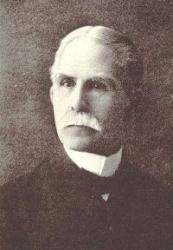
1839 - 1929 Person Name: Rev. E. A. Hoffman Author of "Drive the Saloon Away" in Songs of the New Crusade Elisha Hoffman (1839-1929) after graduating from Union Seminary in Pennsylvania was ordained in 1868. As a minister he was appointed to the circuit in Napoleon, Ohio in 1872. He worked with the Evangelical Association's publishing arm in Cleveland for eleven years. He served in many chapels and churches in Cleveland and in Grafton in the 1880s, among them Bethel Home for Sailors and Seamen, Chestnut Ridge Union Chapel, Grace Congregational Church and Rockport Congregational Church. In his lifetime he wrote more than 2,000 gospel songs including"Leaning on the everlasting arms" (1894). The fifty song books he edited include Pentecostal Hymns No. 1 and The Evergreen, 1873.
Mary Louise VanDyke
============
Hoffman, Elisha Albright, author of "Have you been to Jesus for the cleansing power?" (Holiness desired), in I. D. Sankey's Sacred Songs and Solos, 1881, was born in Pennsylvania, May 7, 1839.
--John Julian, Dictionary of Hymnology, Appendix, Part II (1907)
==============
E. A. Hoffman
Juan Bautista Cabrera Ivars
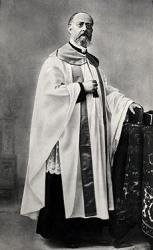
1837 - 1916 Person Name: Juan Bautista Cabrera Author of "Señor, en ti yo creo" in Himnos de la Iglesia Juan Bautista Cabrera Ivars was born in Benisa, Spain, April 23, 1837. He attended seminary in Valencia, studying Hebrew and Greek, and was ordained as a priest. He fled to Gibraltar in 1863 due to religious persecution where he abandoned Catholicism. He worked as a teacher and as a translator. One of the works he translated was E.H. Brown's work on the thirty-nine articles of the Anglican Church, which was his introduction to Protestantism. He was a leader of a Spanish Reformed Church in Gibraltar. He continued as a leader in this church when he returned to Spain after the government of Isabel II fell, but continued to face legal difficulties. He then organized the Spanish Reformed Episcopal Church and was consecrated as bishop in 1894. He recognized the influence of music and literature on evangelism which led him to write and translate hymns.
Dianne Shapiro, from Real Academia de la Historia (https://dbe.rah.es/biografias/39825/juan-bautista-cabrera-ivars) and Himnos Cristanos (https://www.himnos-cristianos.com/biografia-juan-bautista-cabrera/) (accessed 7/30/2021)
Juan Bautista Cabrera Ivars
A. B. Simpson
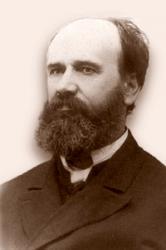
1843 - 1919 Author of "The Days of Heaven" in Hymns of the Christian Life Albert B. Simpson was the founder of The Christian and Missionary Alliance.
Dianne Shapiro
A. B. Simpson
Mary O. Page
Person Name: Mrs. M. O. Page Author of "Jesus leads the way" in Best Hymns
Mary O. Page
Horace B. Durant
Person Name: Dr. Horace B. Durant Author of "Woman's Cause Shall Win" in The White Ribbon Hymnal
Horace B. Durant
David M. Moir
Person Name: Moir Author of "The Mighty God" in Hymns of Victory Moir, David Macbeth, was born at Musselburgh, Jan. 5, 1798. After attending the medical classes in the University of Edinburgh, he settled down as a doctor in his native place. In June, 1851, he went to Dumfries to recruit, but died there, July 6, and was buried at Inveresk, Musselburgh, July 10, 1851. His poems, selected and edited, with a memoir, by Thomas Aird, were published in 1852, in 2 vols., as The Poetical Works of David Macbeth Moir. He marked his graver contributions to Blackwood's Magazine with the signature "Delta" or Δ and in the number for August, 1832, there appeared "Devotional Melodies by Delta." These were three in number:—
1. Return, once more return, O wanderer.
2. O who is like the Mighty One.
3. How pleasant is the opening year.
and seem to have been the only hymns suited for public worship that he ever wrote. [Rev. James Mearns, M.A.]
--John Julian, Dictionary of Hymnology (1907)
David M. Moir
Pages




