You help make Hymnary.org possible. More than 10 million people from 200+ countries found hymns, liturgical resources and encouragement on Hymnary.org in 2025, including you. Every visit affirms the global impact of this ministry.

If Hymnary has been meaningful to you this year, would you take a moment today to help sustain it? A gift of any size—paired with a note of encouragement if you wish—directly supports the server costs, research work and curation that keep this resource freely available to the world.

Give securely online today, or mail a check to:
Hymnary.org
Calvin University
3201 Burton Street SE
Grand Rapids, MI 49546

Thank you for your partnership, and may the hope of Advent fill your heart.

Person Results

Meter:8.6.8.6
All:extender
In:person

Planning worship? Check out our sister site, ZeteoSearch.org, for 20+ additional resources related to your search.
Showing 31 - 40 of 77Results Per Page: 102050

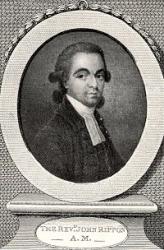
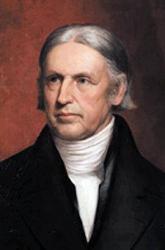
John Rippon

1751 - 1836 Person Name: John Rippon, 1751-1836 Meter: 8.6.8.6 Composer of "TIVERTON" in The Irish Presbyterian Hymnbook Rippon, John, D.D., was born at Tiverton, Devon, April 29, 1751, and was educated for the ministry at the Baptist College, Bristol. In 1773 he became Pastor of the Baptist church in Carter Lane, Tooley Street (afterwards removed to New Park Street), London, and over this church he continued to preside until his death, on Dec. 17, 1836. The degree of D.D. was conferred on him in 1792 by the Baptist College, Providence, Rhode Island. Dr. Rippon was one of the most popular and influential Dissenting ministers of his time. From 1790 to 1802 he issued the Baptist Annual Register, a periodical containing an account of the most important events in the history of the Baptist Denomination in Great Britain and America during that period, and very valuable now as a book of reference. But his most famous work is his Selection of hymns for public worship, which appeared in 1787. The full title of the first edition is A selection of Hymns from the best authors, intended as an Appendix to Dr. Watts's Psalms and Hymns. In 1791 he published a Selection of Psalm and Hymn Tunes from the Best Authors, adapted to Dr. Watts's Psalms and Hymns, and to his own Selection, and from that time the names of tunes were prefixed to the hymns in the successive editions of his hymn-book. In 1800 he published the 10th ed. of his Selections, containing more than sixty additional hymns. In 1827 it was still further enlarged, and in 1844, after his death, appeared The Comprehensive Edition, commonly known as The Comprehensive Rippon, containing most of the additional hymns, with about 400 then first added, making in all upwards of 1170, in 100 metres. A rival to the Comprehensive was also afterwards published under the old title, somewhat enlarged. In the preparation of the original book, and its subsequent improvement, Dr. Rippon performed an important service to Baptist Hymnody, and also, it is said, gained for himself "an estate" through its immense sale. In the preface to the tenth edition lie claims for himself the authorship of some of the hymns, but as he refrained from affixing his name to any of the hymns it is impossible now to say with certainty which ought to be ascribed to him. There can, however, be no reasonable doubt that hymn 535, 3rd part, "The day has dawned, Jehovah comes" (q.v.), is one of his compositions. Other hymns, probably by him, are, "Amid the splendours of Thy state" (Love of God), 1800; and "There is joy in heaven, and joy on earth" (Joy over the Repenting Sinner), 1787. He also altered the texts of and made additions to several of the older hymns. Some of these altered texts are still in common use. In 1830 the additions given in the 27th ed., 1827, of Rippon's Selections were reprinted, with notes by Dr. Slater, as:— Hymns Original and Selected; interspersed in the Twenty-seventh edition of the Selection, with Numerous Doxologies, in the Usual, the Peculiar, and in the less Common metres. By John Rippon, D.D. A second edition of this pamphlet of 82 hymns and doxologies appeared in 1832. [Rev. W. R. Stevenson, M.A.] --John Julian, Dictionary of Hymnology (1907)

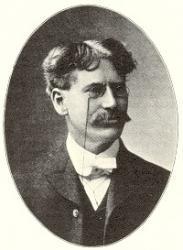
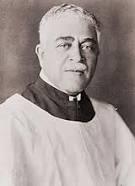
J. B. Herbert

1852 - 1927 Person Name: John Bunyan Herbert Meter: 8.6.8.6 Composer of "LAFAYETTE" in The Cyber Hymnal

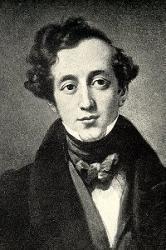
Felix Mendelssohn-Bartholdy

1809 - 1847 Person Name: Felix Mendelssohn, 1809-1847 Meter: 8.6.8.6 Composer of "FELIX" in The Irish Presbyterian Hymnbook Felix Mendelssohn-Bartholdy (b. Hamburg, Germany, 1809; d. Leipzig, Germany, 1847) was the son of banker Abraham Mendelssohn and the grandson of philosopher Moses Mendelssohn. His Jewish family became Christian and took the Bartholdy name (name of the estate of Mendelssohn's uncle) when baptized into the Lutheran church. The children all received an excellent musical education. Mendelssohn had his first public performance at the age of nine and by the age of sixteen had written several symphonies. Profoundly influenced by J. S. Bach's music, he conducted a performance of the St. Matthew Passion in 1829 (at age 20!) – the first performance since Bach's death, thus reintroducing Bach to the world. Mendelssohn organized the Domchor in Berlin and founded the Leipzig Conservatory of Music in 1843. Traveling widely, he not only became familiar with various styles of music but also became well known himself in countries other than Germany, especially in England. He left a rich treasury of music: organ and piano works, overtures and incidental music, oratorios (including St. Paul or Elijah and choral works, and symphonies. He harmonized a number of hymn tunes himself, but hymnbook editors also arranged some of his other tunes into hymn tunes. Bert Polman

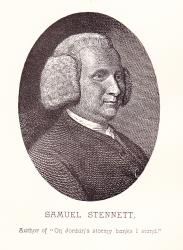
Samuel Stennett

1727 - 1795 Person Name: Stennett Meter: 8.6.8.6 Author of "On Jordan's stormy banks I stand, And cast a wishful eye" in The Voice of Praise Samuel Stennett was born at Exeter, in 1727. His father was pastor of a Baptist congregation in that city; afterwards of the Baptist Chapel, Little Wild Street, London. In this latter pastorate the son succeeded the father in 1758. He died in 1795. Dr. Stennett was the author of several doctrinal works, and a few hymns. --Annotations of the Hymnal, Charles Hutchins, M.A. 1872. ====================== Stennett, Samuel, D.D., grandson of Joseph Stennett, named above, and son of the Rev. Joseph Stennett, D.D., was born most pro;bably in 1727, at Exeter, where his father was at that time a Baptist minister. When quite young he removed to London, his father having become pastor of the Baptist Church in Little Wild Street, Lincoln's Inn Fields. In 1748, Samuel Stennett became assistant to his father in the ministry, and in 1758 succeeded him in the pastoral office at Little Wild Street. From that time until his death, on Aug. 24, 1795, he held a very prominent position among the Dissenting ministers of London. He was much respected by some of the statesmen of the time, and used his influence with them in support of the principles of religious freedom. The celebrated John Howard was a member of his congregation and an attached friend. In 1763, the University of Aberdeen conferred on him the degree of D.D. Dr. S. Stennett's prose publications consist of volumes of sermons, and pamphlets on Baptism and on Nonconformist Disabilities. He wrote one or two short poems, and contributed 38 hymns to the collection of his friend, Dr. Rippon (1787). His poetical genius was not of the highest order, and his best hymns have neither the originality nor the vigour of some of his grandfather's. The following, however, are pleasing in sentiment and expression, and are in common use more especially in Baptist congregations:— 1. And have I, Christ, no love for Thee? Love for Christ desired. 2. And will the offended God again? The Body the Temple of the Holy Ghost. 3. As on the Cross the Saviour hung. The Thief on the Cross. 4. Behold the leprous Jew. The healing of the Leper. 5. Come, every pious heart. Praise to Christ. 6. Father, at Thy call, I come. Lent. 7. Great God, amid the darksome night. God, a Sun. 8. Great God, what hosts of angels stand. Ministry of Angels. 9. Here at Thy Table, Lord, we meet. Holy Communion. 10. How charming is the place. Public Worship. 11. How shall the sons of men appear? Acceptance through Christ alone. 12. How soft the words my [the] Saviour speaks. Early Piety. 13. How various and how new. Divine Providence. 14. Not all the nobles of the earth. Christians as Sons of God. 15. On Jordan's stormy banks I stand. Heaven anticipated. 16. Prostrate, dear Jesus, at thy feet. Lent. Sometimes, "Dear Saviour, prostrate at Thy feet." 17. Should bounteous nature kindly pour. The greatest of these is Love. From this, "Had I the gift of tongues," st. iii., is taken. 18. Thy counsels of redeeming grace. Holy Scripture. From "Let avarice, from shore to shore." 19. Thy life 1 read, my dearest Lord. Death in Infancy. From this "'Tis Jesus speaks, I fold, says He." 20. 'Tis finished! so the Saviour cried. Good Friday. 21. To Christ, the Lord, let every tongue. Praise of Christ. From this,"Majestic sweetness sits enthroned," st. iii., is taken. 22. To God, my Saviour, and my King. Renewing Grace. 23. To God, the universal King. Praise to God. 24. What wisdom, majesty, and grace. The Gospel. Sometimes, “What majesty and grace." 25. Where two or three with sweet accord. Before the Sermon. 26. Why should a living man complain? Affliction. From this, "Lord, see what floods of sorrow rise," st. iii., is taken. 27. With tears of anguish I lament. Lent. 28. Yonder amazing sight I see. Good Friday. All these hymns, with others by Stennett, were given in Rippon's Baptist Selection, 1787, a few having previously appeared in A Collection of Hymns for the use of Christians of all Denominations, London. Printed for the Booksellers, 1782; and No. 16, in the 1778 Supplement to the 3rd edition of the Bristol Baptist Selection of Ash and Evans. The whole of Stennett's poetical pieces and hymns were included in vol. ii. of his Works, together with a Memoir, by W. J. Jones. 4 vols., 1824. [Rev. W. R. Stevenson, M.A.] --John Julian, Dictionary of Hymnology (1907)

John L. Bell

b. 1949 Person Name: John L. Bell (b. 1949) Meter: 8.6.8.6 Composer of "DOWNING" in Church Hymnary (4th ed.) John Bell (b. 1949) was born in the Scottish town of Kilmarnock in Ayrshire, intending to be a music teacher when he felt the call to the ministry. But in frustration with his classes, he did volunteer work in a deprived neighborhood in London for a time and also served for two years as an associate pastor at the English Reformed Church in Amsterdam. After graduating he worked for five years as a youth pastor for the Church of Scotland, serving a large region that included about 500 churches. He then took a similar position with the Iona Community, and with his colleague Graham Maule, began to broaden the youth ministry to focus on renewal of the church’s worship. His approach soon turned to composing songs within the identifiable traditions of hymnody that began to address concerns missing from the current Scottish hymnal: "I discovered that seldom did our hymns represent the plight of poor people to God. There was nothing that dealt with unemployment, nothing that dealt with living in a multicultural society and feeling disenfranchised. There was nothing about child abuse…,that reflected concern for the developing world, nothing that helped see ourselves as brothers and sisters to those who are suffering from poverty or persecution." [from an interview in Reformed Worship (March 1993)] That concern not only led to writing many songs, but increasingly to introducing them internationally in many conferences, while also gathering songs from around the world. He was convener for the fourth edition of the Church of Scotland’s Church Hymnary (2005), a very different collection from the previous 1973 edition. His books, The Singing Thing and The Singing Thing Too, as well as the many collections of songs and worship resources produced by John Bell—some together with other members of the Iona Community’s “Wild Goose Resource Group,” —are available in North America from GIA Publications. Emily Brink

Hosea Ballou

1771 - 1852 Person Name: H. Ballou Meter: 8.6.8.6 Author of "Jesus his empire shall extend" in Hymns for Christian Devotion Ballou, Hosea, a celebrated leader of the sect of Universalists, was born at Richmond, New Hampshire, April 30, 1771. He was entirely self-educated, and began to preach when about 21. In 1807 he settled at Portsmouth, New Hampshire, passing to Salem, Mass., in 1815, and to Boston in 1817. He died in 1852. To the Universalist Hymns composed by different Authors, published in 1808, he contributed 199 hymns. A few of these are still used by the Universalists, but one only, and that probably his best, has passed beyond their ranks. It is:— When God descends with men to dwell. The Second Advent. Ballou also edited with Turner a second collection in 1821, and a third in his own name, 1837. [Rev. F. M. Bird, M.A.] -- John Julian, Dictionary of Hymnology (1907)

Alexander Pope

1688 - 1744 Person Name: Pope Meter: 8.6.8.6 Author of "Father of all, whose cares extend" in Hymns for Christian Devotion Alexander Pope was born in London, in 1688. His parents were Roman Catholics. He had a feeble constitution, was deformed in person, and attained the age of only fifty-six. He early acquired the means of independence by his literary gifts, and purchased his celebrated villa at Twickenham, whither he went to reside at the age of thirty. Of his many published works, his translation of the "Iliad" and "Odyssey" of Homer has given him the greatest reputation. As an English satirist, also, he stands very high. Nearly all his works, however, are imitations. He died at Tickenham, in 1744. --Annotations of the Hymnal, Charles Hutchins, M.A., 1872 ======== Pope, Alexander, the poet, son of a wholesale linen merchant in Lombard Street, London, was born in Plough Court, Lombard Street, May 21, 1688. His father being a Roman Catholic, he was first placed under the charge of Father Taverner, who taught him the rudiments of Greek and Latin. Later he attended a school at Winchester, and then at Hyde Park Corner. When about twelve he retired with his parents to Binfield, in Windsor Forest, and from thenceforth his education was mainly in his own hands. His subsequent success as a writer and poet is a matter of history, and has been dealt with in detail by Dr. Johnson in his Lives of the Poets, and by others. He died May 30, 1744, and was buried in a vault in Twickenham Church. For distinct public use, so far as we are aware, Pope wrote no hymns. His "Messiah"; his "Universal Prayer"; and his "Vital Spark" (q.v.), have been made use of for congregational purposes, but as a Roman Catholic he had no object in writing a hymn in a language which, at that time, his Church would refuse to use. In modern hymn-books his name is identified with the following pieces:-- 1. Father of all, in every age. Universal Prayer. The Lord's Prayer. This Prayer was published in 1738, as a conclusion to his Essay on Man, in 13 st. of 4 1. Warburton in his Advertisement of the 1748 ed. of the Essay, says:— "Concerning the Universal Prayer which concludes the Essay, it may be proper to observe that some pas¬sages in the Essay having been unjustly suspected of a tendency towards Fate and Naturalism, the author composed that Prayer as the sum of all, to show that hi a system was founded in Freewill, and terminated in Piety: that the First Cause was as well the Lord and Governor as the Creator of the Universe; and that by submission to His will (the great principle enforced throughout the Essay) was not meant the suffering ourselves to be carried along with a blind determination; but a religious acquiescence, and confidence full of hope and immortality. To give all this the greater weight and reality, the Poet chose for his model The Lord's Prayer, which of all others best deserves the title prefixed to his Paraphrase." The title here referred to is "The Universal Prayer, Deo Opt. Max." The hymn is found in common use in the following forms:— (1.) Father of all in every age. This is an abbreviated form, and has been in use, especially in Unitarian hymnbooks, from an early date. (2.) Father of all, [and] Thou God of love. This cento was given in 6 st. of 4 1. in the 1815 edition of Cotterill's Selections, No. 2; again in the 1819 ed., 141; in Stowell's Psalms & Hymns, 1831, No. 179; and again in later collections. (3.) Not to this earth's contracted span. In Collyer's Collection 1812, No. 629, in 4 st. of 4 1., and others. (4.) Teach me to feel another's woe. Also in Collyer's Collection, 1812, No. 630, in 4 st. of 4 1., and others. (5.) Thou Great First Cause, least understood. Also in Collyer's Collection, 1812, No. 628, in 4 st. of 4 1., and later hymnals. (6.) When I am right Thy grace impart. Given in Kennedy, 1863, No. 1166. 2. Ye nymphs of Solyma! begin the song. The Messiah. In No. 378 of the Spectator for Wednesday, May 14, 1712, Addison gave this poem with the introduction :— "I will make no apology for entertaining the reader with the following poem, which is written by a great genius, a friend of mine, in the country, who is not ashamed to employ his wit in the praise of his Maker." Then follows the poem with the heading, “Messiah. A Sacred Eclogue, composed of several passages of Isaiah the Prophet. Written in imitation of Virgil's Pollio." It consists of 107 lines. When republished by Pope this heading was expanded into a paragraph as an "Advertisement." As a poem it is unknown to the hymn-book; but from it the following centos have passed into common use:-- (1.) As the Good Shepherd tends his fleecy care. This was given in Collyer's Collection, 1812, No. 626, in 6 st. of 4 1., and has been repeated in later hymnals, but usually in an abridged form. (2.) From Jesse's root, behold a branch arise No. 624 in Collyer's Collection, 1812, in 5 st. of 4 1.; and again in later hymnals. (3.) Hark! a glad voice the lonely desert cheers. No. 625 in Collyer's Collection, 1812, in 4 st. of 4 1.; in Bishop Heber's posthumous Hymns, &c, 1827, p. 106; and again in later collections. (4.) Rise crowned with light, imperial Salem rise. In the Leeds Hymn Book, 1853, No. 687, in 3 st. of 8 1., and several later collections. (5.) The Saviour comes! by ancient seers foretold. In Mercer's Church Psalm & Hymn Book, 1864, and others. It may be noted that 1. 46 of The Messiah reads in the original "He wipes the tears for ever from our eyes." This was altered by Pope at the suggestion of Steele, made to Pope in a letter dated June 1, 1712, to "From every face He wipes off every tear." This latter is the poet's authorized reading, is given in his Works, and is found also in the book form reprints of the Spectator. -- John Julian, Dictionary of Hymnology (1907)

H. T. Burleigh

1866 - 1949 Person Name: Harry T. Burleigh Meter: 8.6.8.6 Arranger of "MCKEE" in Trinity Hymnal (Rev. ed.) Harry T. Burleigh (b. Erie, PA, 1866; d. Stamford, CT, 1949) began his musical career as a choirboy in St. Paul's Cathedral, Erie, Pennsylvania. He also studied at the National Conservatory of Music, New York City, where he was befriended by Antonín Dvořák and, according to tradition, provided Dvořák with some African American musical themes that became part of Dvořák's New World Symphony. Burleigh composed at least two hundred works but is most remem­bered for his vocal solo arrangements of African American spirituals. In 1944 Burleigh was honored as a Fellow of the Hymn Society in the United States and Canada. Bert Polman

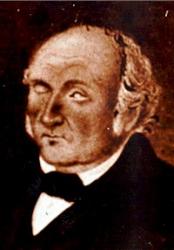
Neil Dougall

1776 - 1862 Person Name: Neill Dougall, 1776-1862 Meter: 8.6.8.6 Composer of "KILMARNOCK" in The Irish Presbyterian Hymnbook Born: De­cem­ber 9, 1776, Green­ock, Ren­frew­shire, Scot­land. Died: Oc­to­ber 1, 1862, Green­ock, Scot­land. Buried: Green­ock, Scot­land. Neil’s fa­ther, wheel­wright Neill Dou­gall, was draft­ed in­to the ar­my, and died in Cey­lon (now Sri Lanka) when his son was on­ly four years old. At age 15, Neil be­came an ap­pren­tice on the ship Bri­tan­nia. In 1795, while he was load­ing a gun to fire the se­cond vol­ley of a sa­lute to com­mem­o­rate Lord Howe’s vic­to­ry over the French, an ex­plo­sion blind­ed him and took his arm. Af­ter re­cov­er­ing, he be­gan his mu­sic­al ca­reer. In 1798, he at­tend­ed a sing­ing class un­der Ro­bert Dun­can, and in the fall of the next year opened his own class, which he ran un­til 1844. He gave an­nu­al con­certs in Green­ock from 1800 [sic, Frost] to 1860. --www.hymntime.com/tch

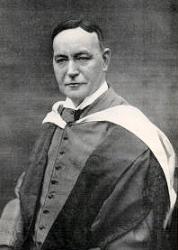
Richard Runciman Terry

1865 - 1938 Person Name: Richard Runciman Terry, 1865-1938 Meter: 8.6.8.6 Composer of "BILLING" in Together in Song Terry, Richard R., was born at Morpeth, Jan. 3, 1868, and was Tate Choral Scholar at King's College, Cambridge. In 1896 he became organist and music-master at Downside R. C. College and Abbey, Bath; and in 1901 organist and director of the choir at Westminster Cathedral (R. C.) London. He contributed to A. E. Tozer's Catholic Hymns, 1898, thirteen tunes and the words of two hymns:— 1. Christ, the Lord, is my true Shepherd. Ps. xxiii. 2. Peaceful eve, so still and holy. Christmas Carol. It is marked as D. C. B., i.e. for Downside Coll., Bath. The tune by Mr. Tozor was published in 1881 to a carol beginning with the same first line, but otherwise entirely different. --John Julian, Dictionary of Hymnology, New Supplement (1907)

Pages


Export as CSV
It looks like you are using an ad-blocker. Ad revenue helps keep us running. Please consider white-listing Hymnary.org or getting Hymnary Pro to eliminate ads entirely and help support Hymnary.org.