You help make Hymnary.org possible. More than 10 million people from 200+ countries found hymns, liturgical resources and encouragement on Hymnary.org in 2025, including you. Every visit affirms the global impact of this ministry.

If Hymnary has been meaningful to you this year, would you take a moment today to help sustain it? A gift of any size—paired with a note of encouragement if you wish—directly supports the server costs, research work and curation that keep this resource freely available to the world.

Give securely online today, or mail a check to:
Hymnary.org
Calvin University
3201 Burton Street SE
Grand Rapids, MI 49546

Thank you for your partnership, and may the hope of Advent fill your heart.

Person Results

Text Identifier:"^awake_my_soul_and_with_the_sun$"
In:people

Planning worship? Check out our sister site, ZeteoSearch.org, for 20+ additional resources related to your search.
Showing 31 - 39 of 39Results Per Page: 102050

Samuel Dyer

1785 - 1835 Person Name: S. Dyer Arranger of "MENDON" in The New Baptist Praise Book Rv Samuel Dyer United Kingdom 1785-1835. Born in White Chapel, Hampshire, the family moved to Wellshire, England, where he was ordained and served as a Baptist minister. In 1806 the family moved to Coventry, and Samuel emigrated to the U.S. in 1811. He married Renee Novak. He taught music and directed choirs in New York City and Philadelphia, PA. He later moved to Baltimore, MD, and wrote, conducted singing schools in the south and east, and conducted the New York Sacred Music Society. He published “New selection of sacred music” (1817), “Anthems” (1822 & 1834), and “The Philadelphia collection of sacred music” (1828). He died in Hoboken, NJ. John Perry

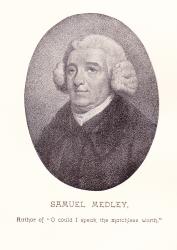
Samuel Medley

1738 - 1799 Author of "Awake, my soul, and with the sun" in The Lyrica Medley, Samuel, born June 23, 1738, at Cheshunt, Herts, where his father kept a school. He received a good education; but not liking the business to which he was apprenticed, he entered the Royal Navy. Having been severely wounded in a battle with the French fleet off Port Lagos, in 1759, he was obliged to retire from active service. A sermon by Dr. Watts, read to him about this time, led to his conversion. He joined the Baptist Church in Eagle Street, London, then under the care of Dr. Gifford, and shortly afterwards opened a school, which for several years he conducted with great success. Having begun to preach, he received, in 1767, a call to become pastor of the Baptist church at Watford. Thence, in 1772, he removed to Byrom Street, Liverpool, where he gathered a large congregation, and for 27 years was remarkably popular and useful. After a long and painful illness he died July 17, 1799. Most of Medley's hymns were first printed on leaflets or in magazines (the Gospel Magazine being one). They appeared in book form as:— (1) Hymns, &c. Bradford, 1785. This contains 42 hymns. (2) Hymns on Select Portions of Scripture by the Rev. Mr. Medley. 2nd ed. Bristol. W. Pine. 1785. This contains 34 hymns, and differs much from the Bradford edition both in the text and in the order of the hymns. (3) An enlargement of the same in 1787. (4) A small collection of new Hymns, London, 1794. This contains 23 hymns. (5) Hymns. The Public Worship and Private Devotion of True Christians Assisted in some thoughts in Verse; principally drawn from Select Passages of the Word of God. By Samuel Medley. London. Printed for J. Johnson. 1800. A few of his hymns are also found in a Collection for the use of All Denominations, published in London in 1782. Medley's hymns have been very popular in his own denomination, particularly among the more Calvinistic churches. In Denham's Selections there are 48, and in J. Stevens's Selections, 30. Their charm consists less in their poetry than in the warmth and occasional pathos with which they give expression to Christian experience. In most of them also there is a refrain in the last line of each verse which is often effective. Those in common use include:— 1. Come, join ye saints, with heart and voice. (1800). Complete in Christ. 2. Death is no more among our foes. Easter. 3. Eternal Sovereign Lord of all. (1789). Praise for Providential Care. 4. Far, far beyond these lower skies. (1789). Jesus, the Forerunner. 5. Father of mercies, God of love, whose kind, &c. (1789.) New Year. 6. Great God, today Thy grace impart. Sermon. 7. Hear, gracious God! a sinner's cry. (1789). Lent. 8. In heaven the rapturous song began. Christmas. 9. Jesus, engrave it on my heart. (1789). Jesus, Needful to all. 10. Mortals, awake, with angels join. (1782). Christmas. 11. My soul, arise in joyful lays. (1789). Joy in God. 12. Now, in a song of grateful praise. Praise to Jesus. In the Gospel Magazine, June, 1776. 13. O could I speak the matchless worth. (1789.) Praise of Jesus. 14. O for a bright celestial ray. Lent. 15. O God, Thy mercy, vast and free. (1800). Dedication of Self to God. 16. O let us tell the matchless love. Praise to Jesus. 17. O what amazing words of grace. (1789). Foutain of Living Waters. 18. Saints die, and we should gently weep. (1800). Death and Burial. From his "Dearest of Names, Our Lord and King." 19. See a poor sinner, dearest Lord. Lent. 20. Sing the dear Saviour's glorious fame. (1789). Jesus the Breaker of bonds. In 1800 a Memoir of Medley was published by his son, which is regarded by members of the family now living as authoritative. But in 1833 appeared another Memoir by Medley's daughter Sarah, to which are appended 52 hymns for use on Sacramental occasions. These she gives as her father's. But 8 of them are undoubtedly by Thos. Kelly, published by him in 1815, and reprinted in subsequent editions of his Hymns. The remainder are by Medley. Nearly all of these 52 hymns (both Medley's and Kelly's) have been altered in order to adapt them to Sacramental use. In Sarah Medley's volume, Kelly's hymns all follow one another, and three of them are in a metre which Medley apparently never used. What could have been Sarah Medley's motive in all this it is hard to divine. She is said to have been a clever, though unamiable woman, and was herself the author of a small volume of Poems published in 1807. In the Memoir she does not conceal her hatred of her brother. [Rev. W. R. Stevenson, M.A.] -- John Julian, Dictionary of Hymnology (1907)

John Mason

1645 - 1694 Author of "Awake, my soul, and with the sun" in A Choice Selection of Hymns. 2nd ed. Mason, John. The known facts of his life are scanty. He was the son of a Dissenting Minister, and the grandfather of John Mason, the author of A Treatise on Self-Knowledge. He was educated at Strixton School, Northants, and Clare Hall, Cambridge. After taking his M.A., he became Curate of Isham; and in 1668, Vicar of Stantonbury, Bucks. A little more than five years afterwards he was appointed Rector of Water-Stratford. Here he composed the volume containing The Songs of Praise, his paraphrase of The Song of Solomon, and the Poem on Dives and Lazarus, with which Shepherd's Penitential Cries was afterwards bound up. This volume passed through twenty editions. Besides the Songs of Praise, it contains six Penitential Cries by Mason, and it is this portion of his work which harmonizes with the compositions of Shepherd. Probably his hymns were used in public worship, and if so, they are among the earliest hymns so used in the Church of England. Some of his hymns are often found in the early Hymn Collections of the 18th century. The most notable work besides this volume is Select Remains of the Rev, John Mason, a collection of sententious and practical sayings and Christian letters, published by his grandson, and much eulogized by Dr. Watts. His friend, Shepherd, who was at Water-Stratford at the remarkable period to which reference is made below, published two of Mason's Sermons, with a preface of his own. Mason was a man of true piety and humility; known for eminent prayerfulness; faithful, experimental, effectual preaching; "a light in the pulpit, and a pattern out of it." His friendship with Baxter, and Shepherd, the Nonconformist Minister of Braintree, probably indicates his sympathies and theological position. Baxter calls him "the glory of the Church of England," and says :— "The frame of his spirit was so heavenly, his deportment so humble and obliging, his discourse of spiritual things so weighty, with such apt words and delightful air, that it charmed all that had any spiritual relish.” The close of his life was sensational enough. One night, about a month before his death, he had a vision of the Lord Jesus, wearing on His head a glorious crown, and with a look of unutterable majesty in His face. Of this vision he spoke; and preached a Sermon called The Midnight Cry, in which he proclaimed the near approach of Christ's Second Advent. A report spread that this Advent would take place at Water-Stratford itself, and crowds gathered there from the surrounding villages. Furniture and provisions were brought in, and every corner of the house and village occupied. Most extraordinary scenes occurred, singing and leaping and dancing. The excitement had scarcely died out when the old man passed away (1694), still testifying that he had seen the Lord, and that it was time for the nation to tremble, and for Christians to trim their lamps. His last words were, “I am full of the loving kindness of the Lord." [Rev. H. Leigh Bennett, M.A.] The full titles of his Songs of Praise, and the additions thereto, are:— (1) Spiritual Songs; or, Songs of Praise to Almighty God upon several occasions, 1683. (2) The Song of Songs which is Solomon's first Turned, then Paraphrased in English Verse. Published with the former. (3) Dives and Lazarus, incorporated with the former 1685. (4) Penitential Cries, Begun by the Author of the Songs of Praise, And carried on by another Hand. Licensed and Entered, Sept. 13, 1693. This forms the concluding part of all editions of the Songs of Praise after 1693. The complete work was reprinted by D. Sedgwick in 1859. This reprint was accompanied by a short Memoir. In this reprint Mason's Penitential Cries and Ps. 86 are given under Songs of Praise, pp. 49-61, those under Penitential Cries being all by Shepherd (q.v.). Mason's Life, by John Dunton, was published in 1694, and included some miscellaneous poems; and another, by Henry Maurice, in 1695, in which are two hymns not found elsewhere. We may add that Mason published a Catechism, with some Verses for Children. Of this, however, no copy is known to exist. Mason's Songs are commonly presented in modern hymnbooks in the form of centos, which are sometimes compiled from a single Song, and in other instances from several Songs. Many of these are annotated under their respective first lines. The rest include:— 1. Blest be my God that I was born. Praise for the Gospel. 2. Lord, for the mercies of the night. Morning. 3. Lord of my life, Length of my days. Praise for Deliverance from Immediate danger of Death. 4. My God, a God of pardon is. Praise for Pardon of Sin. 5. My God, my only Help and Hope. Praise for Providence. 6. My God, my reconciled God. Praise for Peace of Conscience. 7. My God was with me all this night. Morning. 8. Thou wast, 0 God; and Thou wast blest. Praise for Creation. 9. Thousands of thousands stand around. Praise. A cento from Songs i. and ii. In Griffith, Farran & Co.'s Ancient and Modern Library, No. 12, Giles Fletcher's Christ's Victory and Triumph, &c, 1888, p. 208 (edited by W. T. Brooke), a short hymn by Mason is given from Multum in Parvo: or the Jubilee of Jubilees, 1732, beginning "High praises meet and dwell within." It is an indifferent example of Mason's powers as a writer of sacred verse. -- John Julian, Dictionary of Hymnology (1907) ==================== Mason, J., p. 716, ii. Mason's Midnight Cry, stated on p. 717, i. as having been preached in 1694, was delivered in 1691. The 1st ed. of this sermon is:— “The Midnight Cry. A Sermon Preached On the Parable of the Ten Virgins . . . . By J. M., M.A., Rector of W. in the County of B., London: Nathanael Ranew . . 1691. This edition has no hymns. To the 4th ed. in 1692, published by the same Nathanael Ranew, there was added:— The Fourth Edition, with the Addition of two Hymns for the Coming of Christ. By the same Author. The first of these hymns begins:— "The evening of the Day Portends a dismal night," and is in 12 stanzas of 8 lines. The second hymn is:— "Come, come, my dearest, dearest Lord, Make haste and come away." This is in 14 stanzas of 4 lines. Of the first and fifth eds. there are copies in the Brit. Museum, and of the first in the Julian Collection of the Church House, London. --John Julian, Dictionary of Hymnology, New Supplement (1907)

William Gardiner

1770 - 1853 Composer of "WALTON" in The Chapel Hymnal William Gardiner (b. Leicester, England, 1770; d. Leicester, 1853) The son of an English hosiery manufacturer, Gardiner took up his father's trade in addition to writing about music, composing, and editing. Having met Joseph Haydn and Ludwig van Beethoven on his business travels, Gardiner then proceeded to help popularize their compositions, especially Beethoven's, in England. He recorded his memories of various musicians in Music and Friends (3 volumes, 1838-1853). In the first two volumes of Sacred Melodies (1812, 1815), Gardiner turned melodies from composers such as Haydn, Mozart, and Beethoven into hymn tunes in an attempt to rejuvenate the singing of psalms. His work became an important model for American editors like Lowell Mason (see Mason's Boston Handel and Haydn Collection, 1822), and later hymnbook editors often turned to Gardiner as a source of tunes derived from classical music. Bert Polman

J. Henry Showalter

1864 - 1947 Composer of "[Awake, my soul, and with the sun]" in Calvary Songs

George F. Root

1820 - 1895 Person Name: Geo. F. Root Composer of "LOWRY" in The Otterbein Hymnal Root, George F., MUS. DOC, born in Sheffield, Berkshire County, Mass., Aug. 30, 1820. He is much more widely known as a composer of popular music than as a hymn writer. Four of his hymns are in I. D. Sankey's Sacred Songs & Solos, 1878. Nos. 16, 100, 293, and 297. A sympathetic biographical sketch, with portrait, is in The Tonic Sol-Fa Reporter, Sep. 1886. He died Aug. 6, 1895. --John Julian, Dictionary of Hymnology, Appendix, Part II (1907) ===================== George Frederick Root was born in Sheffield, Mass., August 30, 1820. His father moved to North Reading, near Boston, when the boy was six years old, and there his youth was spent. He was always fond of music— not singing at all as a boy, but played upon every kind of instrument that came in his way. At thirteen it was his pride that he could "play a tune" on as many instruments as he was years old. His dream of life was to be a musician, although such an ambition was looked down upon by all his relatives and friends, excepting a fond mother. In the fall of 1838 he went to Boston and made an engagement to work for Mr. A. N. Johnson and take lessons on the piano. His father and one of the brothers were at the time in South America, and the mother, with six younger children, was at home on the farm. When he secured the engagement with Mr. Johnson to receive three dollars a week and board and lessons, the neighbors became interested and encouraged him to go ahead, they promising to help look after the farm and see that the family got along. The young man's happiness over these events can better be imagined than described. On the second day of October, 1838, he entered upon his duties in his new heaven on earth located at Harmony Hall, Mr. Johnson's music-room, in Boston. His duties were to see to the fires, care for the room, answer callers, give information about Mr. Johnson when he was out, and practice his lessons when not otherwise engaged. He worked industriously and made steady progress. It was but a few weeks till Mr. Johnson had him playing for the prayer-meeting, and but a few more till he began turning over pupils to him. In about seven weeks' time Mr. Johnson encouraged him by a considerable increase of salary. A most important event to him was meeting Dr. Lowell Mason and being accepted as a bass singer in the celebrated Bowdoin Street choir. Also, on Mr. Johnson's recommendation, he began taking private voice lessons of Mr. Geo. Jas. Webb, the then celebrated voice teacher of Boston. He continued at least a year with Mr. Webb. His first real singing class was taught the following fall, 1839, at the North End. It lasted nearly through the winter, and on the closing night his class made him a present of a silver goblet, suitably engraved, which he kept among his treasures. Before the first year was up Mr. Johnson proposed a five year partnership, by which Mr. Root was to receive one-third of their earnings, and the former was to have the privilege of visiting Germany part of the time if he chose. They then changed their quarters to three rooms in the basement of Park Street Church. The annual rental was six hundred dollars. They were kept quite busy. At this time Dr. Mason's music teaching in the public schools was a growing success, and Messrs. Johnson and Root were employed to assist him. Drs. Mason and Webb had introduced what is now called Musical Conventions a year or two previous to this. They called them "The Teachers' Class." Teachers and singers were called to Boston from surrounding territory to study and practice pretty much as they do now at normals. In 1841 Mr. Root became one of the teachers in this class. He taught vocal training and continued this work for years afterward in Dr. Mason's teachers' classes, and later incorporated the same method in his own normals. During this year Mr. Johnson went to Germany, and left the two large church choirs (Winter Street and Park Street) in charge of Mr. Root. One of the organs was played by a pupil — Mr. S. A. Bancroft. Everything went smoothly during Mr. Johnson's absence as it did also after his return. During the last year of the five-year partnership, Mr. Root was called to take the organ at Bowdoin Street, Mr. Mason changing to Winter Street. An amicable settlement was made between Messrs. Johnson and Root, and the partnership dissolved. In 1811, Mr. Jacob Abbott (father of Lyman Abbott)and his three brothers had established a young ladies' school in New York City. They wanted a music teacher, and offered the position to Mr. Root. They also secured him the organ and choir of the Mercer Street Church, with prospects for other good work. It required pretty strong persuasive arguments to tempt Mr. Root to leave Boston, he was doing well there, and as the sequel shows, there was an attraction in Boston that held him in too tight a grasp to be relinquished by the mere offer of greater power and place. He made up his mind, however, only after getting the consent of the powders of Boston to take with him this [to him] the greatest attraction of the city — Miss Mary Olive Woodman — an accomplished lady, a sweet singer, and a member of a prominent family of musicians. He went to New York first to prepare a home, and in August, 1845, returned for his bride, who took her place in his New York choir as leading soprano, and through his long and eventful career she was ever at his side, a true helpmeet. He was soon employed at Rutger's Female Institute, Miss Haines' School for Young Ladies, Union Theological Seminary and the New York State Institution for the Blind. Within six weeks after he arrived in New York his time was fully occupied. He continued with Mr. Abbott's young ladies' school ten years. While teaching in New York he continued his summer work with Messrs. Mason and Webb in Teachers' Classes. Up to the year 1849 he had written but little music; only a few hymn tunes while in Boston. He needed more music for the young ladies of his schools, so he made his first book, The Young Ladies' Choir, of which he had enough copies made for his own use, as he had no thought of offering it to the public. Then in connection with Mr. J. E. Sweetser, they compiled the Root and Sweetser's Collection. Mr. Root did work enough for two men, hence broke down in health. Mr. Abbott suggested that he take a trip to Paris. After weighing the matter carefully, in December, 1853, he sailed, and in due time arrived at Paris, where he began studying French, voice culture and piano under celebrated teachers. After spending nearly a year abroad, he returned home in improved health and ready for active work. He began to feel the need of new music for his classes, and after some thought decided upon a musical play ; the subject and title, The Flower Queen. At the Institution for the Blind was a young lady, a former pupil, but now a teacher who had shown some poetical talent. He asked her to help him with the words. He would suggest in prose what the flowers might say and she would put it into rhyme. She did it so well that it seldom needed any alteration. This lady was the now famous Fanny Crosby. The cantata became very popular. About this time Mr. Root wrote a half dozen simple songs for the people. They all sold pretty well, but Hazel Dell and Rosalie, the Prairie Flower, became the most popular, and had a large sale. It was in the summer of 1853 that the first real normal was held. Mr. Root originated it, and held it in New York. The principal teachers were Messrs. Mason, Root, Hastings, and Bradbury. This school became famous. Sessions were also held at North Reading, Mass., a village near Mr. Root's "Willow Farm Home," with Dr. Mason, Mr. Webb, Mr. Bradbury and himself as principal teachers. About this time Mr. Root decided to give up his work in New York, and devote himself entirely to conventions, normal work and authorship. He was eminently successful. Among the most eminent teachers and composers of our country have been students in Dr. Geo. F. Root's Normal Musical Institute. In 1860 Dr. Root settled in Chicago and entered the music publishing business with his brother E. T. Root, and C. M. Cady, as "Root & Cady," Mr. Root's reputation being the most important capital of the firm. His books and popular songs soon made the new firm prosperous. Then came the war with its horror. Dr. Root wielded his musical sword in the way of writing war songs, which made him famous. The Battle Cry of Freedom, Just Before the Battle, Mother, and others, made thousands of dollars for the music house. In the great Chicago fire of 1871 the interests of the firm of Root & Cady became engulfed in the general ruin. Their loss was upward of a quarter of a million dollars. They then sold their book catalogue, plates and copyrights to John Church & Co., of Cincinnati, and the sheet music plates and copyrights to S. Brainard's Sons, Cleveland. These sales realized about §130,000. The final result was that Dr. Root, his talented son F. W., and others became connected with John Church & Co. Under this new business relationship Mr. Root went right on with his normal and convention work; also issued a great many new books and cantatas. In 1872 the Chicago University very worthily conferred upon him the degree Doctor of Music. In 1886 he made a trip to Scotland and England, and arranged with publishers to issue some of his cantatas. He was royally received. Dr. Root was the author of about seventy-five books, nearly two hundred songs in sheet form, and many popular gospel songs. Dr. Root occupies a prominent place in the musical history of this country. It was Dr. Mason who lifted music from almost nothing and gave it an impetus, but he left no better follower than Dr. Root to carry on his work. He was a man of spotless integrity and high Christian character, and to know him was to love him. At the time of Dr. Root's death he was at Bailey Island, Maine, a summer resort, where he and other relatives had cottages. On August 6, 1895, he was seized with neuralgia of the heart — and died within one hour. He was buried at North Reading, Mass., his old home. --Hall, J. H. (c1914). Biographies of Gospel Song and Hymn Writers. New York: Fleming H. Revell Company.

Carl F. Price

1881 - 1948 Person Name: Carl F. Price (1881- ) Composer of "THE MORNING WATCH" in The Church Hymnal

Alfred Beirly

Composer of "[Awake, my soul, and with the sun]" in Deseret Sunday School Songs Dr. Alfred Beirly was the author of many song books: Great Joy!, 1881 Crowning Glory No. 1, 1889 Sovereign Choir No. 1, A Book of Easy Anthems, 1889 Beirly’s Memorial Songs No. 1, 1892 Beirly’s Jubilee Choir Vol. 2, 1892 Beirly’s Song Triumph, 1892 Beirly’s Festal Days, 1894 Golden Grain Nos. 1 and 2 Combined, 1894 Beirly’s School Songs for Public or Private Schools, Academies and Colleges, No. 1, 1896 Beirly’s National Singer, 1898 The Concert Master, 1899 Emmanuel, a Sacred Oratorio, 1892 A Greater Chicago (The Woman’s Temple, date unknown) The Song Wonder, 1907 A New Harbor for Chicago, 1908 NN, Hymnary editor. Source: http://www.hymntime.com/tch/bio/b/e/i/beirly_a.htm

Harold Hart Todd

Composer of "[Awake, my soul, and with the sun]" in The Cokesbury Hymnal

Pages


Export as CSV
It looks like you are using an ad-blocker. Ad revenue helps keep us running. Please consider white-listing Hymnary.org or getting Hymnary Pro to eliminate ads entirely and help support Hymnary.org.