You help make Hymnary.org possible. More than 10 million people from 200+ countries found hymns, liturgical resources and encouragement on Hymnary.org in 2025, including you. Every visit affirms the global impact of this ministry.

If Hymnary has been meaningful to you this year, would you take a moment today to help sustain it? A gift of any size—paired with a note of encouragement if you wish—directly supports the server costs, research work and curation that keep this resource freely available to the world.

Give securely online today, or mail a check to:
Hymnary.org
Calvin University
3201 Burton Street SE
Grand Rapids, MI 49546

Thank you for your partnership, and may the hope of Advent fill your heart.

Person Results

Topics:proper+12
In:people

Planning worship? Check out our sister site, ZeteoSearch.org, for 20+ additional resources related to your search.
Showing 31 - 40 of 210Results Per Page: 102050

Peter Williams

1723 - 1796 Topics: Proper 12 Year A; Proper 12 Year B Translator (into English) of "Guide Me, O Thou Great Jehovah (Guide-moi, Berger fidèle)" in Voices United Peter Williams (b. Llansadurnin, Carmarthanshire, Wales, 1722; d. Llandyfeilog, Wales, 1796) was converted to Christianity by the preaching of George Whitefield and was ordained in the Church of England in 1744. His evangelical convictions soon made him suspect, however, and he left the state church to join the Calvinist Methodists in 1746. He served as an itinerant preacher for many years and was a primary figure in the Welsh revival of the eighteenth century. After being expelled by the Methodists in 1791 on a charge of heresy, he ministered in his own chapel during the last years of his life. He published the first Welsh Bible commentary (1767-1770) and a Bible concordance (1773); he was also one of the annotators for John Canne's Welsh Bible (1790). In addition Williams published a Welsh hymnal, Rhai Hymnau ac Odlau Ysbrydol (1759), as well as Hymns on Various Subjects (1771). Bert Polman

Benjamin Webb

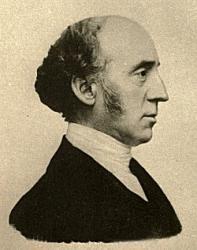
1819 - 1885 Topics: Proper 12 Year B Translator of "O Love, How Deep" in Voices United Benjamin Webb (b. London, England, 1819; d. Marylebone, London, 1885) originally translated the text in eight stanzas, although six only appear in Lift Up Your Hearts. It was published in The Hymnal Noted (1852), produced by his friend John Mason Neale. Webb received his education at Trinity College, Cambridge, England, and became a priest in the Church of England in 1843. Among the parishes he served was St. Andrews, Wells Street, London, where he worked from 1862 to 1881. Webb's years there coincided with the service of the talented choir director and organist Joseph Barnby, and the church became known for its excellent music program. Webb edited The Ecclesiologist, a periodi­cal of the Cambridge Ecclesiological Society (1842-1868). A composer of anthems, Webb also wrote hymns and hymn translations and served as one of the editors of The Hymnary (1872). Bert Polman ================== Webb, Benjamin, M.A., was born in London in 1820, and was educated in St. Paul's School; whence he passed to Trinity College, Cambridge, in 1838, B.A. 1842, M.A. 1845. Ordained by the Bishop [Monk] of Gloucester and Bristol he was Assistant Curate of Kemeston in Gloucestershire, 1843-44; of Christ Church, St. Pancras, 1847-49; and of Brasted, Kent, 1849-51; at which date he was presented to the P. C. of Sheen in Staffordshire, which he held until 1862, when he became Vicar of St. Andrews, Wells Street, London. In 1881 the Bishop [Jackson] of London collated him to the Prebend of Portpool in St. Paul's Cathedral. Mr. Webb was one of the Founders of the Cambridge Camden, afterwards the Ecclesiological Society; and the Editor of the Ecclesiologist from 1842 to 1868, as well as the General Editor of the Society's publications. His first appearance in print was as joint editor of Bishop Montague's Articles of Inquiry in 184; in 1843 he was joined with Mr. J. M. Neale in An Essay on Symbolism, and A Translation of Durandus; in 1847 he put forth his valuable work on Continental Ecclesiology; in 1848 he was joint editor with Dr. Mill of Frank’s Sermons, for the Anglo-Catholic Library, and with the Rev. J. Fuller-Russell of Hierurgia Anglicana. After the decease of his father-in-law (Dr. Mill), he edited Dr. Mill's Catechetical Lectures, 1856; a second edition of Dr. Mill's Christian Advocates Publications on the Mythical Interpretation of the Gospels, 1861; and of Dr. Mill's Sermons on our Lord's Temptation, 1873. He was also one of the editors of the Burntisland reprint of the Sarum Missal. One of his most valuable works is Instructions and Prayers for Candidates for Confirmation, of which the third edition was published in 1882. Mr. Webb was one of the original editors of the Hymnal Noted, and of the sub-Committee of the Ecclesiological Society, appointed to arrange the words and the music of that book; and was also the translator of some of the hymns. In conjunction with the Rev. Canon W. Cooke he was editor of the Hymnary, 1872, for which office his habitual reconstruction and composition of the words of the anthems used at St. Andrew's, Wells Street, as well as his connection with the Hymnal Noted, eminently qualified him. His original hymns contributed to the Hymnary, 1871 and 1872, were:-- 1. Assessor to thy King. St. Bartholomew. In the Hymnary, 1872. 2. Behold He comes, thy King most holy. Advent. Originally written to be sung in St. Andrew's Church, Wells Street, as an anthem to the music of Schumann's Advent-lied, and afterwards published in the Hymnary, 1872. 3. Praise God, the Holy Trinity. Hymn of Faith. Originally written for use in St. Andrew's, Wells Street, and subsequently in the Hymnary, 1872. 4. Praise the Rock of our salvation. Dedication of a Church. Published in the Hymnary, 1872. Mr. Webb's authorised text is in the Westminster Abbey Hymn Book, 1883. 5. Ye angel hosts above. Universal Praise to God. In the Hymnary, 1872. He died in London, Nov. 27, 1885. [Rev. William Cooke, M.A.] -- John Julian, Dictionary of Hymnology (1907)

Edward Hodges

1796 - 1867 Topics: Year B Proper 12 Adapter and Harmonizer of "HYMN TO JOY" in The New Century Hymnal Born: Ju­ly 20, 1796, Bris­tol, Eng­land. Died: Sep­tem­ber 1, 1867, Clif­ton, Bris­tol, Eng­land. Buried: Church of St. Mary the Vir­gin, Stan­ton Drew (about eight miles south of Bristol). Hodges’ mu­sic­al gift showed it­self at an ear­ly age; by 1819, he was play­ing the or­gan at St. James’ Church in Bris­tol, and at St. Nicholas’, 1821-1838. He al­so had an in­ter­est­ing me­chan­ic­al bent, and spurred sev­er­al tech­ni­cal im­prove­ments in or­gan de­sign. He com­posed a num­ber of serv­ic­es and an­them piec­es, and Cam­bridge Un­i­ver­si­ty award­ed him a doc­tor­ate in mu­sic in 1825. Hodges event­u­al­ly em­i­grat­ed, ac­cept­ing a post at the ca­thed­ral in To­ron­to, Ca­na­da, in 1838. The next year, he be­came mu­sic di­rect­or at Trin­i­ty Par­ish in New York Ci­ty. He be­came the or­gan­ist at Trin­i­ty Church when it opened in 1846 (the church had its or­gan built to his spe­ci­fi­ca­tions). He re­tired for health rea­sons in 1859, and re­turned to his native Eng­land in 1863. Hodges’ works in­clude: An Apol­o­gy for Church Mu­sic and Mu­sic­al Fes­tiv­als, in Ans­wer…to the Stan­dard and the Re­cord (Lond­on: 1834) Essays on the Ob­jects of Mu­sic­al Study (Bris­tol, Eng­land: 1838) An Es­say on the Cul­ti­va­tion of Church Mu­sic (New York: 1841) Contributions to the Quar­ter­ly Mu­sic­al Mag­a­zine & Mu­sic­al World Trin­i­ty Col­lect­ion of Church Mu­sic (Bos­ton, Mass­a­chu­setts: 1864) (ed­it­or) Music-- BRISTOL GLOUCESTER HABAKKUK HYMN TO JOY --www.hymntime.com/

Anonymous

Person Name: Unknown Topics: Year B Proper 12 Composer of "[Let us praise God together, let us praise]" in Complete Anglican Hymns Old and New In some hymnals, the editors noted that a hymn's author is unknown to them, and so this artificial "person" entry is used to reflect that fact. Obviously, the hymns attributed to "Author Unknown" "Unknown" or "Anonymous" could have been written by many people over a span of many centuries.

Timothy Dudley-Smith

1926 - 2024 Topics: Proper 12 Year C Author of "O Changeless Christ" in Voices United Timothy Dudley-Smith (b. 1926) Educated at Pembroke College and Ridley Hall, Cambridge, Dudley-Smith has served the Church of England since his ordination in 1950. He has occupied a number of church posi­tions, including parish priest in the diocese of Southwark (1953-1962), archdeacon of Norwich (1973-1981), and bishop of Thetford, Norfolk, from 1981 until his retirement in 1992. He also edited a Christian magazine, Crusade, which was founded after Billy Graham's 1955 London crusade. Dudley-Smith began writing comic verse while a student at Cambridge; he did not begin to write hymns until the 1960s. Many of his several hundred hymn texts have been collected in Lift Every Heart: Collected Hymns 1961-1983 (1984), Songs of Deliverance: Thirty-six New Hymns (1988), and A Voice of Singing (1993). The writer of Christian Literature and the Church (1963), Someone Who Beckons (1978), and Praying with the English Hymn Writers (1989), Dudley-Smith has also served on various editorial committees, including the committee that published Psalm Praise (1973). Bert Polman

G. W. Briggs

1875 - 1959 Person Name: G. W. Briggs, 1875-1959 Topics: Proper 12 Year A Author of "Now is eternal life" in Common Praise George Wallace Briggs is a Canon of Worcester Cathedral and one of the most distinguished British hymn writers and hymnologists of today. Six of his hymns appear in the Episcopal Hymnal of 1940 (American). Another hymn on the Bible entitled "Word of the living God" was written for the 25th Anniversary of the British Bible Reading Fellowship and was sung in Westminster Abbey on June 5, 1947. It has been widely used since that time. Canon Briggs is a leading member of the Hymn Society of Great Britain and Ireland. He is also the composer of several hymn times, six of which have appeared in British hymnals. In addition to his work as a clergy man of the Church of England and an hymnologist, he has interest himself actively in the field of religious education, being largely responsible for two books with wide circulation in Britain, "Prayers and Hymns for used in Schools" and "The Daily Service." These books have had great influence on the worship practices of British schools, public and private. It is of historic interest that he is the author of one of the prayers used at the time of the famous meeting of Churchill and Roosevelt on H.M.S. Prince of Wales in 1941 when the Atlantic Charter was framed. --Ten New Hymns on the Bible, 1952. Used by permission.

P. P. Bliss

1838 - 1876 Topics: Adoration; Choir; Christ Passion; Christ Sacrifice; Passion; Sacrifice; Worship; liturgical Communion Songs Author of ""Man of Sorrows," What a Name" Philip P. Bliss (b. Clearfield County, PA, 1838; d. Ashtabula, OH, 1876) left home as a young boy to make a living by working on farms and in lumber camps, all while trying to continue his schooling. He was converted at a revival meeting at age twelve. Bliss became an itinerant music teacher, making house calls on horseback during the winter, and during the summer attending the Normal Academy of Music in Genesco, New York. His first song was published in 1864, and in 1868 Dwight L. Moody advised him to become a singing evangelist. For the last two years of his life Bliss traveled with Major D. W. Whittle and led the music at revival meetings in the Midwest and Southern United States. Bliss and Ira D. Sankey published a popular series of hymn collections entitled Gospel Hymns. The first book of the series, Gospel Songs, was published in 1874. Bliss's tragic death at the age of thirty-eight happened near the end of 1876. Philip P. Bliss and his wife were traveling to Chicago to sing for the evangelistic services led by Daniel W. Whittle at Dwight L. Moody's Tabernacle. But a train wreck and fire en route claimed their lives. Bert Polman ================= Bliss, Philip, b. at Clearfield County, Pennsylvania, July 9, 1838. In 1864 he went to Chicago in the employ of Dr. George F. Root, the musician, where he was engaged in conducting musical Institutes, and in composing Sunday School melodies. Originally a Methodist, he became, about 1871, a choirman of the First Congregational Church, Chicago, and the Superintendent of its Sunday Schools. In 1874 he joined D. W. Whittle in evangelical work. To this cause he gave (although a poor man) the royalty of his Gospel Songs, which was worth some thirty thousand dollars. His death was sudden. It occurred in the railway disaster at Ashtabula, Ohio, Dec. 30, 1876. ... Some of his verses have obtained wide popularity in most English-speaking countries. The more widely known, and specially those which are found in collections in use in G. Britain, are in the following American works:— i. The Prize, 1870. 1. I should like to die. Death anticipated. This is one of his earliest compositions, and is unworthy of the position it holds. 2. Through the valley of the shadow I must go. Death anticipated. 3. Whosoever heareth, shout, shout the sound. Jesus the Way. Written during the winter of 1869-70 after hearing Mr. H. Moorhouse (from England) preach on St. John iii. 16. ii. The Charm, 1871. 4. Almost persuaded now to believe. Procrastination. This was suggested by the following passage in a sermon by the Rev. Mr. Brundnge, Bliss being present at its delivery:—" He who is almost persuaded is almost saved, but to be almost saved is to be entirely lost." 5. Ho! my comrades! see the signal. Faithfulness. 6. O! Jerusalem, the golden city, bright, &c. Heaven. 7. On what Foundation do [did] you build? Christ the Foundation. iii. The Song Tree, 1872. 8. Light in the darkness, sailor, day is at hand. Safety. This hymn, “The Life-Boat," has attained to great popularity. The incident upon which it is based, that of the rescue of a ship's crew by a life-boat, is given in detail by Mr. Sankey in his Sacred Songs, &c, No. 99 (large ed.). It is sometimes known by its refrain, "Pull for the shore," &c. iv. The Joy, 1873. 9. In me ye may have peace. Peace. 10. To die is gain. Death anticipated. v. Sunshine, 1873. 11. Down life's dark vale we wander. Death anticipated. 12. More holiness give me. For Holiness. 13. Only an armour-bearer. Soldiers of the Cross. 14. Standing by a purpose true. Faithfulness. 15. This loving Saviour stands patiently. Invitation. vi. Gospel Songs, 1874. 16. A long time I wandered. Peace and Joy. 17. Brightly beams our Father's mercy. Mercy. 18. Come, brethren, as we march along. Praise. 19. Free from the law, O happy condition. Redemption. 20. Have you on the Lord believed? Fullness of Grace. This hymn arose out of the following circumstances :—" A vast fortune was left in the hands of a minister for one of his poor parishioners. Fearing that it might be sqmandered if suddenly bestowed upon him, the wise minister sent him a little at a time, with a note saying, “This is thine; use it wisely; there is more to follow.” Hence also the refrain ‘More to follow,’ by which the hymn is known." 21. How much owest thou? Divine Claims. 22. I know not the hour when my Lord will come. Death anticipated. Suggested by reading the book, The Gates Ajar. 23. See the gentle Shepherd standing. The Good Shepherd. 24. Though the way be sometimes dreary. Divine Leading. 25. Will you meet me at the fountain? Fountain of Living Water. The incident out of which this hymn arose is thus stated in The Christian, No. 365, "At the Industrial Exposition at Chicago it was an everyday appointment to meet at the Central Fountain. Mr. P. P. Bliss, whose mind seemed always set on things above, caught up the words, and wrote this hymn, 'Meet me at the Fountain.'" vii. Gospel Hymns, No. 1, 1875. 26. One offer of salvation. The Name of Jesus. 27. Wandering afar from the dwellings of men. The Lepers. viii. The International Lesson Monthly, 1875. 28. Weary gleaner, whence comest thou? Duty. 29. The whole world was lost in the darkness of Sin. Light of the world. 30. Man of sorrows! what a name. Redemption. 31. The Spirit, O sinner, in mercy doth move. Holy Spirit. ix. Gospel Hymns, No. 2, 1876. 32. At the feet of Jesus. The good choice. 33. Come, sing the Gospel's joyful sound. Salvation. 34. Cut it down, cut it down. Justice and Mercy. 35. Do you see the Hebrew captive? Prayer. 36. Hallelujah, He is risen. Easier. Written in the spring of 1876 and first sung by Bliss on Easter afternoon, 1876, in the Court House Square, Augusta, Georgia, to 5900 people. 37. In Zion's rock abiding. Safety. 38. Repeat the story o'er and o'er. Grace and Peace. 39. Tenderly the Shepherd. The Good Shepherd. x. Gospel Hymns, No. 3, 1878. 40. Hear ye the glad good news from heaven. Faith and Salvation. 41. I will sing of my Redeemer. Praise. xi. Gospel Hymns, No. 4, 1881. 42. 'Tis known on earth and heaven too. More about Jesus. xii. Various. 43. Sing over again to me. Words of Life. This appeared in a paper entitled Words of Life, 1874, The following are undated:— 44. March to the battle-field. Duty and Victory. 45. There is sin in the camp. Hinderances. 46. 'Tis the promise of God. Praise. 47. While the silvery moon-beams, fall, New Birth. 48. God is always near me. Omnipresence. Two hymns," I am so glad that our Father in heaven," and " Sowing the seed by the daylight [dawnlight] fair," (sometimes given as " Sowing our seed in the morning fair ") are usually attributed to Mr. Bliss. In his Gospel Songs, Cincinnati, 1874, however, he lays claim to the music only. Mr. Sankey attributes this last to "E. A. Oakey." With the exception of No. 48, these hymns are given in Mr. Sankey's Sacred Songs & Solos, Pts. i. and ii. Their popularity is far beyond their literary merits, and is mainly due to the simple melodies to which they are wedded. As a writer of hymns of this class Mr. Bliss is second only to Mrs. Van Alstyne. Many anecdotes concerning hymns of this class are given in American Evangelists; an Account of their work in England and America, by the Rev. Elias Nason, Boston, U.S., Lathrop & Co., 1877. Mr. Bliss is usually known as "P. P. Bliss." This is found on the title-pages of his collections. On his own authority, however, we are enabled to say that his name originally stood thus : “Philipp Bliss.” Early in life he separated the final p from his Christian name, constituted it a capital P, and thus produced "P. P. Bliss." (For this article we are mainly indebted to Professor F. M. Bird, and Mr. H. P. Main.) -John Julian, Dictionary of Hymnology (1907) ======================== Bliss, Philip , p. 151, i. "Sowing the seed by the daylight fair" is in the Family Treasury , Edinburgh, 1861, pt. i., p. 84. It is said to be by Miss Emily Sullivan Oakey; born at Albany, N. York, Oct. 8, 1829, died May 11, 1883. Note also that Bliss's hymn, No. 43. on p. 150, ii., should read, "Sing them over again to me." --John Julian, Dictionary of Hymnology, Appendix, Part II (1907) ===================== Bliss, P., p. 150, i. Two works have been brought to our notice, since the issue of our first edition of this Dictionary, which concern this author, viz.:— 1. Memoirs of Philip P. Bliss. Edited by D. W. Whittle. Contributions by Rev. E. P. Goodwin, Ira D. Sankey, and Geo. F. Root. Introduction by D. L. Moody. New York, &c.: A. S. Barnes & Co., 1877. 2. My Life and Sacred Songs. By Ira D. Sankey. With an Introduction by Theodore L. Cuyler, D.D). London: Hodder & Stoughton, and Morgan & Scott, 1906. These works have a special interest for those who use I. D. Sankey's Sacred Songs & Solos, and all of P. Bliss's publications. To Mr. Sankey's My Life, &c, we direct special attention for P. Bliss's hymns:— “Do you see the Hebrew captive kneeling?" p. 294. "Down life's dark vale we wander." p. 285. "Ho! my comrades, see the signal." p. 105. "'Tis the promise of God full salvation to give." p. 99. --John Julian, Dictionary of Hymnology, New Supplement (1907)

E. J. Hopkins

1818 - 1901 Person Name: Edward John Hopkins, 1818-1901 Topics: Year C Proper 12 Composer of "ST HUGH" in Complete Anglican Hymns Old and New Dr Edward John Hopkins MusDoc United Kingdom 1818-1901. Born at Westminster, England, the son of a clarinetist with the Royal Opera House orchestra, he became an organist (as did two of his brothers) and a composer. In 1826 he became a chorister of the Chapel Royal and sang at the coronation of King William IV in Westminster Abbey. He also sang in the choir of St. Paul’s Cathedral, a double schedule requiring skill and dexterity. On Sunday evenings he would play the outgoing voluntary at St. Martin’s in-the-field. He left Chapel Royal in 1834 and started studying organ construction at two organ factories. He took an appointment at Mitcham Church as organist at age 16, winning an audition against other organists. Four years later he became organist at the Church of St. Peter, Islington. In 1841 he became organist at St. Luke’s, Berwick St., Soho. Two Years later he was organist at Temple Church, which had a historic organ (built in 1683). He held this position for 55 years. In 1845 he married Sarah Lovett, and they had four sons and five daughters. He was closely associated with the Bach Society and was organist for the first English performances of Bach’s St. Matthew Passion. In 1855 he collaborated with Edward Rimbault publishing “The organ, its history and construction” (3 editions 1855-70-77). In 1864 he was one of the founders of the “College of organists”. In 1882 he received an honorary Doctorate of Music from the Archbishop of Canterbury. He composed 30+ hymn tunes and some psalm chants, used by the Church of England. He died in London, England. John Perry

Bianco da Siena

1350 - 1434 Person Name: Bianco da Siena (d. 1434) Topics: Proper 12 Year B Author of "Come down, O Love divine" in Ancient and Modern Bianco da Siena (b. Anciolina, circa 1350; d. Venice, Italy, circa 1434), an Italian poet and wool worker who was born at Anciolina, in the Val d'Arno. In 1367 he entered the Order of Jesuates, consisting of unordained men who followed the rule of St. Augustine. This order was instituted in that year by one John Colombinus of Siena, and suppressed by Pope Clement IX, possibly because of fear of not being able to control their mystical fervor. Little is known of Bianco beyond the fact that he is said to have lived in Venice for some years, and died there in 1434. His hymns were published at Lucca, in 1851, and edited by T. Bini, under the title, Laudi spirituali del Bianco da Siena. Emily Brink ============== Bianco da Siena, born at Anciolina, in the Val d'Arno, date unknown. In 1367 he entered the Order of Jesuates, consisting of unordained men who followed the rule of St. Augustine. This order was instituted in that year by one John Colombinus of Siena, and suppressed by Pope Clement IX. in 1668. Little is known of Bianco beyond the fact that he is said to have lived in Venice for some years, and died there in 1434. His hymns were published at Lucca, in 1851, and edited by T. Bini, under the title, Laudi spirituali del Bianco da Siena. This work contains 92 pieces. Of these the following have been translated into English, and have come into common use:— 1. Discendi, Amor santo. The Holy Spirit desired. This is No. 35 in the above work and is in 8 stanzas. Of these, Dr. Littledale gave 4 in the People's Hymnal, 1867, No. 473, as, "Come down, 0 Love Divine." 2. Gesil Christo amoroso. Missions. This is No. 79 of the above wdrk. It has been rendered into English by Dr. Littledale, and was published in the People's Hymnal, 1867, No. 400, as, "0 Jesu Christ, the loving.” 3. Vergine santa, sposa dell’ Agnello. St. Lucy. V. M . This is also from the foregoing work, No. 74, in 15 stanzas of 3 lines. Dr. Littledale's translation in the People's Hymnal, 1867, No. 226, is in 7 stanzas of 4 lines, and begins, "0 Virgin Spouse of Christ the Lamb." 4. Ama Jesu el tuo sposo diletto. Love for Jesus . This is No. 45 in the above work, in 33 stanzas. In 1866 Dr. Littledale contributed a cento therefrom to R. Brett's Office of the Moat Holy Name. This was transferred to Brooke's Churchman's Manual of Private & Family Devotion, 1882. It begins, "Love Jesus, Who hath sought thee so." Although the translations Nos. 1-3 have not gone any further than the People's Hymnal, Nos. 1 and 2 are worthy of more extended use. [Rev. John Julian, D.D.] -- John Julian, Dictionary of Hymnology (1907)

John Milton

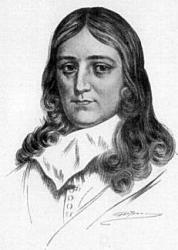
1608 - 1674 Topics: Proper 12 Year C Author of "Let Us with a Gladsome Mind" in Voices United Milton, John, was born in London, Dec. 9, 1608, and died there Nov. 8, 1674. His poetical excellences and his literary fame are matters apart from hymnology, and are fully dealt with in numerous memoirs. His influence on English hymn-writing has been very slight, his 19 versions of various Psalms having lain for the most part unused by hymnal compilers. The dates of his paraphrases are:— Ps. cxiv. and cxxxvi., 1623, when he was 15 years of ago. These were given in his Poems in English and Latin 1645. Ps. lxxx.-lxxxviii., written in 1648, and published as Nine Psalmes done into Metre, 1645. Ps. i., 1653; ii., “Done August 8, 1653;" iii., Aug. 9, 1653; iv. Aug. 10, 1653; v., Aug. 12, 1653; vi., Aug. 13, 1653; vii.Aug. 14, 1653; viii., Aug. 14, 1653. These 19 versions were all included in the 2nd ed. of his Poems in English and Latin, 1673. From these, mainly in the form of centos, the following have come into common use:— 1. Cause us to see Thy goodness, Lord. Ps. lxxxv. 2. Defend the poor and desolate. Ps. lxxxii. 3. God in the great assembly stands. Ps. lxxxii. 4. How lovely are Thy dwellings fair. Ps. lxxxiv. From this, "They pass refreshed the thirsty vale," is taken. 5. Let us with a gladsome [joyful] mind. Ps. cxxxvi. 6. O let us with a joyful mind. Ps. cxxxvi. 7. The Lord will come and not be slow. Ps. lxxxv. Of these centos Nos. 4 and 5 are in extensive use. The rest are mostly in Unitarian collections. There are also centos from his hymn on the Nativity, "This is the month, and this the happy morn" (q.v.). --John Julian, Dictionary of Hymnology (1907)

Pages


Export as CSV
It looks like you are using an ad-blocker. Ad revenue helps keep us running. Please consider white-listing Hymnary.org or getting Hymnary Pro to eliminate ads entirely and help support Hymnary.org.